COMPLETE QUANTUM INFORMATION IN THE DNA GENETIC CODE
MICHEL PLANAT†, RAYMOND ASCHHEIM‡, MARCELO M. AMARAL‡, FANG FANG‡AND KLEE IRWIN‡
Abstract. We find that the degeneracies and many peculiarities of the DNA genetic code may be described thanks to two closely related (fivefold symmetric) finite groups. The first group has signature G= Z5oH whereH =Z2.S4 ∼= 2Ois isomorphic to the binary octahedral group 2O and S4 is the symmetric group on four letters/bases. The second group has signatureG=Z5oGL(2,3) and points out a threefold symmetry of base pairings. For those groups, the representations for the 22 conjugacy classes of G are in one-to-one correspondence with the multiplets encoding the proteinogenic amino acids. Additionally, most of the 22 characters of G attached to those representations are informationally complete. The biological meaning of these coincidences is discussed.
Arxiv: q-bio.OT, quant-ph, math.GR, math.AG PACS: 02. 20.-a, 82.39.Pj, 87.10.Vg, 02.10.De MSC codes: 20C15, 92D20, 20E45, 14H52, 14G05
Keywords: DNA genetic code, informationally complete characters, finite groups, hyperelliptic curve
1. Introduction
La filosofia `e scritta in questo grandissimo libro che continuamente ci sta aperto innanzi a gli occhi (io dico l’universo), ma non si pu`o intendere se prima non s’impara a intender la lingua, e conoscer i caratteri, ne’ quali scritto. Egli `e scritto in lingua matematica, e i caratteri son triangoli, cer-chi, ed altre figure geometriche, senza i qualimezi impossibile a intenderne umanamente parola; senza questi `e un aggirarsi vanamente per un oscuro laberinto. (Galileo Galilei (1564-1642), Il Saggiatore, cap. 6).
Until now, deciphering the code of life [1]-[8] –the genetic code– was still unsuccessful although mathematical theories have been proposed before [9]-[13]. How is our new attempt different from earlier trials? Our mathematical approach lies at the crossroads of finite group theory and quantum informa-tion in the line of other papers mainly devoted to quantum computing [14] but also focused on elementary particles [15].
Life cells need a macromolecule called deoxyribonucleic (or DNA) packed in a chromosome during the cell mitosis. But DNA unwinds to be copied during DNA replication or when its code is used to make proteins. DNA is an helix consisting of two parallel polynucleotide chains carrying genetic instructions in 4 nitrogeneous bases for the growth and reproduction of all living organisms. The genetic code is organized in triples of bases called
1
codons. There are 43= 64 codons but only 20 standard amino acids, mean-ing a high redundancy of the code. In our approach, we use the characters and the corresponding representations of a well defined finite groupGto ex-plain the mapping of the nitrogeneous bases to amino acids. The group char-acters may be used to build minimal and informationally complete quantum measurements, one for each character and the corresponding amino acid.
In Section 2, one details the discovery and main properties of DNA and the genetic code. In Section 3, one recalls how minimal informationally com-plete quantum measurements are performed and the necessary elements of character theory of finite groups. In Section 4, the assignment of characters of the small group G = (240,105) to amino acids is detailed. In Section 5, we provide a justification of the fact that minor and major grooves in the DNA double helix have periods whose ratio is the Golden ratio. This is based on the study of points over a hyperelliptic curve occuring in the character table.
2. DNA and the genetic code
The discovery of DNA is attributed to Watson and Crick in 1953 [1]. But the phosphorous-containing substance now called DNA was first isolated by F. Miescher in 1869 in the nuclei of white blood cells under the name of ‘nuclein’ (a nucleic acid) paving the way of its recognition as the carrier of inheritance [2]. Only in 1909, P. Levene found that DNA contains pentoses such adenine (A), guanine (G), thymine (T), cytosine (C), a deoxyribose and a phosphate group. At that time, it was still believed that the protein component of chromosomes was the true basis of heredity. The recognition that DNA rather than proteins could be the genetic material was suggested by the E. Chargaff’s rules, proposed in 1940 that the four bases are present in the percentages: A ≈ T ≈ 30% and G ≈ C ≈ 20% for all species [3]. Subsequent X-ray crystallography work by English researchers R. Franklin and M. Wilkins contributed to Watson and Crick’s derivation of the three-dimensional, double-helical model for the structure of DNA [4].
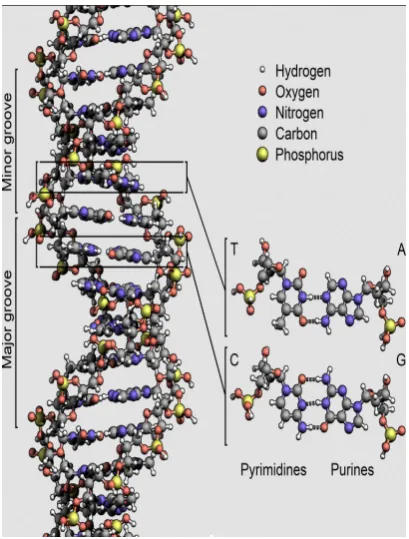
As shown in Fig. 1, DNA is a double helix, with the two strands connected by hydrogen bonds. In the most current form of DNA (called B-DNA), the ratio of the diameterD≈21˚Ato the periodl+Land the ratio between the minor groove l≈13˚A and the major grooveL≈D≈21˚Aare both close to the golden ratio φ= (√5−1)/2≈0.618 [17].
G. Gamow (also a cosmologist) observed that the 43 = 64 possible per-mutations of the four DNA bases A, T, G and C, taken three at a time (as codons), could be reduced to 20 distinct combinations and might code for the twenty amino acids which, he suggested, might well be the sole constituents of all proteins [5]. But the lack of overlapping of codons (not assumed by Gamow) and the demonstration that the genetic code is made up of a series of three base pair codons, which code for individual amino acids, dates back to 1961 with the Crick, Brenner et al. experiment [6]. Now we know that the peculiar non ambiguous and non overlapping assignment of all 64 codons to the 20 amino acids is nearly universal [7].
Figure 1. The double-helical structure of DNA and base
pairing. Complementary bases are held together as a pair by hydrogen bonds. Two hydrogen bonds connect T to A; three hydrogen bonds connect G to C. The image is borrowed to Wikipedia [16].
of nucleotide triplets, or codons) into proteins. Translation is accomplished by the ribosome, which links amino acids in an order specified by messenger RNA (mRNA), using transfer RNA (tRNA) molecules to carry amino acids and to read the mRNA, three nucleotides at a time.
The codons which code for the same amino acids form multiplets and are organized as
* Met, Trp: 2 singlets
* Asn, Asp, Cys, Gln, Glu, His, Lys, Phe, Tyr: 9 doublets * Ile, Term: 2 triplets
* Ala, Gly, Pro, Thr, Val: 5 quadruplets * Arg, Leu, Ser: 3 sextets.
A 21st proteinogenic amino acid Selenocysteine (symbol Sec) was found present in some enzymes and a 22st amino acid Pyrrolysine (Symbol Pyl) in some archaea and bacteria.
Woese and collaborators introduced the concept of polar requirement to express stereochemical associations between amino acids and nucleobases in solution [8]. Taking dimethylpyridine (or DMP) as a solvant, the polar requirement is found as in Fig. 2b [18, 19]. For more recent predictors of the stereochemical associators the reader may read reference [20].
Figure 2. (a) the generic codon table for RNA, (b) the
codon table colored by amino acid polar requirement values [19].
3. Symmetries and quantum information from the characters of a finite group
There are two important ingredients in our approach. One topic follows from our earlier work on ‘magic state’ quantum computing [14] and consists of performing a generalized quantum measurement while keeping a complete information in the process, as explained in Sec. 3.1. The second (more recent) topic consists of finding the ‘magic states’ in the bank of characters of a selected finite group. The latter approach recalled in Section 3.2 was found successful in the context of symmetries of elementary matter particles [15].
Πi =dEi, such that the rank of the Gram matrix with elements tr(ΠiΠj), is precisely d2.
With a MIC, the complete recovery of a state ρ is possible at a minimal cost from the probabilities p(i). In the best case, the MIC is symmetric and called a SIC with a further relation |hψi|ψji|2 = tr(ΠiΠj) = dδdij+1+1 so that the density matrix ρ can be made explicit [21].
In our earlier references, starting with [14], a large collection of MICs are derived. They correspond to Hermitian angles |hψi|ψji|i6=j ∈ A = {a1, . . . , al}belonging to a discrete set of values of small cardinalityl. They arise from the action of a Pauli groupPd[22] on an appropriate magic state pertaining to the coset structure of subgroups of indexdof a free group with relations.
In reference [15], an entirely new class of MICs in the Hilbert space Hd, relevant for the lepton and quark mixing patterns, is obtained by taking fiducial/magic states as characters of a finite groupGpossessingdconjugacy classes and using the action of a Pauli groupPdon them. The same approach is used in this paper.
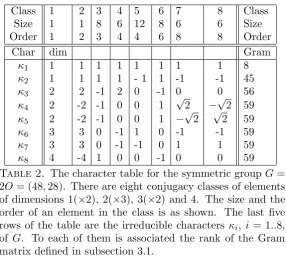
3.2. The character table of a finite group and quantum informa-tion. Let G be a finite group, V a finite-dimensional vector space over a fieldF and letr :G→GL(V) be a representation ofGonV. The character κr(g) associates to an element g∈Gthe trace of the corresponding matrix r(g). A characterκr is called irreducible ifris an irreducible representation. The degree of the character κ is called the dimension of the representation. Assume thatGis made ofdconjugacy classes of elements. One introduces class functions on G from the ring of complex-valued functions on G that are constant on conjugacy classes. In fact we restrict ourselves to functions with values in cyclotomic fields [23].
The table of irreducible characters of G, or character table for short, is a way to summarize the properties of irreducible representations of elements g of G.
Let us take the case of the symmetric groupS4 also called the small group
(24,12) (number 12 in the range of 15 groups of order 24). The character table is in Table 1. It makes explicit the five irreducible characters ofG, the corresponding dimension dim of the representation, as well as the size and order of an element in each class. For each class, we added the calculation of the rank of the Gram matrix that corresponds to the POVM obtained by the action of the 5-dit Pauli group over the irreducible character κi of the class. For the classes 3 to 5, the rank of the Gram matrix is d2 = 25 so that the POVM is a MIC.
Class 1 2 3 4 5 Class
Size 1 3 6 8 6 Size
Order 1 2 2 3 4 Order
Char dim Gram
κ1 1 1 1 1 1 5
κ2 1 1 -1 1 - 1 21
κ3 2 2 0 -1 0 d2
κ4 3 -1 -1 0 1 d2
κ5 3 -1 1 0 -1 d2
Table 1. The character table for the symmetric group G=
S4. There are five conjugacy classes of elements of dimensions
1, 1, 2, 3 and 3, respectively. The size and the order of an element in the class is as shown. The last five rows of the table are the irreducible charactersκi,i= 1..5, ofG. To each of them is associated the rank of the Gram matrix defined in subsection 3.1.
group over the irreducible character κi of the class. None of the characters of the group 2O is informationally complete.
Class 1 2 3 4 5 6 7 8 Class
Size 1 1 8 6 12 8 6 6 Size
Order 1 2 3 4 4 6 8 8 Order
Char dim Gram
κ1 1 1 1 1 1 1 1 1 8
κ2 1 1 1 1 - 1 1 -1 -1 45
κ3 2 2 -1 2 0 -1 0 0 56
κ4 2 -2 -1 0 0 1
√
2 −√2 59
κ5 2 -2 -1 0 0 1 −
√
2 √2 59
κ6 3 3 0 -1 1 0 -1 -1 59
κ7 3 3 0 -1 -1 0 1 1 59
κ8 4 -4 1 0 0 -1 0 0 59
Table 2. The character table for the symmetric group G=
2O = (48,28). There are eight conjugacy classes of elements of dimensions 1(×2), 2(×3), 3(×2) and 4. The size and the order of an element in the class is as shown. The last five rows of the table are the irreducible characters κi, i= 1..8, of G. To each of them is associated the rank of the Gram matrix defined in subsection 3.1.
4. Symmetries and quantum information in the genetic code
We shall impose the constraint that there are enough n-plets to embed the mappings to the proteigenomic amino acids for dimensions n= 1, 2, 3 and 4 and that there are at least 2 sextuplets. Small groups (240,105) and (240,106) (with 22 conjugacy classes) and (240,107) and (240,108) (with 28 conjugacy classes) are the group candidates with the smallest cardinality. All of them have two 6-dimensional representations. We could not find other candidate group of higher cardinality. The most economical groups are thus the former two groups and the latter two are different only in the sense that there are 6 one-dimensional representations instead of two.
The first group (240,105) has signatureG=Z5oH whereH=Z2.S4 ∼=
2Ois isomorphic to the binary octahedral group 2O andS4 is the symmetric
group on four letters/bases. The second group (240,106) has signatureG= Z5 oGL(2,3) and points out a threefold symmetry of base pairings. For those groups, the representations for the 22 conjugacy classes ofGare almost in one-to-one correspondence with the multiplets encoding the proteinogenic amino acids. The assignment is not perfect in the sense that there are only two representations of dimension 6 while there are three sextuplets in the genetic code.
(240,105) dimension 1 1 2 2 2 2 2 2 2 2 2
Z5o(Z2.S4) d-dit, d=22 d2 d2 d2 d2 d2 d2 d2 d2 d2 d2 d2
∼
=Z5o2O amino acid Met Trp Cys Phe Tyr His Gln Asn Lys Glu Asp
order 1 2 3 4 4 5 5 6 8 8 10
polar req. 5.3 5.2 4.8 5.0 5.4 8.4 8.6 10.0 10.1 12.5 13.0 (240,105) dimension 3 3 4 4 4 4 4 4 4 6 6
d-dit, d=22 d2 475 483 480 d2 d2 d2 d2 d2 d2 d2 amino acid Ile Stop Leu,Pyl,Sec Leu Val Pro Thr Ala Gly Ser Arg order 10 15 15 15 15 20 20 30 30 30 30 polar req. 4.9 4.9 5.6 6.6 6.6 7.0 7.9 7.5 9.1 Table 3. For the group G = (240,105) ∼= Z5 o2O, the
table provides the dimension of the representation, the rank of the Gram matrix obtained under the action of the 22 -dimensional Pauli group, the order of a group element in the class and a good assignment to an amino acid according to its polar requirement value. Bold characters are for faithful representations. There is an ‘exception’ for the assignment of the sextet ‘Leu’ that is assumed to occupy two 4-dimensional slots. All characters are informationally complete except for the ones assigned to ‘Stop’, ‘Leu’, ‘Pyl’ and ‘Sec’.
(240,105) dimension 1 1 2 2 2 2 2 2 2 2 2
∼
=Z5o2O amino acid Met Trp Cys Phe Tyr His Gln Asn Lys Glue Asp
bases AUG UGG UGU UUU UAU CAU CAA AAU AAA GAA GAU UGC UUC UAC CAC CAG AAC AAG GAG GAC
(240,105) dimension 3 3 4 4 4 4 4 4 4 6 6
amino acid Ile Stop Leu Leu Val Pro Thr Ala Gly Ser Arg Pyl,Sec
bases AUU UAA UUA CUU GUU CCU ACU CGU GGU UCU CGU AUC UAG UUG CUC GUC CCC ACC GCC GGC UCC CGC AUA UGA UAG CUA GUA CCA ACA GCA GGA UCA GGA UGA CUG GUG CCG ACG GCG GGG UCG CGG AGU AGA AGC AGG Table 4. Excerpt of Table 3 with the assignment of codons
to amino acids according to the standard genetic code. There is no ambiguity in such assignments except for codons, UAG and UGA that code for ‘Stop’, as well as for ‘Pyl’ and ‘Sec’, respectively. According to our approach, this ambiguity is re-flected in the characters being non informationally complete for the corresponding two slots.
(240,106) dimension 1 1 2 2 2 2 2 2 2 2 2
∼
=Z5oGL(2,3) order 1 2 2 3 4 5 5 6 8 8 10
d-dit, d=22 d2 d2 483 d2 d2 d2 d2 d2 d2 d2 d2 (240,106) dimension 3 3 4 4 4 4 4 4 4 6 6
order 10 15 15 15 15 20 20 30 30 30 30 d-dit, d=22 482 d2 d2 d2 d2 d2 d2 d2 d2 440 440 Table 5. The group (240,106)∼=Z5oGL(2,3) as another candidate for the assignments of amino acids. It has the same dimensions of representations and closely related group orders. One may postulate that the group (240,106) encodes D-amino acids while the group (240,105) encodes L-amino acids. For most naturally-occurring amino acids, the carbon alpha to the amino group has the L-configuration.
thus follows the order of a group element in the corresponding class. Most representations are informationally complete with the rank of the Gram ma-trix equal to d2. The exceptions are for the 3-dimensional slot for the Stop codon and the 4-dimensional slot that we associate to the amino-acid Leu and the 2 extra amino acids Pyl and Sec. There is an ambiguity in the as-signment of codons UAG and UGA that code for Stop, and for Pyl (with the codon UAG) and Sec (with the codon UGA). Thus the slight ambiguity of nature in coding the amino acids is recovered in our approach. The assign-ments to codons is displayed in detail in Table 4. According to our approach, this ambiguity is reflected into three characters being non informationally complete.
element in each class and the rank of the Gram matrix for the correspond-ing POVM, as shown in Table 5. One may postulate that it encodes the D-amino acids while the group (240,105) encodes proteinogenic L-amino acids. For most naturally-occurring amino acids, the carbon alpha to the amino group has the L-configuration. D-amino acids are most occasionally found in nature as residues in proteins.
Normal subgroups (48,28)∼= 2O of the group (240,105) and GL(2,3)∼= (48,29) of the group (240,106) may be used to encode most of the so-called essential amino-acids as shown in Table 6. One observes that apart from two exceptions for the 4-dimensional slots ofGL(2,3) the characters of these groups are not informationally complete.
dimension 1 1 2 2 2 3 3 4
order 1 2 3 4 4 6 8 8
(48,28)=2O d-dit, d=8 8 45 56 59 59 59 59 59
(48,29)=GL(2,3) d-dit, d=8 56 58 59 d2 d2 63 63 61
amino acid Met Trp Phe His Lys Ile Stop Thr polar req. 5.3 5.2 5.0 8.4 10.1 4.9 6.6
Table 6. The assignment of representations of groups 2O or GL(2,3) to essential amino acids. There are two extra essential amino acids Val and Leu but they are not strictly essential from a metabolic perspective. Strictly indispensable amino acids are Trp, Lys and Thr which cannot be submitted to transamination.
5. Symmetries of the genetic code, the Golden ratio and a hyperelliptic curve
If one accepts the validity of the aforementioned group theoretical model of the genetic code, one can provide clues why nature selected these par-ticular symmetries. One clue is contained in the detailed structure of the characters of the group (240,105) and its cousin group (240,106). The golden ratio is playing a role in accordance with the DNA structure.
The list of 22 characters for the group (240,105) is in Table 7. A closely related table (not shown) is found for the group (240,106). The entries in the character table are shown to be either rational numbers, quadratic ir-rationalities such as z1 = −(
√
5 + 1)/2, z2 =
√
5−1, z3 = 3(1 +
√ 5)/2, z4 =
√
2 and their algebraic conjugates, or ±ri where ri is one of the four roots ri of the quartic polynomial x4 −x3 −4x2 + 4x + 1 = 0, where r1 = −2 cos(π/15) ≈ −1.956295, r2 = −2 cos(11π/15) ≈ 1.338261, r3 =
−2 cos(7π/15)≈ −0.209056 andr4 =−2 cos(13π/15)≈1.827091.
It is known that such a quartic contains the golden ratio φ = z2/2 and
the irrational √2 in its structure. Following [24, Section 3], the inflection secant S has segments whose length ratio is φ. Also the double tangent, the inflection secant and the straight line passing through the third tangent point and parallel to them separate areas whose ratio is √2.
under the name of BoerdijkCoxeter (BC) helix –an helix made of contiguous tetrahedra– more or less at the same time than the discovery of DNA [25]. The concept was revisited to arrive at a BC helix exhibiting a connection to aperiodicity and the golden ratio [26, 27].
From now, we consider the (genus one) hyperelliptic curve C
C :y2 =x4−x3−4x2+ 4x+ 1
as a potential model of many features of DNA double helix.
The characters responsible of the quadratic irrationalities and the roots of the quartic are defined over the cyclotomic fields Q(ζ5) and Q(ζ15),
re-spectively, whereζnis a primitiven-th complex root of unity. Thus we focus on C with points over such cyclotomic fields.
Points ofCover cyclotomic fields. As usual for elliptic and hyperelliptic curves of genusg,Cis embedded in a weighted projective plane, with weights 1, g+ 1, and 1, respectively on coordinates x, y and z. Therefore, point triples are such that (x :y :z) = (µx:µy :µz), µin the field of definition, and the points at infinity take the form (1 : y : 0). Below, the software Magma is used for the calculation of points of C [23]. For the points of C, there is a parameter called ‘bound’ that loosely follows the heights of the x-coordinates found by the search algorithm.
Let us start with points on Cwith entries over the cyclotomic fieldQ(ζ5).
For points whose entries are bounded by modulus 1, one gets 8 cases as follows (1 : ±1 : 0) (the points at infinity), (0 : ±1 : 1), (1 : ±1 : 1) and (2 +φ : ±(3 +φ) : 1). For points whose entries are bounded by modulus 2, one gets 10 extra cases (±2 : −1 : 0), (±2 : 1 : 1), (2φ :±(3−4φ) : 1), (−2(1 +φ) : ±(7 + 4φ) : 1) and (1−φ : ±(4 +φ) : 1). For points whose entries are bounded by modulus 10, one gets 8 extra cases (4/3 :±1/9 : 1), (6 :±31 : 1), (4/5 :±31/25 : 1), (−1/7 :±29/49 : 1).
Let us continue with points on C with entries over Q(ζ15). Points with
integer entries are as those given over Q(ζ5). In addition, the points whose
entries are bounded by modulus 1 are (r1 : 0 : 1), (r2 : 0 : 1), (r3 : 0 : 1),
(r4 : 0 : 1) (where ri is one of the four roots of the quartic polynomial above), (2 +φ : ±(3 +φ) : 1) [the latter 2 points are on Q(ζ5)] The non
rational points whose entries are bounded by modulus 2 are (2φ:±(3−4φ) : 1), (−2(1 + φ) : ±(7 + 4φ) : 1) [the latter 2 points are on Q(ζ5)] and
(φ2 : ±(1 +φ2) : 1. For non rational points whose entries are bounded by modulus 7, one gets 8 extra cases and no more up to bound 10. The entries could not be found related to simple irrationalities and are approximated as (3.02234 :±5.69063 : 1), (0.90536 : ±1.12804 : 1), (0.50552 : ±1.39140 : 1) and (11.56677 :±125.95399).
Over both cyclotomic fields, there are plenty extra points where the entries have higher modulus but we do not list them here.
The group law on the Jacobian J of the hyperelliptic curve C.
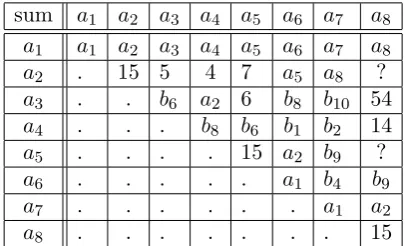
There exists a group law on the Jacobian J of a hyperelliptic curve [28]. Using Magma we provide some results for the operations in J(C) defined over Q(ζ5).
49/16,2),a3= (x−4/5,−x2−3/5,2),a4 = (x−4/3,−x2+5/3,2),a5 = (x+
1/7,−x2−4/7,2),a6= (x−1,−x2+2,2),a7= (x−(2+φ),−x2+2(1+φ),2),
a8 = (x+ 2.25123,−x2+ 8.03750,2).In Table 8, the inverses or elementsai are shown. In Table 9, one explicits the sums ai+aj between two elements of bound 1 in the Jacobian.
A similar group law exists forCdefined overQ(ζ15) but it is more difficult
to explicit the points and we do not give details here.
6. Conclusion
We unveiled part of the machinery of DNA in building the genetic code thanks to the representations of a distinguished finite group of signature G=Z5o2O, where 2Ois the binary octahedral group. The group characters κ of G are found to map to the proteigenomic amino acids and this is performed by almost keeping a complete quantum information when the κ’s are seen as magic states, as in quantum computing. Moreover, there exists a unique quartic and a related hyperelliptic curve Cbehind the DNA scene which gives sense to the irrationalities found in the character table (and in the real biological world). It is still too early to conclude that DNA calculates on points ofCor on points of the JacobianJ(C) but it is tempting to work in this direction in future papers. It may be that other finite groups and their attached hyperelliptic curve are governing the secondary structure of proteins such that the alpha helix or the DNA packing into chromatin and chromosomes.
References
[1] J. D. Watson and F. H.C. Crick, A structure for deoxyribose nucleic acid,Nature171 737-738 (1953).
[2] L. A. Pray, Discovery of DNA Structure and Function: Watson and Crick, Nature Education 1 100 (2008), paper available at the address https://www.nature.com/scitable/topicpage/discovery-of-dna-structure-and-function-watson-397/.
[3] E. Chargaff, Chemical specificity of nucleic acids and mechanism of their enzymatic degradation,Experientia6201209 (1950).
[4] B. Maddox, The double helix and the ‘wronged heroine’,Nature421407-408 (2003). [5] G. Gamov, Possible Relation between deoxyribonucleic acid and protein structures,
Nature173318 (1954).
[6] F. H. Crick, L. Barnett, S. Brenner, R. J. Watts-Tobin, General nature of the genetic code for proteins,Nature,19212276-32 (1961).
[7] E. V. Koonin ans A. S. Novozhikov, Origin and evolution of the genetic code: the universal enigma,IUBMB Life6199-111 (2009).
[8] C. R. Woese, D. H. Dugre, W. C. Saxinger and S. A. Dugre, The molecular basis of the genetic code,Proc. Natl Acad Sci55966-974 (1966).
[9] S. V. Petoukhov, Matrix genetics, part 2: the degeneracy of the genetic code and the octave algebra with two quasi-real units (the Yin-Yang octave algebra), Preprint0803.3330 [q-bio].
[10] J. E.M. Hornos, Y. M.M. Hornos, Algebraic model for the evolution of the genetic code,Phys. Rev. Lett.7144014404 (1993).
[11] M. Di Giulio, The origin of the genetic code: theories and their relationships, Biosys-tems80175-184 (2005).
[13] F. Antonelli and M. Forger, Symmetry breaking in the genetic code: Finite groups,
Math. Comp. Mod.531469-1488 (2011).
[14] M. Planat and Z. Gedik, Magic informationally complete POVMs with permutations,
R. Soc. open sci.4170387 (2017).
[15] M. Planat, R. Aschheim, M. M. Amaral and K. Irwin, Informationally complete characters for quark and lepton mixings,Symmetry121000 (2020).
[16] https://en.wikipedia.org/wiki/DNA (accessed on 1 May 2020).
[17] D. Harel, R. Unger and J. L. Sussman, Beauty is in the genes of the beholder,Trends in Bioch. Sc.11155-156 (1986).
[18] J. R. Jungck, The Genetic Code as a Periodic Table,J. Mol. Evol.11211–224 (1978). [19] D. C. Mathew and Z. Luthey-Schulten, On the physical basis of the amino acid polar
requirement,J. Mol. Evol.66519-528 (2008).
[20] C. W. Carter Jr, Coding of Class I and II aminoacyl-tRNA synthetases, Adv Exp Med Biol.966103148 (2017).
[21] C. A. Fuchs, On the quantumness of a Hibert space, Quant. Inf. Comp. 4467-478 (2004).
[22] Planat, M. Pauli graphs when the Hilbert space dimension contains a square: Why the Dedekind psi function? J. Phys. A Math. Theor.2011, 44, 045301.
[23] Bosma, W.; Cannon, J. J.; Fieker, C. ; Steel, A. (eds).Handbook of Magma functions, Edition 2.23 (2017), 5914pp (accessed on 1 January 2019).
[24] H. TR Aude, Notes on quartic curves,Am. Math. Month.56165-170 (1949). [25] A. H. Boerdijk, Some remarks concerning close-packing of equal spheres,Philips Res.
Rep.730 (1952).
[26] G. Sadler, F. Fang, R. Clawson and K. Irwin, Periodic modification of the Boerdijk-Coxeter helix (tetrahelix),Mathematics71001 (2019).
[27] Fang Fang, K. Irwin, J. Kovacs and G. Sadler, Cabinet of curiosities: the interesting geometry of the angleβ= arcos(3φ−1)/4),Fractal Fract.348 (2019).
[28] C. Costello and K. Lauter, Group law computations on Jacobians of hyperelliptic curves, in T. Johansson and P. Q.Nguyen, editors, EUROCRYPT, volume 7881 of Lecture Notes in Computer Science(Springer, 2013),pp. 194210.
†Universit´e de Bourgogne/Franche-Comt´e, Institut FEMTO-ST CNRS UMR 6174, 15 B Avenue des Montboucons, F-25044 Besanc¸on, France.
E-mail address: [email protected]
‡ Quantum Gravity Research, Los Angeles, CA 90290, USA
κ1 1 1 1 1 1 1 1 1 1 1 1 1
κ2 1 1 1 1 -1 1 1 1 -1 -1 1 1
κ3 2 2 -1 2 0 2 2 -1 0 0 2 2
κ4 2 2 2 2 0 z1 z1∗ 2 0 0 z1 z
∗
1
κ5 2 2 2 2 0 z1∗ z1 2 0 0 z∗1 z1
κ6 2 -2 -1 0 0 2 2 1 z4 −z4 -2 -2
κ7 2 -2 -1 0 0 2 2 1 −z4 z4 -2 -2
κ8 2 2 -1 2 0 z1 z1∗ -1 0 0 z1 z
∗
1
κ9 2 2 -1 2 0 z1∗ z1 -1 0 0 z
∗
1 z1
κ10 2 2 -1 2 0 z1 z1∗ -1 0 0 z1 z
∗
1 κ11 2 2 -1 2 0 z1∗ z1 -1 0 0 z
∗
1 z1
κ12 3 3 0 -1 -1 3 3 0 1 1 3 3
κ13 3 3 0 -1 1 3 3 0 -1 -1 3 3
κ14 4 -4 1 0 0 4 4 -1 0 0 -4 -4
κ15 4 -4 -2 0 0 z2 z2∗ 2 0 0 −z2 −z
∗
2 κ16 4 -4 -2 0 0 z2∗ z2 2 0 0 −z2∗ −z2 κ17 4 -4 1 0 0 z2 z2∗ -1 0 0 −z2 −z2∗ κ18 4 -4 1 0 0 z2 z2∗ -1 0 0 −z2 −z
∗
2 κ19 4 -4 1 0 0 z2∗ z2 -1 0 0 −z2∗ −z2 κ20 4 -4 1 0 0 z2∗ z2 -1 0 0 −z
∗
2 −z2
κ21 6 6 0 -2 0 z3 z3∗ 0 0 0 z3 z
∗
3
κ22 6 6 0 -2 0 z3∗ z3 0 0 0 z∗3 z3
→ 1 1 1 1 1 1 1 1 1 1 d2 Met
→ 1 1 1 1 1 1 1 1 1 1 d2 Trp
→ -1 -1 -1 -1 2 2 -1 -1 -1 - 1 d2 Cys
→ z1∗ z∗1 z1 z1 z1 z1∗ z1 z1 z∗1 z1∗ d2 Phe
→ z1 z1 z1∗ z
∗
1 z
∗
1 z1 z
∗
1 z
∗
1 z1 z1 d
2
Tyr
→ -1 -1 -1 -1 0 0 1 1 1 1 d2 His
→ -1 -1 -1 -1 0 0 1 1 1 1 d2 Gln
→ r1 r2 r3 r4 z1 z1∗ r3 r4 r2 r1 d2 Asn
→ r4 r3 r1 r2 z∗1 z1 r1 r2 r3 r4 d2 Lys
→ r2 r1 r4 r3 z1 z1∗ r4 r3 r1 r2 d2 Glu
→ r3 r4 r2 r1 z∗1 z1 r2 r1 r4 r3 d2 Asp
→ 0 0 0 0 -1 -1 0 0 0 0 d2 Ile
→ 0 0 0 0 -1 -1 0 0 0 0 475 Stop
→ 1 1 1 1 0 0 -1 -1 -1 -1 483 Leu, Pyl, Sec
→ −z1 −z1 −z1∗ −z1∗ 0 0 z1∗ z1∗ z1 z1 480 Leu
→ −z∗1 −z
∗
1 −z1 −z1 0 0 z1 z1 z
∗
1 z
∗
1 d2 Val
→ −r3 −r4 −r2 −r1 0 0 r2 r1 r4 r3 d2 Pro
→ −r4 −r3 −r1 −r2 0 0 r1 r2 r3 r4 d2 Thr → −r1 −r2 −r3 −r4 0 0 r3 r4 r2 r1 d2 Ala
→ −r2 −r1 −r4 −r3 0 0 r4 r3 r1 r2 d2 Gly
→ 0 0 0 0 −z1 −z∗1 0 0 0 0 d2 Ser
→ 0 0 0 0 −z1∗ −z1 0 0 0 0 d
2
Arg
Table 7. The character table for the group G =
(240,105) ∼= Z5 o2O. The two last hand side columns are for the rank of the Gram matrix (with d= 22) for the cor-responding character and the assignment of an amino acid of the genetic code, respectively (see also Table 3 and 4 for further details). The notation in the entries is as fol-lows: z1 = −(
√
5 + 1)/2, z2 =
√
5−1, z3 = 3(1 +
√ 5)/2, z4 =
√
2, the exponent ∗ means the algebraic conjugation, e.g. z∗1 = (√5−1)/2, the ri’s are the four real roots of the quartic curvex4−x3−4x2+ 4x+ 1 = 0, i.e. r1≈ −1.956295,
points of J a1 a2 a3 a4 a5 a6 a7 a8
inverse a1 4 5 15 7 a6 a7 ?
Table 8. The inverse of the 8 elements ai of bound 1 in the Jacobian J of the hyperelliptic curveC overQ(ζ5). One
gets −a2 = (1,−x2+x/2,2), −a3 = (x,−x2−1,2), −a4 =
(x,−x2+ 1,2) and −a5 = (x−1,−x2,2) of bounds 4, 5, 15
and 7, respectively.
sum a1 a2 a3 a4 a5 a6 a7 a8
a1 a1 a2 a3 a4 a5 a6 a7 a8
a2 . 15 5 4 7 a5 a8 ?
a3 . . b6 a2 6 b8 b10 54
a4 . . . b8 b6 b1 b2 14
a5 . . . . 15 a2 b9 ?
a6 . . . a1 b4 b9
a7 . . . a1 a2
a8 . . . 15
Table 9. The addition table between the 8 elements ai of bound 1 in the Jacobian J of the hyperelliptic curve C over Q(ζ5). The 10 elements with bound 2 in the Jacobian are
denoted bi. For entries with bound not 1 or 2, only the bound is given. The points of the Jacobian with bounds 2 used in the table are b1 = (x + 2,−x2 + 3,2), b6 = (x−
70/31,−x2+ 221/31,2), b
8 = (x−6,−x2+ 5,2), b2 ≈(x+
0.19821,−x2+0.28285,2),b9 ≈(x−1.30757,−x2−2.47363,2)
![Figure 2. (a) the generic codon table for RNA, (b) thecodon table colored by amino acid polar requirement values[19].](https://thumb-us.123doks.com/thumbv2/123dok_us/8009416.1331229/4.595.136.460.212.427/figure-generic-codon-table-thecodon-colored-requirement-values.webp)