Relations in Architectural Space
Designs and Effects in Space of the Traditional Thai Houses and Temples
Volume One
Rapit Suvanajata PhD
The Bartlett, University College London
Abstract
What makes the space in a piece of architecture intelligible for us is the fundamental
question of this thesis. Architects and users of buildings are the sources and the receptors of
this intelligibility and therefore are the two points of view used in the research. There are
many discussions and theories that focus on either the architects' or the users' concepts of
architectural space but few focus on both and an even smaller proportion examine the
relations between them. To this end, the thesis investigates the relation of intelligibility of
space known by architects in the design process and the one that exists in the architectural reality known by the users of the buildings.
This thesis sees this relation as the connection between the abstraction and reality of
architecture. It is proposed that this connection in space consists of four dimensions:
structural, experiential, functional and architectural element dimensions which form different
relations in different pieces of architecture in different socio-cultural contexts. In this way,
the research relates abstract properties with their reality in built forms through on-site
observation and participation in activities inside the selected buildings in Thailand. The
analysis shows that some relations appear to be regularities in most architecture whilst others
are specific to the twelve selected Thai houses and temples. These relations are realised in architectural space by both architects and users of the buildings therefore they are designs
and effects which can be configured via three levels in a relation; that is, 1) inside each
dimension, 2) between dimensions and 3) among relations of all dimensions.
it is in the third level that a relation represents a full description of the architectural reality in a space in the form of a relational syntax in which the design and effect of a space are
simultaneously comprehended. Consequently, relational syntaxes become the instruments
that can be seen and used as design strategies in the process of designing or analysing buildings. Through the analytical and descriptive characters of relational syntax, a deep
understanding of architectural space is reached between the architects and the users; that is,
the design is seen as the effects of the actual uses in buildings and vice versa.
Relations in Architectural Space
Table of Contents
Page
Abstract 2
Table of Contents 3
List of Figures 6
List of Tables 15
Acknowledgements 18
Chapter One: The Introduction 19
Chapter Two: literature Review 31
2.1 The pre-structural dimension of space 34
2.2 The Structural dimension of architectural space 41
2.3 The Experiential dimension of architectural space 46
2.4 The Functional dimension of architectural space 54
2.5 The Architectural element dimension of architectural space 64
2.6 Conclusion 73
Chapter Three: The Research Methodology 79
3.1 The analysis 82
-Convex space analysis 82
-Justified graph analysis 84
-Theoretical analysis 85
-Syntactic analysis 88
-Design analysis 90
-Route analysis 93
3.2 The interpretation 103
-Relation analysis 104
-Design strategy analysis 108
3.3 Conclusion 115
Chapter Four: The Traditional Thai Houses and Temples 117
4.1 Theoretical and historical background 117
4.2 Domestic life mside architectural space 131
-The selected conventional Thai houses 136
-The selected contemporary Thai houses 142
4.3 Religious life inside architectural space 148
-The selected conventional Thai temples 162
-The selected contemporary Thai temples 168
4.4 Conclusion 174
Chapter Five: The Analysis: Part I 178
5.1 Convex space analysis 182
-The selected Thai houses 182
-The selected Thai temples 195
5.2 Justified graph analysis 209
-The selected Thai houses 212
-The selected Thai temples 229
5.3 Theoretical analysis 255
- a-passage 258
- a-junction 258
- a-place 259
- b-passage 263
- b-junction 264
- b-place 270
- c-passage 270
- c-junction 275
- c-place 279
- d-passage 282
- d-junction 283
- d-place 288
474
475
476
479
FD inside the back cover Relations in Architectural Space
Chapter Six: The Analysis: Part II 297
6.1 Syntactic analysis 298
- The selected Thai houses 301
- The selected Thai temples 313
6.2 Design analysis 327
- The functional dimension in the selected Thai houses and temples 330
- The architectural element dimension in the selected Thai houses and temples 339
- The function-architectural element relations 352
6.3 Route analysis 357
- Route analysis of the selected Thai houses 361
- Route analysis of the selected Thai temples 377
Chapter Seven: The Conclusion
7.1 Relation analysis
7.2 Design strategies
7.3 Relational syntax
Appendices
- Calculation formula and explanation of syntactic value - Glossary of terms
- Tables 7.3-7.4
- Detailed tables from chapters Three, Five, Six and Seven
Bibliography
401
407
425
464
499
List of Figures
Page
Chapter One
Figure 1.1 29
Figure 1.2 30
Chapter Two
Figure 2.1 40
Figure 2.2 45
Figure 23 57
Figure 2.4 70
Figure 2.5 72
Chapter Three
Figure 3.1 81
Figure 3.2 83
Figure 3.3 83
Figure 3.4 85
Figure 3.5 96
Figure 3.6 96
Figure 3.7 102
Figure 3.8 102
Figure 3.9 112
Figure 3.10 115
Chapter Four
Figure 4.1 118
Figure 4.2 121
Figure 4.3 121
Figure 4.4 123
Figure 4.5 123
Figure 4.6 124
Relations in Architectural Space
Figure 4.7 126
Figure 4.8 127
Figure 4.9 127
Figure 4.10 128
Figure 4.11 129
Figure 4.12 130
Figure 4.13 133
Figure 4.14 135
Figure 4.15 137
Figure 4.16 139
Figure 4.17 141
Figure 4.18 143
Figure 4.19 145
Figure 4.20 147
Figure 4.21 149
Figure 4.22 151
Figure 4.23 152
Figure 4.24 152
Figure 4.25 154
Figure 4.26 154
Figure 4.27 155
Figure 4.28 155
Figure 4.29 157
Figure 4.30 157
Figure 4.31 159
Figure 4.32 161
Figure 4.33 163
Figure 4.34 165
Figure 4.35 167
Figure 4.36 169
Figure 4.37 171
Figure 4.38 173
180 181 185 186 188 189 191 192 194 197 199 200 202 205 206 208 209 213 214 215 216 218 219 220 222 223 224 225 226 Figure 4.39 Chapter Five Figure 5.1 Figure 5.2 Figure 5.3 Figure 5.4 Figure 5.5 Figure 5.6 Figure 5.7 Figure 5.8 Figure 5.9 Figure 5.10 Figure 5.11 Figure 5.12 Figure 5.13 Figure 5.14 Figure 5.15 Figure 5.16 Figure 5.17 Figure 5.18 Figure 5.19 Figure 5.20 Figure 5.21 Figure 5.22 Figure 5.23 Figure 5.24 Figure 5.25 Figure 5.26 Figure 5.27 Figure 5.28 Figure 5.29 177
Relations in Architectural Space
Figure 5.30 228
Figure 5.31 230
Figure 5.32 229
Figure 5.33 232
Figure 5.34 231
Figure 5.35 233
Figure 5.36 235
Figure 5.37 236
Figure 5.38 234
Figure 5.39 237
Figure 5.40 240
Figure 5.41 241
Figure 5.42 243
Figure 5.43 244
Figure 5.44 248
Figure 5.45 249
Figure 5.46 250
Figure 5.47 251
Figure 5.48 254
Figure 5.49 260
Figure 5.50 260
Figure 5.51 260
Figure 5.52 261
Figure 5.53 261
Figure 5.54 261
Figure 5.55 262
Figure 5.56 262
Figure 5.57 262
Figure 5.58 265
Figure 5.59 265
Figure 5.60 265
Figure 5.61 266
Figure 5.62 266
Figure 5.63 266
Figure 5.64 267
Figure 5.65 267
Figure 5.66 267
Figure 5.67 268
Figure 5.68 268
Figure 5.69 268
Figure 5.70 269
Figure 5.71 269
Figure 5.72 269
Figure 5.73 272
Figure 5.74 272
Figure 5.75 272
Figure 5.76 273
Figure 5.77 273
Figure 5.78 273
Figure 5.79 274
Figure 5.80 274
Figure 5.81 274
Figure 5.82 276
Figure 5.83 276
Figure 5.84 276
Figure 5.85 277
Figure 5.86 277
Figure 5.87 277
Figure 5.88 278
Figure 5.89 278
Figure 5.90 278
Figure 5.91 280
Figure 5.92 280
Figure 5.93 280
Relations in Architectural Space
Figure 5.94 281
Figure 5.95 281
Figure 5.96 281
Figure 5.97 284
Figure 5.98 284
Figure 5.99 284
Figure 5.100 285
Figure 5.101 285
Figure 5.102 285
Figure 5.103 286
Figure 5.104 286
Figure 5.105 286
Figure 5.106 287
Figure 5.107 287
Figure 5.108 287
Figure 5.109 290
Figure 5.110 290
Figure 5.111 290
Figure 5.112 291
Figure 5.113 291
Figure 5.114 291
Figure 5.115 292
Figure 5.116 292
Figure 5.117 293
Figure 5.118 293
Figure 5.119 293
Figure 5.120 294
Figure 5.121 294
Chapter Six
Figure 6.1 299
Figure 6.2 307
Figure 6.3 308
Figure 6.4 309
Figure 6.5 310
Figure 6.6 311
Figure 6.7 312
Figure 6.8 321
Figure 6.9 322
Figure 6.10 323
Figure 6.11 324
Figure 6.12 325
Figure 6.13 326
Figure 6.14 332
Figure 6.15 332
Figure 6.16 332
Figure 6.17 333
Figure 6.18 333
Figure 6.19 334
Figure 6.20 334
Figure 6.21 334
Figure 6.22 335
Figure 6.23 335
Figure 6.24 335
Figure 6.25 338
Figure 6.26 338
Figure 6.27 338
Figure 6.28 341
Figure 6.29 341
Figure 6.30 341
Figure 6.31 342
Figure 6.32 342
Figure 6.33 342
Figure 6.34 345
Relations in Architectural Space Figure 6.35 Figure 6.36 Figure 6.37 Figures 6.38a&b Figures 6.39a&b Figures 6.40a&b
Figures 6.41 a&b
Figures 6.42a&b Figures 6.43a&b Figure 6.44 Figure 6.45a,b&c Figures 6.46a,b&c Figures 6.47a&b Figures 6.48a&b Figures 6.49a&b Figures 6.50a&b Chapter Seven Figure 7.1 Figure 7.2 Figure 7.3 Figure 7.4 Figure 7.5 Figure 7.6 Figure 7.7 Figure 7.8 Figure 7.9 Figure 7.10 Figure 7.11 Figure 7.12 Figure 7.13 Figure 7.14 345 346 366 367-68 369-70 371-72 373-74 375-76 377-78 380 387-89 390-92 393-94 395-96 397-98 399-400 408 408 409 411 412 413 419 420 421 422 423 424 431 431
Figure 7.15 432
Figure 7.16 432
Figure 7.17 433
Figure 7.18 434
Figure 7.19 435
Figure 7.20 436
Figure 7.21 440
Figure 7.22 440
Figure 7.23 445
Figure 7.24 449
Figure 7.25 450
Figure 7.26 451
Figure 7.27 452
Figure 7.28 453
Figure 7.29 456
Figure 7.30 457
Figure 7.31 459
Figure 7.32 457
Figure 7.33 463
Figure 7.34 471
Relations in Architectural Space List of Tables
Page
Chapter Three
Table 3.1 85
Table 3.2 87
Table 3.3 88
Table 3.4 91
Table 3.5 92
Tables 3.6-3.8 ED
Table 3.9 107
Table 3.10 PD
Chapter Four
Table 4.1 136
Table 4.2 138
Table 4.3 140
Table 4.4 142
Table 4.5 144
Table 4.6 146
Table 4.7 162
Table 4.8 164
Table 4.9 166
Table 4.10 168
Table 4.11 170
Table 4.12 172
Chapter Five
Table 5.1 183
Table 5.2 183
Table 5.3 210
Table 5.4 210
Table 5.5 211
403
FD
405
ED
Appendix
Appendix
428
437
441
Table 5.6 211
Table 5.7 256
Tables 5.7.1-5.7.6
Table 5.8 257
Tables 5.8.1-5.8.6 FD
Chapter Six
Table 6.1 300
Table 6.2 300
Table 6.3 328
Table 6.4 329
Table 6.5 340
Table 6.6 340
Table 6.7 347
Tables 6.7.1-6.7.6 FD
Table 6.8 350
Tables 6.8.1-6.8.6 FD
Table 6.9 359
Tables 6.9.1-6.9.18 FD
Table 6.10 360
Tables 6.10.1-6.10.18 FD
Chapter Seven
Table 7.1
Tables 7.1.1-7.1.6
Table 7.2
Tables 7.2.1-7.2.6
Table 7.3
Table 7.4
Table 7.3.1
Table 7.3.2
Table 7.3.3
Relations in Architectural Space
Table 7.4.1 446
Table 7.4.2 454
Table 7.4.3 460
Othertablesinthe fIopy disk Tables hi-ho
Tables tl-t2 FD
Acknowledgements
This thesis has been one continuous endeavour into a highly abstract concept which
would not survive without the unconditional belief and strongest support from academic
and personal enviromnents. The scholarship from the Royal Thai Government as well as
the support from my colleagues at King MongkutInstitute of Technology, Lad Krabang
made this research possible. My deepest thanks are for Dr. Julienne Hanson whose
advice, support and supervision could not be more constructive, considerate and
opportune in every way, academic and personal, during the whole course of this research.
My thanks are also due to Professor Bill Hillier for his valuable advice at the important
point of this thesis. In Bangkok, I am grateful to people at the Fine Arts Department and
at the selected houses and temples for their generous and informative helps in
architectural documents and in-depth facts, especially the abbot Sennchai, engineer Jun,
the Bunnag and Ratakasikom families. Challenging and open-minded atmosphere at the
Bartlett and UCL enables this thesis to reach its final form as well as those at Pratt
Institute, New York where the inspiration of this thesis began in 1993 during my Master
of Architecture thesis under Professor Richard Scherr's supervision. My most sincere
thank to Melanie Jane Adams for reading, suggesting and reflecting on the final draft. My
thanks and gratefulness to Dr. Titaya, Dr. Rapee, who are both my mentors and
supportive parents, Rataya and Rachada Suvanajata as well as Pranee Kaeowchareon, Dr.
Subin and Boonsn Pinkayan are beyond words. This thesis is dedicated to Pacharapom
Suvanajata who is always there.
Chapter One. Introduction
1. Introduction
The question about space is perhaps one of the most asked questions in the widest areas of
knowledge, especially those that are concerned with physicality e.g. physics, geometry,
engineering and architecture. This is because we are basically surrounded by two things:
space and matter. In our conception of these, space is the more flexible and ambiguous. We
can see trees, ground, sky etc. are made into parks, streets or horizon. In buildings, we see
walls, columns, windows etc. but conceive space and apprehend it into various things,
rooms, corridors, stairs etc. This research is ab Ut architecture but it is not about what we
can see or about what buildings look like. Instead, it is about what we cannot see: the space
inside the built environment.
Space is both neutral and subjective; the philosopher's space seems to be different from the
architect's space which is also different from many people's space. However, in reality (of our everyday life) we conceive space in similar ways especially when spaces are designed for specific purposes. For example, a staircase is for walking up and down and links two
locations of moderate distance. The question of this research therefore focuses on
architectural space which is the key to understand architecture. Only through use, not design,
will space become architectural space and begins to be very ambiguous not only in how we
use space but also, as a result, in how we design space.
Practically and theoretically, architectural space is often taken for granted as one substance in opposition to or in complement of its envelope. Here lies the problem of how a piece of architecture can be recognised as either a social or artistic object when it is both. 'Why do
buildings designed for similar purposes look different or why are similar designs used
differently in actual activities?' The answers to these questions lie in the relationship between people and architectural space as much as in the relations of spaces themselves. Generally, we can rely on our intuition in dealing with architectural space; that is, we seem able to find
our way through buildings by following natural mechanisms of movement and perception,
or as Bergson puts it 'memory' (1911). For many 20th century philosophers, this
phenomenon is systematic and perhaps universal because space in philosophy is often seen
in a purely abstract environment of cause and re ult at a conceptual level (e.g. Barthes, 1977;
Baudrillard, 1996; Bergson, 1911). This abstract level is necessary as it shapes general
understanding about space as 'a priori' (Kant, 1929) telling us that we are able to act
intelligently upon this abstraction or even begin to see it in a new way (Deleuze, 1993).
This is why, in the built environment, philosopher's space is important to architects (as they
often cite philosophy). But their spaces are not the same because architecture is never built
for just anybody wh se needs and conception are universal. As a social and artistic concept,
architecture adds to pure space the socio-cuhural aspects that convey different values to
different people either in the forms of symbol or use (e.g. Cassirer, 1953; Lefebvre, 1991). In
this way, the conceptual system and universal qualities of space become very complex as the
reality sets in. However, the space which philosophers talk about, architects design and users
move in is always the same which suggests complex relations among different approaches. The question addressed in this research is therefore twofold; it is both in concept and reality for architecture and any system in its space.
The twelve examples and one case study are selected to reflect the interaction of concept and
reality in a specific socio-cultural environment. The traditional Thai houses and temples are
widely regarded as one of the unique architectural designs (e.g. Izikowitz and Sorenson,
1982; Warren, 1989; Aasen, 1998) which emphasises space more than matter in its
architecture (e.g. Jaiongruk, 1975; Kalayamnamitr, 1977; Chareonsuphakul, 1984) In such
designs, the relations between concept and reality could be very elusive and dynamic
therefore an analytical view is needed toward many approaches to architectural space. Be it
philosopher's, architects' or people's spaces, relations among them are influenced by the
socio-cultural and artistic aspects which shape the ways architects design buildings
This research is about relations in architectural space which involve only the archit ct and
the users of the building. At one end of the process, the architect approaches space (and
takes care of its phil sophical aspects) at its conception while at the other end, the users of a
building are in the architectural reality which is the end product of that conception. What
happens in between is analytically vague for most of us but it has been perfectly intelligible
to architects for a long time without much explanation. Therefore, intuition plays a great role
for both architects and users in dealing with buildings except that it is rarely made clear how
Chapter One: Introduction
how this intuition is achieved and furthermore synchronised. Explanations are often made
either from abstract (e.g. Hillier and Hanson, 1984) or architectural approaches (e.g.
Alexander, 1977) but not necessarily the relations between them. The design and use of
space create a bi-directional dialogue inside a piece of architecture in which we give quantity
and quality to space; that is, in space we recognise location, movement, utility and symboL
We tend to divide our time into sections and our space into locations thus separating
activities by means of physical differences in the environment The recognition of location is
spontaneously dealt with in use and intuitively in design before any other requirement, even
before we actually move in the space. We realise that the location of and the amount of time
spent doing an activity will differentiate our space into many pieces that fit together like a
jigsaw. In this way, we understand buildings, as a whole or as parts, firstly by referring to
locations of spaces or in terms of topology, which is shapeless, prior to any geometrical
aspects of space. Every occupiable space has a topological property from the way it is
connected to other spaces in the building. Similar to engineering designs of bridges or roofs
structures etc. (Gordon, 1991), the structural understanding of how we design and use
architectural space makthe whole building intelligible and not just scattering bits of space.
In the design process, architects often start from 'where' they want you to start your intelligible journey through their imaginary buildings. They often try their hardest to
'construct' such a journey in order to sustain an intelligible picture of such a configuration of
space so that its structure does not fall on your brain and cripple your movement; that is, the
building makes sense in our social activities. Using methods such as activity or bubble
diagrams, architects construct a building like engineers calculate the structure of roofs, walls,
floors etc. With a little bit of help from philosophy, architects are able to finalise their
'structure' of space according to social needs and movement. However, it is very difficult to
assess the strength of architects' structure in a straightforward way unlike engineers'
structure, because architecture does not yield only to equations and matter. Hillier and
Hanson (1984) proposed 'Space Syntax' theory that allows numerical assessment and
comparison of a piece of space (they call it a 'convex space') in relation to every other spaces
in a building. This process is done through a structure-like linear graph that differentiates
spaces by their topological properties such as connections and locations in the sequence that
architects structure the designs of our houses, temples etc. This research acknowledges this
topological abstraction as the structural dimension of architectural space.
When architects construct the structural dimension in each space of the buildings, they do so
with the recognition of movement that is, the next question architects ask is of 'how can we
move inside these spaces? Naturally, we move through the spaces that lie in between the
start and the end points of our activities. Based on our experience of being in buildings,
most people would expect to walk through a doorway before getting into a building or along
a corridor to go to a room, etc. The mechanism of our movement in architectural space therefore consists of three fundamental experiences: passage, junction and place (Suvanajata,
1994). One experiences 'passage' when moving in a space such as a corridor or experiences 'junction' when moving through a doorway or making a turn or experiences 'place' when
moving in a room. With these experiences the users, not the architects, begin to deal with
architectural space in an intelligible way; that is, we are able to predict and memorise the movement required to complete the journey and thus its whole architecture. In this way,
architectural space also has the experiential dimension superimposed on its structural
dimension allowing people to understand and even define space in relation to their bodies in
a similar way to dancers in space (Laban, 1960).
Unlike dance, most of our movements in buildings are not for aesthetic but for functional reasons. A woman can make a graceful or dramatic entrance (Alexander, 1969) into a space
provided that there is an appropriate function to receive such movement, e.g. a banquet hall
or a foyer but it is less likely that she finds herself entering a storage or a toilet in this way.
We all need appropriate functions for our movements which is why architects must ask the
question of 'whj the spaces are there. This is the recognition of utility that is spontaneously
dealt with in parallel to the structural and experiential dimensions of architectural space.
However, the ways people use spaces are not as universal as the ways they move in spaces
because of different preferences in different societies and even families (Wood and Beck,
1994). As with the experiential dimension, on-site observation is needed in order to pinpoint the actual functions that take place in the space, at which point possibility of participating in the activities will verify the observations. Therefore, the data in this research represent the
Chapter One: Introduction
actual activities in spaces more than what is described in plans. This property of architectural
space is referred to as the functional dimension.
As with movement, functions need an appropriate object in order to communicate with us. We often quantify architecture by asking how many rooms there are in the building or give
directions by saying that this or that function is in the 'hail' or 'room' at the end of the 'corridor' etc. At this stage of design, architects now ask the question of 'which' objects
signify the designated functions in a way that can be comprehended without difficulty (or
having to deal with the philosophical side of it). Room, stairs, terrace etc. are the language
that architects use to communicate to the users (Kahn, 1986) while they are often referred to
as type in discussions among architects (Quatremere de Quincy, 1977). However, the
research refers to this recognition of object as the architectural element dimension because it
refers to the concept not the objects' appearance. Furthermore, the idea of element is linked
to the designs (not of the elements themselves) and effects created by the way they are put
together. Therefore, the dimension of architectural element refers to both the usual parts of
buildings that we are familiar with in everyday activities and the self-referential property of
these elements in design (Eisenman, 1979).
Even though the four dimensions of structure, experience, function and architectural
element in architectural space are totally independent, they have not been clearly
differentiated in most architectural discussions (e.g. in Farmer and Louw, 1993). Architecture
tends to synchronise these dimensions since both architects and users deal with buildings in an intuitive way. The attempt at analytical discussions often fell into the idea of type (e.g.
Franck and Schneekloth, 1994) or language (e.g. Alexander, 1977; Mitchell, 1990) both of
which are aimed at architectural audienc. Furthermore, the discussions focus on 'matte?
not 'space' or, when they do so, it is not clear how these two paradigms come about let alone
how they relate. This leads to the most asked question, unfortunately for both architects and
the rest, 'what is architecture?' The question is, however, the most discussed by theorists but
it seems to be the scariest question for other people. The reason for ambiguity of the answer
to this very simple question is the fact that the answer is bound to be highly subjective. In
this way, architecture in reality continues to be a mysterious link between we the architects
and we the users.
The approach for understanding architecture (as space and matter at the same time),
therefore, must at first instance be analytical (1-lillier, 1996). Secondly, the research proposes
that the approach should be aimed at how architecture comes to be simultaneously
recognised by designers and users as a multi-dimensional construction of a conceptual
instrument which serves social activities and appreciation of cultural art. This does not
answer what architecture is but informs us as to what it is made of and what it does; that is,
the research approaches architecture as composite of
structure-experience-function-architectural element and does so in an analytical way: from abstraction to architectural
reality. This approach is done from the architect's point of view which starts from the
structural dimension (theoretically, where architects begin their designs) toward the
architectural element dimension (the one the users recognise as the buildings). Using existing
buildings as examples, enables the analysis to be bi-directional in its approach since the
information was collected on site by the researcher acting as the user of the buildings.
To answer the question of what architecture does for us, the research analyses the effects in
spaces that are created by design and those that are the results of everyday activities. For
example, there are many situations, as we shall see in the following chapters, where parts of a
building are used differently to what the architects originally proposed, or, perhaps there are
additional activities and movements in those spaces. Therefore, on-site observation is very
important and fundamental to the research because the examples are seen as spatial
configurations which are quantified as much by social activities (the way we use space) as by
the topography of the buildings' part& In this way, architecture is the end product of the
bi-directional interaction between the act of design and the action of use but are approached at
different ends by the architects and users:
Architects 4 structure-experience-function-architectural element Users
However, design of the architect often determines the evolution of these dimensions as well
as the effects that we have to Jive by in architectural space. For example, to get to the chapel
of a Thai temple from the outside, one has to pass through specific parts of that temple as
designed by the architect. In most conventional temples, one will go through some sort of
Chapter One: Introduction
gateway attached to the cloister before arriving on a terrace with sets of stairs leading into
the chapeL In this way, space synchronises these dimensions into one understanding of a
building either in parts or as a whole. Most buildings are designed as a whole and contain a
few strategies in different proportions representing relations among these four dimensions in
space. As a consequence of the emphasis on the multi-dimension concept of architectural
space, this research therefore focuses on the relations between the
structure-experience-function-architectural element dimensions as the means to fully clarify them firstly by
understanding of how they work independently and then together as a whole.
In conclusion, firstly the research attempts to clarify the existence of these four dimensions
in architectural space. Secondly, it attempts to show that there are systematic relations
among them and it is proposed that the evolution of space into arcthitecture is achieved
through these relations. Finally, the research suests that these relations can be seen as
design strategies which can be used as an instrument to analyse existing buildings and as
guidelines to accompany the design process. The research is initiated on these bases with the
aim of arriving at a clearer concept of space through which designers and users of
architecture can be more aware of, and share, an understanding of their roles in designing
and using space and its properties. Furthermore, the research is carried out in a way that
shows the potential of using the concept in design activity. Therefore, the research is
structured in a similar way to a design project in that the study is allowed to evolve starting
with structure-experience relations in the movement of people in space and concluding with
the architectural reality of functions and architectural elements.
This research contains seven chapters. In chapter two, the philosophical background of the
research is introduced through the works 0f20th century philosophers whose investigations
emphasise the importance of intuition in our recognition of space and the built environment.
Starting from the most abstract, Bergson (1911) said that memory constructs our
unconscious state of recognition in space, time and matter from which we develop our
intuition. This idea is very abstract but necessary in order to understand the development of the concept of intuition which is essential when dealing with space and architecture.
Bergson's philosophy has influenced many philosophers (e.g. Piaget, Deleuze) and architects
(e.g. Eisenman, Lynn, Tschumi). The discussion continues by examining Cassirer's
philosophy (1953-57) showing how our intuition is developed further when put to use in our
creations or defines our knowledge of things expressed in symbolic forms. The most recent
philosophy discussed in chapter two and perhaps the most influential to contemporary
architectural theories is Lefebvre's 'Production of Space' (1991). Lefebvre's philosophy
acknowledges the significance of our intuition in institutional space, everyday activities in
various societies and cultures down to the way we sit, move or make gestures.
Further discussion considers the structural dimension which, as mentioned earlier, draws the
basic idea from the concept of spatial configuration in Hillier and Hanson's Space Syntax
theory (1984). 'Intelligibility' of a spatial configuration is discussed in parallel to other
structural approaches (Alexander, 1977; Mitchell 1990). The discussion of the experiential
dimension is based on actual experience common to most buildings. For example 'passage' is
commonly known as the space used to go from one place to another. Despite this common
notion of movement, socio-cultural factors in each society usually fill in the details of social
activities and how these influence movement (Lefebvre, 1991); these factors describe the
functional dimension which provides meanings as the way that people know space. With this
knowledge of the functional dimension, the means and the end of the design process are
expressed in various architectural elements of room, stairs, corridor etc. which exist in space
as well as in knowledge.
In chapter three, the research methodology is presented using a Thai Buddhist temple to
illustrate the analytical process. The methodology consists of seven analyses starting from a
convex space analysis of the building. A general understanding of a building is presented by
describing its convex spaces in the simplest war, that is as open, connecting and endosed
spaces. However, connections and locations of convex spaces determine the structural
dimension of a building by becoming a configuration that structures the way we move and
how the building maintains its intelligible whole in the same way as a structure of, let's say, a
roof maintains its form. The structure of convex spaces can be illustrated in the form of a
justified graph (Hillier and Hanson, 1984) allowing the experiential dimension to be seen in
relation to the structural dimension. In this 2 analysis, we can now see how our experiences
in movement structure the way we build while the structure-experience relations are
discussed in the 3 analysis, the theoretical analysis.
Chapter One: Introduction
Based on Hillier, Hanson and Graham (1987), the syntactic analysis provides the data that
link the abstraction in structure and experience to the reality of different functions and
architectural elements analysed in the design analysis. The 6th analysis focuses on some
important routes that are essential when using a building. Following the flow of these major
movements, specific sequences of the important spaces in the building become more visible
indicating the key points in the design of the whole building. Finally, the relation analysis
presents all four dimensions in one string of relation in order to clarify the
space-to-architecture process in different types of spaces and buildings. Significant relations (often
those we find in interesting locations or that constitute powerful experiences of the
buildings) will be discussed in depth as they seem to be the important strategies that
architects employ in their designs which in turn characterise the way we use and understand
our buildings.
Chapter four discusses the theory and background of the most fundamental built
environments, temples and houses which are seen as fit to be the first examples of the
investigation since they are the primary references for using and designing other types of
architecture. The twelve examples are the masterpieces of traditional Thai architecture and
represent mature design strategies. The selected buildings are also chosen from different
periods in order to compare and discover the design principle behind conventional and
contemporary Thai houses and temples. The examples were experienced first hand and are
very familiar to the researcher. These Thai houses and temples have very open and flexible
characters influenced by the structure of extended families and Buddhism. It is proposed
that Thai architecture has a high degree of dynamism in its space and architectural elements.
The analysis pinpoints the design strategies used to achieve these dynamic effects such as the
capability to grow or contract with the size of the family in Thai houses or highly dynamic
effects in plans and architectural elements of Thai temples. The discussion shows that
dynamism has consistently been a major design principle of Thai architecture as the concept
is used throughout, from planning to architectural features.
Chapters five and six show how dynamic qualities are achieved by using the research
methodology outlined in chapter three. Chapter five focuses on the structural and
experiential dimensions of architectural space derived from organisation of convex spaces in
architectural plans. A building is therefore seen as a system of connections between convex
spaces which are classified into a-, b-, c- and d-type spaces using justified graphs (Hillier,
1996). These four types of convex spaces create the structural dimension of a building which
has to be experienced in order to verify the structure itself in the same way as we have to actually build to be able to use the building. In general, the way we move in a building is fundamentally based on the architectural characters of space and our natural mechanism of
movements; the experiences of linear movement (passage), of turning (junction) and of
occupation (place) create the experiential dimension (Suvanajata, 1994).
We now have two dimensions and seven ways to describe convex spaces. Theoretically, 12
relations are therefore possible between these two abstract dimensions. There are some
strong structure-experience relations, such as a-place, c-junction or d-passage relations that
can be postulated as fundamental and generic to architectural space while the rest are less
common in the selected examples. However, the significance of these relations is not only in
numbers of occurrence but also in the ways they relate to others. In this way, a relation is an
intrinsic property of a convex space that works with others in a syntactic way; that is, how it is understood in relation to the whole. Syntactic properties of space are basically the concept
of a part-whole relationship between the target space and the whole spatial configuration.
The integration and control values, space-link ratio (SLR) and based difference factor (BDF)
are the syntactic values that allow comparative analyses both in the scale of a convex space
and the whole spatial configuration (Hillier, Hanson and Graham, 1987). Syntactic analysis is
therefore the link between the abstract discussion in chapter five and the architectural
discussion in chapter six.
Chapter six contains three analyses: syntactic, design and route analyses which link concepts
and effects to desiga. Structure-experience relations analysed in chapter five are now seen in
their functional and architectural element dimensions using information from the on-site
observations and actual participation in major activities which occur in the selected
buildings. There are 42 and 30 functional-architectural element relations in the selected houses and temples, respectively. These relations are design properties that most people do
not experience because a building is normally known in parts and not as a whole. In order to
>
-u-D-n-D-Chapter One: Introductionunderstand the most common parts that characterise a building, the real time experience of
walking and participating in the building is needed. Route analysts shows the routes that are
most frequently used by the majority of people in the important parts of the buildings.
Consequently, the four dimension relations in spaces on these routes seem to represent the
reality of the building for most people and thus it is essential that architects focus their
designs on these routes.
Chapter seven condudes the research with all the relations that are created in the spaces of
the selected twelve buildings. However, not all relations discovered are always realised or
important in understanding the buildings. The conclusion brings forth a few major relations
which are seen as the basic syntax in design and use and thus the strongest discourses of the
abstraction-to-architectural reality process. The most important aspect is how these major
relational syntaxes are used as design strategies to create the building. The simultaneity
inherited in the syntax means that one does not have to understand every element in the
string of structure-experience-function-architectural element to be able to comprehend the
architectural space, e.g. one does not require the knowledge of structural dimension to use
the building. It is not the composite of different elements but rather is the relations among
different values, or dimensions, superimposed on the same space. In this way, it is called
relational syntax which may be interpreted as a structure that requires vertical reading.
A.) One-directional linear structure B.) Bi-directional superimposed structure
e.g. language e.g. architectural space
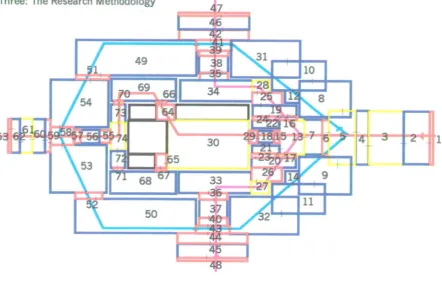
Figure 1.1 Reading of architectural space and language
All four dimensions put together form the conception of syntax which is read as the process
by which space evolves into architectural reality. The structure of the process, however, is
not linear in reality since all four dimensions simultaneously exist in relation to one another.
The reality is therefore three-dimensional in which the elements of the relational syntax are
laid side by side but on separate planes of knowledge (Figure 1.2).
A: reading 4 B: conception 4 C: reality
Figure 1.2 From abstraction to reality
In other words, one understands the whole as a result of the experience of moving around in
parts of the building as required by how functions are structured and architectural elements
are located. The research aims to explain this phenomenon clearly by taking spaces through
the structure of this process. Through such an approach, the research also aims to raise a
more comprehensive view of what architectural space is made of and presents the process in
a sequence that corresponds to the way space is turned into architectural reality. As a result,
relational syntaxes are discovered and some are shown to be more influential than others;
they are in space by either conscious design strategies used by architects or spontaneously
formed by social activities. Through these relations in architectural space, the research
explains and gains a deeper understanding of architectural reality.
Chapter Two: Literature Review
2. Literature Review
The central issue in the research is the process of the evolution of space as an abstract
entity into space as an architectural reality. Abstraction lies in philosophical and
theoretical approaches to space, while architectural reality is concerned with practical and
materialistic approaches to the design and use of architecture. Despite the diverse origins
of the ideas reviewed here, the approaches share the basic interest in three key areas:
space, movement and social activities. The following discussion aims to show how the
idea of the research has reached its present form by examining the ideas in the same
sequence as that by which space is turned into architecture. The sequence of the
discussion will start from the most fundamental aspect of space in philosophy and theory
of architectural space. The discussion then moves on to look at socio-cultural aspects as
these relate the abstract ideas found in philosophy and theory to real spatial experience
focused on socio-cultural aspects of traditional Thai architecture.
The review is representative rather than exhaustive of the literature. Key literature will be
discussed in detail, whilst related ideas will be cited in order to emphasise the specific
argument of the research. The first section is the philosophical background of the
research on the pre-structural aspects of space. The discussion adopts the position that
people understand architectural space firstly through conception not perception of
geometrical shapes in a limited subspace or bounded space, for example, in Nerlich's
sense (Nerlich, 1976). Therefore, the framework for the discussion is about systems in
our mind and intuition. In this respect, the idea is shape-free and topological. However, a
space is given a tangible quality which is not a geometrical orientation but an idea of
configuration in its structural dimension. As a result, topological space is topographically
defined not by its physicality but by its socio-cultural concept. The idea of configuration
plays a very important role starting from the so-called metaphysic philosophy to the idea
of symbolic forms down to the way social activities are carried on in architectural space.
In this way, the comprehension of space in architecture necessarily is a conceptual and
configurational one, in both the architects' and users' terms.
The discussion of the pre-structural concepts of space focuses on the works of Henri
Bergson (early 20th century), Ernst Cassirer (mid 20th century) and Henri Lefebvre (late
20th century). In Bergson's 'Matter and Memory' 1911), the idea of space, time, body and
movement is explained in relation to how people develop their concept of being in and
using space in terms of memory and duration. As a continuation of ideas of movement
and space into the symbolic aspects of form, Cassirer's 'The Philosophy of Symbolic
Forms' (1953-57) has moved the concept of pure space and related it to people's concept
of artefacts and built environment. The last key author is also the most contemporary.
Lefebvre's 'The Production of Space (1991) narrows the discussion of space to its
meanings in social life offering an excellent link between his predecessors' ideas of pure and conceptual space and the idea of the social aspects of space and thus moves space
even closer to people.
The next section is an investigation into the concept of the interdependence among
space, movement and social activities in the occupying space in architecture. The
discussion focuses on the first element in the string of relations, the structural dimension. The specific idea called Space Syntax pioneered by 1-lillier and Hanson (1984) describes
space through its configurational properties. It introduces the idea of a spatial relation
that always refers to at least three portions of permeable spaces or convex spaces to
make sense of social activities in the built environment. The ideas are major parts of the
basic theoretical argument and analytical procedure of the research. Other related works
such as Alexander's (1977) and Mitchell's (1990) are also discussed for their approaches to the structural aspects of architectural space.
The second element in the relational string, the experiential dimension, is the idea of
space types first outlined in 'Instrument of Dynamism' (Suvanajata, 1994). As
architectural spaces are structured in their own logic, they are also experienced in another independent dimension when people move in them. Naturally, most people share the
same kinds of experience when in the same parts of architectural space during their social activities. The socio-cultural background of the discussed architectural spaces helps one
to understand the experience people have when moving inside those spaces. Works on
architectural and anthropological study of Thailand are discussed in this section. Among
them are the works of Tambiah (1976), Kalayanamitr (1 982), Jumsai (1988) and
Waterson (1990). At this point, we begin to depart from the abstract side of architectural
space and step into the physical side fit, that is the point at which functions and
Chapter Two: Literature Review
People may realise the idea of functions before they form an idea about architecture
itself. Social activities create different types of function, for which we then create
different parts of architecture to envelop them. Scholars like Rajadhon (1968), Tambiah
(1969, 1976), Evans (1978), Cstkszentmihalyi and Rochberg-Halton (1981) and Markus
(1993) have conducted studies of how we can understand things or architectural space
from the analysis of function/meaning they hold. More often than not, the
understanding of function i8 confused with that of architecture, causing an analysis in
architecture to be more difficult than it should be. Franck etal (1994) attempted to
classify space based on relations among forms, uses and meanings and then to establish
types of space out of all those ingredients. At a first glance, this approach seems similar
to the idea that this research tries to promote but there is a fundamental difference in the
theoretical and applicational basis which is one of the reasons why the dimension of
architectural element has to be seen and discussed independently.
The dimension of architectural element is at the end of the relational chain, if one begins
with an analytical view of space. However, it is at the beginning of the relational chain if
one takes a practical or user's view of space. In this way, this dimension is no less elusive
and independent of space itself and thus requires an autonomous reading that
differentiates it from its functional counterparts. Therefore, the discussion presumes an
architect's view of design more than the users' views in using a building. Among the few
architects who write, Eisenman is one of the most productive authors whose idea of
objectivity of architecture (Eisenman e.g. 1963, 1980a, 1980b and 1987) is discussed in the review. Other architects such as Kiesler (1996), Venturi (1966), Kahn (1986) and
Alexander (1977, 1979 and 1985) whose works and writings are concerned with
objectivity in architectural elements are also discussed. Finally, the architectural elements
of the traditional Thai concept are discussed in the works of Tambiah (1976) and Kalayanamitr (1982).
As concepts are developed into things, space is turned into architecture. Likewise, the
concept of this research is to explore the potential of using ideas as instruments for
analysis and eventually for design. The idea of the research has been influenced by many
various sources and has developed a line of theoretical argument that attracts and
respects specific parts f these literatures. It has to be made dear that the main aim of
the review is not to make thorough analyses of all angles in the works cited. On the other
hand, the main idea of the review is to show how the idea of the research was developed
in relation to the knowledge already in existence.
2.1 Pre-structural concepts of space
It is the discussion about movement of the body in space in relation to matter that first
brought the research's interest to Bergson's philosophy. Bergson himself has been
influenced by Berkeley and Descartes, he defines matter as ..an aggregate of 'image And /ij 'image' we mean a certain existence which is more than that which the idealist calls a representation,
but less than that which the realist calls a thing an existence placed half-wail between the 'thing' and the
'representation' (1911 :vii). According to Bergson, the half-way point between 'thing' and
'representation' can be comprehended using common sense; it is intuition that Bergson
refers to as he goes on. For Bergson, intuition can be used as a method. It has
well-defined rules and offers a precise result (Delueze, 1988). This idea of intuition is related
to the theoretical basis of the research in that understanding the use and experience of
architecture requires a system of intuition developed through either cultural or
institutional process into intelligibility in different dimensions of space.
The research tackles the question of relations in space which involves both internal
properties and the external relation of each space to the whole spatial system.
Intelligibility of space has to achieve both internal and external relations so that the space
one is currently in is unique and thus makes the recognition of a piece of architecture a
unique experience. The intelligible process in movement happens in the unconscious
state; the awareness of the whole while being in the parts is the example given by
Bergson. ..whenou speak of the town, of the street, of the other rooms in the house, of so manj
pereçptions absentfromyour consciousness andyetgiten outside of it. They are not created asjour consousness receiis them; they existe4 then, in some sort; and since, by hjpothesis,your consciousness
did not apprehend them, how could tb!y exist in themselies unless in the unconscious state?'
(1911:1 83). It is this unconscious state that represents the state of intuition in relation to
intelligibility in space. To this point, the idea becomes the pre-structural aspect of space.
Bergson then goes on to discuss the relation of past and present; he wrote ?racticalty we
perceue on±v the past, the pure present being the incisible progress of the past gnawing into thefuture.'
Chapter Two: Literature Review
representation and resemblance characteristic of things in one's perception. With the
overlapping of the past into the present, the resemblance and the individuals are
perceived in the relationship of the whole and the parts; that is we perceive the
resemblance, as the whole, before we perceive the individuals as the parts which are
resembled. It is through the relations of parts to the whole that space can exist in one's
experience. Bergson places much importance on the memory mechanism when
explaining how space and matter exist in our experience. However, the research will not
overemphasise this issue but rather refer to it as the link in Bergson's idea on the
succession and sequence of parts that leads to a complete picture of the whole.
Bergson seems to have the idea of spatial configuration as he writes: Aplace could be
absolute/y distinguishedfrom anotherplace on?, bj its quality orbj its relation to the totality of ipaee: so that .pace would become, on this hffiotbesis, either composed of beterogeneousparis orJInite. But to finite
pace we should give another p ace as boundajy, and beneath heterogeneous pans of pace we should imagine an homogeneous Jpace as itsfoundation: in both cases it is to homogeneous and indefinite .bace
that we should necessantji return.' (1911:256). It is this homogeneous and indefinite space or
the whole that would carry the conceptual value for one's reading of a certain experience,
of a piece of architecture. Heterogeneous parts or the finites thus become the idea of a
series of configurational reading that through accumulation process in movement
constructing three or even four dimensional experience of space and its envelope.
Bergson's philosophy sees space in its pure conceptual state free from any value-laden
concept. Space is as natural as the body and its movement; it is in between thing and
representation. In the conclusion part of Matter and Memory, Bergson confirms his
belief in self-existing state of matter as Mj consciousness of matter is...not subjectise,for it is in things rather than in me. It is not relative, because the relation between the henomenon'and the 'thing'
is not that of appearance to reality, but mere?, that of the pant to the whole. '(1911:306). Dealing with
perception, which he believes to be the instrument of knowledge, Bergson elaborates the
point of realising spatial experience through the consideration in matter and how we
perceive it in space. (t is we tha4 between this matter and this perception, scientific realism can find
no point of contact, because it develops matter into homogeneous changes in ,pace, while it contracts
perception into un-extended sensations witbin consciousness.' (1911:76). Architecture still has to be
represented in a kind of geometry-, the solution of the paradox of mere form and
self-referential sign must be in the literal use of architectonic elements to deal with the
sources of intelligibility which lie in our perception and movement. Architecture needs to
be here and there to verify the concept. It is here that we have to move beyond pure
space to the idea of symbolic form.
In conclusion, the concept of relations in spatial dimensions brings out intelligibility from
mere space and thus makes the concept of architecture exist in one's consciousness. In
his critique of Bergson's philosophy, Piaget suests that intelligence also resides in the
development process of image not just in successive states in mind (Piaget, 1972). It is, in
fact, the development of the continuing experience that people have in space that ties all
those successive states of images together. From pure intuition in space to experience in
space, we must discuss reality. Ernst Cassirer's lie Philosophy of Symbolic Forms'
(1953-1957) discusses space and experience in the light of human knowledge. For
Cassirer, . .the content of the concept of culture cannot be detachedfrom thefundamentalforms and directions of human actit'iy: here "being" can be apprehended on!, in "action ' '(Cassirer, 1953:80). The research argues that it is necessary to differentiate between spatial dimensions in
order to apprehend man-made spaces. It is here that our understanding of space, or even
our appreciation of space, begins to project itself outward from pure intuition. It is
projected and cast into the environment, into artificial experience that provides one with
the understanding of use in relation to socio-cultural frameworks. As we build a
specific-purpose building, the structural and experiential dimensions are fused together so that we
are able to comprehend the 'being' of things with the 'action' of our movement.
The philosophy of Cassirer provides the necessary step from pure abstraction in
Bergson's because, as he points out, it will release us from the oblivion of instrument
(1957). A system of intuition will gradually turn into intelligibility in space through our
action and experience in the environment. Cassirer acknowledges the importance of the
part-whole relationship as he describes the internal logic of relations linking abstract
ideas to physical attributes. Thefactor of uxtaposition"as it appears in theform of space, the
factor of succession as in theform of time-the combination of matenaiproperties in such a wqy that one
is apprehended as a "thing", the other as an "attribute", or of successive events in such a waj that the one appears as a cause of the other all these are examples of such orzgrnalypes of reh#ion.'(l 953:94). His argument can be compared to the idea of relational string of
structure-experience-function-architectural element. It is the juxtaposition and .pace that provides both
Chapter Two: Literature Review
movement Together with mateñalpropen'zes in things, a cause represents function that
comes with the way we built things; that is how we envelop those functions. This
juxtaposition of different elements is uniquely composed in different cultures.
Cassirer, like Bergson, acknowledges the importance of configuration. They both agree
that intuition is the key to understanding space. This research emphasises this idea of a
system of intuition which is relational and dynamic and natural to our comprehension of
space. Designers and users approach this intelligibility in space from different ends of
spatial relation in reality. This relation is not clearly understood therefore making it clear
and comprehensible from both ends is the aim of the research. To this point, Cassirer
has pointed out that 'We intuit spatialconflgurations on/y y combining into one idea complete
groups ofsensoypercptions which natural/y displace one another in immediate sensory e>pe?ience, and
on the other hand 4y diffusing this unity through the diverciy ofits particular components. It is on'y 1,3
this interphy of concentration and ana/ysis that spatial consciousness is constructed Form then appears
as potential motion, while motion appears aspotentialform. '(1953:100). Here, space becomes not
only concept but also the mould of symbolic objects in a socio-cultural context
It is seen as necessary to formalise space with specific frameworks as the research deals
with architectural space. Cultural life transforms architectural space into two independent
dimensions: functional and architectural-element dimensions. These two dimensions
enable one to actually use and move in space and thus complete the process of
abstraction-to-architectural reality. At this point, architecture has gained its balance
between being conceptual and actual space. Further discussion focuses on how space is
produced by human activities after its conceptual and actual aspects are fused together.
We therefore move on to consider space as a ready-made object embedded with
socio-cultural values in the discussion of Henri Lefebvre's work.
For Lefebvre, space is always loaded with social values. He also discusses the idea of
spatial configuration and pictures it in human activity by using the term 'spatial practice' (1991). Spatial relations are conceived using firstly intuition and then, as space is
culturalised or institutionalised, by way of intelligibility in spatial configuration. Once
made for specific purposes by particular groups of users, space becomes even more
relational both in its internal properties, structure-experience-function-architectural
element, and its external properties, socio-cultural aspects of the particular groups who
use it. Lefebvre's argument is similar on this point, The theoretical envr is to be content to see a
pace without conceâing of it, without concentrating discrete p ercptions bj means of a mental act, without
assembling details into a whole 'realiy without apprehending contents in ten'ns of their interreIationshps
within the containingforms. '(1991:94). His arguments on space proceed from macro to
micro level, from social space to gestures in different culture.
One thing to be careful about when analysing space is being too reductive in the
analytical methods. In analysing space, as the research has proposed, the lived experience
of the selected space cannot be neglected. One cannot fully understand the structure,
function or architectural element of a building without connecting with the experiential
side of such space. Social space, in particular, requires this experiential link through body
movement and even more; that is to actually 'participate' in activities in space not just externally experience it. Lefebvre gives the example that one cannot predict the
experience of Gothic churches from the experience of, for example, Romanesque
churches. To this concern, a lived experience and observation is a necessary step in the research's concept. Furthermore, by actual experience and participation in space, the structural, functional and architectural elements dimensions become more distinct in their own terms as well as in their relations among one another, because it is only in this way that one can truly connect with their composite intelligibility.
Lefebvre proposes three general concepts for social space: form, structure and function.
This view, however, is oriented towards perception and thus objectivises space rather
than utilises it. To use space is to experience it in movement. When we move, the body
forms its concept and presence over space and in this way the structural dimension can
be linked to the utilisation in the functional dimension. In architecture, we conceive
function and architectural elements in relation to the ways we move in configured spaces;
without such experiences we cannot adjust or orient ourselves to the environment. The
so-called structure would become more distant like when we look at a sculpture and we
have to invent endless functions and elements each and every time we come across a new
structure. This point makes clear that we cannot only depend on the quantitative side of
body movement such as volume or frequency of movement in space but also the
qualitative side of it as well such as types of experience and activities. With these two
sides of body movement working together, we achieve what Lefebvre calls 'an
Chapter Two: Literature Review
This intelligence seems not to be in the forefront of our consciousness, as the
configurational aspect is not the most obvious in a building however, it produces effects
naturally and unceasingly in space. Therefore, when we use space,it automatically
corresponds with this intelligence so that such space inherits and develops its intelligence
in correspondence to the natural intelligence in body movements. That is why, to borrow
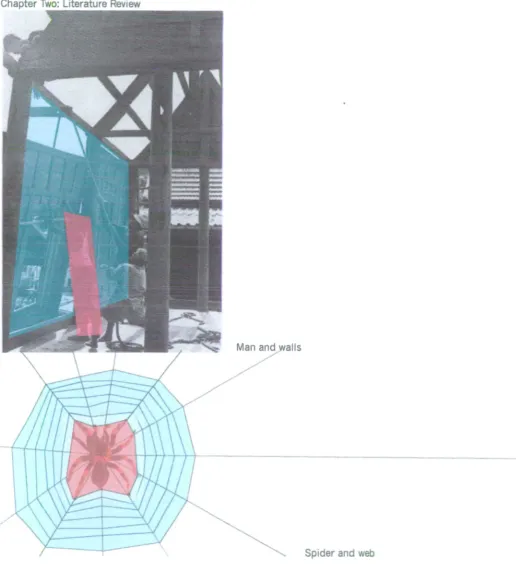
the spider analogy from Lefebvre, a spider's horizontal-oriented body and people's
vertical-oriented body create webs and erect vertical boundaries, respectively. Built
environments, after all, in the pre-structural concept are the exercise and representation
of the builder's body and its movement (Figure. 2.1). As people tend to form groups, so
all buildings are made to serve more than one body and to accommodate many types of
movement. Regardless of different types of movement and activities, buildings maintain
the same basic intelligence recognisable to everybody using them.
Built environment has been created according to many constraints; most of the time in
reference to 'lived experience' (1991:190). From the many types of built environment, the
research focuses on the two most fundamental types: house and temple which are the
most mature types of space known to people. In this way, they are suitable to be taken as
the first type to be examined by the research's idea. It is unimportant whether people
first created the house or temple. What is important is that they both fulfil very
important functions in human society. The question of whether the house is influenced
by the temple or vice versa is also insignificant. It is sufficient to conclude that they
influence each other's existence and appearance. Looking back to the origin of man's
social development, temples and houses are the most influential and thus the closest to
our concept of everyday lives. We base our concept of space on the experiences we have
in religious and domestic life and expand from there. (Raglan, 1964; Durkheim, 1915).