Review Article
1
Linking Aromatic Hydroxy Metabolic Functionalization of Drug Molecules to
2
Structure and Pharmacologic Activity
3
Babiker M. El-Haj 1,*, Samrein B.M. Ahmed 2, Mousa A. Qarawi 2,, Heyam S.Ali4
4
1 Department of Pharmaceutical Sciences, College of Pharmacy, Ajman University, UAE; b.elhag.ajman.ac.ae
5
2 College of Medicine, Sharjah Institute for Medical Research, University of Sharjah, UAE;
6
samreinahmed@sharjah. ac.ae
7
3 Department of Pharmaceutical Sciences, College of Pharmacy, Ajman University, UAE;
8
9
4 Department of Pharmaceutics, Dubai Pharmacy College, UAE; [email protected]
10
11
* Correspondence: e-mail: b.elhag.ajman.ac.ae; Tel.: 0071567204338
12
13
Abstract: Drug functionalization through formation of hydrophilic groups is the norm in phase I
14
metabolism of drugs for modification of drug action. The reactions involved are mainly oxidative
15
catalyzed mostly by CYP isoenzymes. The benzene ring, as phenyl or fused with other rings, is the
16
most common hydrophobic pharmacophoric moiety in drug molecules. On the other hand the
17
alkoxy group (mainly methoxy) bonded to the benzene ring assumes an important and sometimes
18
essential pharmacophoric status in some drug classes. Upon metabolic oxidation, both moieties, i.e.
19
the benzene ring and the alkoxy group, produce hydroxy groups; the products are arenolic in
20
nature. Through a pharmacokinetic effect, the hydroxy group enhances the water solubility and
21
elimination of the metabolite with the consequent termination of drug action. However, through
22
hydrogen bonding, the hydroxy group may modify the pharmacodynamics of the interaction of the
23
metabolite with the site of parent drug action (i.e. the receptor). Accordingly, the expected
24
pharmacologic outcome will be enhancement, retaining, attenuation, or loss of activity of the
25
metabolite relative to the parent drug. All the above issues have been presented and discussed in
26
this review using selected members of different classes of drugs with inferences regarding
27
mechanisms, drug design and drug development.
28
Keywords: Aromatic hydroxy metabolites; arenolic drug metabolites; metabolic O-dealkylation;
29
metabolic aromatic ring hydroxylation; primary and auxiliary pharmacophores; auxophores;
30
metabolic modification of drug activity.
31
Introduction
32
Phase I metabolism of drugs (also known as the non-synthetic or functionalization phase) is
33
mainly brought about by microsomal enzymes by adding hydrophilicity to hydrophobic moieties in
34
drug molecules. In most cases, this is attained metabolically by revealing or introducing the
35
hydrophilic hydrogen bonding hydroxyl group. Generally, metabolic interference may take place at
36
pharmacophoric and/or auxophoric groups. Accordingly, the location in a drug molecule at which
37
the metabolic change takes place may determine the pharmacologic outcome of the metabolite.
38
In any case, the resulting drug metabolite may be pharmacologically inactive, less active,
39
equiactive, or even more active with respect to the parent drug. In other cases, an inactive parent
40
drug is metabolically converted to the active form, in which case the inactive parent drug is known
41
as ‘prodrug.’ Cases where the metabolic changes are intermediary in drug activation are also known.
42
For some drug metabolites, the pharmacologic outcomes - pharmacodynamic,
43
pharmacokinetic, and toxicologic - have proven to be substantially more favorable compared to their
44
parent drugs. In such cases, the metabolites have been developed into drugs of their own rights. In
45
this review, such drug metabolites will be referred to as “metabolite drugs”.
46
Generally, in drug development, the pharmacophoric or auxophoric roles of functional groups
47
in lead drug compounds or drug prototypes are modified in the synthetic laboratory in some ways.
48
Introduction of a group in the framework, reduction of a group to framework status, or replacement
49
of a group by another are the main strategies followed. Through biotransformation, the body may
50
play an analogous in vivo role by changing pharmacophoric and/or auxophoric groups into others
51
or by introducing groups at certain positions of the drug molecule with concomitant changes in
52
pharmacodynamic and/or pharmacokinetic properties of the metabolite relative to the parent drug.
53
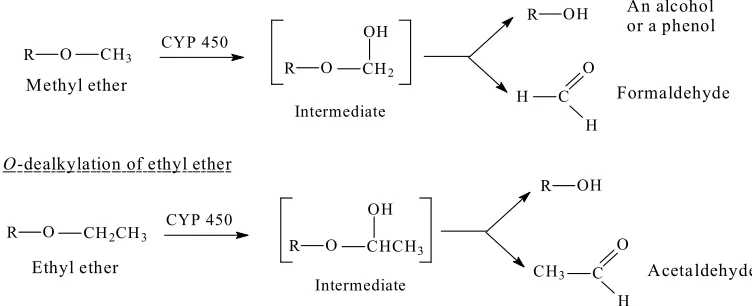
Such metabolic changes of a drug molecule may lead to a variety of pharmacologic outcomes. The
54
dependence of the metabolic change on the structure of the drug molecule and the pharmacologic
55
outcomes of the resulting metabolites are the subjects of this review.
56
57
Objective of the Review
58
The objective of this review is to investigate the relationship between the metabolic change and
59
modification of pharmacodynamic and/or pharmacokinetic properties of the drug in an endeavor to
60
explain when the pharmacologic activity of the metabolite is retained, decreased, lost, or even
61
enhanced with respect to the parent drug. The link of the metabolic functionalization and
62
pharmacologic activity to the structure of the drug is also a prime interest. Such information, as
63
described above, will be useful in drug designing, when contemplating new drug entities. As well, it
64
should be useful in drug development when considering what chemical changes need to be made in
65
a lead or prototype for better drug efficacy and metabolic stability
66
67
Methodology
68
The inclusion criteria of the selection of drugs to be reviewed include
69
(a) drugs that are metabolized by O-dealkylation or aromatic ring hydroxylation; and
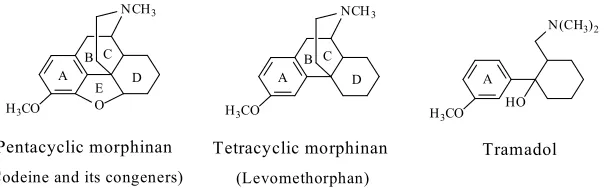
70
(b) availability of data regarding the pharmacologic activity of the major
71
metabolite(s).
72
The sources of information include:
73
the published literature;
74
drug manufacturers’ data sheets; and
75
reference books on drug metabolism and activity of metabolites
76
The selection of the case study drugs has been based on varying the pharmacologic and
77
chemical classes, as will be described in each section.
78
79
Review Strategy
80
Although the selected drugs are mostly metabolized by multi routes, only metabolic oxidative
81
reactions that result in one chemical functionality, the aromatic hydroxy group, will be considered.
82
The representative drugs are selected based on both chemical structure and pharmacologic action.
83
Each study/metabolite(s) case will be presented in a figure including the following information
84
subject to availability in the literature:
85
the chemical structure of the drug and metabolite(s), and the enzymes or isoenzymes
86
involved;
87
the status of the pharmacologic activity of the metabolite;
88
the percentage concentration of the metabolite(s) with respect to the parent drug.
89
Each parent drug will be briefly reviewed. The arguments for the links of metabolic changes to
90
pharmacologic activity and structure will be discussed for some drug/metabolite cases as they are
91
presented with an overall discussion given for all the cases at the end of the section.
92
93
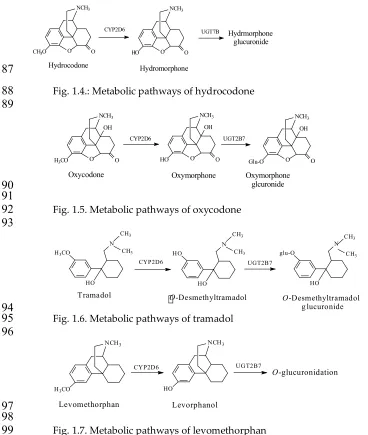
Aromatic-Hydroxy (Arenolic) Metabolites
94
Arenolic metabolites can result from one of two metabolic reactions: O-dealkylation of aralkoxy
95
groups or hydroxylation of aromatic rings (mainly benzene); in the latter case, the positions of the
96
hydroxy groups are determined by the prevailing electronic and steric effects on the aromatic ring.
97
The benzene ring may be present in the drug molecule as a separate entity (i.e. as a phenyl group), or
98
it may be fused to another benzene ring, or to an alicyclic or a heterocyclic ring. When the benzene
ring is fused to either an alicyclic or heterocyclic ring the resulting ring system may be described as
100
benzenoid. Arenolic metabolites will be presented and discussed in two sections, 1 and 2.
101
102
Section 1. Arenolic Metabolites Resulting from O-Dealkylation of Aralkoxy Groups
103
Metabolic CYP-catalyzed O-dealkylation of aralkoxy groups involves, as a first step, the
104
hydroxylation of the carbon atom of the alkyl group that is linked to the oxygen atom. This
105
hydroxylated metabolite is unstable. It breaks spontaneously into two molecules: the dealkylated
106
metabolite (e.g., an alcohol or a phenol), and an aldehyde (e.g., formaldehyde after demethylation,
107
or acetaldehyde after deethylation, etc.). The reaction is shown for a general case in Fig. 1.1., where
108
the group R can be aliphatic or aromatic [1].
109
110
R O CH3
R O CH2
OH
R OH
H C
O
H Methyl ether
CYP 450
Intermediate
An alcohol or a phenol
R O CH2CH3
R O CHCH3
OH
R OH
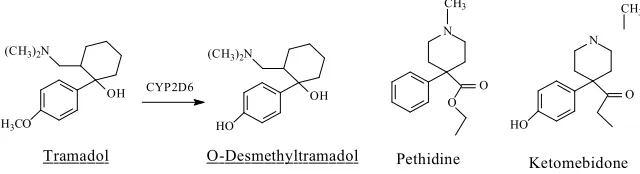
CH3 C
O
H CYP 450
Intermediate Aceta ldehyde
Ethyl ether
Formaldehyde O-dealkylation of methyl ether
O-dealkylation of ethyl ether
111
Fig. 1.1. CYP-catalyzed O-dealkylation of alkyl or aralkyl ethers
112
113
O-dealkylation of aralkyl ethers results in the production of arenolic metabolites of varying
114
pharmacologic activities, as will be reviewed for the following selected cases:
115
(1) Enhancement of activity occurring in the opioid narcotic/analgesic drug codeine and its
116
semisynthetic and synthetic congeners, all containing an aryl-methoxy group, and the
117
analgesic/antipyretic drug phenacetin, which contains an aryl-ethoxy group
118
(2) Retaining of activity in the SSRI antidepressant venlafaxine, containing an aryl-methoxy
119
group
120
(3) Loss of activity in the COX1/COX2-inhibiting NSAIDS naproxen, indomethacin, and
121
nabumetone, each containing an aryl-methoxy group
122
123
1.1. Metabolic Aralkoxy Cleavage Resulting in Enhancement of Pharmacologic Activity:
124
Opioids and Phenacetin
125
1.1.1. Opioids. Opioid drugs can be defined as those acting on the different types of opioid
126
receptors (mu, kappa, and delta) to produce a variety of biologic effects. Mu-receptor stimulation is
127
associated with analgesic (antinociceptive) effects, respiratory depression, reduced GI motility
128
(constipation), and euphoric and dependence effects, while kappa-receptor stimulation is associated
129
with analgesia, psychomimetic effects, dysphoria, and diuresis [2, 3].
130
For the sake of discussion, methoxy-group-containing opioid drugs can be classified with
131
regard to source and chemical build-up. Source includes natural origin (e.g. codeine), semisynthetic
132
(e.g. codeine congeners), and synthetic (e.g. tramadol). Tramadol is considered to be a
133
synthetic-codeine congener since it was developed using codeine as template. Chemically, codeine
134
and its semisynthetic congeners are classified as pentacyclic or tetracyclic morphinans (Fig. 1.2.). On
135
the other hand, tramadol is a non-morphinan bicyclic opioid devoid of rings B and C, as shown in
136
Fig. 1.2.
O NCH3
H3CO
A B C
D E
Pentacyclic morphinan Tetracyclic morphinan
(Codeine and its congeners) (Levomethorphan)
A
H3CO
N(CH3)2
HO
Tramadol
NCH3
H3CO
A B C
D
138
Fig. 1.2. Chemical classification of methoxy-group-containing morphinan and non-morphinan
139
opioids
140
141
1.1.1.1. Codeine. Codeine (Fig. 1.3) is an opium alkaloid; ii is the methyl ether of morphine and is
142
present in opium in 1-3% concentration [4]. It is obtained semisynthetically on a large scale by the
143
methylation of morphine. Codeine is a weak mu-receptor agonist, being only about 0.1% as active as
144
morphine [5]. The analgesic activity of codeine has been attributed mainly to its metabolites.
145
Codeine is metabolized per the pathways shown in Fig. 1.3 to codeine-6-glucuronide, morphine, and
146
norcodeine. The resulting morphine is further metabolized to the 3- and 6-glucuronide conjugates
147
[6, 7]. As indicated in Fig. 1.3, reports in the literature on the concentrations of codeine metabolites
148
are variable. Further, reports on the mu-receptor affinity and analgesic activity of codeine
149
metabolites are even contradictory. It is a longstanding belief that the mu-receptor affinity and
150
analgesic activity of codeine are mediated through its metabolite morphine, which has an affinity for
151
the mu-opioid receptor 200-fold greater than that of codeine [8]. The analgesic activity of codeine has
152
been suggested to be largely due its metabolite morphine [8-11]. However, of late, Vree et al. (2000)
153
have developed a different view of codeine’s affinity to the mu-opioid receptor and its analgesic
154
activity. Here, we quote the abstract of their paper:
155
Eighty per cent of codeine is conjugated with glucuronic acid to codeine-6-glucuronide. Only
156
5% of the dose is O-demethylated to morphine, which in turn is immediately glucuronidated at the
157
3- and 6-positions and excreted renally. Based on the structural requirement of the opiate molecule
158
for interaction with the mu-receptor to result in analgesia, codeine-6-glucuronide, in analogy to
159
morphine-6-glucuronide, must be the active constituent of codeine. Poor metabolizers of codeine,
160
those who lack the CYP450 2D6 isoenzyme for the O-demethylation to morphine, experience
161
analgesia from codeine-6-glucuronide. Analgesia of codeine does not depend on the formation of
162
morphine and the metabolizer phenotype. [12]
163
The literature’s contradictory evidence on the mu-receptor affinity and the analgesic activity of
164
codeine and its metabolites will be weighed in the discussion section.
165
166
O NCH3
O NCH3
Morphine (active)
1
2
3 4 5
6 7 8
HO OH
H3CO OH
Codeine
CYP2D6
UGT2B7
Morphie-3-glucuronide
(60%)
(5-10%
)
Morphie-6-glucuronide (active) (Inactive)
Codeine-6-glucuronide UGT2B7
(active) 50-70%
0-15%
167
168
Fig. 1.3: Metabolic pathways of codeine
169
170
It may be of interest to note that codeine’s metabolic pathways cover almost the entire spectrum
171
of biological activity by including reactions that are augmenting, activating, inactivating, and
172
attenuating of the analgesic activity of the metabolite with respect to the parent drug.
173
1.1.1.2. Codeine congeners. Codeine synthetic pentacyclic-morphinan congeners include
174
hydrocodone, oxycodone, and the tetracyclic morphinan congener levomethorphan, which all have
3-arylmethoxy groups. On the other hand, tramadol may be considered to be a non-morphinan
176
codeine analogue since its development has been based on codeine as template. Tramadol contains
177
an arylmethoxy group relative in position to that of codeine. While hydrocodone, oxycodone, and
178
tramadol are currently clinically used in pain management [13, 14], levomethorphan has never been
179
used. The four drugs are metabolized by the isozyme CYP2D6 to their corresponding O-desmethyl
180
phenolic counterparts as shown in the corresponding figures: 1.4, 1.5, 1.6, and 1.7 [15-17]. Due to
181
their substantially higher mu-receptor affinities and, accordingly, their higher analgesic activities
182
compared to their parent drugs [15, 16], the four phenolic metabolites have been developed into
183
drugs of their own rights. Presumably, the increase in mu-receptor affinity and analgesic activity is a
184
result of the phenolic hydroxy groups in the four-metabolite drugs. We will present possible
185
explanation of why this is the case in the discussion of this section.
186
O NCH3
O
CH3O O
NCH3
O HO
Hydrocodone Hydromorphone
UGT7B CYP2D6
Hydrmorphone glucuronide
187
Fig. 1.4.: Metabolic pathways of hydrocodone
188
189
O NCH3
O H3CO
OH
O NCH3
O HO
OH
O NCH3
O OH
Glu-O CYP2D6
Oxycodone Oxymorphone
UGT2B7
Oxymorphone glcuronide
190
191
Fig. 1.5. Metabolic pathways of oxycodone
192
193
H3CO
N
HO
CH3
CH3 H O
N
HO
CH3
CH3
Tramadol O-Desmethyltramadol
glu-O
N
HO
CH3
CH3
O-Desmethyltramadol g lucuronide
CYP2D6 UGT2B7
194
Fig. 1.6. Metabolic pathways of tramadol
195
196
NCH3
H3CO
NCH3
HO
O-glucuronidation
Levomethorphan Levorphanol
UGT2B7 CYP2D6
197
198
Fig. 1.7. Metabolic pathways of levomethorphan
199
200
Discussion of Section 1.1.1 on Opioids
201
Section 1.1.1 on the metabolic O-demethylation of the methoxy-group-containing opioids is
202
discussed separately because of the availability of substantial supportive evidence.
203
A number of theories have been proposed to account for the role of the phenolic-hydroxy group
204
in mu-receptor interaction and the consequent production of analgesia.
205
Foye (2013) has classified opioid drugs into two categories according to the pharmacophore
206
responsible for mu-receptor interaction: the rigid multicyclic (morphinan) opioids (exemplified by
207
morphine, codeine, and codeine congeners), and the flexible opioids (exemplified by
4-arylpyridinepethidine) [18]. To the latter category, we may add arylcyclohexylmethylamine,
209
which is found in tramadol. The structures of the three categories are depicted in Fig. 1.8.
210
211
M o rp h in an
A B
C D
N R
1 4
4 -A ry lp ip erid in e
R = M eth y l o r eth y l
N
A ry lcy clo h ex y l d im eth y l m eth y lam in e
A A
N H
O E
F lex ib le n o n -m o rp h in an o p io id s
212
213
Fig. 1.8. Structures of the opioid drugs pharmacophores
214
215
Foye (2013) has argued the importance of a phenolic-hydroxy group on ring A (Fig. 1.1.8) to the
216
mu-receptor interaction and analgesic activity of the rigid multicyclic morphinan opioids such as
217
morphine and the O-desmethyl metabolites of codeine congeners [18]. The author also maintained
218
that a phenolic-hydroxy group is not a requirement for the mu-receptor interaction and analgesic
219
activity of the flexible non-morphinan opioids. It should be noted that none of the latter groups of
220
drugs contain a phenolic hydroxy group and that, to our knowledge, aromatic-ring hydroxylation
221
has not been reported as a metabolic route of any of them.
222
Foye’s theory of “phenolic OH binding liability” for the flexible opioids (18) may be contested
223
based on observations from the metabolic activity of O-desmethyltramadol (a metabolite of
224
tramadol) (Fig. 1.6) and ketomebidone (an analogue of pethidine) (Fig. 1.9). Both drugs can be
225
categorized as non-rigid flexible non-morphinan opioids. O-Desmethyltramadol exhibits a 200-fold
226
increase in mu-receptor affinity and analgesic activity relevant to tramadol [19]. Ketomebidone, on
227
the other hand, has four-fold mu-receptor affinity and analgesic activity compared to pethidine
228
[20].The enhanced mu-receptor affinity and analgesic activity of both O-desmethyltramadol and
229
ketomebidone can be attributed to the phenolic hydroxy group, which is reminiscent in position to
230
that of morphine.
231
N
O O CH3
N
O
HO
CH3
OH
H3CO
(CH3)2N
OH
HO (CH3)2N
Pethidine
Tramadol O-Desmethyltramadol
CYP2D6
Ketomebidone
232
233
Fig.1.9. Tramadol/O-desmethyltramadol and pethidine/ketomebidone
234
235
Another opioid drug-receptor interaction theory has been suggested by Beckett and Casy(1959)
236
[21] who stated that the macromolecule with which the analgesic interacts has, or attains, a certain
237
conformation into which the phenolic group must fit before the biological effect (of analgesia) can
238
occur. A “three-point” attachment of the macromolecule to a substrate’s flat aromatic moiety, its
239
basic center, and its hydrocarbon area was postulated.
240
Glucuronide and acetyl derivatives of morphine provide substantiating evidence of the
241
phenolic hydroxy group’s involvement in strengthening the mu-receptor affinity and, accordingly,
242
the analgesic activity of the morphinan-opioid drugs that contain it, either intrinsically or
243
metabolically. Further discussion of this point will follow.
244
By virtue of its phenolic-hydroxy group at position 3 and alcoholic hydroxy group at position 6
245
(Fig. 1.10), morphine forms two glucuronide conjugates: morphine-3-glucuronide and
246
morphine-6-glucuronide (Fig.1.3). While morphine-6-glucuromide is a far more potent mu-receptor
247
agonist and analgesic than morphine [22–24], morphine-3-glucuronide is devoid of both effects [25].
248
Furthermore, the O-glucuronide conjugates of both O-desmethyltramadol (Fig. 1.6) and levorphanol
(Fig. 1.7) are devoid of mu-receptor agonistic effects and, accordingly, analgesic activity [26-27]. The
250
above data may be explained based on size and hydrogen-bonding ability differences between the
251
hydroxy and glucuronide groups. In morphine, the hydrogen bonding provided by the 6-OH group
252
is important for mu-receptor fitting and thus analgesic activity. With three hydroxy moieties, the
253
glucuronide group at position 6 of morphine is capable of establishing more hydrogen bonds than
254
the 6-OH. Further stronger interactions of the glucuronide group with the mu receptor involve
255
ion-ion and ion-dipole binding provided by the carboxylate (COO-) moiety. Such state of affairs
256
will most probably lead to stronger mu-receptor fit and hence higher analgesic activity of
257
morphine-6-glucuronide than morphine. On the other hand, the size factor favors the hydroxy
258
group at position 3 of morphine to anchor the aromatic ring in its hydrophobic pocket in the mu
259
receptor rather than the considerably bigger glucuronide group. With reference to the tug-of-war
260
hypothesis (to be discussed in section 1.1.3), the glucuronide group may even cause the dislodging
261
of the aromatic ring from its hydrophobic pocket.
262
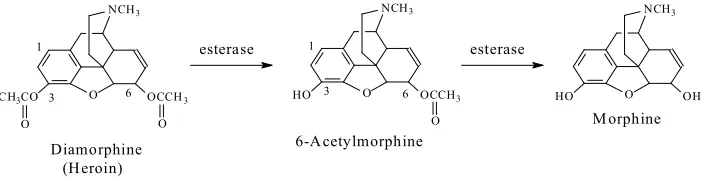
Upon comparing the mu-receptor affinity and analgesic activity of morphine,
263
6-acetylmorphine, and diamorphine (heroin) (Fig. 1.10), 6-acetylmorphine has been found to be the
264
most active of the three opiates. It is four times as active as morphine. Heroin is also more active than
265
morphine by a factor of two but less active than 6-acetylmorphine [28-31].
266
267
O NCH3
HO OH
O NCH3
HO OCCH3
O O
NCH3
C H3CO OCCH3
O O
3 6
3 6
Diamorphine (H eroin)
M orphine 6-A cetylmorphine
1 esterase 1 esterase
268
269
Fig. 1.10. Diamorphine, 6-acetylmorphine, and morphine
270
271
A plausible explanation of the above data is as follows: being more lipophilic than morphine,
272
both 6-acetylmorphine and heroin (Fig. 1.1.10) will cross the blood-brain barrier faster and in higher
273
concentrations than morphine. On the other hand, having a free phenolic hydroxy group,
274
6-acetylmorphine will interact with the opioid mu receptor more efficiently than diamorphine.In
275
diamorphine, the free hydroxy group is generated metabolically in the brain by esterase hydrolysis,
276
which will lead to a delayed effect and reduced efficacy. The effects of morphine and the two
277
acetylated opiates (diamorphine and 6-acetylmorphine) can therefore be explained by a combination
278
of pharmacodynamic and pharmacokinetic influences.
279
Extra substantiating evidence for the role of the free phenolic hydroxy group may be obtained
280
from levomethorphan and its O-desmethyl metabolite levorphanol (Fig. 1.7). These two tetracyclic
281
opiate drugs lack the 6-hydroxy group and hence the ability to form glucuronide conjugates at that
282
position; yet, levorphanol has a stronger affinity for the mu receptor and analgesic activity than its
283
parent drug levomethorphan [32].
284
In conclusion, we may summarize the role of the hydroxy group in arenolic opioidsinthe
285
following statement: ‘As shown in the opioid pharmacophores in Fig. 1.8, the aromatic rings labeled
286
A, present in both morphinan and non-morphinan opioids, are essential components of the
287
pharmacophore of the opioid-mu-receptor interaction. The high affinity of the phenolic opioids for
288
the mu receptor is an indication of a logistic role played by the hydroxy group. Through hydrogen
289
bonding with an adjacent amino-acid residue in the mu receptor, the hydroxy group plays the
290
logistic role of anchoring the aromatic ring to the assigned hydrophobic pocket in the receptor, thus
291
enhancing both affinity and efficacy. Substantiating evidence to the above statement is provided by
292
the work of Sahu et al (2008) on the HIV-1-NNRT inhibitors, tetrahydroimidazobenzodiazepinones
293
[33]. In this class of compounds, the predominant hydrophobic proper orientation for maximum
294
effect has been found to be enhanced by hydrogen bonding and polar interactions.
Vree’s et al assertion that the analgesic activity of codeine being entirely due to its glucuronide
296
conjugate [12] may now be reconsidered in view of the evidence so far presented about the role of
297
phenolic hydroxy group in the opioid drugs. It is important to emphasize that Vree’s et al.
298
conclusion was abstract rather than experimental and, as such, may be subject to difference of
299
opinion.
300
Because both codeine and tramadol have intrinsic analgesic activities, they can be viewed as
301
prodrugs of morphine and O-desmethyltramadol respectively, both having sustained-release effects.
302
Both morphine and O-desmethyltramadol are strong mu-receptor agonists used in the management
303
of severe pain but having the disadvantage of causing dependence. Therefore, for the management
304
of mild to moderate pain it would be advisable to use the corresponding prodrugs, codeine and
305
tramadol, which have the advantage of sustained release. However, some people who are poor
306
CYP2D6 metabolizers do not make use of the beneficial prodrug-sustained-release effect. For such
307
people, it is advisable to adjust the dose of the parent drug, give the O-desmethyl metabolites, or
308
seek alternative therapies. The frequency of the phenotype of poor metabolizers differs among
309
ethnic groups. Less than 1% of Asians, 2-5% of African Americans, and 6-10% of Caucasians are poor
310
metabolizers of CYP2D6 [34-36].
311
In addition to the pharmacodynamic receptor interactions of the methoxy opioids (occurring
312
mainly through their polar hydroxy metabolites), the analgesic effects of hydrophobic opioid drugs,
313
such as fentanyl, dextropropoxyphene, methadone, and pethidine (Fig. 1.11), have mainly been
314
explained by pharmacokinetic effects. These drugs cross the blood-brain barrier more efficiently
315
and, accordingly, they reach the mu-receptors in the brain in higher concentrations than the
316
methoxy-group-containing members [18, 37].
317
318
N N
O
N
O O
N O
N O O
Fentanyl
Dextropropoxyphene
Methadone Pethidine
319
Fig. 1.11. Highly hydrophobic opioids
320
321
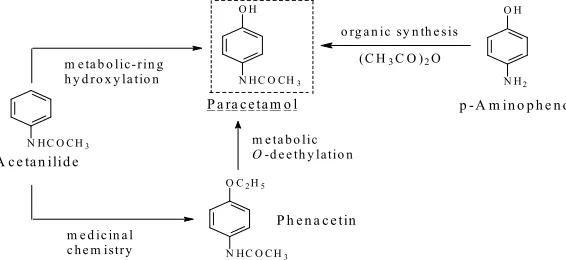
1.1.2. Acetanilide/Phenacetin/Paracetamol. The story of the development of the most
322
commonly used analgesic antipyretic drug, paracetamol, as a metabolite drug of acetanilide and
323
phenacetin, is depicted in Fig 1.12. Both the latter two drugs were once used as analgesics and
324
antipyretics. Paracetamol results from phenacetin by metabolic O-deethylation [38] and from
325
acetanilide by metabolic para-hydroxylation of the aromatic ring [39]. Compared to its two
326
precursors, paracetamol has been found to have superior pharmacologic profiles, including toxicity
327
and therapeutic index (38, 39). The free hydroxy group seems to give paracetamol the edge in
328
inhibiting, through hydrogen-bonding interaction, two prostaglandin H2 synthases, now believed to
329
be involved in the mechanism of action of paracetamol [40]. Besides, the hydroxy group may play
330
the logistic role of anchoring the aromatic ring in the proper geometric orientation in the enzyme
331
active cavity.
332
N H C O C H3
N H C O CH3
O H
N H C O C H3
O C2H5
m e d ic in a l c h e m istr y
N H2
O H
m e ta b o lic - r in g h y d r o x y la tio n
m e ta b o lic
O-d e e th y la tio n
o rg a n ic sy n th e s is
( C H3C O )2O
P a ra c e ta m o l p - A m in o p h e n o l
A c e ta n ilid e
P h e n a c e tin
334
Fig. 1.12: From acetanilide to phenacetin to paracetamol
335
336
1.2. Metabolic O-Dealkylation of Aralkoxy Groups Resulting in Retaining of Pharmacologic
337
Activity: Venlafaxine/Desvenlafaxine
338
Venlafaxine is an antidepressant in the SSRI category. It is mainly metabolized by
339
O-demethylation to equiactive desvenlafaxine (O-desmethylvenlafaxine) (Fig. 1.13). Venlafaxine is
340
further metabolized through N-demethylation and glucuronide conjugation to inactive products
341
(Fig.1.1.13) [41-44]. Desvenlafaxine has been developed into a drug of its own right and approved by
342
the FDA in the US for the treatment of major depressive disorder (MDD), similarly to its parent
343
drug, venlafaxine, which is used for major depressive and anxiety disorders. However, the
344
European Medicines Agency (EMA) had second thoughts and did not approve desvenlafaxine as a
345
drug. They argue that venlafaxine is almost all metabolized to desvenlafaxine and that both
346
compounds have essentially the same pharmacologic and pharmacokinetic profiles; hence, there is
347
no strong reason to use desvenlafaxine as a separate drug [45].
348
Venlafaxine carries structural similarity to the analgesic drug tramadol. The latter drug exerts
349
its analgesic effect mainly through serotonin-norepinephrine reuptake inhibition (SNRI) [46] and to
350
a minor extent through blocking oh the mu-receptor. O-Demethylation of both venlafaxine and
351
tramadol has resulted in active metabolites that have been developed into drugs of their own rights.
352
The fact that neither venlafaxine nor desvenlafaxine has analgesic effects, and that neither tramadol
353
nor O-desmethyltramadol has antidepressant effects, emphasizes the close link between drug action
354
and drug structure.
355
356
N
H3CO
OH CH3
CH3
Venlafaxine
N
HO
OH C H3
CH3
Desvenlafaxine
(O-Desmethylvenlafaxine) UGT2B7 CYP2D6
Desvenlafaxine glucuronide
357
358
Fig.1.13: Metabolic pathway of venlafaxine
359
360
1.3. Metabolic O-Dealkylation of Aralkoxy Groups Resulting in Loss of Pharmacologic
361
Activity: NSAIDS (Naproxen, Indomethacin and Nabumetone)
362
NSAIDS fall into five chemical classes: arylalkanoic acids, salicylates, fenamates, oxicams
363
(cyclic sulfonamides), and diarylheteroaromatics. The benzene ring, either as a separate entity or
364
fused with other rings, constitutes an integral part of the pharmacophore in all the NSAIDS chemical
365
classes. The carboxyl group (in the form of carboxylate ion COO-) forms the other part of the
366
pharmacophore in the arylalkanoic acid NSAIDS. With the exception of aspirin, the mechanism of
367
action of the NSAIDS involves the competitive inhibition of arachidonic acid, the precursor of
368
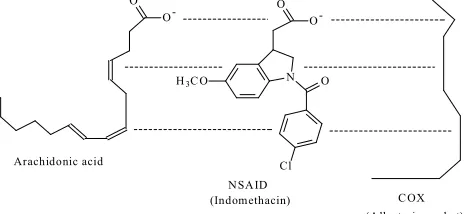
prostaglandins, from accessing the COX active cavity. The binding of the arylalkanoic acid NSAID to
369
the amino-acid moieties in COX active cavity involves ion-ion and ion-dipole through the
370
carboxylate group (COO-) and hydrophobic through alkyl and aryl groups [47-50] as depicted in
371
Fig. 1.14.
372
O -O
N O -O
O
Cl H3C O
Arachidonic acid
N SA ID
(Indomethacin) C OX
(A llosteric pocket)
374
Fig. 1.14: An NSAID (Indomethacin) inside the COX receptor (adapted from [50])
375
376
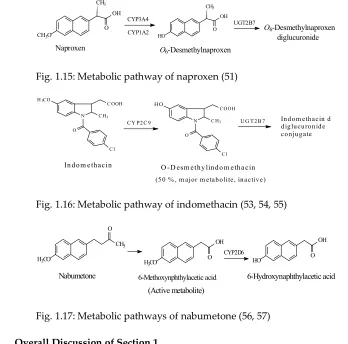
Naproxen, indomethacin, and nabumetone (Figs. 1.15, 1.16, and 1.17 respectively) are NSAIDS
377
that act through COX1/COX2 inhibition. To our knowledge, they are about the only three
378
arylalkanoic acid NSAIDS that contain aromatic methoxy groups. Further, nabumetone is a prodrug
379
NSAID, which must first be activated by metabolic oxidation to the carboxy derivative,
380
6-methoxynaphthylacetic acid, as shown in Fig. 1.17. Naproxen, indomethacin, and the active form
381
of nabumetone are mainly metabolized through O-demethylation to give O-desmethylnaproxen,
382
O-desmethylindomethacin, and 6-hydroxynaphthylacetic acid, respectively (Figs. 1.15, 1.16, and
383
1.17). The first two O-desmethyl metabolites are devoid of COX inhibitory effect and, accordingly, of
384
NSAID activity [51-53]. By analogy, 6-hydroxynaphthylacetic acid, the O-desmethyl metabolite of
385
nabumetone, is expected to be devoid of NSAID activity. According to Duggan et al. (1972), the
386
p-hydroxy groups in the O-desmethyl metabolites place polar, hydrogen bond-donating properties
387
within otherwise entirely aromatic-hydrophobic-pharmacophoric groups in the parent drugs [54].
388
Presumably, a poor metabolite-COX fit would result with a subsequent loss of pharmacologic
389
activity. The loss of pharmacologic activity in the O-desmethyl arylalkanoic acid NSAIDS is further
390
reflected on in the discussion section
391
392
OH
O CH3O
CH3
OH
O HO
CH3
CYP3A4
Naproxen O6-Desmethylnaproxen
CYP1A2
UGT2B7
O6-Desmethylnaproxen diglucuronide
393
394
Fig. 1.15: Metabolic pathway of naproxen (51)
395
396
N
C OOH H3CO
C H3
O
C l
N
C O OH
H O
C H3
O
C l
O - D esm eth y lin d o m eth a cin In d o m e th acin
(5 0 % , m a jor m e ta b o lite , in a c tiv e )
C Y P 2 C 9 U G T 2 B 7 In d o m e th a c in d
d ig lu c u ro n id e c o n ju g a te
397
398
Fig. 1.16: Metabolic pathway of indomethacin (53, 54, 55)
399
400
CH3
O
H3CO H
3CO
OH
O
Nabumetone
(Active metabolite)
HO
OH
O CYP2D6
6-Hydroxynaphthylacetic acid 6-Methoxynphthylacetic acid
401
402
Fig. 1.17: Metabolic pathways of nabumetone (56, 57)
403
404
Overall Discussion of Section 1
405
Phase I metabolic O-dealkylation of aralkoxy groups almost invariably occurs in all the drugs
406
containing these moieties.
407
From the cited drug examples in this section, metabolic O-dealkylation of aralkoxy groups has
408
resulted in three situations regarding pharmacologic activity:
409
(1) Enhancement of activity is exhibited by the O-desmethyl morphinan opioids,
410
O-desmethyltramadol and O-desethyl phenacetin,
411
(2) Retaining of activity is exhibited by O-desmethyl venlafaxine, and
(3) Loss of activity is exhibited by O-desmethyl naproxen and O-desmethyl indomethacin.
413
Some inferences can be made from the effect on pharmacologic activity in the three NSAID
414
cases upon considering the new state of structural affairs created by the loss of the hydrophobic
415
methyl group and generation of the hydrophilic hydroxy group. The effect mostly depends on the
416
site of drug action involved. The cases where the activity is enhanced involve the opioid drugs
417
acting on the mu-receptor. In these drugs, the aromatic ring A, an integral part of the
418
pharmacophore (Fig. 1.14), binds to the receptor through hydrophobic forces of attraction. The
419
hydroxy group on the aromatic ring plays the logistic role of optimally anchoring the hydrophobic
420
ring in its hydrophobic pocket in the mu-receptor [53, 58]. The same theory can be extended to the
421
acetanilide/phenacetin/paracetamol case, where the sites of action are the H2 synthase enzymes used
422
in the formation of prostaglandin, as has been recently proposed [39].
423
The loss of pharmacologic activity upon O-demethylation of the aryl-methoxy group is mainly
424
observed in the NSAIDS indomethacin and naproxen and inferred for nabumetone. In this class of
425
arylalkanoic acid NSAIDS, a hydrophobic moiety that fits into a hydrophobic pocket in COX is an
426
essential requirement for activity as depicted in Fig. 1.14 (44, 50). O-demethylation of the
427
aryl-methoxy group in these drugs results in two situations that may be explained in
428
pharmacodynamic terms. Firstly, loss of the methoxy methyl group, which represents a small but
429
essential hydrophobic interacting moiety with COX. Secondly, formation of a hydrophilic hydroxy
430
group, which through hydrogen bonding with an adjacent amino-acid residue in COX can dislodge
431
the hydrophobic moiety in the NSAID from its hydrophobic pocket in the enzyme. An analogy can
432
be made to the tug-of-war hypothesis, as depicted in Fig. 1.18. The hydrogen-bonding and the
433
hydrophobic binding site in COX respectively pull on the hydroxy group and the aromatic ring in
434
the metabolite. Hence, both the hydroxy group and the aromatic ring in the metabolite represent the
435
rope, while the two binding sites represent the players. The hydrogen-bonding interaction, being the
436
stronger, wins the game and dislodges the aromatic ring out of the plane of interaction with the
437
hydrophobic site in the enzyme. The situations described above will act synergistically with the loss
438
of the methoxy methyl group to cause significant weakening of the drug-COX hydrophobic
439
interaction, thus leading to loss of activity. However, a pharmacokinetic effect may not be excluded.
440
Aromatic hydroxy groups are almost invariably metabolized in phase II to the highly water-soluble
441
and rapidly eliminated glucuronide conjugates. Such effect will lead to reduction of the effective
442
concentration of the metabolite at the receptor or enzyme active cavity thus resulting in curtailing or
443
loss of activity. According to Fura (2006), attenuation or loss of pharmacologic activity is associated
444
with biotransformation of pharmacophoric groups and the possible accompanying changes in
445
physicochemical properties [59].
O H3C
X
O
X small hydrophobic
binding site large hydrophobic
binding site
H weak H-bond
strong H-bond
large hydrophobic binding site The strong H-bond pulls the
aromatic ring out of the plane of the hydrophobic site.
The arrows indicate the direction of the pull on the hydroxyl group by the H-bonding sites and on the aromatic ring by the large hydrophobic site. The strong H-bond pull causes the dislodging of the aromatic ring out of the plane of the hydrophobic pocket. The combined effect of the dislodging of the aromatic ring from its binding site and the loss of the methyl-group hydrophobic binding lead to loss of affinity of the NSAID to COX and hence loss of efficacy.
vacant small hydrophobic binding site NSA ID (naproxen,
indomethacin or nabumetone)
(O-desmethyl metabolite of NSAID)
Tug-o f-war
H
448
449
Fig. 1.18: Tug-of-war game between COX-active sites and NSAID/O-desmethyl NSAID
450
451
The retaining of antidepressant activity of desvenlafaxine indicates a non-essential
452
hydrophobic binding role of the methoxy methyl group in venlafaxine. Nevertheless, a
453
hydrogen-bonding role may not be excluded since it is provided by the methoxy oxygen in
454
venlafaxine and by the hydroxy group in desvenlafaxine, however, with prominence in the latter
455
case.
456
457
Section 2. Arenolic Metabolites Resulting from Aromatic Ring Hydroxylation
458
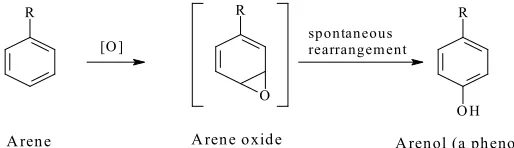
The mechanism of metabolic aromatic-ring hydroxylation involves, as a first step, the formation
459
of an epoxide (arene oxide) intermediate, which rearranges rapidly and spontaneously to the arenol
460
product in most instances (Fig. 2.1) [60, 61].
461
462
R R
O
R
O H
[O ] spontaneousrearrangem ent
A ren e A ren e o xid e A ren ol (a ph eno l)
A rom atic -rin g hy d roxy lation ca ta ly ze d by a v ariety o f en zy m e s in differen t xe no biotic m o le cules
463
464
Fig. 2.1: Mechanism of aromatic-ring hydroxylation
465
466
Metabolic aromatic-ring hydroxylation assumes its importance from the fact that a large
467
number of drug molecules contain the benzene ring as a separate entity (phenyl) or fused with other
468
rings, alicyclic or heterocyclic. In drug molecules, aromatic rings serve the dual role of providing
469
relatively large hydrophobic sites for interaction with receptors or acting as carriers for other
470
functional groups. However, not all of the benzene rings in drug molecules are subject to metabolic
471
hydroxylation. This is because certain electronic and steric effects dictate metabolic hydroxylation of
472
aromatic rings. These effects include the following with possible anomalous events:
(a) the least substituted aromatic ring will be favorably oxidized, especially at the least
474
hindered carbon atom;
475
(b) the activated ring (i.e., the ring bearing an electron-donating group such as alkyl) will be
476
better oxidized;
477
(c) ring-deactivating groups (generally groups with negative inductive effects such as halo and
478
nitro groups) discourage ring hydroxylation;
479
(d) being the farthest from steric effects in di-substituted benzene rings, the para position is the
480
favored site of hydroxylation;
481
(e) if two aromatic rings in a drug molecule have the same chemical environment,
482
hydroxylation will occur in only one of them; and
483
(f) when the parent drug contains an aromatic hydroxy group, further metabolic
484
hydroxylation is generally not favored even if there was more than one aromatic ring.
485
Aromatic-ring hydroxylation of drugs has led to the formation of inactive metabolites,
486
metabolites with attenuated activity, and metabolites that are equiactive with the parent drugs.
487
These situations have been reviewed using selected representative drugs. The basis for the choice of
488
the candidate drugs is as follows:
489
varying the chemical classes of the drugs;
490
varying the pharmacologic class of the drugs and, accordingly, the type of
491
drug-site-of-action interaction involved (i.e., the mechanism of action of the class of
492
drugs); and
493
varying the aromatic character in both number of rings and chemical environment.
494
Metabolic aromatic-ring hydroxylation leading to loss of activity is exemplified by:
495
(a) the CNS depressant anticonvulsant drugs, phenobarbital and phenytoin, of the imide
496
chemical class (Fig. 2.2);
497
(b) the CNS depressant tranquilizer benzodiazepines diazepam (Fig. 2.3) and estazolam (Fig.
498
2.4);
499
(c) the arylalkanoic acid NSAIDs diclofenac, flurbiprofen, and ketorolac(Figs. 2.5-2.8) and the
500
pyrazolone derivative phenylbutazone (Fig. 2.12);
501
(d) the anticoagulant warfarin (Fig. 2.9); and
502
(e) the proton-pump inhibitors (the ‘prazoles’).
503
Metabolic aromatic-ring hydroxylation leading to attenuation of activity is exemplified by the
504
CNS depressant and major tranquilizer chlorpromazine (Fig. 2.10).
505
Metabolic aromatic-ring hydroxylation leading to the formation of equiactive products is
506
exemplified by:
507
(a) the beta-blocker propranolol of the chemical class aryloxypropanolamine (Fig. 2.11); and
508
(b) the HMG-CoA reductase inhibitor atorvastatin (used in lowering blood cholesterol level)
509
(Fig. 2.11).
510
Metabolic-ring hydroxylation leading to enhancement of activity is exemplified by acetanilide
511
to paracetamol, which has already been discussed in section 1.1.
512
513
2.1. Metabolic aromatic-ring hydroxylation leading to loss of activity
514
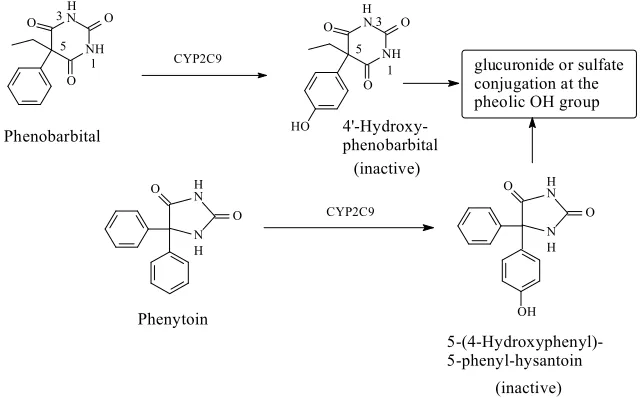
2.1.1. Phenobarbital/Phenytoin. The anticonvulsant drug phenobarbital (Fig. 2.2) has been
515
chosen as representative of the barbiturate group of drugs because it is the only member that
516
contains an aromatic benzene ring susceptible to metabolic hydroxylation. On the other hand, the
517
anticonvulsant drug phenytoin (Fig. 2.2) has been selected for its similarity to phenobarbital with
518
respect to chemical structure, pharmacologic activity, and even mechanism of action. Phenytoin
519
additionally contains two benzene rings with an identical chemical environment. Both phenobarbital
520
and phenytoin are metabolized by aromatic-ring hydroxylation (Fig. 2.2), a process that has led to
521
loss of pharmacologic activity [62-65].
NH
N O
O
O
NH
N O
O
O
HO
Phenobarbital 4'-Hydroxy-phenobarbital
N
N O
O H
H
N
N O
O H
H
OH
5-(4-Hydroxyphenyl)-5-phenyl-hysantoin
(inactive) Phenytoin
(inactive)
glucuronide or sulfate conjugation at the pheolic OH group H
CYP2C9 CYP2C9
1 3
5
1 3
5 H
524
525
Fig. 2.2: Major metabolic pathways of phenobarbital and phenytoin
526
527
The barbiturates’ CNS depressant activity (sedative, hypnotic, and anticonvulsant) and its
528
termination are mainly dependent on the drugs’ lipophilicity, which is imparted by the aromatic
529
rings and the alkyl groups [66]. Lipophilicity helps the barbiturates to cross the blood-brain barrier,
530
exert their effects, and again facilitate their distribution to other tissues, thus reducing their effective
531
concentrations at the brain’s GABA receptors. This redistribution process of the barbiturates is
532
considered a deactivation process. In addition, metabolism plays a role in the deactivation of
533
barbiturates. All barbiturates contain two alkyl groups at carbon 5 of the barbituric acid ring (Fig.2.2)
534
with the exception of phenobarbital, which contains an alkyl group (ethyl) and a phenyl group. All
535
the alkyl groups in barbiturates are metabolized by oxidation in phase I at the ω or ω-1 carbons to
536
either primary or secondary alcohols, respectively. The primary alcoholic groups may further be
537
oxidized to carboxyl (COOH) groups. On the other hand, the phenyl group in phenobarbital is
538
metabolically oxidized to a phenolic group at the favored para position (Fig. 2.2). All such
539
hydrophilic functionalities are detrimental to the essential hydrophobicity of the alkyl and phenyl
540
groups and thus to the ability of the resulting metabolites to cross the blood-brain barrier.
541
Enhancement of the water solubility of the barbiturate metabolites and their subsequent, fast
542
elimination is a further cause of termination of pharmacologic activity resulting from the
543
introduction of hydrophilic functionalities. Even more, the phase I metabolites, either carboxylic or
544
phenolic, may further be conjugated in phase II to glucuronides and/or sulfates (Fig. 2.2) with a
545
consequent further reduction in lipid solubility and inability to cross the blood-brain barrier. In
546
addition, enhancement of water solubility and rapid elimination through the kidneys is a further
547
deactivating process.
548
Despite the fact that the pharmacokinetics of the barbiturates play a major role in their
549
deactivation, a pharmacodynamic dimension cannot be excluded: the introduction of a
550
hydrogen-bonding functionality, such as the hydroxy (OH) group, on an essentially hydrophobic
551
site, will most probably negatively affect binding to the GABA receptor, resulting in loss of
552
pharmacologic activity. The tug-of-war analogy described for the NSAIDS in section 1.1.3 may be
553
extended to barbiturates and phenytoin.
554
The two aromatic rings in phenytoin have identical chemical environments, and only one of
555
them is hydroxylated, which is consistent with the rules of metabolic aromatic-ring hydroxylation.
556
The same reasoning that applies for the loss of activity of the phenolic metabolite of phenobarbital
557
discussed above should apply to the loss of activity of the phenolic metabolite of phenytoin.
558
559
2.1.2. Benzodiazepines: Diazepam and Estazolam. The benzodiazepines are CNS depressants
560
used as minor tranquilizers, sedatives, hypnotics, and anticonvulsants; in these respects, they have
561
largely superseded the barbiturates. Their mechanism of action involves binding to GABA receptors
[67-69]. The benzodiazepines are metabolized through several phase I oxidative reactions with some
563
followed by phase II conjugative reactions. The metabolic pathways of the two benzodiazepine
564
representative members, diazepam [70, 71] and estazolam [72, 73], are shown Figs. 2.3 and 2.4,
565
respectively, with only aromatic-ring hydroxylation discussed in this section. The other metabolic
566
pathways of diazepam and estazolam will be discussed where relevant.
567
568
The tw o hydroxy metabolites are further metabolized by glucuronide conjugation in phase II.
N
N O
Cl
OH C H3
N
N O
C l
CH3
N
N O
C l
OH C H3
1
3
5 6 7 8
9
1'
4' 3
Diazaepam Temazepam
4'-H ydroxydiazepam (inactive) (active)
(major) (minor)
C YP3A4
A B
C
1' 2' 3' 4' 5' 6'
569
570
Fig. 2.3: Metabolic pathways of diazepam
571
572
N N
C l
N N
N N
Cl
N N
OH
N N
C l
N N
O H 1
2
3
4
1' 2'
3' 4 '
Estazolam
4'-Hydroxyestazolam
C YP3A4
(major)
C YP3 A4
(m inor)
4
4-H ydroxyestazolam
4'
The tw o hydroxy metabolites are further metabolized by glucuronide conjugation in phase II. (inactive)
(inactive)
573
574
Fig. 2.4: Metabolic pathways of estazolam
575
576
Due to favorable electronic and steric structural environments, diazepam and estazolam, to our
577
knowledge, are the only two members of the clinically used benzodiazepines to undergo metabolic
578
aromatic-ring hydroxylation at the 4’ position (Fig. 2.3 and Fig. 2.4). In most of the other members,
579
metabolic 4’-hydroxylationis is possibly disfavored by the presence of an electron-withdrawing halo
580
group at position 2’ (fluoro in flurazepam, flunitrazepam, and quazepam, and chloro in triazolam
581
and clonazepam). (For the numbering of the benzodiazepine ring system, refer to the structure of
582
diazepam in Fig. 2.3.)
583
4’-Hydroxylation of both diazepam [70, 71] and estazolam [72, 73] has resulted in inactive
584
metabolites. Foye (2013) has attributed the loss of sedative-hypnotic effects of 4’-hydroxyestazolam
585
to two factors [72]. The first factor is of pharmacodynamic nature. It is explained by the 4’-hydroxy
586
group weakening optimal binding of the aromatic ring to GABAA receptor by a steric effect. The
587
result is decreased receptor affinity and drug potency. Interestingly, in its essence, the steric
588
hindrance factor proposed by Foye (2013) [72] lends credence to our tug-of-war hypothesis discussed
589
in section 1.3. The second factor is of a pharmacokinetic disposition and results from decreased
590
hydrophobicity (i.e., increased hydrophilicity), which results in the decrease of the effective
591
concentrations of the circulating 4’-hydroxy metabolites due to enhanced polarity, water solubility,
592
and elimination, as per se and as glucuronide conjugates. In the absence of reports regarding the loss
593
of activity of 4’-hydroxydiazepam, an analogy may be extrapolated from that of
594
4’-hydroxyestazolam.
595
In contrast to 4’ hydroxylation, metabolic hydroxylation at position 3 of the diazepine ring in
596
diazepam (Fig. 2.3) has not affected activity but has rather introduced a pharmacokinetic dimension:
597
the 3-hydroxy metabolite is more hydrophilic and is subject to glucuronide conjugation with
subsequent enhanced rate of elimination and hence shorter duration of action than diazepam. These
599
observations tend to consolidate a major pharmacodynamic role of 4’-aromatic-ring hydroxyl group
600
on causing loss of activity of diazepam as well as estazolam. The plausible explanation is that the
601
introduction of the hydrogen-bonding group (the hydroxy) into an essentially pharmacophoric
602
hydrophobic moiety (the benzene ring) is detrimental to the optimal GABAA receptor binding as can
603
be inferred from Foye’s (2013) explanation [72].
604
A halo group at position 2’ of the benzodiazepine backbone (ring C, Fig. 2.3) serves three
605
purposes: it adds a welcomed hydrophobicity to the drug, disfavors metabolic ring hydroxylation,
606
and imparts a conformation-locking effect on the aromatic ring through a steric effect. The
607
consequence of these effects could be enhanced selectivity on drug-receptor interaction leading to
608
higher efficacy and possibly higher potency. Increased hydrophobicity would tend to enhance
609
blood-brain barrier penetration and therefore increased access to the GABAA receptor.
610
In the above context, it would be worthwhile to investigate the effect of another halo group at
611
position 6’ (Fig. 2.3) on the conformation locking of the aromatic rings in comparison to the NSAID
612
pair fenoprofen/diclofenac. In diclofenac (Fig. 2.5), the two ortho-positioned chloro groups have
613
resulted in a restricted conformation with consequent enhanced selectivity, efficacy, and potency
614
compared to fenoprofen, in which the two chloro groups are absent [74].
615
616
2.1.3. NSAIDS.
617
The chemical classes of the NSAIDS have been discussed in section 1.3.
618
2.1.3.1. Diclofenac. Diclofenac is a phenylacetic acid NSAID. It was developed as a variant of
619
fenoprofen by introducing two ortho-positioned chloro groups in the anilino-aromatic ring to
620
restrict its free rotation (74). This restriction of rotation increases selectivity and hence potency with
621
respect to fenoprofen.The metabolism of diclofenac shown in Fig. 2.5 [75] represents one of the
622
anomalies of aromatic-ring hydroxylation in that hydroxylation occurs at the meta position of two
623
chloro groups. The hydroxy metabolites are pharmacologically inactive.
624
In accounting for the structure-activity relationship of diclofenac, Foye (2013) [75] has proposed
625
that the function of the two ortho chloro groups was to force the anilino-phenyl ring out of the plane
626
of the phenylacetic acid portion. Such twisting, as proposed by Foye (2013) [75], is important in the
627
binding of diclofenac to the active site of COX. The introduction of a hydroxy group in the
628
anilino-phenyl group would create a hydrogen-bonding character, which would weaken or hinder
629
the necessary twisting, thus resulting in attenuation or loss of pharmacologic activity.
630
631
N
OH O Cl
Cl H
N
OH O Cl
Cl HO
H
Diclofenac
4'-Hydroxydiclofenac
CY P2C
9
N
OH O Cl
Cl
HO H
N
OH O Cl
Cl OH H CYP3
A4 YC
P
2
C
9
3'-Hydroxydiclofenac 5-Hydroxydiclofenac
N
OH O Cl
Cl HO
OH H
4',5-Dihydroxydiclofenac (20-30%)
(10-20%)
632
633
Fig. 2.5. Metabolic pathways of diclofenac
634
635
2.1.3.2. Ketorolac. Ketorolac (Fig. 2.6) is a pyrrole-acetic acid derivative structurally related to
636
indomethacin and tolmetin. It is metabolized to p-hydroxyketorolac (Fig. 2.6), which is inactive.