Series 2018–2019, №6, Pages 1–44.
— Theory of g-Tg-Interior and g-Tg-Closure Operators — Definitions, Essential Properties, and Commutativity
Khodabocus m. i. and Sookia n. u. h.
Department of Mathematics, Faculty of Science, University of Mauritius
Abstract. In a generalized topological spaceTg= (Ω,Tg), ordinary interior and ordinary closure operatorsintg,clg:P(Ω)−→P(Ω), respectively, are defined in terms of ordinary sets. In order to let these operators be as general and unified a manner as possible, and so to prove as many generalized forms of some of the most important theorems in generalized topological spaces as possible, thereby attaining desirable and interesting results, the present au-thors have defined the notions of generalized interior and generalized closure operatorsg-Intg, g-Clg :P(Ω) −→ P(Ω), respectively, in terms of a new class of generalized sets which they studied earlier and studied their essen-tial properties and commutativity. The outstanding result to which the study has led to is: g-Intg :P(Ω) −→ P(Ω) isfiner (or,larger,stronger) than
intg:P(Ω)−→P(Ω)andg-Clg:P(Ω)−→P(Ω)iscoarser(or,smaller,
weaker) than clg :P(Ω)−→ P(Ω). The elements supporting this fact are reported therein as a source of inspiration for more generalized operations.
Key words and phrases. Generalized topological space, generalized sets, generalized interior operator, generalized closure operator, commutativity
Contents
1. Introduction 2
2. Theory 4
2.1. Preliminaries 4
3. Main Results 6
3.1. Essential Properties 7
3.2. Commutativity 15
4. Discussion 30
4.1. Categorical Classifications 30
4.2. A Nice Application 34
4.3. Concluding Remarks 36
Appendix A. Pre-preliminaries 37
References 43
Email Address for Correspondence: [email protected]. 1
1. Introduction
Just as the concepts of T, g-T-interior1 operators in T-spaces (ordinary and
generalized interior operators in ordinary topological spaces) andT,g-T-closure op-erators inT-spaces (ordinary and generalized closure operators in ordinary topo-logical spaces) are essential operators in the study of T-sets in T-spaces (arbi-trary sets in ordinary topological spaces) [CJK04, Cs6, Cs5, Cs8, Cs7, GS17, JN19, Kal13, Lev70, Lev63, Lev61, MG16], so are the concepts of Tg, g-Tg-interior
op-erators in Tg-spaces (ordinary and generalized interior operators in generalized
topological spaces) andTg,g-Tg-closure operators inTg-spaces (ordinary and
gen-eralized closure operators in gengen-eralized topological spaces) essential operators in the study ofTg-sets inTg-spaces (arbitrary sets in generalized topological spaces)
[DB11, GS14, Min10, Min05, Mus17].
Intuitively,T, g-T-interior operators, respectively, in aT-space can be charac-terized as one-valued mapsint,g-Int :P(Ω)−→P(Ω)from the power setP(Ω)
of Ω into itself, assigning to each T-set in the T-space the ∪-operation (union operation) of all T, g-T-open subsets of the T-set [And96, Dix84, Nj5, Wil70]. When the role of ∪-operation and T, g-T-open subsets, respectively, are given to
∩-operation (intersection operation) andT, g-T-closed supersets of the T-set, the dual notions, called T, g-T-closure operators in the T-space follow [AON09, Cs8, Dix84, DM99, Kur22, Wil70], which can likewise be characterized as one-valued maps cl, g-Cl : P(Ω) −→ P(Ω). Finally, when (T,T,g-T) 7−→ (Tg,Tg,g-Tg
)
, the notions ofTg,g-Tg-interior andTg,g-Tg-closure operators in aTg-space follow
[Cam19, Min11a, Pan11, SKK15, TC13], which can in a similar manner be char-acterized as one-valued maps of the typesintg, g-Intg :P(Ω)−→P(Ω) andclg,
g-Clg :P(Ω)−→P(Ω), respectively.
Thus, in aT-space,int,g-Int :S 7−→int (S),g-Int (S)describe two types of collections of points interior inS and, cl, g-Cl :S 7−→cl (S),g-Cl (S)describe another two types of collections of points but close toS. Similarly, in aTg-space, intg, g-Intg : Sg 7−→ intg(Sg), g-Intg(Sg) describe two types of collections of
points interior inSgand,clg,g-Clg:Sg7−→clg(Sg),g-Clg(Sg)describe another
two types of collections of points but close toSg. Of all such operatorsint,cl,g-Int, g-Cl :P(Ω)−→P(Ω)inT-spaces andintg,clg,g-Intg,g-Clg:P(Ω)−→P(Ω)
inTg-spaces,int,cl :P(Ω)−→P(Ω)are the oldest andg-Intg,g-Clg:P(Ω)−→
P(Ω)are the newest. Hence, the studies of operators of these kinds have evolved from the studies of ordinary operators in ordinary topological spaces to the studies of generalized operators in generalized topological spaces.
In the literature ofTg-spaces ong-Tg-interior andg-Tg-closure operators, some
new types of one-valued maps g-Intg, g-Clg :P(Ω)−→P(Ω) have been defined
and investigated by Mathematicians.
1Notes to the reader: The structuresT= (Ω,T)andTg = (Ω,T
g), respectively, are called ordinary and generalized topological spaces (briefly, T-space and Tg-space). The symbols T
andTg, respectively, are called ordinary topology and generalized topology (briefly, topology and g-topology). Subsets ofTandTg, respectively, are calledT-sets andTg-sets; subsets ofT and
Tg, respectively, are calledT-open andTg-open sets, and their complements are calledT-closed andTg-closed sets. Generalizations ofT-sets,T-open andT-closed sets inT, respectively, are calledg-T-sets,g-T-open andg-T-closed sets; generalizations ofTg-sets,Tg-open andTg-closed sets inTg, respectively, are called g-Tg-sets, g-Tg-open and g-Tg-closed sets. By a Λ-operator is meant an operator using Λ-sets to characterize its argument, whereΛ ∈ {T,T,g-T,g-T} ∪ {
Tg,Tg,g-Tg,g-Tg }
In one paper, [Min09] has introduced g-Tg-interior and g-Tg-closure operators
based on θ-sets in Tg-spaces characterized by iθ, cθ : P(Ω) −→ P(Ω), respec-tively; theg-Tg-operators were used to study some properties ofθ(g, g′)-continuity in Tg-spaces. In one subsequent paper, [Min11b] has introduced another types
ofg-Tg-interior andg-Tg-closure operators in Tg-spaces characterized byiθ(ν1,ν2),
cθ(ν1,ν2):P(Ω)−→P(Ω), respectively; theθ(ν1, ν2)-operators were used to study other properties on mixed weak continuity on Tg-spaces. In another subsequent
paper, [Min11a] has made use of such θ, θ(ν1, ν2)-interior and θ, θ(ν1, ν2)-closure
operators to study the notions of mixed θ-continuity on Tg-spaces. In the work
of [CYWW13], the authors have introduced and then used otherg-Tg-interior and
g-Tg-closure operators in T-spaces called λ-interior and λ-closure operators and characterized byiλ,cλ:P(Ω)−→P(Ω), respectively, whereλ∈ {α, β, σ, π}.
In studying the properties ofµ-open sets in˜ Tg-spaces, [SKK15] have also used
these g-Tg-sets to define new g-Tg-interior and g-Tg-closure operators called µ-˜
interior and µ-closure operators and characterized by˜ iµ˜, cµ˜ : P(Ω) −→ P(Ω),
respectively, and studied some of their properties. Thereafter, in studying a new family ofg-Tg-sets calledgu-semi closed sets inTg-spaces, [SJ16] have introduced
newg-Tg-interior andg-Tg-closure operators called g-semi interior andg-semi clo-sure operators and characterized bysig,scg:P(Ω)−→P(Ω), respectively. In the
paper of [Boo18], the author gave the definitions ofg-Tg-interior and g-Tg-closure
operators calledδ(µ)-interior andδ(µ)-closure operators and characterized byiδ(µ),
cδ(µ):P(Ω)−→P(Ω), respectively, and utilized them to study the properties of
ζδ(µ) and (ζ, δ(µ))-closed sets in strong in Tg-spaces. Later on, in extending the
notion ofµ- ˆβg-closed set introduced by [KN12] inT-spaces toTg-spaces and then
studying their properties, [Cam19] has also investigated the related g-Tg-interior
and g-Tg-closure operators called, µ- ˆβg-interior and µ- ˆβg-closure operators and characterized byβˆgiµ,βˆgcµ:P(Ω)−→P(Ω), respectively. Relative to theg-Tg -interior andg-Tg-closure operators introduced by [Cs2, Cs5], the author found that the image of a Tg-set underβˆgi
µ : P(Ω) −→ P(Ω) is a superset of that under iµ:P(Ω)−→P(Ω) and, the image of theTg-set underβˆgcµ :P(Ω)−→P(Ω) is a subset of its image undercµ:P(Ω)−→P(Ω).
In this paper titled Theory of g-Tg-Interior and g-Tg-Closure Operators and subtitledDefinitions, Essential Properties, and Commutativity, the authors attempt to add, in as unique and unified a way as possible, a further contribution to the field with these two research objectives in mind:
• i. To present the definitions and the essential properties of a new class of
g-Tg-interior andg-Tg-closure operators inTg-spaces.
• ii. To discuss the commutativity of the g-Tg-interior and g-Tg-closure
op-erators of this class.
The rest of this paper is structured as thus: InSect. 2, preliminary notions are described inSect. 2.1 (Appx. A contains pre-preliminary notions extracted from the preliminary section of our first work titledTheory of g-Tg-Sets) and the main results of the theory of g-Tg-interior and g-Tg-closure operators in Tg-spaces are
reported inSect. 3: results associated with essential properties are given inSect.
the g-Tg-interior and g-Tg-closure operators in a Tg-space is presented in Sect.
4.2. Finally, Sect. 4.3 provides concluding remarks and future directions of the theory ofg-Tg-interior andg-Tg-closure operators inTg-spaces.
2. Theory
2.1. Preliminaries. Foreign terms used here are extracted from the preliminary section of our first work titledTheory of g-Tg-Setsand are presented inAppx. A. The discussion commences by defining the notions of g-Tg-closure and g-Tg -interior operators of categoryν inTg-spaces.
Definition 2.1 (g-ν-Tg-Interior,g-ν-Tg-Closure Operators). LetTg = (Ω,Tg)be a Tg-space, let Csubg-ν-O[Tg][Sg]
def
= {Og ∈g-ν-O [
Tg]: Og ⊆Sg }
be the family of all g-ν-Tg-open subsets ofSg ∈P(Ω) relative to the class g-ν-O [Tg] of g-ν-Tg
-open sets, and letCsupg-ν-K[T g][Sg]
def
= {Kg ∈g-ν-K [
Tg ]
: Kg ⊇Sg }
be the family of all g-ν-Tg-closed supersets of Sg ∈ P(Ω) relative to the class g-ν-K [Tg] of g-ν-Tg-closed sets. Then, the one-valued maps of the types
g-Intg,ν:P(Ω) −→ P(Ω)def= {Sg,µ⊆Ω : µ∈I∞∗
}
(2.1)
Sg 7−→
∪
Og∈Csubg-ν-O[ Tg][Sg]
Og,
g-Clg,ν:P(Ω) −→ P(Ω)def= {Sg,µ⊆Ω : µ∈I∞∗
}
(2.2)
Sg 7−→
∩
Kg∈Csupg-ν-K[ Tg][Sg]
Kg
on P(Ω) ranging in P(Ω) are called, respectively, a ”g-Tg-interior operator of category ν” and a ”g-Tg-closure operator of category ν.” The classes g-I [Tg]
def
= {
g-Intg,ν: ν ∈I0 3 }
andg-C [Tg]
def
= {g-Clg,ν: ν ∈I0 3 }
, respectively, are called the classes of allg-Tg-interior andg-Tg-closure operators.
Remark 2.2. According to their definitions, g-Intg:P(Ω)−→P(Ω) is thedual
ofg-Clg:P(Ω)−→P(Ω), and conversely. For, the definition of the first rests on
such concepts as∪,⊆,Og,1,Og,2,. . .whereas the second, on∩,⊇,Kg,1,Kg,2,. . .,
which are dual concepts to∪,⊆,Og,1,Og,2,. . ., respectively.
It is interesting to viewg-Intg, g-Clg : P(Ω) −→P(Ω) as the components of some so-calledg-Tg-vector operator.
Definition 2.3 (g-Tg-Vector Operator). LetTg = (Ω,Tg)be a Tg-space. Then,
an operator of the type
g-Icg,ν:P(Ω)×P(Ω) −→ P(Ω)×P(Ω)
(2.3)
(Rg,Sg) 7−→ (
g-Intg,ν(Rg),g-Clg,ν(Sg) )
onP(Ω)×P(Ω) ranging inP(Ω)×P(Ω) is called a ”g-Tg-vector operator of category ν.” Then, g-IC [Tg]def= {g-Icg,ν = (g-Intg,ν,g-Clg,ν) : ν ∈I0
3 }
Remark2.4. Observing that, for everyν∈I3∗, the first and second components of
theg-Tg-vector operator g-Icg,ν =
(
g-Intg,ν,g-Clg,ν
)
are based on g-ν-O [Tg] and
g-ν-K [Tg], respectively, it follows that:
• i. g-Icg,ν=icg
def
= (intg,clg)if based onO [Tg] andK [Tg];
• ii. g-Icg,ν=g-Icν def= (g-Intν,g-Clν)if based ong-ν-O [T]andg-ν-K [T];
• iii. g-Icg,ν=icdef= (int,cl)if based onO [T]andK [T].
In this way,icg,g-Icν,ic:P(Ω)×P(Ω)−→P(Ω)×P(Ω)are called aTg-vector operator in aTg-space Tg= (Ω,Tg), ag-T-vector operator of categoryν in a T
-spaceT= (Ω,T)and aT-vector operator in aT-spaceT= (Ω,T), respectively. Accordingly,
g-IC [T] def= {g-Icν =(g-Intν,g-Clν): ν ∈I30} (2.4)
⊆ {g-Intν : ν∈I30}×{g-Clν : ν∈I30}def= g-I [T]×g-C [T].
Then, g-IC [T] denotes the class of all g-T-vector operators in the T-space T = (Ω,T);g-I [T]denotes the class of all g-T-interior operators whileg-C [T] denotes the class of allg-T-closure operators in theT-spaceT= (Ω,T).
Definition 2.5 (Complement g-Tg-Operator). Let Tg = (Ω,Tg) be a Tg-space.
Then, the one-valued map
g-Opg,Rg :P(Ω) −→ P(Ω)
(2.5)
Sg 7−→ {Rg(Sg),
where{Rg :P(Ω)−→P(Ω)denotes the relative complement of its operand with
respect toRg∈g-S [Tg], is called a ”natural complementg-Tg-operator” onP(Ω).
For clarity, the notation g-Opg,Rg =g-Opg is employed whenever Rg = Ω or
Rg is understood from the context. When g-Opg,Rg : P(Ω) −→ P(Ω) is with
respect toRg ∈S [Tg],Rg∈g-S [T]andRg∈S [T], the terms natural complement Tg-operator, natural complementg-T-operator and natural complementT-operator are employed and these terms stand forOpg,Rg,g-OpRg,OpRg :P(Ω)−→P(Ω), respectively.
Definition 2.6 (Symmetric Difference g-Tg-Operator). Let Tg = (Ω,Tg) be a
Tg-space. Then, the one-valued map
g-Sdg:P(Ω)×P(Ω) −→ P(Ω)
(2.6)
(Rg,Sg) 7−→ g-Opg,Rg(Sg)∪g-Opg,Sg(Rg)
is called the ”symmetric differenceg-Tg-operator” onP(Ω).
When the definition ofg-Sdg :P(Ω)×P(Ω) −→P(Ω) is based onOpg,Rg,
g-OpR
g, OpRg : P(Ω) −→ P(Ω) instead of g-Opg,Rg : P(Ω) −→ P(Ω), the
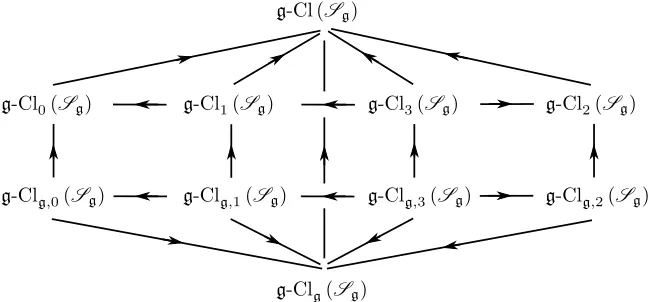
The components ofg-Icg ∈g-IC [Tg] are said to commute in aTg-space if and
only if, for someSg∈P(Ω),g-Intg◦g-Clg:Sg 7−→g-Clg◦g-Intg(Sg), or
equiv-alently,g-Clg◦g-Intg :Sg7−→g-Intg◦g-Clg(Sg). Thus, the definition follows. Definition2.7 (g-ν-Pg-Property). ATg-setSg⊂Tgin aTg-spaceTg= (Ω,Tg)
is said to haveg-Pg-property of category ν in Tg if and only if it belongs to:
g-ν-P [Tg]def= {Sg: g-Intg,ν◦g-Clg,ν(Sg)←→g-Clg,ν◦g-Intg,ν(Sg)
}
,
(2.7)
called the class of allTg-sets havingg-Pg-property of category ν inTg.
The following classes:
P [Tg]
def
= {Sg: intg◦clg(Sg)←→clg◦intg(Sg) }
,
g-ν-P [T] def= {Sg: g-Intν◦g-Clν(Sg)←→g-Clν◦g-Intν(Sg) }
, (2.8)
P [T] def= {Sg: int◦cl (Sg)←→cl◦int (Sg) }
,
respectively, stand for the class of allTg-sets havingPg-property inTg, the class of
allT-sets havingg-P-property of categoryν inTand the class of allT-sets having
P-property in T. Thus, by Sg ∈ g-P [Tg]
def
= ∪ν∈I0
3g-ν-P [Tg] is meant a Tg-set havingg-Pg-property inTgand bySg∈g-P [T]
def
= ∪ν∈I0
3g-ν-P [T], aT-set having
g-P-property inT. The notion ofTg-set having g-Qg-property of category ν may
well be defined as thus.
Definition2.8 (g-ν-Qg-Property). ATg-setSg⊂Tgin aTg-spaceTg= (Ω,Tg)
is said to haveg-ν-Qg-property of categoryν in Tg if and only if it belongs to: g-ν-Nd [Tg]
def
= {Sg: g-Intg,ν◦g-Clg,ν:Sg7−→ ∅ }
, (2.9)
called the class of allTg-set havingg-Qg-property inTg. In an analogous manner, the following classes:
Nd [Tg]
def
= {Sg: intg◦clg :Sg7−→ ∅ }
,
g-ν-Nd [T] def= {Sg: g-Intν◦g-Clν :Sg7−→ ∅ }
, (2.10)
Nd [T] def= {Sg: int◦cl :Sg7−→ ∅ }
,
respectively, stand for the class of allTg-sets having Qg-property in Tg, the class of all Tg-sets having g-Q-property of category ν in T and the class of all T-sets
havingQ-property inT. Hence, by Sg∈g-Nd [Tg]
def
= ∪ν∈I0
3g-ν-Nd [Tg]is meant a Tg-set havingg-Qg-property inTg and bySg ∈g-Nd [T]
def
= ∪ν∈I0
3g-ν-Nd [T], a
T-set havingg-Q-property inT.
In the the following sections, the main results of the theory ofg-Tg-closure and g-Tg-interior operators are presented.
3. Main Results
Using the foregoing definitions, some essential properties as well as the commu-tativity of theg-Tg-interior andg-Tg-closure operators inTg-spaces are presented
3.1. Essential Properties. The discussion begins by giving some of the basic consequences resulting from the foregoing definition.
Lemma3.1. If{Sg,ν⊂Tg : ν ∈Iσ∗}be a collection ofσ≥1Tg-sets of aTg-space
Tg= (Ω,Tg), then:
• i. CsubO[T g]
[∩
ν∈Iσ∗Sg,ν
]
= ∩
ν∈Iσ∗
CsubO[T
g][Sg,ν],
• ii. CsupK[Tg][∪ν∈I∗
σSg,ν
]
= ∪
ν∈Iσ∗
CsupK[Tg][Sg,ν].
Proof. Let {Sg,ν⊂Tg: ν∈Iσ∗} be a collection of σ ≥1 Tg-sets of a Tg-space Tg= (Ω,Tg), then by virtue ofTg-set-theoretic(∩,∪)-operation, it results that
CsubO[Tg] [∩
ν∈Iσ∗Sg,ν
]
= {Og∈O [Tg] : Og⊆ ∩
ν∈Iσ∗Sg,ν
}
= {Og∈O [Tg] : ∧
ν∈Iσ∗
(
Og ⊆Sg,ν
)}
= ∩
ν∈Iσ∗
{
Og∈O [Tg] : Og ⊆Sg,ν
}
= ∩
ν∈Iσ∗
CsubO[Tg][Sg,ν] ;
CsupK[Tg][∪ν∈I∗
σSg,ν
]
= {Kg∈K [Tg] : Kg ⊇ ∪
ν∈Iσ∗Sg,ν
}
= {Kg∈K [Tg] : ∨
ν∈Iσ∗
(
Kg⊇Sg,ν
)}
= ∪
ν∈Iσ∗
{
Kg∈K [Tg] : Kg⊇Sg,ν
}
= ∪
ν∈I∗σ
CsupK[T
g][Sg,ν].
The proof of the lemma is complete. Q.e.d.
For any (Og,Kg) ∈ O [Tg]×K [Tg], the relations Og ⊆ opg(Og) and Kg ⊇
¬opg(Kg)hold, or alternatively, O [Tg]⊆g-O [Tg]andK [Tg]⊆g-K [Tg].
Conse-quently,
(
Og∈O [Tg]−→Og∈g-O [Tg] )
∧(Kg∈K [Tg]−→Kg∈g-K [Tg] )
.
As a consequence of the above lemma, the corollary follows.
Corollary 3.2. If {Sg,ν⊂Tg: ν∈Iσ∗} be a collection of σ ≥ 1 Tg-sets of a
Tg-space Tg= (Ω,Tg), then:
• i. Csubg-O[Tg][∩ν∈I∗
σSg,ν
]
= ∩
ν∈I∗σ
Csubg-O[Tg][Sg,ν],
• ii. Csupg-K[T g]
[∪
ν∈I∗σSg,ν
]
= ∪
ν∈Iσ∗
Csupg-K[T
g][Sg,ν].
Remark 3.3. It is easily seen that the relationsCsubg-O[Tg][∩ν∈I∗
σSg,ν=∅
] = {∅}
and Csupg-K[Tg][∪ν∈I∗
σSg,ν
]
= {Ω} hold. On the other hand, Csubg-O[Tg] [
Sg = Ω ]
=
g-O [Tg]andCsupg-K[T g]
[ Sg=∅
]
=g-K [Tg].
Proposition 3.4. Let Sg ⊂ Tg be a Tg-set and, let g-Intg, g-Clg : P(Ω) −→
P(Ω), respectively, be a g-Tg-interior and a g-Tg-closure operators in a T g-space Tg = (Ω,Tg). Then, the necessary and sufficient conditions for (ξ, ζ) ∈ g-Intg(Sg)×g-Clg(Sg)⊂Tg×Tg to hold in Tg are:
• i. ξ∈g-Intg(Sg) ←→ (
∃Og,ξ∈g-O [Tg]
)[
Og,ξ ⊆Sg ]
,
• ii. ζ∈g-Clg(Sg) ←→ (
∀Og,ζ∈g-O [Tg]
)[
Og,ζ∩Sg6=∅ ]
Proof. Let Sg ⊂ Tg be a Tg-set and, let g-Intg, g-Clg : P(Ω) −→ P(Ω),
respectively, be a g-Tg-interior and a g-Tg-closure operators in a Tg-space Tg = (Ω,Tg). Suppose
(ξ, ζ)∈g-Intg(Sg)×g-Clg(Sg) =
( ∪
Og∈Csubg-O[ Tg][Sg]
Og )
×
( ∩Kg∈Csupg-K[ Tg][Sg]
Kg )
.
Then, since the relations
∪
Og∈Csubg-O[ Tg][Sg]
Og ←→
{
ξ: (∃Og∈Csubg-O[Tg][Sg] )[
ξ∈Og ]}
,
∩
Kg∈Csupg-K[ Tg][Sg]
Kg ←→
{
ζ: (∀Kg∈Csupg-K[T g][Sg]
)[
ζ∈Kg ]}
hold and g-O [Tg]×g-K [Tg] ⊇ Csubg-O[Tg][Sg]×Csupg-K[T
g][Sg], and, on the other
hand, the relation ξ ∈ Og,ξ ⊆ Sg ⊆ Kg,ξ also holds for any (ξ,Og,ξ,Kg,ξ) ∈
Sg×Csubg-O[Tg][Sg]×C
sup
g-K[Tg][Sg], it follows that
ξ∈g-Intg(Sg) ←→ (
∃Og∈Csubg-O[Tg][Sg] )[
ξ∈Og ]
←→ (∃Og,ξ∈g-O [Tg]
)[
Og,ξ⊆Sg ]
;
ζ∈g-Clg(Sg) ←→ (
∀Kg ∈Csupg-K[T g][Sg]
)[
ζ∈Kg ]
←→ (∀Og,ζ ∈g-O [Tg] )[
Og,ζ∩Sg6=∅ ]
.
Hence, ξ ∈ g-Intg(Sg) is equivalent to (∃Og,ξ ∈ g-O [Tg]
)[
Og,ξ ⊆ Sg ]
and ζ ∈
g-Clg(Sg) is equivalent to (
∀Og,ζ ∈ g-O [Tg]
)[
Og,ζ∩Sg 6=∅ ]
. The proof of the
proposition is complete. Q.e.d.
In a Tg-space, the g-Tg-interior of finite intersection and the g-Tg-closure of
finite union equal intersections ofg-Tg-interiors andg-Tg-closures, respectively, as proved in the following theorem.
Theorem 3.5. If {Sg,ν⊂Tg: ν∈Iσ∗} be a collection ofσ≥1 Tg-sets of a T
g-spaceTg= (Ω,Tg) then:
• i. g-Intg: ∩
ν∈Iσ∗Sg,ν7−→
∩
ν∈Iσ∗
g-Intg (
Sg,ν
)
∀g-Intg∈g-I [Tg],
• ii. g-Clg:∪ν∈I∗
σSg,ν7−→
∪
ν∈Iσ∗
g-Clg(Sg,ν
)
Proof. Let {Sg,ν⊂Tg: ν∈Iσ∗} be a collection of σ ≥1 Tg-sets of a Tg-space Tg= (Ω,Tg). Then for any
(
g-Intg,g-Clg)∈g-I [Tg]×g-C [Tg], it follows that g-Intg :
∩
ν∈I∗
σ
Sg,ν 7−→
∪
Og∈Csubg-O[ Tg]
[∩
ν∈Iσ∗Sg,ν ]Og
= ∪
Og∈∩ν∈Iσ∗Csubg-O[Tg][Sg,ν] Og
= ∩
ν∈Iσ∗
( ∪
Og∈Csubg-O[
Tg][Sg,ν] Og
)
= ∩
ν∈Iσ∗
g-Intg(Sg,ν) ;
g-Clg : ∪
ν∈Iσ∗
Sg,ν 7−→
∪
Kg∈Csupg-K[ Tg]
[∪
ν∈Iσ∗Sg,ν ]Kg
= ∪
Kg∈∪ν∈Iσ∗C sup
g-K[Tg][Sg,ν] Kg
= ∪
ν∈Iσ∗
( ∪
Kg∈Csupg-K[
Tg][Sg,ν] Kg
)
= ∪
ν∈Iσ∗
g-Clg(Sg,ν).
The proof of the theorem is complete. Q.e.d.
Theorem 3.6. If Sg⊂Tg be anyTg-set in aTg-spaceTg= (Ω,Tg), then: (
∀g-Icg∈g-IC [Tg] )[(
g-Intg(Sg)⊆Sg )
∧(g-Clg(Sg)⊇Sg )]
. (3.1)
Proof. Let Sg ⊂ Tg be anyTg-set and g-Icg ∈ g-IC [Tg] be arbitrary in a Tg
-spaceTg= (Ω,Tg). Then, by virtue of the definition of theg-Tg-operatorsg-Intg,
g-Clg :P(Ω)−→P(Ω), it results that,
g-Intg:Sg 7−→
∪
Og∈Csubg-O[ Tg][Sg]
Og
g-Clg:Sg 7−→
∩
Kg∈Csupg-K[ Tg][Sg]
Kg,
respectively. But, for every (Og,Kg) ∈Csubg-O[Tg][Sg]×Csupg-K[T
g][Sg], the relation (Og,Sg)⊆(Sg,Kg)holds. Hence, g-Intg(Sg)⊆Sg and g-Clg(Sg)⊇Sg. This
completes the proof of the theorem. Q.e.d.
A consequence of the above theorem is the following corollary.
Corollary 3.7. If Sg⊂Tg be anyTg-set in aTg-space Tg= (Ω,Tg), then: (
∀g-Icg∈g-IC [Tg] )[
g-Intg(Sg)⊆Sg⊆g-Clg(Sg) ]
. (3.2)
Remark 3.8. Employing the terminology of [Lev63], any Tg-set Sg ⊂ Tg in a
Tg-space Tg = (Ω,Tg) which satisfies the relation Og = g-Intg(Sg) ⊆ Sg ⊆ g-Clg(Sg) =g-Clg(Og)for someg-Tg-open setOg ∈g-O [Tg]may well be termed
Proposition 3.9. If Tg= (Ω,Tg)be a strongTg-space, then: (
∀g-Icg∈g-IC [Tg])[g-Icg : (Ω,∅)7−→(Ω,∅)]. (3.3)
Proof. Letg-Icg∈g-IC [Tg]in a strongTg-spaceTg = (Ω,Tg). Then, sinceTgis
a strongTg-space,(Ω,∅)∈g-O [Tg]×g-K [Tg]and, therefore,Ωis the biggestg-Tg
-open subset contained in itself and,∅is the smallestg-Tg-closed superset containing
itself. Consequently,
g-Icg: (Ω,∅) 7−→
( ∪
Og∈Csubg-O[ Tg][Ω]
Og,
∩
Kg∈Csupg-K[ Tg][∅]
Kg )
=
( ∪
Og∈{Ω}∪Csubg-O[ Tg][Ω]
Og,
∩
Kg∈{∅}∪Csupg-K[ Tg][∅]
Kg )
= (Ω,∅).
Hence,g-Icg: (Ω,∅)7−→(Ω,∅). The proof of the proposition is complete. Q.e.d.
In aTg-space, the components of g-Icg ∈g-IC [Tg] are both idempotentg-Tg
-operators, as demonstrated in the following proposition.
Proposition 3.10. If Sg⊂Tg be anyTg-set in aTg-space Tg= (Ω,Tg), then:
• i. g-Intg◦g-Intg:Sg7−→g-Intg(Sg) ∀g-Intg∈g-I [Tg],
• ii. g-Clg◦g-Clg:Sg7−→g-Clg(Sg) ∀g-Clg∈g-C [Tg].
Proof. LetSg⊂Tgbe any Tg-set and let (
g-Intg,g-Clg)∈g-I [Tg]×g-C [Tg]be arbitrary in aTg-spaceTg= (Ω,Tg). Then,
g-Intg: g-Intg(Sg) 7−→
∪
Og∈Csubg-O[
Tg][g-Intg(Sg)]
Og;
g-Clg: g-Clg(Sg) 7−→
∩
Kg∈Csupg-K[
Tg][g-Clg(Sg)]
Kg.
But,g-Intg(Sg)⊆Sg⊆g-Clg(Sg)and consequently, ∪
Og∈Csubg-O[
Tg][g-Intg(Sg)]
Og =
∪
Og∈Csubg-O[ Tg][Sg]
Og;
∩
Kg∈Csupg-K[
Tg][g-Clg(Sg)]
Kg =
∩
Kg∈Csupg-K[ Tg][Sg]
Kg.
Hence,g-Intg◦g-Intg :Sg 7−→g-Intg(Sg) andg-Clg◦g-Clg :Sg 7−→g-Clg(Sg).
This completes the proof of the proposition. Q.e.d.
Proposition 3.11. If Sg⊂Tg be anyTg-set in aTg-space Tg= (Ω,Tg), then:
• i. g-Intg◦g-Clg:Sg 7−→g-Intg(Sg) ∀ (
g-Intg,g-Clg)∈g-IC [Tg],
• ii. g-Clg◦g-Intg:Sg7−→g-Clg(Sg) ∀ (
g-Intg,g-Clg)∈g-IC [Tg]. Proof. LetSg ⊂Tg be any Tg-set and letg-Icg ∈g-IC [Tg]be a g-Tg-operator
P(Ω)−→P(Ω)×P(Ω)operated ong-Clg(Sg),g-Intg(Sg)⊂Tg gives
g-Intg: g-Clg(Sg) 7−→
∪
Og∈Csubg-O[
Tg][g-Clg(Sg)]
Og
= ∪
Og∈Csubg-O[
Tg][g-Clg(Sg)] (
Og∩g-Clg(Sg) )
= ∪
Og∈Csubg-O[ Tg][Sg]
(
Og∩Sg )
= ∪
Og∈Csubg-O[ Tg][Sg]
Og,
g-Clg : g-Intg(Sg) 7−→
∩
Kg∈Csupg-K[
Tg][g-Intg(Sg)]
Kg
= ∩
Kg∈Csupg-K[
Tg][g-Intg(Sg)] (
Kg∪g-Intg(Sg) )
= ∩
Kg∈Csupg-K[ Tg][Sg]
(
Kg∪Sg )
= ∩
Kg∈Csupg-K[ Tg][Sg]
Kg,
respectively. Hence,g-Intg◦g-Clg:Sg7−→g-Intg(Sg)andg-Clg◦g-Intg:Sg7−→
g-Clg(Sg). The proof of the proposition is complete. Q.e.d.
In a Tg-space, theg-Tg-interior and g-Tg-closure of subset are subsets ofg-Tg
-interior andg-Tg-closure, respectively, as shown in the theorem below.
Theorem3.12. Ifg-Icg∈g-IC [Tg]be a given pair ofg-Tg-operatorsg-Intg,g-Clg:
P(Ω)−→P(Ω) in aTg-spaceTg = (Ω,Tg)then, for every (Rg,Sg)⊂Tg×Tg such that Rg⊆Sg:
g-Icg(Rg,Rg)⊆g-Icg(Sg,Sg).
(3.4)
Proof. Let Tg = (Ω,Tg) be a Tg-space. Suppose g-Icg ∈ g-IC [Tg] be given
and (Rg,Sg) ⊂ Tg ×Tg such that Rg ⊆ Sg be an arbitrary pair of Tg-sets.
Then, since for any Sg ∈ Pg(Ω), (Og,Sg) ⊆ (Sg,Kg) for every (Og,Kg) ∈ Csubg-O[Tg][Sg]×C
sup
g-K[Tg][Sg], it follows by virtue of the relation Rg ⊆ Sg that
(Og,Rg)⊆(Rg,Sg)⊆(Sg,Kg)for any (Og,Kg)∈Csubg-O[Tg][Rg]×Csupg-K[T g][Sg].
Consequently, it results on the one hand that
g-Intg :Rg 7−→
∪
Og∈Csubg-O[ Tg][Rg]
Og=
∪
Og∈Csubg-O[ Tg][Rg]
(Og∩Sg)
⊆ ∪
Og∈Csubg-O[ Tg][Sg]
(Og∩Sg) =
∪
Og∈Csubg-O[ Tg][Sg]
and on the other hand,
g-Clg:Rg 7−→
∩
Kg∈Csupg-K[ Tg][Rg]
Kg=
∩
Kg∈Csupg-K[ Tg][Rg]
(Kg∩Rg)
⊆ ∩
Kg∈Csupg-K[ Tg][Sg]
(Kg∩Sg) =
∩
Kg∈Csupg-K[ Tg][Sg]
Kg=g-Clg(Sg).
These show that the images of Rg under g-Intg, g-Clg : P(Ω) −→ P(Ω),
re-spectively, are subsets of g-Intg(Sg) and g-Clg(Sg). Hence, g-Icg(Rg,Rg) ⊆ g-Icg(Sg,Sg). The proof of the theorem is complete. Q.e.d. Theorem3.13. Ifg-Icg∈g-IC [Tg]be a given pair ofg-Tg-operatorsg-Intg,g-Clg:
P(Ω) −→ P(Ω) and icg ∈ IC [Tg] be a given pair of Tg-operators intg, clg :
P(Ω)−→P(Ω) in a Tg-spaceTg= (Ω,Tg), then: (
∀Sg ⊂Tg )[(
intg(Sg),g-Clg(Sg) )
⊆(g-Intg(Sg),clg(Sg) )]
. (3.5)
Proof. Let Tg = (Ω,Tg) be a Tg-space. Suppose g-Icg ∈ g-IC [Tg] and icg ∈ IC [Tg]be given andSg ⊂Tg be an arbitraryTg-set. Then,
intg:Sg 7−→
∪
Og∈CsubO[ Tg][Sg]
Og⊆
∪
Og∈Csubg-O[ Tg][Sg]
Og=g-Intg(Sg) ;
clg:Sg 7−→
∩
Kg∈CsupK[ Tg][Sg]
Kg ⊇
∩
Kg∈Csupg-K[ Tg][Sg]
Kg=g-Clg(Sg).
Therefore, it follows that the images ofSgunderintg,g-Clg:P(Ω)−→P(Ω),
re-spectively, are subsets ofg-Intg(Sg)andclg(Sg). Hence, (
intg(Sg),g-Clg(Sg) )
⊆ (
g-Intg(Sg),clg(Sg)). The proof of the theorem is complete. Q.e.d. Proposition 3.14. If g-Icg ∈ g-IC [Tg] be a given pair of g-Tg-operators g-Intg, g-Clg : P(Ω) −→ P(Ω) and icg ∈ IC [Tg] be a given pair of Tg-operators intg, clg:P(Ω)−→P(Ω) in aTg-spaceTg = (Ω,Tg)then, for anyTg-set Sg⊂Tg,
(
g-Intg(Sg)⊆Sg⊆g-Clg(Sg) )
−→(intg(Sg)⊆Sg⊆clg(Sg) )
. (3.6)
Proof.
Remark3.15. If ”g-Intg %intg” stands for ”g-Intg(Sg)⊇intg(Sg)” and ”g-Clg -clg,” for ”g-Clg(Sg)⊆clg(Sg),” then the outstanding facts are: g-Intg:P(Ω)−→
P(Ω) is finer (or, larger, stronger) than intg : P(Ω) −→ P(Ω) or, intg :
P(Ω)−→P(Ω) iscoarser (or, smaller, weaker) thang-Intg:P(Ω)−→P(Ω);
g-Clg : P(Ω) −→ P(Ω) is coarser (or, smaller, weaker) than clg : P(Ω) −→
P(Ω) or, clg : P(Ω) −→ P(Ω) is finer (or, larger, stronger) than g-Clg :
P(Ω)−→P(Ω).
Ifg-Icg∈g-IC [Tg]andicg∈IC [Tg]be given and, letSg⊂Tg be an arbitrary Tg-set in a Tg-space Tg = (Ω,Tg). Then, g-Intg(Sg) ⊆ Sg ⊆g-Clg(Sg). But
since(intg(Sg),g-Clg(Sg) )
⊆(g-Intg(Sg),clg(Sg) )
it follows that
intg(Sg)⊆g-Intg(Sg)⊆Sg ⊆g-Clg(Sg)⊆clg(Sg).
Hence, g-Intg(Sg) ⊆ Sg ⊆ g-Clg(Sg) implies intg(Sg) ⊆Sg ⊆ clg(Sg). The
Proposition 3.16. If g-Icg ∈ g-IC [Tg] be a given pair of g-Tg-operators g-Intg, g-Clg : P(Ω) −→ P(Ω) and icg ∈ IC [Tg] be a given pair of Tg-operators intg, clg:P(Ω)−→P(Ω), and(Rg,Sg)⊂Tg×Tgbe any pair ofTg-sets in aTg-space Tg= (Ω,Tg), then:
(Rg,Sg)∈O [Tg]×K [Tg] −→ g-Icg(Rg,Sg) =icg(Rg,Sg).
(3.7)
Proof. Let g-Icg ∈ g-IC [Tg] and icg ∈ IC [Tg] be given and, let (Rg,Sg) ⊂ Tg×Tgbe arbitrary in aTg-spaceTg= (Ω,Tg). Then, sinceS [Tg] = O [Tg]∪K [Tg]
and,O [Tg]⊆g-O [Tg] andg-K [Tg]⊇K [Tg], it follows that
g-icg : (Rg,Sg) 7−→
( ∪
Og∈CsubO[ Tg][Rg]
Og,
∩
Kg∈CsupK[ Tg][Sg]
Kg )
=
( ∪
Og∈CsubO[
Tg]∩g-O[Tg][Rg] Og,
∩
Kg∈CsupK[
Tg]∩g-K[Tg][Sg] Kg
)
=
( ∪
Og∈Csubg-O[ Tg][Rg]
Og,
∩
Kg∈Csup g-K[Tg][Sg]
Kg )
= g-Icg(Rg,Sg).
Hence, g-Icg(Rg,Sg) = icg(Rg,Sg). The proof of the proposition is complete. Q.e.d.
Proposition 3.17. If g-Icg ∈ g-IC [Tg] be a given pair of g-Tg-operators g-Intg, g-Clg :P(Ω)−→P(Ω) in a Tg-spaceTg= (Ω,Tg), then:
(
∀Sg∈P(Ω) )[(
g-Intg(Sg)⊆g-Intg◦g-Clg(Sg) )
∧(g-Clg(Sg)⊇g-Clg◦g-Intg(Sg))]. (3.8)
Proof. LetTg = (Ω,Tg)be aTg-space. Suppose g-Icg∈g-IC [Tg] be given and
Sg∈P(Ω) be an arbitraryTg-set. Then,
g-Intg:g-Clg(Sg) 7−→ ∪
Og∈Csub
g-O[Tg][g-Clg(Sg)]
Og
⊇ ∪
Og∈Csubg-O[ Tg][Sg]
Og =g-Intg(Sg) ;
g-Clg:g-Intg(Sg) 7−→
∩
Kg∈Csupg-K[
Tg][g-Intg(Sg)]
Kg
⊆ ∩
Kg∈Csubg-K[ Tg][Sg]
Kg=g-Clg(Sg).
Hence, the image of g-Clg(Sg) under g-Intg : P(Ω) −→ P(Ω) is a superset of
g-Intg(Sg)and that of g-Intg(Sg)under g-Clg : P(Ω) −→P(Ω) is a subset of
The theorem stated below and the corollary following it mark the end of this section.
Theorem3.18. Ifg-Icg∈g-IC [Tg]be a given pair ofg-Tg-operatorsg-Intg,g-Clg:
P(Ω)−→P(Ω) in a Tg-spaceTg= (Ω,Tg), then: (
∀Sg∈P(Ω) )[
g-Icg(Sg)∈g-O [Tg]×g-K [Tg]]. (3.9)
Proof. LetTg = (Ω,Tg)be aTg-space. Suppose g-Icg∈g-IC [Tg] be given and
Sg ∈P(Ω) be an arbitrary Tg-set. Then, by virtue of the definition ofg-Icg, it
results that,
g-Intg:Sg 7−→
∪
Og∈Csubg-O[ Tg][Sg]
Og
⊆ ∪
Og∈CsubTg[Sg]
opg(Og) = opg
( ∪
Og∈CsubTg[Sg]
Og )
;
g-Clg:Sg 7−→
∩
Kg∈Csupg-K[ Tg][Sg]
Kg
⊇ ∩
Kg∈Csup¬Tg[Sg]
opg(Kg) = opg
( ∩
Kg∈Csup¬Tg[Sg]
Kg )
.
But since
( ∪
Og∈CsubTg[Sg]
Og,
∩
Kg∈Csup¬Tg[Sg]
Kg, )
∈Tg× ¬Tg,
it follows, consequently, that g-Intg(Sg) ∈ g-O [Tg] and g-Intg(Sg) ∈ g-K [Tg].
Hence,g-Icg(Sg)∈g-O [Tg]×g-K [Tg]. This proves the theorem. Q.e.d.
An immediate consequence of the above theorem is the corollary stated below.
Corollary 3.19. If g-Icg ∈ g-IC[Ω] be a given pair of g-Tg-operators g-Intg, g-Clg :P(Ω)−→P(Ω) andSg⊂Tg be anyTg-set in a Tg-space Tg= (Ω,Tg), then there exists(Og,Kg)∈Tg× ¬Tg such that:
[
g-Intg(Sg)⊆opg(Og)]∧[g-Clg(Sg)⊇ ¬opg(Kg)]. (3.10)
In view of Thms3.2, 3.5 andProps 3.9, 3.10, it follows immediately that the
g-Tg-interior and g-Tg-closure operators g-Intg, g-Clg: P(Ω) −→ P(Ω),
respec-tively possess similar properties analogous to theKuratowski closure Axiomswhich can be grouped and stated in the form of a corollary.
Corollary 3.20. Let g-Intg, g-Clg : P(Ω) −→P(Ω) be a g-Tg-interior and a g-Tg-closure operators in a strongTg-spaceTg= (Ω,Tg). Then:
• For every(Rg,Sg)∈P(Ω)×P(Ω),
– i. g-Intg(Ω) = Ω,
– ii. g-Intg(Rg)⊆Rg,
– iii. g-Intg◦g-Intg(Rg) =g-Intg(Rg),
– iv. g-Intg(Rg∩Sg) =g-Intg(Rg)∩g-Intg(Sg).
– v. g-Clg(∅) =∅,
– vi. g-Clg(Rg)⊇Rg,
– vii. g-Clg◦g-Clg(Rg) =g-Clg(Rg),
– viii. g-Clg(Rg∪Sg) =g-Clg(Rg)∪g-Clg(Sg).
Some nice Mathematical vocabulary follow. InCor. 3.20,Items i.,ii.,iii. and
iv. state that theg-Tg-interior operator g-Intg :P(Ω)−→P(Ω)is Ω-grounded, non-expansive, idempotent and ∩-additive, respectively. Items v., vi., vii. and
viii. state that theg-Tg-closure operatorg-Clg :P(Ω)−→P(Ω) is∅-grounded,
expansive,idempotent and∪-additive, respectively.
The axiomatic definitions of the concepts of g-Tg-interior and g-ν-Tg-closure
operators inTg-spaces follow.
Definition 3.21 (Axiomatic Definition: g-Tg-Interior Operator). A one-valued map of the type g-Intg : P(Ω) −→ P(Ω) in a Tg-space Tg = (Ω,Tg)is called
a ”g-Tg-interior operator” on P(Ω) ranging in P(Ω) if and only if, for any
(Rg,Sg)∈P(Ω)×P(Ω), it satisfies the following axioms:
• Ax. i. g-Intg(Rg)⊆Rg,
• Ax. ii. Rg⊆Sg −→ g-Intg(Rg)⊆g-Intg(Sg).
Thus, a g-Tg-interior operator g-Intg : P(Ω) −→ P(Ω) in a Tg-space Tg = (Ω,Tg)is a non-expansiveg-Tg-set-valued set map forming a generalization of the Tg-set-valued set mapintg:P(Ω)−→P(Ω)in theTg-spaceTg, provided
[
g-Intg(Rg)⊆Rg ]
∧[g-Intg(Rg∩Sg)⊆g-Intg(Rg)∩g-Intg(Sg) ]
(3.11)
holds for any(Rg,Sg)∈P(Ω)×P(Ω).
Definition 3.22 (Axiomatic Definition: g-Tg-Closure Operator). A one-valued map of the type g-Clg : P(Ω) −→ P(Ω) in a strong Tg-space Tg = (Ω,Tg) is
called a ”g-Tg-closure operator” onP(Ω) ranging inP(Ω)if and only if, for any
(Rg,Sg)∈P(Ω)×P(Ω), it satisfies the following axioms:
• Ax. i. g-Clg(Rg)⊇Rg,
• Ax. ii. Rg⊆Sg −→ g-Clg(Rg)⊆g-Clg(Sg).
Hence, a g-Tg-closure operator g-Clg : P(Ω) −→ P(Ω) in a Tg-space Tg = (Ω,Tg) is an expansive g-Tg-set-valued set map forming a generalization of the
Tg-set-valued set mapclg:P(Ω)−→P(Ω)in theTg-spaceTg, provided [
g-Clg(Rg)⊇Rg ]
∧[g-Clg(Rg∪Sg)⊇g-Clg(Rg)∪g-Clg(Sg) ]
(3.12)
holds for any (Rg,Sg) ∈ P(Ω)×P(Ω). The discussion of the present section
terminates here.
3.2. Commutativity. It is the intent of the present section to give some charac-terizations on the commutativity of the g-Tg-operators inTg-spaces, giving some
Lemma 3.23. If g-Icg∈g-IC [Tg] be a given pair of g-Tg-operators g-Intg,g-Clg :
P(Ω)−→P(Ω) and g-Opg :P(Ω)−→P(Ω) be the natural complement g-Tg-operator of its components in aTg-spaceTg= (Ω,Tg), then:
(
∀Sg ∈P(Ω) )[(
g-Intg(Sg)←→g-Opg◦g-Clg◦g-Opg(Sg) )
∧(g-Clg(Sg)←→g-Opg◦g-Intg◦g-Opg(Sg) )]
. (3.13)
Proof. Letg-Icg ∈g-IC [Tg]be a given and, letg-Opg:P(Ω)−→P(Ω)be the
natural complement g-Tg-operator of its components in aTg-spaceTg = (Ω,Tg).
Then, for aSg ∈P(Ω)taken arbitrarily, it follows that
g-Opg◦g-Intg:g-Opg(Sg) 7−→ g-Opg
( ∪
Og∈Csubg-O[
Tg][g-Opg(Sg)]
Og )
;
g-Opg◦g-Clg:g-Opg(Sg) 7−→ g-Opg
( ∩
Kg∈Csupg-K[
Tg][g-Opg(Sg)]
Kg )
.
Let {Og,ν : (∀ν∈I∞∗ ) [Og,ν⊆Sg]
}
and {Kg,ν : (∀ν∈I∞∗ ) [Kg,ν⊇Sg]
}
stand forCsubg-O[T
g][Sg]⊆g-O [Tg]andC
sup
g-K[Tg][Sg]⊆g-K [Tg], respectively. Then, g-Opg
( ∪
Og∈Csubg-O[
Tg][g-Opg(Sg)]
Og )
= g-Opg( ∪
ν∈I∗∞ (
Og,ν⊆g-Opg(Sg) ))
= {Ω ( ∪
ν∈I∞∗
(
Og,ν⊆g-Opg(Sg) ))
= ∩
ν∈I∞∗
(
{Ω(Og,ν)⊇{Ω (
{Ω(Sg) ))
= ∩
Kg∈Csupg-K[
Tg][g-Opg(Sg)]
Kg;
g-Opg
( ∩
Kg∈Csupg-K[
Tg][g-Opg(Sg)]
Kg )
= g-Opg( ∪
ν∈I∗∞
(
Og,ν⊆g-Opg(Sg) ))
= {Ω ( ∩
ν∈I∞∗
(
Kg,ν⊇g-Opg(Sg) ))
= ∪
ν∈I∞∗
(
{Ω(Kg,ν)⊆{Ω (
{Ω(Sg) ))
= ∪
Og∈Csubg-O[
Tg][g-Opg(Sg)]
Og.
SinceSg∈P(Ω) is arbitrary, it follows that, for everySg∈P(Ω), the relations g-Intg(Sg) ←→ g-Opg◦g-Clg◦g-Opg(Sg),
hold. The proof of the lemma is complete. Q.e.d.
A necessary and sufficient condition for a Tg-sets to have g-Pg-property in a
Tg-space is contained in the following theorem.
Theorem 3.24. A Tg-sets Sg ⊂ Tg in a Tg-space Tg = (Ω,Tg) is said to have g-Pg-property inTg if and only if:
Sg∈g-P [Tg]←→g-Opg(Sg)∈g-P [Tg].
(3.14)
Proof. Necessity. LetSg ∈ g-P [Tg] be a Tg-set having g-Pg-property in a Tg
-spaceTg= (Ω,Tg). Then,
g-Intg : g-Clg◦g-Opg(Sg)7−→g-Intg◦g-Clg◦g-Opg(Sg) = g-Opg◦g-Clg◦g-Opg◦g-Clg◦g-Opg(Sg)
= g-Opg◦g-Clg◦g-Intg(Sg) = g-Opg◦g-Intg◦g-Clg(Sg)
= g-Opg◦g-Intg◦g-Clg◦g-Opg◦g-Opg(Sg)
= g-Opg◦g-Opg◦g-Clg◦g-Opg◦g-Clg◦g-Opg◦g-Opg(Sg) = g-Clg◦g-Intg◦g-Opg(Sg)
Thus, it follows that
g-Intg◦g-Clg(g-Opg(Sg) )
←→g-Clg◦g-Intg(g-Opg(Sg) )
,
and hence, g-Opg(Sg) ∈ g-P [Tg]. The condition of the theorem is, therefore,
necessary.
Sufficiency. Conversely, supposeg-Opg(Sg)∈g-P [Tg]be aTg-set havingg-Pg
-property in aTg-spaceTg. SetRg =g-Opg(Sg). Then,
Sg ←→ g-Opg◦g-Opg(Sg) ←→ g-Opg(Rg).
ButRg ∈g-P [Tg] and it in turn impliesg-Opg(Rg)∈g-P [Tg]. Hence, it follows
thatg-Opg(Sg)∈g-P [Tg]impliesSg∈g-P [Tg]. The condition of the theorem is,
therefore, sufficient. Q.e.d.
Two if-then conditions for aTg-set to haveg-Pg-property in aTg-space are given
in the following proposition in terms of theg-Tg-interior and closure operators.
Proposition 3.25. If Sg⊂Tg be aTg-set in aTg-spaceTg= (Ω,Tg), then:
• i. Sg ∈g-P [Tg]−→g-Intg(Sg)∈g-P [Tg],
Proof. i. Let Sg ∈ g-P [Tg] be a Tg-set having g-Pg-property in a Tg-space Tg= (Ω,Tg). Then,
g-Intg◦g-Clg(g-Intg(Sg) )
=g-Intg◦g-Clg◦g-Intg(Sg)
←→g-Intg◦g-Clg◦g-Intg◦g-Opg◦g-Opg(Sg)
←→g-Intg◦g-Opg◦g-Intg◦g-Opg◦g-Intg◦g-Opg◦g-Opg(Sg)
←→g-Intg◦g-Opg◦g-Intg◦g-Clg◦g-Opg(Sg)
←→g-Intg◦g-Opg◦g-Clg◦g-Intg◦g-Opg(Sg)
←→g-Intg◦g-Opg◦g-Opg◦g-Intg◦g-Opg◦g-Intg◦g-Opg(Sg)
←→g-Intg◦g-Intg◦g-Opg◦g-Intg◦g-Opg(Sg)
←→g-Intg◦g-Clg(Sg)
←→g-Clg◦g-Intg(Sg)←→g-Clg◦g-Intg (
g-Intg(Sg) )
Hence,Sg ∈g-P [Tg] impliesg-Intg(Sg)∈g-P [Tg]. The proof of Item i. of the
proposition is complete.
ii. SupposeSg∈g-P [Tg]in Tg. Then,
g-Clg◦g-Intg(g-Clg(Sg))=g-Clg◦g-Intg◦g-Clg(Sg)
←→g-Clg◦g-Intg◦g-Clg◦g-Opg◦g-Opg(Sg)
←→g-Clg◦g-Opg◦g-Clg◦g-Opg◦g-Clg◦g-Opg◦g-Opg(Sg)
←→g-Clg◦g-Opg◦g-Clg◦g-Intg◦g-Opg(Sg)
←→g-Clg◦g-Opg◦g-Intg◦g-Clg◦g-Opg(Sg)
←→g-Clg◦g-Opg◦g-Opg◦g-Clg◦g-Opg◦g-Clg◦g-Opg(Sg)
←→g-Clg◦g-Clg◦g-Opg◦g-Clg◦g-Opg(Sg)
←→g-Clg◦g-Intg(Sg)
←→g-Intg◦g-Clg(Sg)←→g-Intg◦g-Clg(g-Clg(Sg))
Hence,Sg ∈g-P [Tg]implies g-Clg(Sg)∈g-P [Tg]. The proof of Item ii. of the
proposition is complete. Q.e.d.
Theorem 3.26. If Sg ⊂Tg be a Tg-set of a strong Tg-space Tg = (Ω,Tg) such that Sg∈g-Nd [Tg]org-Opg(Sg)∈g-Nd [Tg]in Tg, thenSg∈g-P [Tg].
Proof. Let Sg ⊂ Tg be a Tg-set in a strong Tg-space Tg = (Ω,Tg) such that
Sg∈g-Nd [Tg]org-Opg(Sg)∈g-Nd [Tg]in Tg. Then:
Case i. Suppose Sg ∈ g-Nd [Tg] in Tg. Then, for every g-Icg ∈ g-IC [Tg],
it follows that g-Intg◦g-Clg : Sg 7−→ ∅. But g-Intg◦g-Clg(Sg) ⊇ g-Intg(Sg)
and consequently, g-Intg : Sg 7−→ ∅. Since Tg is a strong Tg-space, it follows,
furthermore, that g-Clg◦g-Intg : Sg 7−→ ∅. Therefore, g-Intg◦g-Clg(Sg) =∅ = g-Clg◦g-Intg(Sg)and, hence,Sg∈g-P [Tg].
Case ii. Suppose g-Opg(Sg)∈g-Nd [Tg]in Tg. Then, by virtue of the above
case,g-Opg(Sg)∈g-P [Tg]and by virtue of the fact thatg-Opg(Sg)∈g-P [Tg]is
Theorem 3.27. Let Sg ⊆Tg,Γ be aTg-set in aTg-subspace Tg,Γ= (Γ,Tg,Γ)of a Tg-space Tg,Ω= (Ω,Tg,Ω), whereTg,Γ:P(Γ)7−→Tg,Γ=
{
Og∩Γ : Og∈Tg,Ω }
. Then:
• i. Γ∈g-O [Tg,Ω]implies g-Intg,Γ(Sg) =g-Intg,Ω(Sg),
• ii. Γ∈g-K [Tg,Ω]impliesg-Clg,Γ(Sg) =g-Clg,Ω(Sg).
Proof. Let Sg ⊆ Tg,Γ be a Tg-set in a Tg-subspace Tg,Γ = (Γ,Tg,Γ) of a Tg
-spaceTg,Ω= (Ω,Tg,Ω)and let (
g-Intg,Λ,g-Clg,Λ )
∈g-I [Tg,Λ]×g-C [Tg,Λ]be a pair
of g-Tg-interior and g-Tg-closure operators g-Intg,Λ, g-Clg,Λ : P(Λ) −→ P(Λ), respectively, whereΛ∈ {Ω,Γ}. Then:
i. SupposeΓ∈g-O [Tg,Ω]in Tg,Ω. Then,
g-Intg,Ω:Sg 7−→
∪
Og∈Csub g-O[Tg,Ω]
[Sg]
Og
= ∪
Og∈Csub g-O[Tg,Ω]
[Γ∩Sg]
Og
⊆ ∪
Og∈Csub g-O[Tg,Ω]
[Γ]
Og=g-Intg,Ω(Γ) = Γ.
Thus,Γ∩g-Intg,Ω(Sg) =g-Intg,Ω(Sg). On the other hand,
g-Intg,Γ :Sg 7−→
∪
Og∈Csub g-O[Tg,Γ]
[Sg]
Og
←→ ∪
Og∈Csub g-O[Tg,Γ]
[Sg]
(Og∩Γ)
←→ ∪
Og∈Csub g-O[Tg,Ω]
[Sg]
(Og∩Γ)
←→ Γ∩
( ∪
Og∈Csub g-O[Tg,Ω]
[Sg]
Og )
= Γ∩g-Intg,Ω(Sg).
ButΓ∩g-Intg,Ω(Sg) =g-Intg,Ω(Sg)and hence,g-Intg,Γ(Sg) =g-Intg,Ω(Sg). ii. SupposeΓ∈g-K [Tg,Ω]inTg,Ω. Then,
g-Clg,Ω:Sg 7−→
∩
Kg∈Csup
g-K[Tg,Ω][Sg]
Kg
⊆ ∩
Kg∈Csup g-K[Tg,Ω][Γ]
Consequently,Γ∩g-Clg,Ω(Sg) =g-Clg,Ω(Sg). On the other hand,
g-Clg,Γ:Sg 7−→
∩
Kg∈Csup g-K[Tg,Γ]
[Sg]
Kg
←→ ∩
Kg∈Csup g-K[Tg,Γ]
[Sg]
(Kg∩Γ)
←→ ∩
Kg∈Csup g-K[Tg,Ω]
[Sg]
(Kg∩Γ)
←→ Γ∩
( ∩
Kg∈Csup g-K[Tg,Ω]
[Sg]
Kg )
= Γ∩g-Clg,Ω(Sg).
ButΓ∩g-Clg,Ω(Sg) =g-Clg,Ω(Sg)and hence,g-Clg,Γ(Sg) =g-Clg,Ω(Sg). The
proof of the theorem is complete. Q.e.d.
Theorem 3.28. Let Qg ∈ g-O [Tg]∩g-K [Tg] be a g-Tg-open-closed set and let (Sg,α,Sg,β) ⊆ Tg ×Tg be a pair of Tg-sets in a Tg-space Tg = (Ω,Tg). If (Sg,α,Sg,β)⊆
(
Qg,g-Opg(Qg) )
, then:
(
∀g-Intg ∈g-I [Tg] )[
g-Intg(∪σ=α,βSg,σ
)
= ∪
σ=α,β
g-Intg(Sg,σ)
]
. (3.15)
Proof. LetQg∈g-O [Tg]∩g-K [Tg]be ag-Tg-open-closed set, let(Sg,α,Sg,β)⊆
Tg×Tgbe a pair ofTg-sets in aTg-spaceTg = (Ω,Tg)and, suppose(Sg,α,Sg,β)⊆
(
Qg,g-Opg(Qg) )
. Then, for every Sg∈ {Sg,α,Sg,β},
g-Intg:Sg 7−→
∪
Og∈Csubg-O[ Tg][Sg]
Og
⊆ ∪
Og∈Csubg-O[
Tg][Sg,α∪Sg,β]
Og=g-Intg (∪
σ=α,βSg,σ
)
.
Consequently,g-Intg(∪σ=α,βSg,σ
)
⊇∪σ=α,βg-Intg(Sg,σ). SetSˆg,α=Sg,α∩Qg
and Sˆg,β =Sg,β∩g-Opg(Qg). Then, since(Sg,α,Sg,β)⊆
(
Qg,g-Opg(Qg) )