Clinical Interventions in Aging
Dove
press
S h o rt r e p o rt
open access to scientific and medical research
open Access Full text Article
Alfonso Castillo-rodríguez1
José Luis Chinchilla-Minguet2
1Faculty of Sport, University of pablo
de olavide, Seville, 2Department
of Didactics of Musical, plastic, and Corporal expression, University of Malaga, Malaga, Spain
Correspondence: Alfonso Castillo-rodríguez
Faculty of Sport – Edifice 14, University of pablo de olavide, Carretera Utrera km 1, Seville 41013, Spain
tel +34 954 977 512 email [email protected]
Cardiovascular program to improve physical
fitness in those over 60 years old – pilot study
Background: In Spain, more than 50% of 60-year-olds are obese. Obesity is a disease with serious cardiovascular risks. The mortality rate for cardiovascular disease in Spain is 31.1%.
Objectives: To improve aerobic fitness, strength, flexibility and balance, and body composition (BC) in persons over 60 years old.
Materials and methods: A clinical intervention study of 24 participants was carried out over a period of 3 months. Aerobic fitness was assessed using the Rockport 1-Mile Walk Test. Upper-body strength was evaluated with an ad hoc test. Flexibility and balance were evaluated using the Sit and Reach Test and the Stork Balance Stand Test, respectively. Anthropometric measurements were taken by bioelectrical impedance.
Results: After 3 months of training, aerobic fitness was improved, as demonstrated by improved test times (pretest 13.04 minutes, posttest 12.13 minutes; P0.05). Body composition was also improved, but the results were not statistically significant (fat mass pretest 31.58%±5.65%, posttest 30.65%±6.31%; skeletal muscle mass pretest 43.99±9.53 kg, posttest 46.63±10.90 kg).
Conclusion: Our data show that in subjects over 60 years old, aerobic fitness was improved due to program intervention. However, these results should be treated with caution, because of the limited sample size and the brief time period of this pilot study. A more rigorous study would include a sample of at least 100 participants.
Keywords: Rockport 1-Mile Walk Test, IPAQ, Sit and Reach Test, Stork Balance Stand Test, bioelectrical impedance and strength
Introduction
Obesity is the second-leading cause of preventable death. It has been shown that inactivity and obesity have a positive correlation with certain health problems, ie, hypertension, hypercholesterolemia, diabetes mellitus, heart disease, and other chronic degenerative diseases (eg, metabolic syndrome, cancer, arthrosis).1 Clinical
interven-tion programs address these problems by reducing obesity and inactivity. In Spain, older people have become more aware of the benefits of the continued practice of physical activity (PA).
Aging is accompanied by a gradual and inevitable deterioration of physical capacities. In addition, certain degenerative diseases, which manifest themselves over a period of years,2 are more commonly seen in the elderly, and also result in decreased
physical capacities. These physical capacities are related to body composition (BC), ie, fat mass (FM) and skeletal muscle mass (SMM).3,4 For example, with obesity, we
see an increase in FM, and with sarcopenia, a loss of SMM. Both phenomena result in decreased strength and aerobic capacity.5,6
PA such as aerobic and resistance exercises, prevent the ordinary reduction in the size and number of muscle fibers (sarcopenia).7–9 Regular, vigorous PA also prevents
Journal name: Clinical Interventions in Aging Journal Designation: Short Report
Year: 2014 Volume: 9
Running head verso: Castillo-Rodríguez and Chinchilla-Minguet Running head recto: Cardiovascular program pilot study DOI: http://dx.doi.org/10.2147/CIA.S66190
Clinical Interventions in Aging downloaded from https://www.dovepress.com/ by 118.70.13.36 on 20-Aug-2020
For personal use only.
This article was published in the following Dove Press journal: Clinical Interventions in Aging
13 August 2014
Dovepress
Castillo-rodríguez and Chinchilla-Minguet
loss of bone mass and thus osteoporosis.10–13 Finally, PA
improves quality of life due to the reduction of FM and obesity,10 and as a result allows the individual to enjoy a
more independent lifestyle.2,11
The aim of this study was to assess the loss of weight and FM, and the gain of SMM, strength, aerobic fitness, flexibility, and balance in Spanish people over 60 years old during a 3-month pilot intervention study.
Materials and methods
participants
Twenty-four participants (nine men and 15 women) vol-unteered for this pilot study. They were from the south of Spain (Malaga). Subjects were briefed on the experimental procedures, completed a medical history form, and signed an informed consent statement. Participants were recruited through advertisements at Malaga University. Inclusion crite-ria were the age of the participants – more than 60 and less than 70 years old – because for this age-group, it is very important to gain health benefits and to improve life quality. Exclusion criteria were having a chronic disease, taking medications, and limited functional mobility. The aim of the participants was to lose FM and improve cardiorespiratory endurance. Six participants dropped out due to continued absence in the program. Power calculations showed that the sample size necessary was 52 participants (0.80 coefficient intraclass). Our sample was 24 participants, so the conclusions obtained in this pilot study should be considered with caution.
Instruments and tests
InstrumentsAn SC-330 portable BC analyzer (Tanita Corporation, Tokyo, Japan) was used to measure BC (by bioelectrical impedance), FM, SMM, bone mass, fat-free mass, waist cir-cumference, and basal metabolism.14 Waist circumference
was measured with an inelastic plastic-fiber tape measure (Prym Consumer USA Inc., Spartanburg, SC, USA) placed directly on the skin while the subject stood balanced on both feet, with the feet touching each other and both arms hanging freely. The measurement was taken at the end of expiration. Before a reading was taken, specific attention was given to placing the tape perpendicular to the long axis of the body and horizontally to the floor. All participants performed this test under the following pretest restrictions:
• Do not eat or drink for at least 4 hours prior to testing.
• Do not practice any PA for at least 4 hours prior to testing.
• Do not consume alcohol for at least 24 hours prior to testing.
• Empty bladder 30 minutes before testing.
• Remove any metal objects, such as jewelry, watches, etc.
International physical Activity Questionnaire
The International Physical Activity Questionnaire (IPAQ) assesses the level of PA according to the intensity of exercise and the number of training days per week.15 The questionnaire
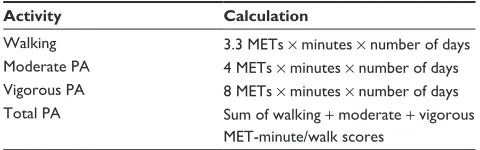
is recommended for people between 15 and 69 years old. It contains seven questions (short version), and quantifies all activities (such as work, leisure time, home activities) in metabolic equivalent of tasks (METs). A MET is the unit of measurement of metabolic rate, and is defined as the amount of heat emitted by a person in a sitting position per square meter of skin. We followed the test protocol to calculate results, which are shown in Table 1.16 This questionnaire has
been validated for older Spanish people.17
rockport 1-Mile Walk test
This is a submaximal aerobic-capacity test to estimate maxi-mal oxygen consumption (VO
2max). The successful
perfor-mance of this test requires a fast walk (not run) for 1 mile (1,609 m) in the shortest time possible.18 The test has been
validated by Kline et al.19 To calculate the effort variable,
it is necessary to note the age (years), height (centimeters), weight (kilograms), maximum heart rate (HR; beats per minute, measured at the end of the test), and total test time. The complete equation differs according to sex: women, VO2=154.899 – (0.0947×2.2046× weight) – (0.3709× age) – (3.9744× time) – (0.1847× HR); men, VO2 =116.579 – (0.0585×2.2046× weight) – (0.3885× age) – (2.7961× time) – (0.1109× HR).
Sit and reach test
The Sit and Reach (SR) Test quantifies the degree of elasticity of the lower back and hamstring muscles (Table 2). This test has been validated by Jones et al.20 The SR Test was performed
following the procedures specified in the American College of Sports Medicine (ACSM) manual.9 The participant sits on
Table 1 test-calculation short-form International physical Activity
Questionnaire in metabolic equivalent of tasks (Mets)15 Activity Calculation
Walking 3.3 Mets × minutes × number of days
Moderate pA 4 Mets × minutes × number of days
Vigorous pA 8 Mets × minutes × number of days
total pA Sum of walking + moderate + vigorous
Met-minute/walk scores
Abbreviation: pA, physical activity.
Clinical Interventions in Aging downloaded from https://www.dovepress.com/ by 118.70.13.36 on 20-Aug-2020
Dovepress Cardiovascular program pilot study
the floor with the right leg fully extended and the right foot flat against a box that is 30.5 cm high by 60 cm long by 27 cm wide. The left knee is bent, with the sole against the medial border of the extended knee. The participant extends their arms forward, with palms down sliding down the measuring scale as far as possible.
Ad hoc strength test
This test required participants to perform 15 repetitions on the quadriceps extension machine (men, 30 kg; women, 25 kg). After completing the test, subjects were asked to rate their perceived exertion (RPE) according to the category ratio 10 scale.21
Stork Balance Stand test
This test measures balance on one foot. With the subject bare-foot on a carpet and hands at the waist, one bare-foot is placed on the inside of the knee of the other leg (support). Time begins when the participant lifts one foot off the ground.22 The time
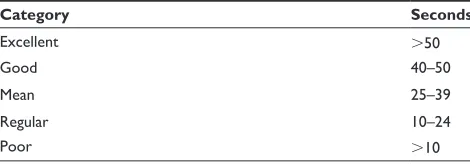
ends when one or both hands separate from the waist, the support foot changes position (moves), or the foot resting on the opposite knee loses contact. Categories of the Stork Balance Stand Test are explained in Table 3.
procedure
This study was initiated in October 2010. The execution of the test battery proposed in this study was carried out in three sessions. The program duration was 90 days (3 months), with the requirement to attend three times a week for 60 minutes each workout.
Session 1
In this session, we explained to the subjects the aim of our research and that participation was voluntary. Informed consent was signed, and we explained the protocol for the assessment of BC. Participants completed the IPAQ (short) and performed the SR Test preceded by a formal warm-up (10 minutes of cycling).
Session 2
During the second training session, we proceeded with the assessment of BC, Stork Balance Stand Test, and ad hoc strength test (preceded by the same warm-up).
Session 3
During the last session, we performed the Rockport 1-Mile Walk Test (preceded by the same warm-up). After the assessment sessions, we started the intervention-training program. We followed the protocol prescribed in the ACSM manual.9 Contents were treated as upper- and lower-body
strength exercises, flexibility, and aerobic capacity. The fre-quency of sessions was three times a week in the afternoon, lasting 60 minutes per session. The intervention-training program was planned by the same trainer/researcher. The program had a 90% attendance rate during this period. This rate was very important in this first phase to achieve the objective of the study. This study was approved by the Ethics Committee of the University of Malaga and the participants signed informed consent forms agreeing to participate in the study.
Statistical analyses
Analysis of results was performed with SPSS 17.0 for Windows (SPSS Inc., Chicago, IL, USA). We checked the abnormality of the data distribution using the Kolmogorov– Smirnov test and ran descriptive tests (mean, standard deviation, and confidence interval to 95%). We also performed paired samples through the Wilcoxon test, Spear-man coefficient correlations, and stepwise linear regressions. The level of significance was P0.05.
Results
Firstly, basal metabolism was calculated pretest (men 1,789.2±244.4 cal, women 1345.0±123.1 cal; P0.05). Results of the intervention program are shown in Table 4. Participants (both men and women) reduced their waist measurements (P0.05). FM was reduced and SMM was increased, although not to a statistically significant degree (P0.05).
Table 2 Categories of the Sit and reach test data
Category Men (cm) Women (cm)
high excellent 27 30
excellent 17–27 21–30
Good 6–16 11–20
Mean 0–5 1–10
regular -8 to -1 -7 to 0
poor -20 to -9 -15 to -8
high poor -20 -15
Table 3 Categories of the Stork Balance Stand test
Category Seconds
excellent 50
Good 40–50
Mean 25–39
regular 10–24
poor 10
Clinical Interventions in Aging downloaded from https://www.dovepress.com/ by 118.70.13.36 on 20-Aug-2020
Dovepress
Castillo-rodríguez and Chinchilla-Minguet
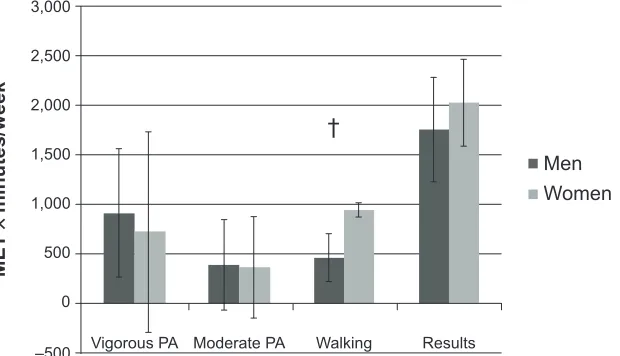
The average time spent sitting between men and women was 6.2±2.39 and 2.0±1.41 hours per day, respectively. This difference was not significant (P0.05). Women demonstrated higher performance than men in the walking variable (940.5±70.0 versus 458.6±240.3 MET × minutes/ week, P0.05; Figure 1).
The Rockport 1-Mile Walk Test resulted in lower post-test times for both men and women (Table 5). However, the improvement was significant only for men (P0.05). RPE in the ad hoc upper-body strength test was lower posttest. Post-test times for the Stork Balance Stand Test were improved, although again these differences were not significant (P0.05). No improvements were seen in the SR Test.
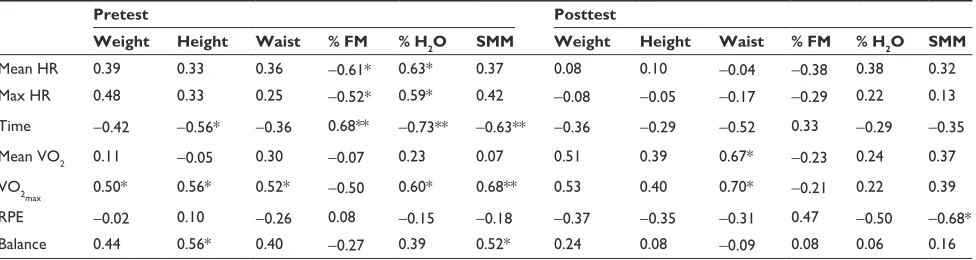
Spearman coefficient correlations were calculated to demonstrate the relationship between BC, the IPAQ, and the physical fitness test. Pretest mean HR showed a high correlation with vigorous PA (ρ =-0.84, P0.01) and was also related to the time of the Rockport test (ρ =-0.51, P0.05). Table 6 shows the relationship between the
IPAQ, the physical fitness test (Rockport, strength, and balance) and BC.
Discussion
The aim of this study was to assess the loss of weight and FM and gains in SMM, strength, aerobic fitness, flexibility, and balance in Spanish people over 60 years old during a 3-month pilot intervention study. PA results in health benefits for those who practice it. This has been demonstrated in published studies of previous healthy-intervention programs, where tests were performed to evaluate BC and such physical abilities as aerobic capacity, strength, and balance.23
It has also been shown that motivation has a positive correlation with the continued practice of PA.24 Participants
were motivated in this longitudinal study, so the practice of PA was done on a daily basis.25 It has been found that
persons with higher body weight have a lower motivation toward PA.26 The ACSM,9 as part of a guide on basic
exer-cises, recommends that the elderly use training programs
Table 4 Characteristics of body composition according to sex
Men (n=9) Women (n=15) P
Pretest Posttest P Pretest Posttest P
Weight (kg) 80.84±9.89 79.14±7.69 NS 61.33±5.86 61.62±6.01 NS **
height (cm) 168.6±7.67 167.1±6.89 NS 156.8±2.32 156.8±2.52 NS **
Age (years) 63.80±5.45 64.14±5.31 NS 63.50±5.47 64.25±4.52 NS NS
Waist (cm) 102.4±5.98 101.6±8.04 † 91.00±6.07 87.77±7.40 † *
FM (%) 27.00±5.29 25.32±3.36 NS 35.10±4.29 34.25±3.98 NS **
Water (%) 51.29±2.50 51.96±2.19 NS 44.53±2.84 44.75±2.38 NS **
SMM (kg) 54.99±6.55 57.10±6.39 NS 37.40±2.02 38.14±1.88 NS ***
Notes: *P0.05; **P0.01; ***P0.001; †P0.05 (pre/post).
Abbreviations: FM, fat mass; SMM, skeletal muscle mass; NS, not significant.
Figure 1 International physical Activity Questionnaire results between men and women. Note: †P0.05.
Abbreviations: Met, metabolic equivalent of task; pA, physical activity.
3,000
2,500
2,000
1,500
1,000
500
0
–500
Men Women
Moderate PA Walking Results Vigorous PA
†
MET
×
minutes/week
Clinical Interventions in Aging downloaded from https://www.dovepress.com/ by 118.70.13.36 on 20-Aug-2020
Dovepress Cardiovascular program pilot study
that focus on resistance, strength, aerobic capacity, and flex-ibility exercises.
From the age of 30 years, the body begins to show signs of decreasing physical abilities. This decrease in biological capacities and metabolic rates also extends to other aspects, such as neuromuscular capacity, flexibility, FM, SMM, and density of bone cells.27,28
This pilot intervention study was performed over a period of 3 months following the guidelines found in the ACSM.9 Pretest and posttest readings were recorded and
compared to assess improvements in physical fitness. Posttest, subjects improved the time of the Rockport 1-Mile Walk Test. The same success occurred in the study of Pazoki et al.29 This test has been used to assess the VO
2
by some studies. Rockport is an excellent test for older people.30–32
In addition, BC was improved due to decreased FM and increased SMM. However, these differences were not sig-nificant. This was anticipated, as the intervention program was limited to a time period of 90 days, too short to manifest definitive improvements in BC. Dias et al33 and Lim et al34 did
not find any improvements in their participants either. The reason for this is thought to be due to the short duration of the course (6 weeks). Natural physical deterioration and decreas-ing physical fitness as part of the agdecreas-ing process must also be taken into account, even for a period of 3 months.6,35 When
there is an increase in FM, there is a reduction in muscle strength, physical capacity, and quality of life, along with a loss of fat-free mass.36
In the second phase, we used a larger sample, necessary to verify the results obtained in this pilot study. Future research should test how this clinical intervention affects each of the capacities measured with two types of instruments. There-fore, the differences will be more reliable.
Conclusion
As a result of the healthy-intervention program performed for 90 days (3 months), persons 60 years or older were able to increase their physical fitness, as demonstrated by the specific tests performed. They also showed improved FM and SMM. These results should be considered with caution, due to the limited sample size of this pilot study.
Table 5 Physical fitness variables before and after the interventional physical activity program
Men (n=9) Women (n=15) P
Pretest Posttest P Pretest Posttest P
Max hr (bpm) 150.7±16.7 150.6±17.81 NS 128.9±19.0 138.0±27.2 NS *
Vo2max (cm) 37.50±2.95 37.95±3.19 NS 28.82±5.55 35.76±6.10 NS NS
time (years) 14.33±1.03 14.00±0.71 † 16.64±1.29 14.39±3.77 NS NS
rpe (points) 4.40±1.34 3.80±1.64 NS 6.60±2.51 4.60±2.19 NS *
Balance (seconds) 33.00±20.79 39.00±10.39 NS 22.50±17.41 26.75±19.96 NS *
Notes: *P0.05; †P0.05 (pre/post).
Abbreviations: Max hr, maximum heart rate; Vo2max, maximal oxygen consumption; RPE, rating of perceived exertion (ad hoc strength test); NS, not significant.
Table 6 Spearman coefficient correlation between the International Physical Activity Questionnaire, physical fitness test, and body
composition
Pretest Posttest
Weight Height Waist % FM % H2O SMM Weight Height Waist % FM % H2O SMM
Mean hr 0.39 0.33 0.36 -0.61* 0.63* 0.37 0.08 0.10 -0.04 -0.38 0.38 0.32
Max hr 0.48 0.33 0.25 -0.52* 0.59* 0.42 -0.08 -0.05 -0.17 -0.29 0.22 0.13
time -0.42 -0.56* -0.36 0.68** -0.73** -0.63** -0.36 -0.29 -0.52 0.33 -0.29 -0.35
Mean Vo2 0.11 -0.05 0.30 -0.07 0.23 0.07 0.51 0.39 0.67* -0.23 0.24 0.37
Vo2max 0.50* 0.56* 0.52* -0.50 0.60* 0.68** 0.53 0.40 0.70* -0.21 0.22 0.39
rpe -0.02 0.10 -0.26 0.08 -0.15 -0.18 -0.37 -0.35 -0.31 0.47 -0.50 -0.68*
Balance 0.44 0.56* 0.40 -0.27 0.39 0.52* 0.24 0.08 -0.09 0.08 0.06 0.16
Notes: *P0.05; **P0.01.
Abbreviations: Max hr, maximum heart rate; hr, heart rate; Vo2max, maximal oxygen consumption; rpe, rating of perceived exertion (ad hoc strength test); FM, fat mass; SMM, skeletal muscle mass.
Clinical Interventions in Aging downloaded from https://www.dovepress.com/ by 118.70.13.36 on 20-Aug-2020
Dovepress
Castillo-rodríguez and Chinchilla-Minguet
Disclosure
The authors report no conflicts of interest in this work.
References
1. Regidor E, Gutiérrez-Fisac JL, Alfaro M. Indicadores de Salud 2009.
Evolución de los indicadores del estado de salud en España y su magnitud en el contexto de la Unión Europea. Madrid: Ministerio de
Sanidad y Política Social; 2009.
2. American College of Sports Medicine. Position Stand. The recom-mended quantity and quality of exercise for developing and maintaining cardiorespiratory and muscular fitness, and flexibility in healthy adults.
Med Sci Sports Exerc. 1998;30(6):975–991.
3. Peake J, Della Gatta P, Cameron-Smith D. Aging and its effects on inflammation in skeletal muscle at rest and following exercise-induced muscle injury. Am J Physiol RegulIntegr Comp Physiol. 2010;298(6):R1485–R1495.
4. Colado JC, Garcia-Masso X, Rogers ME, Tella V, Benavent J, Dantas EH. Effects of aquatic and dry land resistance training devices on body composition and physical capacity in postmenopausal women. J Hum
Kinet. May 2012;32:185–195.
5. Evans WJ, Campbell WW. Sarcopenia and age-related changes in body composition and functional capacity. J Nutr. 1993;123(2 Suppl): 465–468.
6. Katula JA, Sipe M, Rejeski WJ, Focht BC. Strength training in older adults: anempowering intervention. Med Sci Sports Exerc. 2006;38(1):106–111.
7. Zhang J, Feldblum PJ, Fortney JA. Moderate physical activity and bone density among perimenopausal women. Am J Public Health. 1992;82(5):736–738.
8. Roubenoff R, Hughes VA. Sarcopenia: current concepts. J Gerontol A
Biol SciMed Sci. 2000;55(12):M716–M724.
9. ACSM ACoSM. Guidelines for Exercise Testing and Prescription. 8th ed. Philadelphia (PA): Lippincott, Wilkins, and Williams; 2009. 10. Hayes LD, Grace FM, Sculthorpe N, et al. The effects of a formal
exercise training programme on salivary hormone concentrations and body composition in previously sedentary aging men. Springerplus. 2013;2(1):18.
11. Woo J, Yu R, Yau F. Fitness, fatness and survival in elderly populations.
Age (Dordr). 2013;35(3):973–984.
12. Marcos Becerro JF. Consideraciones sobre la acción del ejercicio y el
deporte en el mantenimiento de la salud y prevención de la enfermedad. Salud. Ejercicio y Deporte. Madrid: Fundación Mapfre medicina. 1995.
13. Gómez-Cabello A, Ara I, González-Agüero, A, Casajús JA, Vicente- Rodríguez G. Effects of Training on Bone Mass in Older Adults.
Sports Med. 2012;42(4):301–325.
14. SEEDO. Consenso SEEDO’2000 para la evaluación del sobrepeso y la obesidad y el establecimiento de criterios de intervención terapéutica.
Med Clin. 2000;115(15):587–597.
15. Craig CL, Marshall AL, Sjostrom M, Bauman AE, Booth ML, Ainsworth BE, et al. International physical activity questionnaire: 12–coun-try reliability and validity. Med Sci Sports Exerc. 2003;35:1381–1395. 16. Ainsworth BE, Haskell WL, Whitt MC, Irwin ML, Swartz AM,
Strath SJ, et al. Compendium of physical activities: an update of activity codes and MET intensities. Med Sci Sports Exerc. 2000;32(9 Suppl): S498–S504.
17. Roman-Viñas B, Serra-Majem L, Hagströmer M, Ribas-Barba L, Sjöström M, Segura-Cardona R. International Physical Activity Question-naire: Reliability and validity in a Spanish population. European Journal of Sport Science 2010;10:297–304. DOI:10.1080/17461390903426667 18. Rockport Walking Institute. Rockport fitness walking test. Marlboro,
MA: Rockport Walking Institute; 1986.
19. Kline GM, Porcari JP, Hintermeister R, Freedson PS, et al. Estimation of VO2max form a one-mile track walk, gender, age, and body weight.
Med Sci Sport Exerc. 1987;19(3):253–259.
20. Jones CJ, Rikli RE, Max J, Noffal G. The Reliability and Validity of a Chair Sit-and-Reach Test as a Measure of Hamstring Flexibility in Older Adults. Research Quarterly for Exercise and Sport. 1998; 69(4):338–343.
21. Borg G. Borg’s RPE Scale: a Method for Measuring Perceived
Exer-tion. Stockholm: Borg Perception; 1994.
22. Johnson BL, Nelson JK. Practical measurements for evaluation in
physical education. 4th Edit. Minneapolis: Burgess; 1979.
23. Ruiz-Montero PJ, Castillo-Rodriguez A, Mikalački M, Nebojsa C, Korovljev D. 24–weeks Pilates-aerobic and educative training to improve body fat mass in elderly Serbian women. Clin Interv Aging. 2014;31;9:243–8. doi: 10.2147/CIA.S52077.
24. Sonstroem RJ. Exercise and Self-esteem: Recommendations for Exposi-tory Research. Quest. 1981;33(2):124–139.
25. Bocalini DS, Lima LS, de Andrade S, et al. Effects of circuit-based exercise programs on the body composition of elderly obese women.
Clin Interv Aging. 2012;7:551–556.
26. Castillo A, Videra A. Estudio de la motivación y ansiedad previos a la práctica de deportes de raqueta en personas mayores. In Montiel P, Merino A, Sánchez A, Heredia, A, Salinas F. (Eds.), 3rd International
Congress of Physical Activity and Sport for elderly. March 12–14,
(861–872). Malaga: Junta de Andalucia (2009).
27. Carter JS, Williams HG, Macera CA. Relationships between physical activity habits and functional neuromuscular capacities in healthy older adults. J ApplGeront. 1993;12(2):283–293.
28. White JA, Wright V, Hudson AM. Relationship between habitual physical activity and osteoarthrosis in ageing women. Public Health. 1993;107:459–470.
29. Pazoki R,Nabipour I, Seyednezami N, Reza Imami S. Effects of a community-based healthy heart program on increasing healthy women’s physical activity: a randomized controlled trial guided by Community-based Participatory Research (CBPR). BMC Public Health. 2007;7(216):1–8.
30. Kamrani AAA, Shams A, Dehkordi PS, Mohajeri R. The effect of low and moderate intensity aerobic exercises on sleep quality in elderly adult males. Pak J Med Sci. 2014;30(2):417–421. doi: http://dx.doi. org/10.12669/pjms.302.4386
31. Morrell JS, Cook SB, Carey GB. Cardiovascular fitness, activity, and metabolic syndrome among college men and women. Metab Syndr
Relat Disord. 2013;11(5):370–6. doi:10.1089/met.2013.0011 .
32. Seneli RM, Ebersole KT, O’Connor KM, Snyder AC. Estimated V(O2)max from the rockport walk test on a nonmotorized curved treadmill. J Strength Cond Res. 2013;27(12):3495–505. doi: 10.1519/ JSC.0b013e31828f04d8.
33. Dias R, Prestes J, Manzatto R, et al. Efeitos de diferentes programas de exercício nos quadros clínico e funcional de mulheres com excesso de peso [Effects of different exercise programs in clinic and functional status of overweight women]. Rev Bras Cineantropom Desempenho
Hum. 2006;8(3):58–65. Portuguese.
34. Lim EC, Poh RL, Low AY, Wong WP. Effects of Pilates-based exer-cises on pain and disability in individuals with persistent nonspecific low back pain: a systematic review with meta-analysis. J Orthop Sports
Phys Ther. 2011;41(2):70–80.
35. Lavie CJ. Making exercise and fitness a high priority. Ochsner J. 2007;7(4):154–157.
36. Katula JA, Sipe M, Rejeski WJ, Focht BC. Strength training in older adults: an empowering intervention. Med Sci Sports Exerc. 2006;38(1): 106–111.
Clinical Interventions in Aging downloaded from https://www.dovepress.com/ by 118.70.13.36 on 20-Aug-2020
Clinical Interventions in Aging
Publish your work in this journal
Submit your manuscript here: http://www.dovepress.com/clinical-interventions-in-aging-journal
Dove
press
Clinical Interventions in Aging is an international, peer-reviewed journal focusing on evidence-based reports on the value or lack thereof of treatments intended to prevent or delay the onset of maladaptive correlates of aging in human beings. This journal is indexed on PubMed Central, MedLine,
CAS, Scopus and the Elsevier Bibliographic databases. The manuscript management system is completely online and includes a very quick and fair peer-review system, which is all easy to use. Visit http://www.dovepress. com/testimonials.php to read real quotes from published authors.
Dovepress Cardiovascular program pilot study
Clinical Interventions in Aging downloaded from https://www.dovepress.com/ by 118.70.13.36 on 20-Aug-2020