ISSN: 2319-8753
International Journal of Innovative Research in Science,
Engineering and Technology
(An ISO 3297: 2007 Certified Organization)
Vol. 2, Issue 10, October 2013
Commutative Associative Binary Operations
on a Set with Three Elements
Yogesh Kumar
1Sarita
21
Ph.D Student, Mathematics Department, Indian Institute of Technology, Delhi, India
2
Mathematics Department, Govt.College for Women, Rohtak, Haryana, India.
Abstract: Associativity, Commutative, Existence of identity are fundamental properties of binary operation in abstract algebra. In this paper, the authors discuss binary operations on a three-element set and show, by partition and composition of mapping, that exactly 63 operations out of the 19683 existing binary operations on the set are associative as well as commutative with counting that how many composition tables are to be verified
Keywords: binary operations, associativity, commutative, isomorphism, order, Partition AMS Classification:- 20M10 I. INTRODUCTION
The number of binary operation on a set of only three elements is as large as 19683. To prove this is an easy calculation;
there are three different answers for each of the 9 seats of a 3Χ3 operation table so the number of distinct binary
operations is 39 . The number of commutative operations on the 3-set can calculated in a similar way, resulting in 36=729 binary operations. This calculation is straightforward, but no easy calculation and no educated guess, seems to give the answer to following question:-
“How many binary operations on a three elements are associative as well as commutative?”
The objective of this paper is to answer this question. In other words, how many of the 19683 different binary operations on three-element set are associative as well as associative.
II. GENERALCONCEPTS
A binary operation (hereafter referred to only as an operation) on a set S is a rule that assigns to each ordered pair (a, b),
where a and b are elements of S, exactly one element, denoted by ab, in S. An operation on a set is associative if x (yz) = (xy) z for every x, y and z in S.
An isomorphismbetween S and S’ is a one-to-one function Φ mapping S onto S’ such that Φ(xy)= Φ(x)Φ(y) for all x
and y in S. If there exists an isomorphism between S and S’, then S and S’ are said to be isomorphic, denoted by S≈S’.
Order of an element is cardinality of set generated by that element.
III.USEFUL THEOREM
The following theorem about sets, S and S’, closed under operations are well known and easy to prove:-
Theorem 1: - If there exists an isomorphism between S and S’ and the operation on S is associative then an
operation on S’ is also associative.
Theorem 2: - If there exists an isomorphism between S and S’ and the operation on S is commutative then an
operation on S’ is also commutative.
IV.OPERATIONS ON A SET WITH TWO ELEMENTS
ISSN: 2319-8753
International Journal of Innovative Research in Science,
Engineering and Technology
(An ISO 3297: 2007 Certified Organization)
Vol. 2, Issue 10, October 2013
Number of associative binary operation on a set of two elements is 8.See [2]. Number of commutative binary operation on a set of two elements is 8.See [2].
Number of associative as well as commutative binary operation on a set of two elements is 6 See [2].
V. OPERATIONS ON A SET WITH THREE ELEMENTS
As mentioned in the introduction, the number of possible binary operations on a set of three elements is 19683. Of these 729 are commutative. We now proceed to answer the question: How many binary operations on a set of three elements are associative as well as commutative?
For a three-element set S proving associatively for a given operation amounts to verify different equations (xy) z=x (yz), where x, y, z are elements of S. A single counterexample suffices to show that a given operation is not associative. Clearly, counterexamples need not to be unique.
For a two-element set S proving commutatively for a given operation amounts to verify different equations xy=yx, where x, y are elements of S. A single counterexample suffices to show that a given operation is not commutative. Clearly, counterexamples need not to be unique.
Now we discuss alternative ways to check the associativity. Define Φafrom (S, *) into (S,*), by Φa(x) =a*x for all x in
S, where a belong to S. If composition of Φawith Φb is equal to Φa*b for all a, b in S then we say that S is associatively
under the binary operation *. Explanation: -
a*(b*c) =Φa(b*c) = Φa(Φb(c)) …..(1)
(a*b)*c=Φa*b(c) …..(2)
From (1) and (2) we conclude that above definition is equivalent with definition of associatively of binary operation * on set S. See [3]
VI.ALGORITHM FOR FINDING NUMBER OF ASSOCIATIVE AS WELL AS COMMUTATIVE BINARY OPERATION ON
N-ELEMENT
Algorithm given below is extended from of Amit Sehgal & Manmohan [3] and Sarita & Amit Sehgal [4].The analysis of the associative binary operations on n-element set S will now divide into 3
steps:-1). Partition the set of nn mappings in such a way that element of same partition can be obtained by using one-one and onto mapping from S onto S.
2). Rearrange the partition according to their order of any element of the partition.(Say order as k).
3).Calculate the contribution towards number of associative as well as commutative binary operations when one row is fill by the first element of ith partition which can also fill k-1 more rows and remaining row n-k can be filled by ith and onwards partitions (if any) with two conditions given below.
Conditions: - Before starting calculation, firstly we insured that no associative as well as commutative table counted
twice. For this, we make some rules:-
(i) If we fixed rth row from any element ith partition (which has order k) then we can fill at least k-1 more rows. Remaining unfilled rows can by filled with element of ith and onwards partition (if any) however selected element of ith partition cannot fill the unfilled rows before selected row.
(ii) If table contains n different entry of ith partition then contribution towards number of associative as well as commutative operations counted is 1/n.
Explanation (How partition reduces the checking of associative work):- Firstly, we prove that Table-1 and Table-2
ISSN: 2319-8753
International Journal of Innovative Research in Science,
Engineering and Technology
(An ISO 3297: 2007 Certified Organization)
Vol. 2, Issue 10, October 2013
* a b c * a b d
a b a a a
b b b c b
c c
Table-1 Table-2
Here, if we define an isomorphic mapping from S to S by f (a) =b, f (b) =c, f(c) =a. Then we get f(b)=f(a)f(a) , f(a)=f(a)f(b), f(a)=f(a)f(c). Then composition table after applying above isomorphic mapping to Table-1, we get table-2. Hence, table-1 and table-2 are isomorphic.
Similarly, we can prove that if baa comes in second row is isomorphic to bcb in third row, if baa comes in third row is isomorphic to bcb in first row . Hence, table with at least one row baa is isomorphic to table with at least one row bcb (row number of bcb may be different from row number of baa).
Hence, there is no need to check associative composition table for bcb when associative composition table bcb is checked because they give isomorphic composition table. (By theorem stated in section 3 if a composition table with baa is associative then isomorphic composition having row bcb is also associative).
As above discussion, if we apply any one-one and onto to baa we get {baa,ccb,bab,bcb,cca,caa } which forms a
partition and now our calculation is reduced six times (out of six elements now we have to check associativity
only for single element).
On the basis of above algorithm, now we proceed towards finding number of associative as well as comutative operations on a set with three elements.
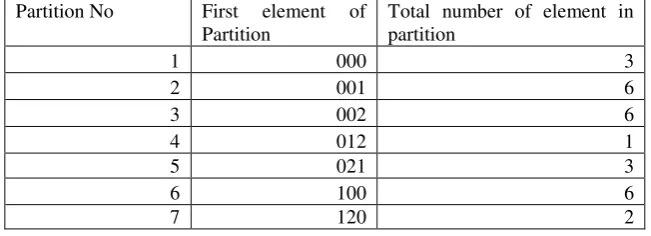
A. Step 1st
If set S has n elements, then total number of mapping possible from set S to S= nn In our problem n=3, then total number of mapping possible from set S to S= 27 .
Here we consider S={0,1,2} and first digit of each mapping comes from 0, second comes from 1, third comes from 2
Partition No First element of Partition
Total number of element in partition
1 000 3
2 001 6
3 002 6
4 012 1
5 021 3
6 100 6
7 120 2
ISSN: 2319-8753
International Journal of Innovative Research in Science,
Engineering and Technology
(An ISO 3297: 2007 Certified Organization)
Vol. 2, Issue 10, October 2013
B. Step 2nd
Partition No
First element of Partition
Order of an element of
partition
Generated elements belongs
to partition
1 120 3 1,1,7
2 021 2 2,7
3 100 2 3,5
4 001 2 4,6
5 002 1 5
6 000 1 6
7 012 1 7
Table -4
C. Step 3rd
1).When i=1(assume element from partition is 120)
Number of elements in Ist Partition are 2
Assumed row for 120
Total number of composition to be
verified
contribution towards number of associative as well as commutative
Ist 1 0.5×2=1
2nd 1 0.5×2=1
3rd 1 0.5×2=1
Total 3 3
Table -5
2).When i=2(assume element from partition is 021)
Number of elements in 2nd Partition are 3 Assumed
row for 021
Total number of composition to be
verified
contribution towards number of associative as well as commutative
Ist 1 0×3=0
2nd 3 2×3=6
3rd 3 2×3=6
Total 7 12
Table -6
3).When i=3(assume element from partition is 100)
Number of elements in 3rd Partition are 6 Assumed row
for 100
Total number of composition to be
verified
contribution towards number of associative as
well as commutative
Ist 3 2×6=12
2nd 3 1×6=6
3rd 1 0×6=0
Total 7 18
ISSN: 2319-8753
International Journal of Innovative Research in Science,
Engineering and Technology
(An ISO 3297: 2007 Certified Organization)
Vol. 2, Issue 10, October 2013
4).When i=4(assume element from partition is 001)
Number of elements in 4th Partition are 6 Assumed row for
001
Total number of composition to be
verified
contribution towards number of associative as
well as commutative
Ist 1 0×6=0
2nd 3 0.5×6=3
3rd 3 0.5×6=3
Total 7 6
Table -8
5).When i=5(assume element from partition is 002)
Number of elements in 5th Partition are 6 Assumed row
for 002
Total number of composition to be
verified
contribution towards number of associative as well as
commutative
Ist 12 2×6=12
2nd 1 0×6=0
3rd 4 1.5×6=9
Total 17 21
Table -9
6).When i=6(assume element from partition is 000)
Number of elements in 6th Partition are 3 Assumed
row for 000
Total number of composition to be
verified
contribution towards number of associative as well as
commutative
Ist 4 1×3=3
2nd 1 0×3=0
3rd 1 0×3=0
Total 6 3
Table -10
7).When i=7(assume element from partition is 012)
Number of elements in 7th Partition are 1 Assumed row for
012
Total number of composition to be verified
contribution towards number of associative as well as
commutative
Ist 1 0×1=0
2nd 1 0×1=0
3rd 1 0×1=0
Total 3 0
ISSN: 2319-8753
International Journal of Innovative Research in Science,
Engineering and Technology
(An ISO 3297: 2007 Certified Organization)
Vol. 2, Issue 10, October 2013
Partition-No Total contribution towards number of
associative binary operations of partition
number of composition tables verified
1 3 3
2 12 7
3 18 7
4 6 7
5 21 17
6 3 6
7 0 3
Total 63 50
Table -12
VII. CONCLUSIONS
The conclusion of this paper is that among the 19683 different operations on a Three-element set, S={0,1,2}, there are exactly 63 operations which are associative and only 50 composition tables are to be verified out of 19683. In other words, there exist exactly 63 three-element commutative semi groups.
VIII.FUTURE WORK
One can find out Associative binary Operations on a n-Element Set by using same Algorithm , which we have used for Four-element and also verify the one of the result for four element set in 1140 [6].
REFERENCES
1. A.Distler and T. Kelsey, The semigroups of order 9 and their automorphism groups, arXiv preprint arXiv: 1301.6023, 2013
2. Amit Sehgal,Ravinder Kumar and Ombir Dahiya, , Associative Binary operation on a set with Five elementst, International Journal of Computer Applications Volume 76- No 6, Auguest 2013/ ISSN No :- 0975-8887
3. Amit Sehgal and ManMohan , Associative Binary operation on a set with Three elements, International Journal of Essential Sciences, Vol 5, No. 1, pp1-8,2011 (ISSN:0973-8436)
4. Amit Sehgal, Sarita and Sunil Dua, Associative Binary operation on a set with Four elements, International Journal of Computer Science and Communication Engineering Volume 1 Issue 2 paper id IJCSCE 121204, 2013 (ISSN:2319-7080)
5. Fri∂rik Diego and Kristǐn Halla Jǒnsdǒttiǐ , Associative Operations on a Three-Element Set, TMME, vol 5, nos2 &3 , pp 257-268, 2008.
6. George E. Forsythe, Swac Computers 126 distinct semi groups of order 4 Proc. Amer. Math. Soc. 6 (1955), 443-447.
7. Lyle Ramshaw, The On-Line Encyclopedia of Integer Sequences -A023815 (Number of binary operations on n-set that are commutative and associative )
8. Man-Keung Siu, Which Latin Squares are Cayley Tables?, AMS Monthly , 98 (1991) 625-627