Recent Results on Meson Decays from A2
PatrikAdlarson for the A2 Collaboration1,?
1Institut für Kernphysik, Johannes Gutenberg-Universität Mainz, D-55099 Mainz, Germany
Abstract. Light meson decays are used to investigate topics related to fundamental as-pects of particle physics. Precision measurements of meson Dalitz decays give input to theoretical evaluations of the Hadronic Light-by-Light contribution (HLbL) to the anoma-lous magnetic moment of the muon. The A2 collaboration, using the Crystal Ball/TAPS setup at MAMI, has recently published several high precision results on transition form factors which are related to HLbL. Pseudoscalarη0
decays allow for studies of topics likeππscattering lengths, effective field theories and fundamental symmetries. In 2014 the collaboration had a dedicated experimental campaign with one of its main goals to measure the dynamics ofη0→π0π0ηwith high precision. A brief overview of the
exper-imental setup, physics motivations, analyses and results are given.
1 Introduction
Mesons and their properties continue to be of interest to the hadron and particle-physics communities. The electromagnetic transition form factors (TFF) are of interest for probing the precision frontier of the Standard Model (SM) and for understanding the intrinsic properties of the hadrons themselves. There has been a renewed interest in light meson TFFs of e.g. π0,η andω, as they provide input
to theoretical contributions to the anomalous magnetic moment of the muon, (g−2)µ. Also the η0 meson and its decay modes play an important role in our understanding of Quantum ChromoDynamics (QCD) and its related phenomenological models. This proceeding will focus on four recent results from the A2 collaboration: the Dalitz decaysπ0 → e+e−γ [1],η → e+e−γ,ω → π0e+e−[2], and the decayη0 → π0π0η[3]. The proceeding structure is as follows: after the introduction (section 1) a description of the Crystal Ball-TAPS experimental setup at MAMI is given (section 2), followed by the three physics channels related to the TFFs and theη0 → π0π0η channel (sections 3 and 4,
respectively). Finally, a summary is given (section 5).
2 Experimental Setup
The electron accelerator MAMI (Mainz Microtron) [4, 5] can provide an electron beam up to 1.604 GeV. The Pseudoscalar (P=π0, η, η0) and Vector (V=ω) mesons are produced in the reac-tionγp → P/V pwhen beam photons impinge on an extended Liquid Hydrogen target. The photon beam is created when the electron beam interacts with a radiator, producing bremsstrahlung electrons and photons. The postbremsstrahlung electrons are detected to provide the energy measurement of
the photon beam which are incident on the target. For energies covering∼0.08-1.5 GeV the Glasgow-Mainz tagger is used [6–8], while for higher photon energies the end-point tagging spectrometer (EPT) [9] is used. The final statee±- andγ-particles from the meson decays were measured in the Crystal Ball (CB) [10] and TAPS [11, 12] calorimeters. The CB detector consists of 672 NaI(Tl) crystals forming a sphere encapsulating the target, covering 93% of 4π. The target is covered by the Particle Identification Detector (PID) [13] used to identify charged particles. The TAPS detector is installed 1.5 m downstream and consists of 384 hexagonal BaF2crystals. To be able to run with higher
beam currents, e.g. in theη0production experiment, 18 of the BaF2 crystals closest to the beam line were replaced with 72 PbWO4 crystals. The results presented here were analysed with data taken
between the years 2007-2014.
3 Transition Form Factors
3.1 Motivation:aµand Meson TFF
One of the most precisely known quantities in the SM is that of the anomalous magnetic moment of the muon,aµ=(gµ−2)/2. The muon magnetic moment, measured by the E821 experiment, is known experimentally to the 10th decimal [14] with even more precise measurements planned in the near future [15, 16]. The E821 result deviates from the SM calculation by 3-4σ[17, 18]. Theoretically, the poorest understood SM contributions toaµare from interactions involving hadrons,ahadrµ = aHV Pµ + aHLbLµ , whereaµHV PandaµHLbL, refer to the hadronic vacuum polarization (HVP) and Hadronic
Light-by-Light (HLbL), respectively. The latter contribution has historically been difficult to estimate as it was mostly obtained from models suffering from large and uncontrolled uncertainties [19]. In recent years dispersive approaches have been proposed to reduce the present day errors of HLbL [20, 21]. A better understanding of HLbL comes from the study of meson TFFs [22]. Meson TFFs can be accessed in kinematical regions of four-momentum transferq2through study of both space- and
time-like processes. The A2 collaboration can measure the TFFs in the time-time-like region by measuring pseudoscalar Dalitz decays, i.e. P → γ∗γ→ e+e−γ, but alsoω → π0e+e−. For the caseP → γγ∗, theq2 range is given by 4m2
l <q 2 <m2
P. In general, however, A → Bγ
∗has the rangem2 l ≤q
2 ≤
(mA−mB)2, (l=e, µ). The time-like meson TFFsFP(mll) andFωπ0(mll) are obtained by dividing the
differential decay distribution with its corresponding Quantum ElectroDynamics (QED) contribution. In the Vector Meson Dominance model (VMD), the virtual photon couples to an intermediate virtual-vector-meson state (e.g. V = ρ, ω, φ). To quantify the TFF dependence the slope parameteraP is
defined, which reflects the slope value extracted atq2=0. Related to this quantity is also the effective massΛ, which, under the VMD approximation, parametrizes the TFFs in a pole approximation. These are given by
aP≡ FP(mll)
dq2 |q=0, FPγ/ωπ0(mll)=(1− m2ll
Λ2)
−1, Λ−2=a
P. (1)
Due to the smallness of the momentum-transfer range for theπ0 Dalitz decay, the form factor is
parametrized asFπ0γ(mll)=1+aπ·(mll/mπ0)2.
3.2 π0→e+e−γ
The PDG value of the slope parameter for theπ0Dalitz decay,a
π0=0.032±0.004 [23], is dominated
by the CELLO result,aπ0 = 0.0326±0.0026stat±0.0026syst [24]. The CELLO result introduces a
model dependence. This is becauseaπ0 is extrapolated from relatively large momentum transfers in
of the slope parameter in the time-like region, which can be provided by the A2 collaboration. The most accurate theoretical descriptions ofaπ0are obtained from Padé approximants [26] and dispersive
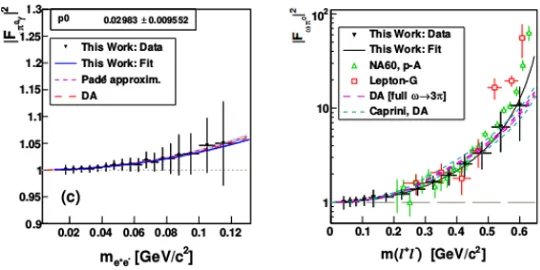
theory [27]. Theπ0Dalitz decay was searched for in events containing 3 and 4 reconstructed clusters. For the final event selection kinematic-fit [28, 29] was used both to select the signal and reject the main background contribution, coming fromπ0 → γγevents. The lepton pairs were identified by requiring two hits in the PID. The final event sample of 4.0·105 π0Dalitz decays was split up into 18 bins in them(e+e−) range 15-120 MeV. The Dalitz decays were corrected for the efficiency in each bin ofm(e+e−) and divided by the corresponding QED contributions and decay widths. The form factor squared,|Fπ0γ|2, shown as a function ofm(e+e−) for theπ0 Dalitz decay, is seen in the
left frame of Fig. 1. By fitting the pole approximation its slope parameter was obtained as aπ =
0.030±0.010tot, where the error includes both statistical and systematical uncertainties. This result is
in good agreement with the PDG value [23] and theoretical estimates [26, 27]. At the same time as the A2 result became available [1], also the NA62 collaboration released their results [25]. They obtained the valueaπ =0.0368±0.0051stat±0.0025systwhich is in good agreement with the A2 result. In the
near future a new high-statisticsπ0Dalitz decay measurement from A2 is planned.
3.3 η→e+e−γ
For theη Dalitz decay, the best experimental result for the slope parameter comes from the NA60 collaboration, Λ−ηγ2 = (1.934±0.067stat ±0.050syst) GeV−2 [30]. There are two previous results
from the A2 collaboration at MAMI [32, 33] and the higher-statistics result measured the value
Λ−2
η = (1.95±0.15stat ±0.10syst) GeV−2. A recent theoretical prediction comes from the Jülich
group, using a dispersive approach [34, 35]. In addition, there are also predictions based on Padé approximants [36] and with a chiral Lagrangian approach [37]. For the Dalitz decay analysis both 3-and 4-cluster events were selected, 3-and kinematic-fit was used both to identify the signal channel 3-and reject background contributions. The only serious background candidate comes fromη →γγwhere one photon undergoes conversion in the material between the production vertex and the calorimeter material. The remaining final event sample contained 5.4·104 ηDalitz decays and the fit with the
pole approximation to the data givesΛ−2
η = (1.97±0.13) GeV−2, in agreement with the previous
results [30–33] and theoretical calculations [34–37].
3.4 ω→e+e−π0
Much attention has been given to the time-likeωπ0 TFF in theq-range covered by theω → π0l+l+
decay. This is because the available experimental data from NA60 [30, 31] and Lepton-G [38] for
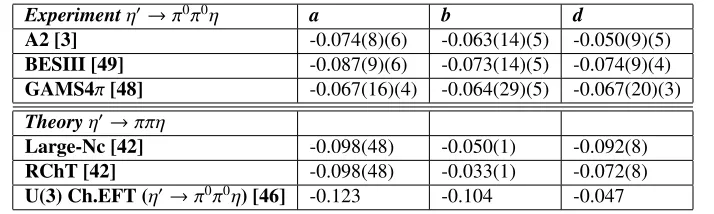
m(l+l−) >600 MeV are discrepant, so far, with every available theoretical approach. One of these approaches are also calculated under model-independent assumptions [39]. The experimental data are, however, in agreement with each other. For the A2 analysis only five-cluster events were selected, as four-cluster events resulted in much larger background contributions. For this channel there are three major sources of background: γp → π0π0p,γp → π0ηpandω → π+π−π0. Suppression of these
channels required analysis of energy losses in the PID, cuts on the kinematic-fit confidence level (CL), vertex cuts and cuts based on electromagnetic shower properties. The number ofω→π0e+e− events in the final sample was 1.1·103. The fit to the form factor|F
ωπ0|2, shown in the right frame
of Fig. 1, gives the fit valueΛ−ωπ20 =(1.99±0.21tot) GeV
−2. This is a bit lower compared to the latest
result from NA60,Λ−ωπ20 =(2.223±0.026stat±0.037syst) GeV
−2 [30], and in better agreement with
Figure 1. (left)|Fπ0γ|2 results with total uncertainties. The fitted values to the points are shown by blue lines, withp0 being the slope parameteraπ. Comparison to calculations with Padé approximants [26] is seen as the short-dashed magenta line with a gray error band and to the dispersive analysis (DA) [27] shown as the red, long-dashed line. The error band for the latter analysis is by a factor of four narrower, compared [26], and is omitted. (right)|Fωπ0(me+e−)|2 results (black filled triangles) fitted with the pole approximation (black solid line). The experimental results from Lepton-G [38] (open red squares) and NA60 in p–A collisions [30] (open green triangles) are shown together with dispersive analysis calculation by the Bonn group [40] (magenta dashed lines) and upper and lower bounds by Caprini [41] (cyan dashed lines) for the discontinuity calculated with the partial-wave amplitudef1(t) based on [40].
4
η
0→
π
0π
0η
Theη0meson and its decay modes play an important role in understanding low-energy QCD and its related theoretical models [42, 46, 47]. The neutral decay modeη0 → π0π0ηallows a test of pion
scattering length combinations, most notably seen as a cusp in them(π0π0) spectrum at theπ+π−mass threshold [43]. The matrix element for theη0 → π1π2ηdecay is described by the Dalitz plot where
three body decays are expressed in terms of the variablesXandY, defined in eqn. (2). The Dalitz plot is expanded aroundX=Y =0 and a polynomial is used for describing the matrix element,
X= √
3
Q (Tπ1−Tπ2), Y =
Tη
Q( mη
mπ +2)
−1, |M|2∼1+aY+bY2+cX+dX2, (2)
wherea, b, cand d are Dalitz plot parameters. The observablesTπ1, Tπ2 and Tη are the kinetic
energies of the two final-state pions andη, respectively. All kinetic energies are calculated in theη0 rest frame. The sum of kinetic energies are given byQ=Tη+Tπ1+Tπ2 =mη0−mη−2mπ. All Dalitz
plot parameters of odd-poweredX are expected to be 0 for symmetry reasons. Recent experimental determinations and theoretical estimates of the Dalitz plot parameters are given in Table 1. The reactionγp→η0p →π0π0ηp→ 6γpwas searched for in 7-cluster events, assuming that one of the
clusters was from the recoil proton. Suppression of the background channelγp→π0π0π0pwas done
Experimentη0→π0π0η a b d
A2 [3] -0.074(8)(6) -0.063(14)(5) -0.050(9)(5)
BESIII [49] -0.087(9)(6) -0.073(14)(5) -0.074(9)(4)
GAMS4π[48] -0.067(16)(4) -0.064(29)(5) -0.067(20)(3)
Theoryη0→ππη
Large-Nc [42] -0.098(48) -0.050(1) -0.092(8)
RChT [42] -0.098(48) -0.033(1) -0.072(8)
U(3) Ch.EFT (η0→π0π0η) [46] -0.123 -0.104 -0.047
Table 1.Dalitz plot-parameter values forη0→π0π0ηwith errors given in the parentheses. For the experimental
data, the first and second parentheses denote the statistical and systematical errors, respectively.
the BESIII collaborations [49]. The A2 result is consistent with these measurements. In addition, for the first time the statistics and experimental resolution allowed, an observation of a structure below theπ+π−mass threshold, in good agreement with the predicted cusp based on theππscattering length combination,a0−a2, previously extracted fromK→3πdecays [50].
5 Summary
In these proceedings, three recent results from the A2 collaboration were presented for the TFFs
|Fπ0γ|,|Fηγ|and|Fωπ0|. These were obtained by analyzing the decaysπ0 → e+e−γ,η → e+e−γand ω→π0e+e−and the slope parameters for the e/m TFFs were given. While the results for theπ0and
ηDalitz decays are in agreement with other experimental results and theoretical calculations, |Fωπ0|
are in a better agreement with theoretical calculations, compared to the available experimental data. However, because of limited experimental statistics, no firm conclusion can be drawn to rule out the previousω→π0l+l−results. For the decay modeη0→π0π0ηthe Dalitz-plot parameters were given.
In the future, results for the decaysη0→e+e−γandη0→ωγfrom A2 can be expected.
References
[1] P. Adlarsonet al.(A2 Collaboration at MAMI), Phys. Rev. C95025202 (2017). [2] P. Adlarsonet al.(A2 Collaboration at MAMI), Phys. Rev. C95035208 (2017). [3] P. Adlarsonet al.(A2 Collaboration at MAMI), arXiv:1709.04230 [hep-ex]. [4] H. Herminghauset al., IEEE Trans. Nucl. Sci.30, 3274 (1983).
[5] K.-H. Kaiseret al., Nucl. Instrum. Methods Phys. Res. A593, 159 (2008). [6] I. Anthonyet al., Nucl. Instrum. Methods Phys. Res. A301, 230 (1991). [7] S. J. Hallet al., Nucl. Instrum. Methods Phys. Res. A368, 698 (1996). [8] J. C. McGeorgeet al., EPJ A37, 129 (2008).
[9] P. Adlarsonet al., Phys. Rev. C 92, 024617 (2015). [10] A. Starostinet al., Phys. Rev. C64, 055205 (2001). [11] R. Novotny, IEEE Trans. Nucl. Sci.38, 379 (1991).
[12] A. R. Gableret al., Nucl. Instrum. Methods Phys. Res. A346, 168 (1994).
[13] D. Watts,Proceedings of the 11th International Conference on Calorimetry in Particle Physics, Perugia, Italy, 2004 (World Scientific, Singapore, 2005), p. 560.
[15] J. Grangeet al.(Muon g-2 Collaboration), FERMILAB-FN-0992-E, FERMILAB- DESIGN-2014-02; B. L. Roberts, these proceedings.
[16] T. Mibe(J-PARC g-2 Collaboration), Chin. Phys. C34, 745 (2010); these proceedings. [17] M. Davier, A. Hoecker, B. Malaescu, Z. Zhang. EPJ C71, 1515 (2011).
[18] M. Benayoun, P. David, L. DelBuono, F. Jegerlehner, EPJ C75, 613 (2015). [19] A. Nyffeler, Phys. Rev. D94, 053006 (2016).
[20] V. Pauk, M. Vanderhaeghen, Phys. Rev. D90, 113012 (2014).
[21] G. Colangelo, M. Hoferichter, M. Procura, JHEP 1409, 091 (2014); G. Colangelo, M. Hoferichter, B. Kubis, M. Procura, P. Stoffer, Phys. Lett. B 738, 6 (2014); G. Colangelo, M. Hoferichter, M. Procura, P. Stoffer, JHEP1509, 074 (2015).
[22] L. G. Landsberg, Phys. Rep.128, 301 (1985).
[23] C. Patrignaniet al.(Particle Data Group), Chin. Phys. C40, 100001 (2016). [24] H. J. Behrendet al.(CELLO Collaboration), Z. Phys. C49(1991) 401 (1991). [25] C. Lazzeroniet al.(NA62 Collaboration), arXiv:1612.08162 [hep-ex].
[26] P. Masjuan, Phys. Rev. D86, 094021 (2012).
[27] M. Hoferichter, B. Kubis, S. Leupold, F. Niecknig, S.P. Schneider, EPJ C74, 3180 (2014). [28] V. Blobel, E. Lohrmann. Statistische Methoden der Datenanalyse, Teubner Studienbücher,
Teub-ner, e-book http://www.desy.de/blobel/eBuch.pdf, 1998.
[29] S. Prakhovet al.(Crystal Ball Collaboration at MAMI and A2 Collaboration), Phys. Rev. C
79, 035204 (2009).
[30] R. Arnaldiet al., Phys. Lett. B757, 47 (2016). [31] R. Arnaldiet al., Phys. Lett. B677, 260 (2009). [32] H. Berghäuseret al., Phys. Lett. B701, 562 (2011). [33] P. Aguar-Bartolomeet al.Phys. Rev. C89, 044608 (2014).
[34] C. Hanhart, A. Kup´s´c, U.-G. Meißner, F. Stollenwerk, A. Wirzba, EPJ C73, 2668 (2013);ibid. 75, 242 (2015).
[35] C. W. Xiao, T. Dato, C. Hanhart, B. Kubis, U.-G. Meißner, A. Wirzba, arXiv:1509.02194 [hep-ph].
[36] R. Escribano, P. Masjuan, P. Sanchez-Puertas, Phys. Rev. D89, 034014 (2014); EPJ C75, 414 (2015).
[37] C. Terschlüsen, Diploma Thesis, University of Gießen, 2010; C. Terschlüsen, S. Leupold, M. F. M. Lutz, EPJ A48, 190 (2012).
[38] R. I. Dzhelyadinet al., Phys. Lett. B102, 296 (1981).
[39] B. Ananthanarayan, I. Caprini, B. Kubis, EPJ C74, 3209 (2014). [40] S. P. Schneider, B. Kubis, F. Niecknig, Phys. Rev. D86, 054013 (2012). [41] I. Caprini, Phys. Rev. D92, 014014 (2015).
[42] R. Escribano, P. Masjuan, J. J. Sanz- Cillero. JHEP,05, 094 (2011). [43] B. Kubis, S P. Schneider, EPJ C62, 511 (2009).
[44] N. Beisert, B. Borasoy, Nucl. Phys. A,716186 (2003). [45] B. Borasoy, R. Nissler, EPJ A,26383 (2005).
[46] B. Borasoy, U.-G. Meissner, R. Nissler, Phys. Lett. B643, 41 (2006). [47] T. Isken, B. Kubis, S. P. Schneider, P. Stoffer, EPJ C77489 (2017).
[48] A. M. Bliket al.(GAMS4πcollaboration), Phys. Atom. Nucl.72231 (2009). [49] M. Ablikimet al.(BESIII Collaboration), arXiv:1709.04627 [hep-ex].