ISSN: 2319-8753
I
nternational
J
ournal of
I
nnovative
R
esearch in
S
cience,
E
ngineering and
T
echnology
(An ISO 3297: 2007 Certified Organization)
Vol. 2, Issue 10, October 2013
Effect of Ethanol-Gasoline Blends on MPFI
Engine Performance, Emission and
Lubricating oil Properties
K B Siddegowda
1, J Venkatesh
21
Associate Professor , Department of Automobile Engineering, P. E. S. College of Engineering, Mandya-571401, Karnataka, India
2
Professor, Department of Automobile Engineering, P. E. S. College of Engineering, Mandya-571401, Karnataka, India.
Abstract: Experimental investigation has been carried out on MPFI engine to study the effects of gasoline-ethanol
blends on lubricating properties. For any four stroke engine the function of engine lubricants play an important role since the lubricants does not burn along with fuel in the combustion chamber as two stroke engine. The lubricant will circulate around inside the engine and its quality decreased time b y time. Basically the functions of engine lubricants are prevent wear from friction and keep the engine cool. The performance of engine lubricants is to reduce friction, oxidation, minimize deposit formation and prevent corrosion and wear. In this experimental study of gasoline and gasoline-ethanol blends like 10, 20, 30, by volume compared with results gasoline and gasoline ethanol blends. The lubricating properties examined in the assessment work lubricating capacity, viscosity, stability of oxidation, foaming charactes, carbon residue and flash point , kinematic viscosity and iron content are lower than gasoline run engine can be effectively used with E20. The lubricating properties are examined by AAS and IS standards.
Keywords: MPFI engine, gasoline-ethanol blends, lubricating oil, viscosity
I. INTRODUCTION
When one surface moves over other there is always some resistance to movement. The force that opposes movement called friction. Generally lubricant is to reduce friction like metal rolling, and elimination of brake and clutch in the car. The lubricating system provides oil as a film between the moving parts of the engine to prevent wear from friction and to keep the engine cool. Lubricating oil should provide the film of proper thickness between the moving surfaces under all conditions of operations remains stable under changing temperature conditions and not to corrode the metal surface [6]. Apart from lubrication engine oil lubricating moving parts, also cleans inhibits corrosion, improves sealing and cools the engine by carrying heat away from moving parts [3].The environment in which it operates affects lubricant stability such factors as temperature, oxidation, potential and contamination with water, unburnt fuel fragments corrosive acid limits the useful life of the lubricant [6].
ISSN: 2319-8753
I
nternational
J
ournal of
I
nnovative
R
esearch in
S
cience,
E
ngineering and
T
echnology
(An ISO 3297: 2007 Certified Organization)
Vol. 2, Issue 10, October 2013
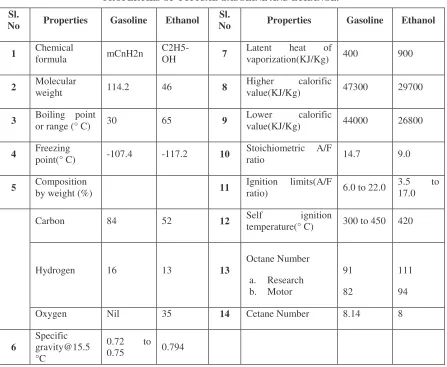
emissions are increased due to increased combustion. The lubricating oil used in pure gasoline the same oil may be used in gasohol. Table.1 shows the properties of typical gasoline used as I.C. engine fuel and ethanol.
II. PRODUCTION OF ETHANOL
As the main intention of using alternative fuels is to save gasoline, it must be obtained from non-petroleum products. Ethanol can be easily manufactured from non-petroleum products such as sugarcane, corn, timber and other cellulose wastes. India being an agro – based country is having good prospects of producing sugarcane. Production of ethanol from sugarcane requires only simple, well – established processes since the fermentable sugar is obtained directly from sugarcane.The cane is first cut and ground, and the cane juice is extracted by maceration. After clarification by filtration and concentration through evaporation, the juice is fermented with yeast to yield raw ethanol. A series of distillation steps, including a final extractive distillation with benzene are used to obtain anhydrous ethanol. Ethanol is produced by fermentation of carbohydrates by the Gay Lussac relation. In this process 180 gram of ethanol of carbohydrates are converted to liquid fuel weighing only 92 gram with almost no loss of energy. Figure 2.3.1 shows schematically the conversion of sugarcane to ethanol in a sugar factory via the molasses route. Such manufacturing plants of ethanol can easily be set up along with sugar factory to utilize raw product of sugar factory called molasses. In fact, there are such plants installed in western Maharashtra at Sangli, Satara and Solapur districts.
Figure.1: Conversion of sugarcane to ethanol
Table.1 shows the properties of typical gasoline used as I.C. engine fuel and ethanol.
II. EXPERIMENTAL SETUP AND TESTING
ISSN: 2319-8753
I
nternational
J
ournal of
I
nnovative
R
esearch in
S
cience,
E
ngineering and
T
echnology
(An ISO 3297: 2007 Certified Organization)
Vol. 2, Issue 10, October 2013
23min each. The various parameters such as lubricating oil temperature, water inlet temperature, water outlet temperature, amount of fuel consumed per minute, CO, HC emission reading etc are taken into consideration and readings are taken. In the third mode, the engine is made to run for two hour under constant speed of 3000rpm and constant load of 8Kg. In terms of kmph the engine is made to run at 70kmph speed. The readings of the various parameters as mentioned above should be taken. Again, in the fourth mode, the engine is made to run for 45min under constant speed of 3500 rpm and constant load of 10 Kg. In terms of kmph the engine is made to run at 85 kmph speed and various readings are taken. In the fifth mode, the engine is run for 50 min. under constant speed of 2500 rpm and gradually decreasing load from 8Kg to 0 Kg. For each load the engine is made to run for 10min each in terms of kmph the engine is made to run at 60kmph.
TABLE 1:
PROPERTIES OF TYPICAL GASOLINE AND ETHANOL.
Sl.
No Properties Gasoline Ethanol
Sl.
No Properties Gasoline Ethanol
1 Chemical
formula mCnH2n
C2H5-OH 7
Latent heat of
vaporization(KJ/Kg) 400 900
2 Molecular
weight 114.2 46 8
Higher calorific
value(KJ/Kg) 47300 29700
3 Boiling point
or range (° C) 30 65 9
Lower calorific
value(KJ/Kg) 44000 26800
4 Freezing
point(° C) -107.4 -117.2 10
Stoichiometric A/F
ratio 14.7 9.0
5 Composition
by weight (%) 11
Ignition limits(A/F
ratio) 6.0 to 22.0
3.5 to
17.0
Carbon 84 52 12 Self ignition
temperature(° C) 300 to 450 420
Hydrogen 16 13 13
Octane Number
a. Research
b. Motor
91
82
111
94
Oxygen Nil 35 14 Cetane Number 8.14 8
6
Specific [email protected] °C
0.72 to
ISSN: 2319-8753
I
nternational
J
ournal of
I
nnovative
R
esearch in
S
cience,
E
ngineering and
T
echnology
(An ISO 3297: 2007 Certified Organization)
Vol. 2, Issue 10, October 2013
1. Engine test rig 14. Speedometer 2. Engine bed 15. Fuel Indicator 3. Engine 16. Exhaust pipe
4. Shaft 17.Cylinder cut off switch 5. Dynamometer
6. Loading arrangement 7. Water supply 8. Ignition switch 9. Load indicator
10. Dynamometer speed indicator 11. Temperature indicator 12. Ignition switch
13. Accelerometer
Figure 2: Schematic diagram of experimental setup
III. RESULTS AND DISCUSSION
A. TOTAL FUEL CONSUMPTION
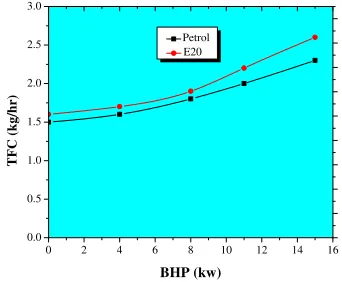
Figure 3 & Figure 4 shows the variation of total fuel consumption verses brake horse power for 100% gasoline and E-20 run engine at 2000 and 2500 rpm speed of the engine. It is seen from the graph that at low and moderate load conditions the fuel consumption with gasoline as a fuel is comparatively lower than that of E20. This is because a gallon of ethanol contains less than 2/3 of the energy of a gallon of petrol. Hence the volumetric fuel economy decreased slightly with E-20 in comparison with 100% gasoline run engine.
0 2 4 6 8 10 12 14
0.0 0.5 1.0 1.5 2.0 2.5
Petrol E20
BHP (kW)
T
F
C
(
k
g
/h
r)
0 2 4 6 8 10 12 14 16
0.0 0.5 1.0 1.5 2.0 2.5 3.0
Petrol E20
BHP (kw)
TFC (kg/hr)
Fig.3: Variation of TFC with BHP at 2000rpm FiFg.4: Variation of TFC with BHP at 2500rpm
B. SPECIFIC FUEL CONSUMPTION
ISSN: 2319-8753
I
nternational
J
ournal of
I
nnovative
R
esearch in
S
cience,
E
ngineering and
T
echnology
(An ISO 3297: 2007 Certified Organization)
Vol. 2, Issue 10, October 2013
required for petrol (14.7:1), also the calorific value (CV) of ethanol is lower than that of petrol. To generate equal amount of energy, approximately 64% greater weight of ethanol is required as compared to petrol. Hence for E20 also the SFC is slightly more in comparison to 100% gasoline, however energy based economy increased using ethanol gasoline blend because of the increase in octane number of the ethanol- gasoline blend due to which the combustion characteristics are improved and consequently proper and effective burning of the fuel.
0 2 4 6 8 10 12 14 16 0.0
0.1 0.2 0.3 0.4 0.5 0.6
Petrol E20
BHP (kW)
SFC (kg/kW-hr)
0 2 4 6 8 10 12 14 16
0.0 0.1 0.2 0.3 0.4 0.5 0.6
Petrol E20
BHP (kW)
SFC (kg/kW-hr)
Fig.5: Variation of SFC with BHP at 2000rpm Fig.6: Variation of SFC with BHP at 2500rpm
C. BRAKE THERMAL EFFICIENCY
The Fig.7 & Fig.8 shows the variation of brake thermal efficiency versus brake horse power for different engine speed. It is seen from graph that the brake thermal efficiency of E20 is slightly higher than that of the 100% gasoline. This is mainly because of the fact that the Cv of ethanol-gasoline blend (E20) is lower than that of the gasoline. Again, since the low engine speed and moderate load condition the total fuel consumption for E-20 is higher as compare to 100% gasoline, the brake thermal efficiency of E20 is only slightly higher in comparison with 100% gasoline at 2000 rpm engine speed.
0 2 4 6 8 10 12 14
0 5 10 15 20 25 30 35 40 45
Petrol E20
BHP (kW)
Thermal Efficency (%)
0 2 4 6 8 10 12 14 16
0 5 10 15 20 25 30 35 40 45
Petrol E20
BHP (kW)
Thermal Efficency (%)
ISSN: 2319-8753
I
nternational
J
ournal of
I
nnovative
R
esearch in
S
cience,
E
ngineering and
T
echnology
(An ISO 3297: 2007 Certified Organization)
Vol. 2, Issue 10, October 2013
D. MECHANICAL EFFICIENCY
Fig.9 shows the variation of mechanical efficiency in percentage verses load in kg for E-20 and 100% gasoline. From the graph it is seen that the mechanical efficiency of E-20 fuel engine is always in higher side than that of the gasoline engine. At all load conditions the mechanical efficiency of E-20 is higher than that of 100% gasoline. It is also seen from the graph that the differences in the values of mechanical efficiency are higher at higher load condition.
0 2 4 6 8 10 12 14 16 18 0
5 10 15 20 25 30 35 40 45 50
Petrol E20
BHP (kW)
Mechanical Efficency (%)
Fig.9: Variation of Mechanical efficiency with BHP at 2500rpm
E. EXHAUST EMISSION i. CARBON MONOXIDE
The Fig.10 shows the variation of CO emission in percentage verses load in Kg for 100% gasoline and E-20 at different engine speed. It is seen from the graph that CO emission of E-20 is far better than the gasoline at all load condition. The CO emission of 100% gasoline may be as high as 0.6% whereas for E-20 it is as high as 0.4%. The reduction in the CO emission with E-20 is because of the enleanment of the mixture due to ethanol and also due to the improved catalyst oxidation efficiency with excess oxygen content.
0 1 2 3 4 5 6 7 8 9
0.0 0.1 0.2 0.3 0.4 0.5 0.6 0.7
Petrol E20
Load (kg)
CO (%)
0 1 2 3 4 5 6 7 8 9
0 10 20 30 40 50 60 70 80
Petrol E20
Load (kg)
HC (%)
ISSN: 2319-8753
I
nternational
J
ournal of
I
nnovative
R
esearch in
S
cience,
E
ngineering and
T
echnology
(An ISO 3297: 2007 Certified Organization)
Vol. 2, Issue 10, October 2013
ii. HYDRO CARBON
The Fig.11 shows the variation of HC emission (in ppm) verses load for 100% gasoline and E-20 respectively. From the graph it is seen that the HC emission for E20 is greatly reduced in comparison to 100% gasoline. This is because of the fact that addition of ethanol improves the octane number of the fuel due to which the fuel will burn more completely resulting in lesser unburned HC emission.
IV. CONCLUSION
One can run the engine efficiently and economically with ethanol gasoline blend(E20) as engine fuels for SI engines.
Alcohols are basically not suitable for C.I engine operation, because of their lower cetane number.
Use of alcohol-gasoline blend improves start ability because of increase in octane number of fuel due to addition of alcohol into gasoline.
The high octane number of alcohols compared to gasoline means higher compression ratio can be used, which results in higher engine efficiency and higher power from engine.
Existing engine cannot be run with straight alcohol, because the engine needs certain modification in the fuel supply system.
Use of ethanol-gasoline blend (E20) as an engine fuel results in lesser CO emissions compared to gasoline. Fuel consumption is slightly increased by using ethanol-gasoline blend (E20) as compared to gasoline.
Specific fuel consumption is slightly higher for E20. This means that the volumetric fuel economy is decreased whereas energy wise fuel economy is increased.
Brake thermal efficiency of the engine using gasoline ethanol blend is considerably more than that of the engine using gasoline alone as fuel.
Mechanical efficiency of the engine using gasoline ethanol blend is considerably more than that of the engine using gasoline alone as a fuel.
Use of ethanol gasoline blend (E20) results in lesser HC emission compared to gasoline. The lubricating oil used for gasoline run engine can be effectively used with E20.
REFERENCES
[1] Richard van Basshuysen and Fred Schafer, Internal Combustion Engine Handbook, SAE Publications. [2] BOSCH, Automotive Handbook, 5th Edition.
[3] Maruti 800 Service Manual.
[4] A Study of Motorcycle Oils by AMSOIL.
[5] Abstracts of Procedures Performed by the Fuels and Lubricants Research Division of SOUTHWEST RESEARCH INSTITUTE, USA. [6] Challenge- to meet stringent emission norms by Dr. D.S.Khatri, Engineering Division, Maruti Udyog Ltd.
[7] R.K PEFLEY, A Feedback controlled fuel injection system can accommodate any alcohol-gasoline blend, University of Santa Clara, California, U.S.A.
[8] Jerry R. Allsup, Ethanol/Gasoline blends as Automotive Fuels, Department of Energy, U.S.A. [9] Ethanol-Gasoline blend as Automotive Fuels, Govt College of Engineering, Karad. [10] Mathur & Sharma, A course in I.C.Engines, Dhanpat Rai Publications,
[11] Kirpal Singh, Automobile Engineering Volume I & II, Standard Publishers Distributors.