X
(3915)
as a tensor
D
∗D
¯
∗molecule
V. Baru1,2,?, C. Hanhart3,??, and A. V. Nefediev2,4,5,???
1Institut für Theoretische Physik II, Ruhr-Universität Bochum, D-44780 Bochum, Germany
2Institute for Theoretical and Experimental Physics, B. Cheremushkinskaya 25, 117218 Moscow, Russia
3Forschungszentrum Jülich, Institute for Advanced Simulation, Institut für Kernphysik and Jülich Center for
Hadron Physics, D-52425 Jülich, Germany
4National Research Nuclear University MEPhI, 115409, Kashirskoe highway 31, Moscow, Russia Moscow
Institute of Physics and Technology, 141700
5Institutsky lane 9, Dolgoprudny, Moscow Region, Russia
Abstract.Two-photon decays of a tensorD∗¯ D∗
molecule are studied and the suggested approach is applied to theX(3915) charmonium-like state under the assumption of the latter being a 2++molecule — a spin partner of theX(3872). It is argued that the existing experimental data disfavour such an identification of this state. Therefore, it is suggested that either theX(3915) has a different exotic nature or it has to be identified as a scalar.
1 Introduction
Spectroscopy of the so-called exotic hadronic states keeps on bringing new puzzles for phenome-nologists — for reviews see, for example, [1–6]. One of such states, theX(3915), was observed by the Belle Collaboration in the two-photon annihilation to theωJ/ψfinal state [7], and the variety of options for theJPC quantum numbers of this state was limited to just 0++and 2++. Later, the BaBar Collaboration found the angular distributions in the given final state to favour the 0++ option [8], so that this state is often identified as theχc0(2P) charmonium [9, 10]. It has to be noticed, however, that this assignment was questioned in [11, 12]. It should also be stressed that the experimental analysis by BaBar relies on the assumption of a helicity-2 dominance for the tensor state. Indeed, it was found long ago that in the two-photon decays of the 2++ positronium and quarkonium the helicity-0 am-plitude provides only a small relativistic correction to the dominating helicity-2 amam-plitude [14–16]. However, it was pointed out in [13] that the helicity-2 dominance constraint may be relaxed in the data analysis if one assumes theX(3915) to be an exotic state. The authors concluded that, for the helicity-0 amplitude comparable in magnitude with the helicity-2 one, the measured angular distri-butions are compatible with the 2++quantum numbers for theX(3915). In our recent work [17] we investigated whether or not a prominent helicity-0 component was compatible with theX(3915) being a 2++D∗D¯∗molecular state predicted to exist as tensor spin partner of theX(3872) treated as aDD¯∗
bound state [18]. The results obtained are discussed in this contribution.
2 The amplitude
γγ
→
X
2→
final state
We start from the amplitude of the two-photon fusion processγγ → X2 which, irrespective of a particular nature of the tensor stateX2, takes the form
M(γγ→X2)=Mµνρσεµ(k1)εν(k2)ερσ(p), p=k1+k2, (1)
whereεµ(k1),εν(k2) are the first and the second photon polarisation vector, respectively, andερσis the
X2polarisation tensor which obey the standard constraints,
k1·ε(k1)=k2·ε(k2)=0, pρερσ(p)=pσερσ(p)=gρσερσ(p)=0. (2)
Since there exist in total four independent, gauge invariant two-photon structures,
S(1)ρσ∝gρσ(∂αFµν(1))(∂αF(2)µν), (3)
S(2)ρσ∝(∂ρFµν(1))(∂σF(2)µν)+(∂σF(1)µν)(∂ρF(2)µν)−1
2gρσ(∂αF (1)
µν)(∂αF(2)µν), (4)
S(3)ρσ∝(∂ρ∂σF(1)µν)F(2)µν+Fµν(1)(∂ρ∂σF(2)µν), (5)
S(4)ρσ∝F(1)ρβFσ(2)β+F(1)σβFρ(2)β−1
2gρσF (1)
µνF(2)µν, (6)
the amplitudeMµνρσfrom (1) can be expanded as
Mµνρσ=gX2D∗D¯∗e
2 4
X
n=1
Cneµνρσn (7)
in a complete set of four tensors{eµνρσn }(n = 1..4) which are defined by the structures (3)-(6) and which can be chosen to be mutually orthogonal, normalised, symmetric and transversal,
eµνρσm e
µνρσ
n =δmn, e
µνρσ
n =e
µνσρ
n , k1µe µνρσ
n =k2νe µνρσ
n =0, m,n=1,4. (8)
In particular, for real photons, a possible choice of such tensors is given by [17]
eµνρσ1 = 1
2 √
2
gρσ gµν− k1νk µ 2 (k1·k2)
!
, (9)
eµνρσ2 = √1 2
k1ρk2σ+k1σkρ2
(k1·k2) −1
2g
ρσ! gµν− kν1k µ 2 (k1·k2)
!
, (10)
eµνρσ3 =
kρ1kσ1 +k2ρk2σ
2(k1·k2)
gµν− kν1k µ 2 (k1·k2)
!
, (11)
eµνρσ4 = 1
2 √
2
k1σk2µgνρ+k1ρk2µgνσ−(k1σk2ρ+k1ρk2σ)gµν (k1·k2)
−gµσ gνρ− k
ν 1k
ρ 2 (k1·k2)
!
−gµρ gνσ− k
ν 1k
σ 2 (k1·k2)
!
+gρσ gµν−
kν1k2µ
(k1·k2)
!!
. (12)
It can be demonstrated that, due to the properties of the polarisation tensorερσ(p), only the coeffi -cientC4and the linear combination (C2
√
2−C3) contribute to the helicity-2 and helicity-0 amplitude, respectively, of the two-photon annihilation process which is assumed to proceed through the forma-tion of the tensor stateX2 [17]. Then, for any final state f, the angular distribution takes a universal form,
dσ(γγ→X2→ f)
dcosθ =constf
h
|A0|2f (f)
0 (cosθ)+2|A±2| 2f(f)
2 (cosθ)
i
k1
k2 l
l+k1
l−k2 D∗
D∗ D(∗)
k1
k2 l
l+k2
l−k1 D∗
D∗ D(∗)
k1
k2
l+k1
l−k2
D∗
D∗
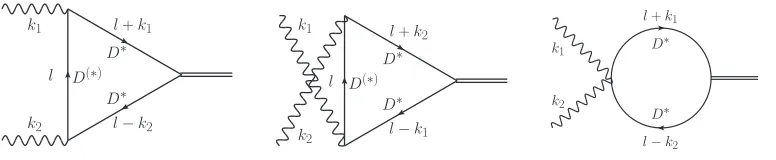
Figure 1.Diagrams contributing to amplitude (1) in the molecule picture of theX(3915).
where the functions f0(f)and f2(f)depend on the particular final state and are given by the normalised helicity-0 and helicity-2 distribution, respectively — see, for example, the distributions derived in [13, 17, 19]. The dynamics of the reaction is encoded in the helicity amplitudesA0andA±2trivially related to the aforementioned combinations of the coefficientsCn,
A0=C2 √
2−C3, A±2 =
r
3
2C4. (14)
It also proves convenient to introduce a ratio of the amplitudes,
R≡2|A±2| 2
|A0|2
, (15)
which defines the relative strength of the helicity-0 and helicity-2 contributions to the probability. In particular, the total cross section can be presented in the form
σ(γγ→X2→final state)=σ0(1+R), (16)
whereσ0corresponds to the total cross section evaluated solely for the helicity-0 amplitude. If the helicity-2 component is dominant, like for the genuine tensor quarkonium [16],R1.
3 Ratio of the helicity amplitudes from data
If one assumes theX(3915) to be anS-wave molecular state with the quantum numbers 2++ then the only plausible candidate for such a resonance is theD∗D¯∗molecule. Then, its dominating
pro-duction/decay mechanism proceeds through the S-waveX2 → D∗D¯∗ vertex preceded/followed by
D(∗)-meson loops, as depicted in Fig. 1. It is important to note that, while each individual coefficient
Cn defined in (7) and given by a loop integral diverges, the combinationC2 √
2−C3(and, therefore, the helicity-0 contribution to the two-photon width of theX(3915)) appears to be finite [17], so that one needs only one observable to completely fix the model.
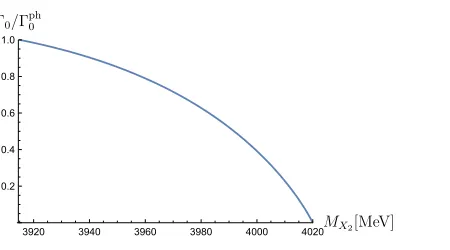
However, before we proceed to the full calculation, we make an instructive exercise and study the dependence of the helicity-0 contribution to the two-photon width on the mass of the resonance. To make things even more transparent, we evaluate the ratioΓ0(MX2)/Γ
ph
0 , where Γ ph
0 ≡ Γ0(M ph X2)
withMphX
2 = 3915 MeV. In this ratio, the coupling constantgX2D∗D¯∗ drops out since it scales both
helicity components and, therefore, the result is insensitive to the details of the molecule coupling to its constituents and as such is a prediction of the model, although it is known to carry a significant mass dependence itself,g2
X2D∗D¯∗
∝ p
The result of the calculations is depicted in Fig. 2 and demonstrates that, near the threshold, the helicity-0 part to the width vanishes as a result of strong cancellations between different contributions to the amplitude. In other words, near the threshold, helicity-2 dominance holds also for theD∗D¯∗
molecule, in analogy to regular charmonia. However, since the mass of theX(3915) is significantly below theD∗D¯∗threshold, further considerations appear to be necessary.
In order to proceed to the calculation of the two-photon width of theX(3915) one needs to estimate the couplinggX2D∗D¯∗. Typically, as was mentioned above, the coupling constant of a molecule to its
constituents can be evaluated through its binding energy [20, 21], however, in case of theX(3915) as a
D∗D¯∗molecule, the binding energy appears to be as large as about 100 MeV that entails uncontrolled
finite-range corrections to the coupling obtained this way. We choose to bypass this problem by employing an additional assumption that theX(3915) is a spin-2 partner of theX(3872) treated as the
DD¯∗molecule. Under this assumption, the couplingsg
X1DD¯∗ andgX2D∗D¯∗are related by the
Heavy-Quark Spin Symmetry (HQSS) which is expected to be accurate up to the corrections1governed by a fairly small parameterΛQCD/mc'1/5. Since the binding energy of theX(3872) is tiny [10],
EB=m0+m∗0−MX1=0.01±0.20 MeV, (17)
wherem0 andm∗0 are the masses of the neutral D and D∗ mesons, respectively, the finite-range corrections to the result for the couplinggX1DD¯∗ derived from value (17) [22] are also tiny, and the
main uncertainty comes from the accuracy of the binding energy extraction from the data — see the error in (17). For the reasons explained below we choose the maximal valueEB = 0.21 MeV consistent with the experimental result (17). This allows us to arrive at the following theoretical prediction for the two-photon decay width of theX(3915):
Γth(X2→γγ)= Γ0(X2→γγ) [1+R], (18)
where, as before,Γ0(X2→γγ) denotes the width evaluated solely for the helicity-0 amplitude [17],
Γ0(X2→γγ).0.015 keV. (19)
We may now employ the result from (18) to extract the ratioRfrom the data onΓ(X(3915)→γγ) for which we take the value
Γexp(X(3915)→γγ)'0.18 keV (20) consistent with various measurements performed by Belle and BaBar [10] — see a detailed discussion of the issue in [17].
Therefore, in order to reconcile the theoretical result from (18) with the experimental one con-tained in (20) one needs as large ratiosRas
R&111, (21)
and it is important to notice that smaller values of theX(3872) bindingEBwould result in even larger values ofRin (21) that justifies our above-mentioned choice of the maximalEB consistent with the data.
4 Conclusions
In conclusion, let us summarise the results obtained in this work and give an outlook.
3920 3940 3960 3980 4000 4020 0.2
0.4 0.6 0.8 1.0
Figure 2.The helicity-0 contribution to the width,Γ0(X2→γγ), in units of its physical value (that is, its value at the mass 3915 MeV) as a function of the mass of theX2state. In this ratio, the binding energyEBis cancelled.
Motivated by the claim made in [13], we investigate the possibility that theX(3915) charmonium-like state may be identified as a tensorD∗D¯∗molecule and as such may have a prominent helicity-0 component in its wave function which would allow one to treat theX(3915) as a helicity-0 realisation of theχc2(3930) state.2Thus, we study the two-photon annihilation processes proceeding through the
X(3915) and, in particular, evaluate the two-photon decay width of this state. We find that, for the tensorD∗D¯∗molecule, the helicity-0 component vanishes as the binding energy tends to zero while the helicity-2 piece (which contains an unknown counter term) is expected to be finite, unless theX(3915) completely decouples from theγγchannel in this limit. Thus, it appears natural that theX(3915), as a shallow bound state, shares the feature of a helicity-2 dominance with regular charmonia.
As a next step, we employ the Occam’s razor principle to identify the tensorX(3915) state with the hypothetical spin-2 partner of theX(3872) treated as an axial-vectorDD¯∗molecule. This allows us to use the HQSS constraints to relate the coupling constant of theX(3915) to theD∗D¯∗pair with the experimentally measured binding energy of theX(3872). Then we evaluate the contribution of the helicity-0 amplitude to the two-photon decay width of theX(3915), which is finite and comes out as a prediction of the model, and argue that the experimental data presently available favour a scenario in which the contribution of the helicity-2 amplitude dominates over the helicity-0 one, similarly to the case of the genuine 2++charmonium. Therefore, if theX(3915) is indeed dominated by the helicity-0 contribution of a nearby tensor state, as suggested in [13], its nature would require some exotic interpretation related neither with regular quarkonia nor with theD∗D¯∗spin partner of theX(3872). However, an important disclaimer for the results and conclusions obtained in this work is that the analysis performed is subject to several uncertainties which are difficult to quantify, given the present status of the experimental data as well as our theoretical understanding of the charmonium spectrum above the open-flavour thresholds. We expect that these uncertainties could be reduced in future studies.
An alternative scenario for theX(3915) would be to assign it the quantum numbers 0++ but, to avoid the criticisms contained in [11, 12], to treat it as an exotic scalar. For example, in [25], the
X(3915) was proposed to be a scalarDsD¯smolecule. The scalar D∗D¯∗molecule option also looks plausible for theX(3915), however, it requires an additional experimental input to fix the model. This work is in progress and will be reported elsewhere.
2We adopt the naming scheme defined in the RPP [10], so that calling the stateχ
This work is supported in part by the DFG and the NSFC through funds provided to the Sino-German CRC 110 “Symmetries and the Emergence of Structure in QCD”. Work of A. N. was per-formed within the Institute of Nuclear Physics and Engineering supported by MEPhI Academic Ex-cellence Project (contract No 02.a03.21.0005, 27.08.2013). He also acknowledges support from the Russian Foundation for Basic Research (Grant No. 17-02-00485). Work of V. B. is supported by the DFG (Grant No. GZ: BA 5443/1-1).
References
[1] N. Brambillaet al., Eur. Phys. J. C71, 1534 (2011). [2] N. Brambillaet al., Eur. Phys. J. C74, 2981 (2014).
[3] T. Abeet al.[Belle-II Collaboration], arXiv:1011.0352 [physics.ins-det].
[4] A. G. Drutskoy, F. K. Guo, F. J. Llanes-Estrada, A. V. Nefediev and J. M. Torres-Rincon, Eur. Phys. J. A49, 7 (2013).
[5] D. M. Asneret al., Int. J. Mod. Phys. A24, S1 (2009) [arXiv:0809.1869 [hep-ex]]. [6] M. F. M. Lutzet al.[PANDA Collaboration], arXiv:0903.3905 [hep-ex].
[7] S. Ueharaet al.[Belle Collaboration], Phys. Rev. Lett.104, 092001 (2010). [8] J. P. Leeset al.[BaBar Collaboration], Phys. Rev. D86, 072002 (2012). [9] X. Liu, Z. G. Luo and Z. F. Sun, Phys. Rev. Lett.104, 122001 (2010). [10] C. Patrignaniet al.[Particle Data Group], Chin. Phys. C40, 100001 (2016). [11] F. K. Guo and U. G. Meißner, Phys. Rev. D86, 091501 (2012).
[12] S. L. Olsen, Phys. Rev. D91, 057501 (2015).
[13] Z. Y. Zhou, Z. Xiao and H. Q. Zhou, Phys. Rev. Lett.115, 022001 (2015). [14] A. I. Alekseev, Soviet Zh. Eksp. Teor. Fiz.,34, 1195 (1958).
[15] M. Krammer and H. Krasemann, Phys. Lett.73B, 58 (1978). [16] Z. P. Li, F. E. Close and T. Barnes, Phys. Rev. D43, 2161 (1991). [17] V. Baru, C. Hanhart and A. V. Nefediev, JHEP1706, 010 (2017). [18] J. Nieves and M. P. Valderrama, Phys. Rev. D86(2012) 056004. [19] J. L. Rosner, Phys. Rev. D70, 094023 (2004).
[20] L. D. Landau, Soviet Zh. Eksp. Teor. Fiz.39, 1856 (1960). [21] S. Weinberg, Phys. Rev.137, B672 (1965).
[22] F. K. Guo, C. Hanhart, U. G. Meißner, Q. Wang and Q. Zhao, Phys. Lett. B725, 127 (2013). [23] V. Baru, E. Epelbaum, A. A. Filin, C. Hanhart, U.-G. Meißner and A. V. Nefediev, Phys. Lett. B
763, 20 (2016)