A Generic Design Environment for the Rural Industry Knowledge Acquisition
Shah Jahan Miah
a1, Don Kerr
b, John Gammack
a, Tom Cowan
c aGriffith Business School, Department of Management, Griffith University, Logan Campus,
Queensland, Australia
b
Faculty of Business, University of the Sunshine Coast
Maroochydore DC, Queensland, Australia
cMutdapilly Research Station, Department of Primary Industries and Fisheries, Queensland,
Australia
Abstract
This paper describes a new knowledge acquisition method using a generic design environment where context-sensitive
knowledge is used to build specific DSS for rural business. Although standard knowledge acquisition methods have
been applied in rural business applications, uptake remains low and familiar weaknesses such as obsolescence and
brittleness apply. We describe a decision support system (DSS) building environment where contextual factors relevant
to the end-users are directly taken into consideration. This “end user enabled design environment” (EUEDE) engages
both domain experts in creating an expert knowledge-base and business operators/end users (such as farmers) in using
this knowledge for building their specific DSS. We document the knowledge organisation for the problem domain,
namely a dairy industry application. This development involved a case study research approach used to explore dairy
operational knowledge. In this system end users can tailor their decision-making requirements using their own
judgement to build specific DSSs. In a specific end user’s farming context, each specific DSS provides expert
suggestions to assist farmers in improving their farming practice. The paper also shows the environment’s generic
capability.
Keywords: knowledge acquisition; design environment; rural application; DSS process
1 Introduction
The knowledge acquisition process generally involves problem formulation from the extracted knowledge in the
problem domain. Gunn et al. (1999) discusses existing knowledge acquisition techniques based on manual learning,
machine learning and logic programming. However, these methods suffer from difficulties such as poor understanding
of the key issues of knowledge, users’ ability to incorporate issues outside their area of expertise and the need to engage
highly computational techniques for the purpose (Gunn et al. 1999; Pietersma et al. 2003; Walker and Johnson, 1996).
Meantime rural industry uptake of agricultural DSS is low, (e.g. Cox, 1996; Kerr, 2004; McCown, 2002), and end user
development of DSS is problematic (Wagner, 2000). The problems identified present a clear motivation for the
development of a straightforward knowledge acquisition method for rural businesses. Farmers’ knowledge of local
conditions and expert knowledge of science and best practice are both required for effective decision making,
particularly in a context of an industry undergoing rapid changes. Combination of knowledge from the both parties is
important. Therefore, in this paper, we describe an expert-driven knowledge acquisition method for modelling domain
knowledge relevant to building farm-specific DSS for rural business operators.
We called the new solution software environment an “end user enabled design environment” (EUEDE). EUEDE
represents a specific type of design environment where end users (the people who will be the primary user of the
system) involvement is central. Another reason is that our aim is to focus on the end user’s thought processes, relevant
technology and their own judgement in order to give them active participation in their own application development.
This design environment enables the farmer (end-user), to build a specific DSS that assists decision making by
reporting on the potential production that can be achieved using relevant improvement strategies. In addition, the design
itself will be able to deal with a range of rapidly changing factors in rural business operations (for example as shown in
Kerr and Winklhofer, 2005).
Previous studies reported that low adoption rates are one of the problems associated with current DSS usage in rural
business domains (Cox, 1996; Kerr, 2004; McCown, 2002). These studies identify three main reasons that influence the
adoption rate of agricultural DSS, namely:
1) The developed DSS does not adapt to the rapidly changing situation in farming businesses
2) Many of the DSS modules are developed by researchers with the intention of discovering data relationships
rather than solving real world and practical problems
3) Researcher or solution developer often uses their theoretical knowledge for problem solving rather than using
farmers’ practical knowledge for problem solving.
In addition, Fountas et al. (2006) suggests that farmers base their problem solving on their unique experience and
familiarity with their own farm and that because of this, farmers are more likely to utilize information in ways not fully
understood by researchers or advisors. The factors suggested above indicate that there is a need for site-specific,
updatable, and re-configurable systems to accommodate changes within the context of each farm. The EUEDE design
environment discussed in this paper offers a different knowledge acquisition process whereby a domain expert can
The EUEDE aims to allow the business operators to re-use and share their knowledge in a specific business context.
Previously, a problem ontology model using a knowledge acquisition architecture was developed in medical informatics
(Achour et al. 2001) which implemented the idea of re-use and sharing concepts. Achour’s et al. (2001) work was about
designing a knowledge acquisition tool in which medical experts are enabled to create and maintain a knowledge base.
Their solution model for knowledge acquisition has not revealed its generic capability for general users although it has
practical implications in the medical industry. We also adopted the idea of creating and reusing knowledge components
in designing for generic feasibility of knowledge acquisition in EUEDE. Our approach goes further though, in
facilitating the flexibility to build a specific DSS for decision requirements at the end user level.
In comparison to expert systems and other conventional DSS, our approach aims to present a new ontologically-
informed architecture, that will deal with problems such as systems rigidity, end user subjectivity in the context of use,
obsolescence, limitations of a single expert source, maintenance problems due to requirement for a knowledge
engineering intermediary and differences in problem solving emphases between end users and designers. IDIOMS
(Gammack et al. 1992) is a design environment for building intelligent DSS that proposed a solution for the above
issues. The IDIOMS approach prioritised a constraint-based knowledge representation for extracting expert decision
making rules from databases rather than acquiring rules qualitatively from human experts. In the knowledge acquisition
process of EUEDE, an ontological set of expert parameters and rules for decision making is identified by domain
experts, which is then used to generate the target-relevant DSS according to the end users decision making
requirements.
Unlike the other knowledge acquisition methods in the rural domain such as POSEIDON (Gunn et al. 1999) and
decision-tree induction (Pietersma et al. 2003), EUEDE enables a straightforward knowledge acquisition process for the
domain experts. In this approach, domain experts identify required knowledge components for a scoped problem
domain. They specify the decision making parameters, variable factors, instances and their relationships (examples from
the dairy case are given in tables 2 and 4). Afterwards, they formulise relationships by defining ratios for each potential
level of production in each production class and add expert suggestions for improvement within each class. These ratios
come from known industry statistics and science, are stored in the knowledge repository and are later used in displaying
guidance in the developed specific DSS. Without extensive re-engineering, experts can update this knowledge with
current or emerging information, such as new policies, market requirements or properties from new diet or climate
The rest of the paper is organised in the following manner. The next section (section 2) describes a case of a single
system development in the dairy industry, this is used as an example and proof of concept to key stakeholders. Section
3, methods and data extraction, describes the methods adopted and data collection procedures for the EUEDE. Section
4 describes the data collected from expert focus group sessions then section 5 describes how these knowledge
components are converted into a generic model. Section 6 explains the knowledge acquisition and decision model in the
developed design environment. Finally, the discussion and summary section (section 7) presents a brief summary and
justification of the ontology development for outlining the knowledge acquisition system within the target problem
domain.
2 A Dairy Industry Case: the Milk protein problem
In this section we describe a representative rural industry application: the protein level of cows’ milk. Several recent
research studies have reported on the effect of climate change on rural business domains, for instance on Australian
milk protein production (Kendall et al., 2006). Heat stress can reduce milk protein (DRDC, 2003), but apart from
climate-relevant factors, biological factors (such as a cow’s health, stage of lactation, body condition and genetics) also
influence milk protein production (Givens and Shingfield, 2003; Schingoethe, 1996). Whilst the three main factors
affecting milk protein content are nutritional, physiological and genetic factors (Givens and Shingfield, 2003), these
vary from farm to farm, region to region. Different regional herbage and diets results in low concentrations of milk
protein especially in Queensland and Western Australia (Walker et al. 2004), and several other factors, including herd
management practices (White, 2001) can affect milk protein levels. Such findings force farmers to consider a range of
relevant factors in their operational decision making.
Industry factors relating to pricing and markets also impact on decision making. The Australian dairy industry’s
deregulation in 2000 resulted in a drastic change (Parker et al., 2000), such that milk factories provided seasonal price
incentives based on the constituents of milk, in particular, milk protein. Decision making factors, not only for this case,
but, we contend, for other rural businesses are thus shaped both by internal and externally business-oriented factors.
There is a general need to assess the production potential impact of these different factors on rural business, but also, a
specific need to optimise decisions at the farm level.
Following an overview presentation of the proposed design the dairy industry stakeholders suggested that milk protein
enhancement was a suitable test domain. A case-study approach was then used to acquire an in-depth understanding
from documentation and from dairy experts of the decision-making factors related to milk protein production.
For initial knowledge acquisition several two-hours to three-hour focus group (Focus group method - Morgan, 2002)
sessions were held, comprising dairy domain experts with different areas of expertise, including dairy extension
professionals, nutritionists, physiologists, dairy practitioners and dairy researchers. Their enthusiastic exchange of ideas
helped establish a clear and shared understanding of the issues. The experts agreed on six main factors associated with
milk protein enhancement, namely dry matter intake in feed; feed value; water management; herd management; heat
stress management and breed management. From these factors, subsequent focus group meetings identified a list of
decision-making parameters and their specific impacts, providing the basis for the EUEDE’s problem ontology.
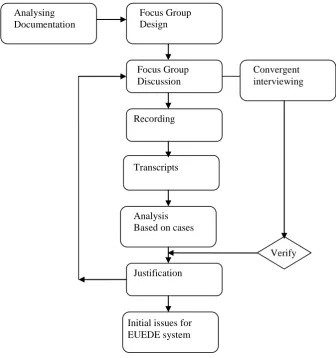
For knowledge verification, we used a convergent interviewing technique (Dick, 2002) in which experts were asked
individually about aspects of the elicited knowledge, until agreement was reached. The final knowledge base was
verified with other industry experts and against documentation. A process flow diagram is given below (in Figure 1) to
illustrate our approach to knowledge extraction using qualitative techniques. As part of existing literature analysis, a set
Figure 1: The process flowchart for knowledge acquisition using qualitative data collection techniques
4. Data findings
In this section, we will show how the six identified factors apply specifically for milk protein enhancement, but we
contend that these are also applicable to rural livestock production potentials generally, including dairy, beef cattle,
sheep, goat, pig, and chicken farming industries.
We describe the relationships between the inputs and the critical factors of milk protein enhancement in dairy
operations which were identified from the extracted knowledge and supplemented by reference to an industry reference
manual (DPI, 2006).
4.1 Influence of different factors
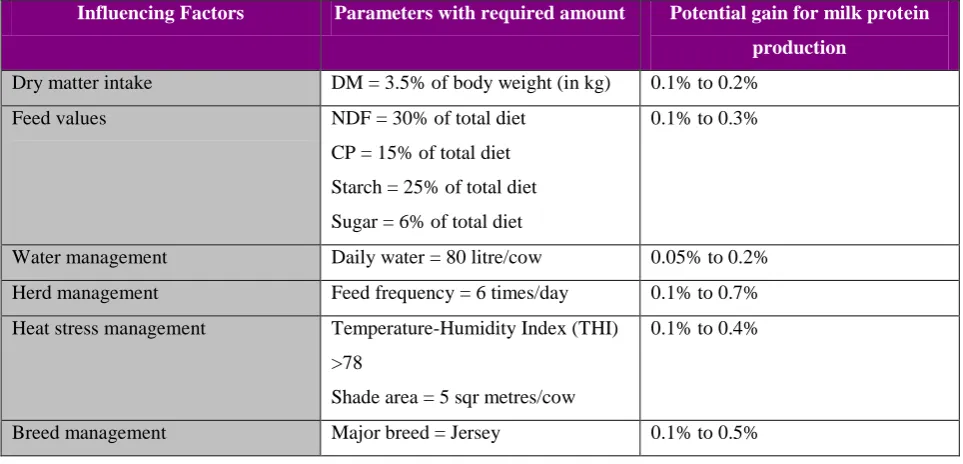
The effect of the six factors is shown in table 1. For each factor, participants suggested how its optimisation could
potentially lift milk protein levels in daily production by a specific percentage range. Focus Group
Design Analysing
Documentation
Focus Group Discussion
Recording
Transcripts
Analysis Based on cases
Justification
Initial issues for EUEDE system
Experts agreed that the amount of dry matter (DM) intake in daily feed is important to improving milk protein
production. The specific amount is relative to body weight, but also depends on other factors such as the cow’s stage of
lactation, production potential, and amount of feed on offer and feeding types and methods. Individual experts
suggested nutritional targets, with which others agreed: in this instance, experts agreed a target limit of DM intake as
3.5% of a cow’s body weight.
Variations in a cow’s diet also impacts milk protein levels. Useful estimates of feed quality include NDF (neutral
detergent fibre), crude protein (CP), starch and sugar levels of feed items. Related factors such as feed processing,
growing seasons and feeding methods also play important roles in feed quality. Rules of thumb were captured for these
factors e.g. specifying sugar and starch levels as a percentage of the total ration.
Table 1: Six factors with the potential ranges for improvement
Influencing Factors Parameters with required amount Potential gain for milk protein
production
Dry matter intake DM = 3.5% of body weight (in kg) 0.1% to 0.2%
Feed values NDF = 30% of total diet
CP = 15% of total diet Starch = 25% of total diet Sugar = 6% of total diet
0.1% to 0.3%
Water management Daily water = 80 litre/cow 0.05% to 0.2%
Herd management Feed frequency = 6 times/day 0.1% to 0.7%
Heat stress management Temperature-Humidity Index (THI)
>78
Shade area = 5 sqr metres/cow
0.1% to 0.4%
Breed management Major breed = Jersey 0.1% to 0.5%
Water management is one of the most dominant factors associated with changes in protein levels in milk. A cow
requires approximately 80 litres of water per day during summer (DPI, 2006).
In herd management, the stage of lactation also impacts milk protein levels. There are considered to be a total of 300
milking days for the production of cow’s milk, and rules relating to cow’s body condition score, calving pattern and
Minimising heat stress, particularly in summer, is a significant management factor. Heat stress impacts are estimated as
a Temperature-Humidity Index – THI (a mathematical correlation between local temperature and humidity). Milk
composition may be affected above 78 so various shade and cooling strategies were suggested.
Finally, genetics also makes a difference: certain breeds produce a relatively higher protein percentage. A herd
dominated by Jersey cattle for example can produce a milk protein percentage gain of up to 0.5%.
5 Generic knowledge modelling
Rather than use the knowledge base to develop a specific expert system, we parameterised the extracted knowledge
using a specific ontology-based development methodology. We partially utilised an approach for ontology development
called METHONTOLOGY (Fernandez et al., 1997), which advocates the use of a structured informal representation to
support the ontology development (Bally et al., 2004). The scope of ontology development allows development of
generic and reusable decision-making components that can enable the domain experts to outline their decision-making
scenarios within a specific farming condition. The components of the ontology are summarised in table 2
Table 2: Terms used in the problem ontology development
The methodology of the problem ontology development involves five phases: knowledge acquisition; conceptualisation,
evaluation, specification, and implementation. The decision-making parameters are identified and documented for the
different protein dominant classes/factors in the knowledge acquisition phase. In the conceptualisation phase, the
relationships associated with the decision-making parameters are defined. The evaluation phase involves domain
experts to refine the reusability options and for verification against user requirements. In the specification, a complete
knowledge base is developed for the problem ontology. The developed ontology is then programmed in the
implementation phase. Our ontology’s details are specifically scoped to the milk protein domain, (given by the policy
Ontology terms Definitions
Parameters Attributes that have input values and help determine the factor values
Relationships Type of impacts of the parameters on the factors. For example, “is-a” means the required
level of the parameters will be one defined value. “depends on” means the required level of the parameters will be a co-relational value
Ratios Mathematical figure that defines a rule to set the desired level of the parameters value
Inputs Current values of the parameters which will be entered by the users
Required level The desired level of the parameters value which is a estimated value from the rules
context set for the project), and we specify these next. The major parameters however, are held to be generic across
intensive livestock industries, and the architecture and approach more generally lend themselves to application in
industries beyond these.
In our domain model, parameters in any dairy farm are classified into three common instances: animal instances
including parameters relevant to the cow’s physiological and breed conditions; management instances including
parameters relevant to local farming conditions; and climate instances including parameters relevant to external impacts
such as heat stress. These parameters are outlined in Table 3.
Table 3: Parameter details for the EUEDE system
To model the domain knowledge, our focus was to use acquired knowledge components that enable generic reasoning
in outlining facts for DSS building. In this way, the model can be re-used in other domains of rural businesses for
building this type of system without any intermediary requirement. Thus without involvement of an external knowledge
engineer, a domain expert can be involved in interpreting and understanding the domain knowledge before any actual Different instances Parameters Definitions of the parameters
Animal Instances Average live weight Cows’ average live weight, normally measured in kg
Days in milk Cows’ average milking days considered to be 300 days.
Major breed Cows’ breed, for example, Jersey, Friesian.
Average milk protein Protein level in milk yield as a percentage.
Milk per day/cow Total milk produced by a cow per day measured in litres.
ABV Australian Breed Values : a practice for improving
values from cows.
Water availability per day Allocation of adequate amount of fresh water daily
Management Instances
Frequency of feeding Approximate measure of how often cows are fed daily. Feeding access to pasture Cows’ access to pasture where they move freely to feed
Climate Instances Temperature-humidity (THI) index
Mathematical correlation between local temperature and humidity for specific farming region
Distance between the shade and feeding area
Distances cows usually walk for feeding. This helps in determining energy for body maintenance.
Approximate shade length total shade length to protect cows from the elements
Sprinklers A device that supplies cool water to maintain cows’
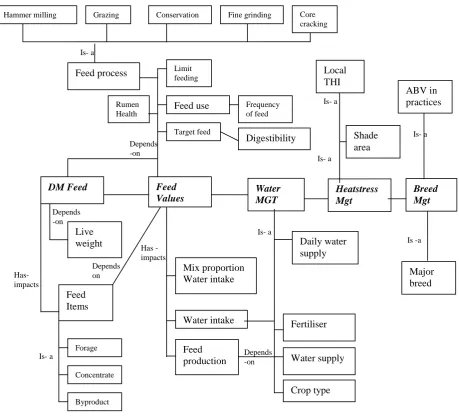
development occurs, the following model, Figure 2, shows how the dairy operational knowledge was modelled for the
EUEDE system development.
Figure 2: Generic knowledge model in the EUEDE
Figure 3 shows the knowledge base repository where the domain expert can acquire generic knowledge components
from any intensive livestock business domain. The expert can select relevant parameters from the model or potentially
add new ones as (for example) new science or different feedstuffs become available, and a DSS can then be
dynamically generated using the range of parameters relevant to the task in question. In this figure, the acquired
knowledge shows a complete knowledge base from the milk protein enhancement domain in the dairy as an example.
An end user would select the parameters applicable to their own decision making and add farm relevant information,
DM Feed Feed
Values Water MGT Mix proportion Water intake Water intake Feed production Has -impacts Fertiliser Water supply Crop type Depends -on Live weight Depends -on Feed Items Has- impacts Forage Concentrate Byproduct Is- a Feed use Rumen Health Target feed Frequency of feed Depends -on Limit feeding Feed process Is- a Depends on
Hammer milling Grazing Conservation Fine grinding Core
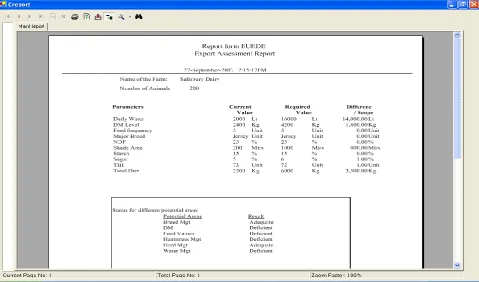
such as number of cows and diet details. Figure 4 shows a report generated from this information, indicating specific
deficiencies for a particular farm, and related further advice and expert information can follow (Figure 5).
Figure 3: Knowledge repository in the EUEDE.
Figure 5: Specific outcomes from the developed DSS in EUEDE.
5.1 Rules creation
The main function here is the development of rules based on heuristic knowledge. The process involves simplifying
domain knowledge into knowledge components using parameters that apply in to defining a farming situation. For
example, dry matter intake (DM) is a factor that determines milk protein level. We use a bottom-up design method, as
the decision-making rules need to be resolved first. The following is an example of one type of rules generation:
For the relationship: is-a
Required level = Estimated values input by domain experts
Where the required values are given by the experts
For the relationship: depends- on
Required level = ratio * parameter
Where required level = factors (changeable by domain experts) that determines output variable level
Ratio is any variable (changeable by domain experts) that determines relations (e.g 4% of body weight)
In this way, specific farming knowledge is converted into a knowledge base for building decision support tools since it
establishes meaningful relationships between factors and parameters within the ontology. This relationship defines the
required level of the potential influencing factors that have impacts on rural business production. By differentiating
between the required or optimal status (as outlined by experts) and the current status (as entered by farmers), a
developed DSS can identify the scope for specific improvements, supplemented by expert suggestions and information.
This uses the knowledge components at a reconfigurable and generic level, allowing them to be reused and shared in
producing other specific DSS.
The decision outcomes are processed in terms of conventional IF-THEN rules, for example:
Condition 1
If current DM feed level >= required DM feed level,
Then
No scope for DM improvement
Condition 2
If required DM feed level > current DM feed level,
Then
Scope for improvement with potential protein enhancement of max 0.2%
In such conditions the system will calculate the deficient DM amount and make a specific recommendation
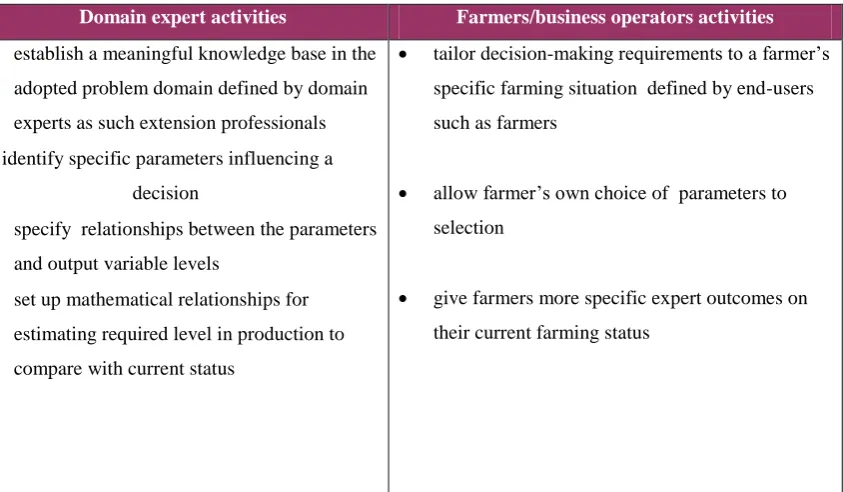
Table 4: Activity roles in the EUEDE system
Domain expert activities Farmers/business operators activities
establish a meaningful knowledge base in the
adopted problem domain defined by domain experts as such extension professionals
identify specific parameters influencing a
decision
specify relationships between the parameters
and output variable levels
set up mathematical relationships for
estimating required level in production to compare with current status
tailor decision-making requirements to a farmer’s
specific farming situation defined by end-users such as farmers
allow farmer’s own choice of parameters to
selection
give farmers more specific expert outcomes on
6. Knowledge acquisition and decision model
The aim of the knowledge acquisition approach was to simplify rural business domain knowledge into different
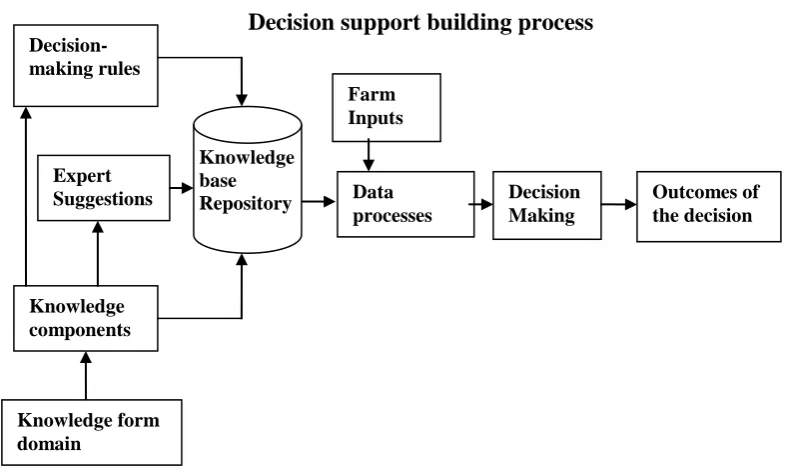
building-blocks and store it into a central knowledge repository so that it could be used for DSS development. Figure 6
shows the knowledge acquisition process and associated decision support building. Domain experts extract the
knowledge components such as business production goals and the factors relevant to achieving those. Subsequently,
domain experts formulate the rules by defining the relationships and ratios among parameters. They also record the
expert suggestions for each factor for use in reports displayed for the developed DSS.
To define the decision-making process, Figure 6 illustrates the generic decision process model from ‘knowledge
components into decisions in our proposed system. In the context of Precision Agriculture, Fountas et al. (2006)
describe a general data-flow diagram to characterise farmers’ decision-making process in information-intensive
practices which was validated for several decision-making operations by both university farm managers and
commercial farmers. Fountas et al.’s (2006) data-flow model was based on Skidmore’s (1997) methodology for
structured systems analysis and design for designing IS, while our data-flow model for decision making process was
based on a practical decision making approach outlined in the industry best practice handbook (DPI, 2006) for milk
protein management, which was used for farmers’ decision making. In this approach, both knowledge and data inform
decision as illustrated in the figure 6.
Figure 6: Knowledge acquisition and decision process model of EUEDE
Knowledge components
Expert
Suggestions Data processes
Decision-making rules
Decision Making
Outcomes of the decision Knowledge
base Repository
Decision support building process
Farm Inputs
7. Discussion and summary
The objective of this paper was to discuss an upgradeable knowledge model of the design environment which offers a
straightforward method of rural business knowledge acquisition for building specific DSS. The paper reported the
application of the rural business knowledge in the development of a new design environment called EUEDE where the
business operators get assistance from domain experts in building their specific DSS. For instance, the goal was to
explore dairy operational knowledge from a dairy expert’s perspective since the EUEDE solution environment has been
outlined from this knowledge. However, operational knowledge from any other rural industries can be used in this
design environment by upgrading the reusable knowledge model. This facilitates a generic knowledge acquisition that is
workable in any rural businesses. For outlining generic knowledge model, we examined some critical aspects that have
impacts on the rural business potentials. For example, critical aspects that caused decreasing or increasing milk protein
level in production from the practitioner’s point of view, although many other aspects that could have great impact on
protein concentrate in milk production were overlooked.
The proposed knowledge acquisition process in the EUEDE contributes to decision support tool development in rural
industries by reducing technological constraints that appear as rigid options to end-users. This is caused by a great range
of changing decision requirements and the need to use various rules of thumb in the rural sector that often might not be
suited to traditional DSS design methodologies. The upgradeable provisions for the business operators can reduce the
contrast between individual farming practice and the relevant technological actions. Earlier researches, such as in
bioinformatics (Baker et al., 1999; Lambrix and Edberg, 2003), in World Wide Web design (Crampes and Ranwez,
2000; Liddle et al., 2003; Sunagawa et al., 2003) and medical informatics (Achour et al., 2001; Gennari et al., 2002;
Musen, 1998) justified ontology development as an established and workable concept in effective knowledge
modelling. Unlike other domains, we used the ontology development approach as a progressive way to model
knowledge from the dairy operational domain, which was utilised for developing and delivering specific and
target-relevant DSS because of its generic capability. Our developed ontology framework enables us to differentiate
knowledge components from the problem domain and conceptualise them in a generic model, so that the relationship
between the knowledge components could form the rules for decision making. These rules can be changed at any time
depending on the domain expert’s judgment (decision-making rules in terms of heuristic based estimation). This also
reduces the complexity in mapping of functions to the system components in the developed DSS. In addition, as
Our proposed system could be easily maintainable because users hold options for mapping the knowledge components
of system functions of the developed DSS.
The decision making aspect of the rural businesses such as beef cattle, or sheep industry are very similar with the dairy,
because the potentials of the production also depends on the similar types of factors relevant with animal management
or climate. For instance, the decision making rules associated with water supply in the dairy business could be applied
to the beef cattle industry by changing the required amount of water for beef cattle. Therefore, to adjust the EUEDE
within the other domain, we can change the name of the parameters, potential factors and the rules for decision making.
For example, there are six main potential factors in dairy for the milk protein enhancement however; there are four main
potentials for the beef cattle in enhancing the quality of meat (for example, breed management, heat stress management,
feed management, and feed values). So, it is predicted that this EUEDE architecture could be utilised for building the
DSS applications in beef cattle industry.
Acknowledgement
We would like to thank Geoff Johnston, David Barber and Geoff Hetherington for participating in this research project
and express our appreciation to the Queensland Department of the Primary Industries and Fisheries for their continuous
funding support and relevant support for this project to be up and running. We also acknowledge the Australian
Research Council for their continuous financial support.
References
Achour, S.L., Dojat, M., Rieux, C., Bierling, P., Lepage, E., 2001. A UMLS based knowledge acquisition tool for
rule based clinical decision support system development, Journal of the American Medical Informatics
Association, vol. 8, pp. 351-360.
Baker, P.G., Goble, C.A., Bechhofer, S., Paton, N.W., Stevens, R., Brass, A. 1999. An ontology for bioinformatics
applications, Bioinformatics, vol. 15, pp.510-520.
Bally, J., Boneh, T., Nicholson, A. E., Korb, K. B., 2004. Developing an ontology for the Meteorological
Forecasting Process, Decision Support in an Uncertain and Complex World: The IFIP TC8/WG8.3 International
Conference, (Available at URL:
http://vishnu.sims.monash.edu.au:16080/dss2004/proceedings/pdf/08_Bally_Boneh_Nicholson_Korb.pdf)
Crampes, M., Ranwez, S., 2000. Ontology-supported and ontology-driven conceptual navigation on the World Wide
Web, Proceedings of the eleventh ACM on Hypertext and Hypermedia, San Antonio, Texas, USA.
Dairy Research and Development Corporation-DRDC, 2003. Protein Plus: Improving dairy milk protein levels,
CSIRO website, (Available at URL:
http://www.csiro.au/index.asp?type=faq&id=Milk%20protein%20content&stylesheet=divisionFaq )
Dick, B., 2002. Convergent interviewing. Session 8 of Areol - action research and evaluation on line, (Available at
URL: http://www.scu.edu.au/schools/gcm/ar/areol/areol-session08.html)
DPI, 2006. Protein Plus Check Book: A Guide to Increasing Milk Protein % and Profit, Department of Primary
Industries and Fisheries, Queensland Government, Australia.
Fernandez, M., Gomez-Perez, A. & Juristo, N. 1997. METHONTOLOGY: From Ontological Art Towards
Ontological Engineering, Presented to AAAI97, Workshop on Ontological Engineering, Stanford University,
pp. 33-40.
Fountas, S., Wulfsohn, D., Blackmore, B.S., Jacobsen, H.L., Pedersen, S.M., 2006. A model of decision-making and
information flows for information-intensive agriculture, Agricultural Systems, vol 87(2), 1 February 2006, pp.
192-210.
Gammack, J.G., Fogarty, T.C., Battle, S.A., Ireson, N.S. & Cui, J. 1992. Human Centered Decision Support: The IDIOMS System,
Journal of AI & Society, vol. 6, pp. 345 – 366.
Gennari, J.H, Musen, M.M, Fergerson, R.W., Grosso, W.E., Crubezy, M, Eriksson, H., Noy, N.F., Tu, S.W., 2002.
The evaluation of Protégé: An Environment for Knowledge Based systems development, available at URL:
http://smi-web.stanford.edu/pubs/abstracts_by_author/Noy,N.papers.html,
Givens, D.I., Shingfield, K.J., 2003. Improving the nutritional quality of milk, In Dairy Processing, Improving
Quality, pp.515-531, (G. Smit, editor) (Available at URL: http://www.chipsbooks.com/dairypro.htm)
Gunn, A., Sutcliffe, G., Walker, D., 1999. Knowledge acquisition for natural resources management, Computer and
Electronics in Agriculture, vol. 23, pp. 71-82
Hyland-Wood, D., Carrington, D., Kaplan, S., 2006. Enhancing software maintenance by using semantic web
techniques, International Semantic Web Conferences (ISWC) 2006, (available at URL:
http://www.itee.uq.edu.au/~dwood/papers/SoftwareMaintenanceViaSemWeb.pdf)
Kendall, P.E., Nielsen, P.P, Webster, J.R., Verkerk, G.A., Littlejohn, R.P., Matthews, L.R., 2006. The effects of
Kerr, D., 2004. Factors influencing the development and adoption of Knowledge Based Decision Support Systems
for small, owner-operated rural businesses, Artificial Intelligence Review, vol. 22, pp.127-147.
Kerr, D., Winklhofer, H., 2005. The effect of rapid rural industry changes on the development of a decision support
system for dairy farmers in Australia, Computers and Electronics in Agriculture, vol. 50, pp.61-69.
Lambrix, P., Edberg, A., 2003. Evaluation of ontology merging tools in bioinformatics, Proceedings of Pacific
Symposium on Bioinformatics, vol. 8, pp.589-600.
Liddle, Stephen W., Hewett, Kimball A., Embley, David W., 2003. An Integrated Ontology Development
Environment for Data Extraction, 2nd International Conference on Information Systems Technology and its
Applications, National Technical University, Kharkiv, Ukraine, June 19-21.
McCown, R.L., 2002. Changing systems for supporting farmer’s decisions: problems, paradigms, and prospects,
Agricultural Systems, vol.74, pp.179 -220.
Morgan, D. L., 2002. Focus Groups as Qualitative Research, second edition, Sage Publications Inc, California.
Musen, M.A., 1998. Modern architectures for intelligent systems: Reusable ontology and problem solving methods,
Proceedings of AMIA symposium, 46-52, (available at
http://smi-web.stanford.edu/pubs/SMI_Reports/SMI-98-0734.pdf)
Parker, A., Woodford, K., Woods, E., 2000. Deregulation and restructuring in the Queensland dairy industry,
occasional paper, 7 (2), school of natural and rural systems, the University of Queensland, Brisbane, Australia.
vol. 7 (2), pp.1-28.
Pietersma, D., Lacroix, R., Lefebvre, D. Wade, K.M., 2003. Induction and evaluation of decision trees for lactation
curve analysis, Computers and Electronics in Agriculture, vol. 38, pp. 19-32
Schingoethe, D., 1996. Dietary influence on protein level in milk and milk yield in dairy cows, Animal Feed Science
Technology, vol. 60, pp.181-190.
Skidmore, S., 1997. Introducing Systems Analysis, MacMillan Press Ltd, Oxford, UK.
Sunagawa, E., Kozaki, K., Kitamura, Y., Mizoguchi, R., 2003. An environment for distributed ontology
development based on dependency management. Proceedings of the 2nd International Semantic Web
Conference (ISWC2003), pp. 453-468.
Walker, D.H., Johnson, A.K.L. 1996. Delivering flexible decision support for environmental management: a case
study in integrated catchment management, Australian Journal of Environmental Management, Vol. 3 (3), pp,
174-188
Walker, G.P., Dunshea, F.R., Doyle, P.T., 2004. Effects of nutrition and management on the production and
composition of milk fat and protein: a review, Australian Journal of Agricultural Research, vol. 55,
pp.1009-1028.
Walker, G.P., Stockdale, C.R., Wales, W.J., Doyle, P.T., Dellow, D.W., 2001. The effect of level of grain
supplementation on milk production responses of dairy cows in mid-late lactation when grazing irrigated
pastures high in paspalum, Australian Journal of Experimental Agriculture, vol. 41, pp.1-11.
White, C.L., 2001. Factors affecting milk protein concentration in Australian dairy cows, Australian Journal of Dairy