A Chosen Plaintext Attack on Oset Public Permutation
Mode
Miloslav Homer [email protected]
April 15, 2018
Abstract
Oset Public Permutation Mode (OPP) by Granger et al. is a one-pass authen-ticated encryption scheme supporting associated data (AEAD scheme). Leveraging an error in analysis of the scheme, a chosen plaintext attack that creates a forgery was discovered. This attack makes no assumptions about the underlying tweakable blockcipher while having negligible complexity requirements and high probability of success. An implementation of the attack is also provided.
Keywords: symmetric cryptography, block cipher mode of operation, authenti-cated encryption, forgery attack, distinguishing attack.
1 Introduction
Authenticated Encryption (AE) refers to providing both condentiality and authentic-ity. These schemes are symmetric, meaning that a single key is used for both encryption and decryption. Often it is required that such scheme supports Associated Data (also called Header) data whose authenticity is ensured but which are not encrypted (such schemes are AEAD schemes). These schemes have huge practical applications, providing a simple interface to accomplish two security goals.
In [1] a new single pass AEAD scheme named Oset Public Permutation Mode (OPP) was published. This scheme oers high speed of encryption (peaking at 0.55 cycles per byte) and full paralelization. If such scheme also had a valid proof of security, it would be very attractive for all applications.
Unfortunately, the authors of OPP made an error in their analysis. This error lead to a chosen plaintext attack with negligible complexity requirements and high probability of success. This attack is presented in this paper. Originally, this attack was discovered in [2] (in Slovak). This paper completes and expands it.
2 Notation
Denote by F2n the nite eld of order 2n withn ≥1. A b-bit string X is an element
of {0,1}b (or equivalently of the
F2-vector space Fb2). The length of such string X is
denoted by |X| (for X ∈ {0,1}b holds |X|=b). The bit string of length 0 is denoted by. The concatenation of two bit stringsX, Y is denoted byXkY. Symbol⊕denotes bit-wise XOR.
Given a b-bit string X = x0k. . .kxb−1 we dene firstl(X) =x0k. . .kxl−1 (for 1 ≤
l≤b). Denote padAb (Y)the padding function:
padAb (Y) =YkAk0b−|Y|−|A|.
3 Preliminaries
3.1 Tweakable Blockciphers
Let T be a set of "tweaks". A tweakable blockcipher E: {0,1}k × T × {0,1}b → {0,1}b is a function such that for every K ∈ {0,1}k and every tweak T ∈ T func-tion E(K, T, .) : {0,1}b → {0,1}b is a permutation. Inverse permutation is denoted E−1(K, T, .).
A tweakable permutation π:T {0,1}b → {0,1}b is a function such that for every T ∈ T function π(T, .) :{0,1}b → {0,1}b is a permutation.
Granger et al. [1] proposed Mixed tweakable pseudorandom permutation (MTPRP) security as a security denition for a tweakable blockcipher. It is a middle ground be-tween tweakable pseudorandom permutation (TPRP) notion and strong TPRP (STPRP) notion.
• In the former, the adversary is permitted encryption queries only.
• In the latter, the adversary is also permitted decryption queries.
• In MTPRP, we utilize a partition of tweakspace, say T = T0∪ T1. For tweaks in T0 the adversary can only ask encryption queries while for tweaks in T1 the
adversary can also ask decryption queries.
The goal of the adversary is to distinguish between a tweakable blockcipher with randomly chosen key and a randomly chosen tweakable permutation. We say thatE is a secure MTPRP if the advantage:
AdvM T P RP(A) =Pr
AE = 1
−Pr [Aπ = 1]
is negligible for every bounded adversaryA, where AE = 1 denotes that the adversary
interacted with a tweakable blockcipher with randomly chosen key and the adversary returned it interacted with a tweakable blockcipher with an unknown key. The symbol Aπ = 1 denotes that the adversary interacted with a randomly chosen tweakable
per-mutation and the adversary returned it interacted with a tweakable blockcipher with an unknown key.
3.2 Nonce-based Authenticated Encryption (with Associated Data) Denote the associated data H and the key K. OPP employs a nonce this value should not be repeated for a given key, although an adversary can know and predict it (denotedN). A tag is a short string appended to the ciphertext (denotedT). Formally, an abstract Authenticated Encryption with Associated Data (AEAD) scheme utilizing nonces operates as follows:
EK(N, H, M) = (C, T), DK(N, H, C, T) =M/⊥.
If for given (N,H,C,T) there doesn't exist a messageM such thatEK(N, H, M) = (C, T) then the decryption algorithm outputs⊥indicating that such ciphertext C with tagT is invalid given nonceN, associated data H and keyK.
Distinguishing between such an oracle and a real scheme with random key is the goal of the adversary denoted PRIV as in [3]. The advantage of such adversary is dened as:
AdvP RIVAEAD(A) =
Pr
AAEAD= 1
−PrhA$ = 1i .
In PRIV there are additional restrictions placed on the adversary: the adversary can only use encryption queries and cannot repeat nonces.
Granger et al. [1] relaxed these restrictions for the OPP scheme. The adversary can use decryption queries a random oracle would always return ⊥ (i.e. the ciphertext with tag are always invalid). The adversary is nonce-respecting in the following sense, citing [1], Appendix B: "Let D be a nonce-respecting AE distinguisher against OPP, which means that it never makes an encryption query for a nonce that was used before." Therefore, in their setting it is possible to ask multiple decryption queries with a previ-ously used nonce, provided that only one encryption query for a given nonce was asked. One natural restriction was added: the adversary cannot query a text for decryption if such text was recieved as an output of an encryption query. The advantage of an adversary is dened as:
AdvGrangerAEAD (A) =
Pr
AAEAD = 1
−PrhA$= 1i .
Granger et al. do not claim anything else about OPP. In contrast, Rogaway denes a second experiment, denoted AUTH. In AUTH, the attacker interacts with real scheme with random key. The attacker is tasked to produce a forgery value(N, H, C, T). If
DK(N, H, C, T) 6= ⊥, the attacker is successful. The advantage of such adversary is dened as:
AdvAU T HAEAD(A) = Pr
DK(AAEAD)6=⊥
. The adversary is restricted:
• The adversary can only ask encryption queries.
• The forgery attempt cannot be an output of an encryption query.
• The adversary is nonce-respecting: two encryption queries cannot have identical nonce.
Note that the adversary can reuse a nonce in his forgery attempt.
4 Oset Public Permutation Mode
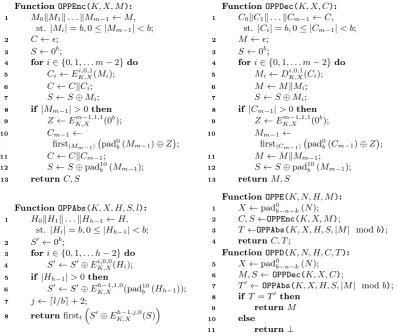
OPP mode dened in [1] utilizes tweakable blockciphers. Since the attack described in this article does not assume anything about the tweakable blockcipher, we do not need to concern ourselves with the details of tweakable blockcipher construction. Instead, it is assumed that a MTPRP secure abstract tweakable blockcipher is used with tweakspace T = T0 ∪ T1 such that (X,0,0,0) ∈ T0 for all X ∈ {0,1}b (see subsection 3.1, and assumptions of theorem 2 in [1]). The condition of (X,0,0,0)∈ T0 for all X ∈ {0,1}b
is satised: since such tweaks are used only in one line (see line 4 in function OPPAbs in gure 1) such tweaks are not used in inverse direction. There are no assumptions aboutT1.
The tweaks are of the form{0,1}b−k×
N3. Calling a tweakable blockcipher encryp-tion on plaintext P with keyK and tweak (X, i0, i1, i2) is denoted by EK,Xi0,i1,i2(P). In similar fashion a tweakable blockcipher decryption is denoted byDi0,i1,i2
K,X (C)
Function OPPEnc(K, X, M): 1 M0kM1k. . .kMm−1←M,
st. |Mi|=b,0≤ |Mm−1|< b; 2 C←;
3 S←0b;
4 fori∈ {0,1, . . . m−2}do
5 Ci←Ei,K,X0,1(Mi);
6 C←CkCi;
7 S←S⊕Mi;
8 if |Mm−1|>0then 9 Z←EK,Xm−1,1,1(0 b
);
10 Cm−1←
first|Mm−1| pad 0
b(Mm−1)⊕Z
;
11 C←CkCm−1; 12 S←S⊕pad10
b (Mm−1); 13 returnC, S
Function OPPDec(K, X, C): 1 C0kC1k. . .kCm−1←C,
st. |Ci|=b,0≤ |Cm−1|< b; 2 M←;
3 S←0b;
4 fori∈ {0,1, . . . m−2}do
5 Mi←DK,Xi,0,1(Ci);
6 M ←MkMi;
7 S←S⊕Mi;
8 if |Cm−1|>0then 9 Z←EK,Xm−1,1,1(0
b );
10 Mm−1←
first|Cm−1| pad 0
b(Cm−1)⊕Z
;
11 M ←MkMm−1; 12 S←S⊕pad10
b (Mm−1); 13 returnM, S
Function OPPAbs(K, X, H, S, l): 1 H0kH1k. . .kHh−1←H,
st. |Hi|=b,0≤ |Hh−1|< b; 2 S0←0b;
3 fori∈ {0,1, . . . h−2}do
4 S0←S0⊕EK,Xi,0,0(Hi);
5 if |Hh−1|>0then
6 S0←S0⊕EK,Xh−1,1,0(pad10b (Hh−1)); 7 j← dl/be+ 2;
8 returnfirstt
S0⊕EK,Xh−1,j,0(S)
Function OPPE(K, N, H, M): 1 X←pad0
b−n−k(N);
2 C, S←OPPEnc(K, X, M);
3 T←OPPAbs(K, X, H, S,|M| modb); 4 returnC, T;
Function OPPD(K, N, H, C, T): 5 X←pad0b−n−k(N);
6 M, S←OPPDec(K, X, C);
7 T0←OPPAbs(K, X, H, S,|M| modb); 8 if T =T0 then
9 returnM 10 else
5 The Attack
5.1 DescriptionThe attack is described as a routine of an adversary the adversary performs the steps. Additionally, the adversary can query the encryption/decryption oracle. To avoid complicated formalism this action is denoted as a function call. The task of the adversary is to distinguish between a real oracle and a random oracle (see subsect. 3.2).
Algorithm 1: Routine creating a forgery using one chosen plaintext request. Function CreateForgery(E, N, H, p):
1 M1 ←02b+p;
2 C, T ← E(N, H, M1);
3 C1kC2kC3 ←C, st. |C1|=b,|C2|=b,|C3|=p;
4 return N, H, C1k0p, T
A routine (see algorithm 1) that produces forgeries with signicant probability of validity was discovered in [2]. A forgery consists of a nonce, a header and a ciphertext with tag. This routine can be used for every valid header and valid nonce, so these are specied as the parameters of the routine. The last parameter,1≤p≤t, species the length of the last block used in the attack. To achieve optimal theoretical probability of generating a valid forgery setp= 1.
Proposition 1. LetE be the oracle providing encryption routine of OPP using an ideal tweakable blockcipher. Let N be a valid OPP nonce and letH be a valid OPP header. Let1≤p≤t. Then the routine in algorithm 1 called with parametersE, N, H, preturns a valid forgery with probability2−p.
Proof. Denote the output of the query O = C1kC2kC3, T, where |C1|= |C2|= b and
|C3|=p.
This proof has three parts:
1. Showing that C1 decrypts to0b.
2. Verifying that 0p (last block) decrypts to0p with probability2−p.
3. Given the last block (0p) decrypts to0p, showing that the result of decryption is
not⊥.
The rst step is trivial, since the nonce and the key used are identical. Second step:
0p is decrypted by XOR-ing withprandom bits (see line 10 in OPPDec in gure 1). The bits are random since it is assumed that the tweakable blockcipher used is ideal and the tweak(X,0,1,1)was not used when computing the query.
To show the third step, we only need to show that valueScomputed in OPPEnc/OPPDec and used in OPPAbs is equal "in query" and "in forgery verication". In query:
S =M1⊕M2⊕(0)p10(0)b−p−2 = 0b⊕0b⊕(0)p10(0)b−p−2 = (0)p10(0)b−p−2.
Given that0p is decrypted to 0p in forgery verication:
S = 0b⊕(0)p10(0)b−p−2 = (0)p10(0)b−p−2.
Therefore routine CreateForgery can be used to create a valid forgery with signi-cant probability. Therefore OPP cannot satisfy the AUTH requirement for nonce-based AEAD schemes. However, Granger et al. do not claim that OPP satises this require-ment.
This routine can also be used to distinguish between a random and a real oracle. To avoid unnecessary formalism, it is assumed that the adversary is provided access to two oracles an encryption oracle and a decryption oracle.
Algorithm 2: Distinguishing between a real and a random oracle via forgery. Function Distinguish(E,D, N, H, p):
1 (N, H, F, T)←CreateForgery(E, N, H, p); 2 o← D(N, H, F, T);
3 if o=⊥then
4 return 0
5 else
6 return 1
In algorithm 2 we can see an example of an attacker using the ability to create forgery to distinguish between a real and a random oracle. Again, the nonce and the header can be chosen arbitrarily, so they are a parameter of the distinguisher.
Proposition 2. Let E,D be either the oracle providing encryption/decryption routine of OPP using an ideal tweakable blockcipher or corresponding random oracles. LetN be a valid OPP nonce and let H be a valid OPP header. Let 1≤p≤t. Then the routine in algorithm 2 called with parameters E,D, N, H, p has advantage greater or equal to
2−p.
Proof. To determine the advantage, we have to determine two values: the probability that the distinguisher returns 1 when interacting with the real oracle and the probability that the distinguisher returns 1 when interacting with the random oracle.
Starting with the latter, this probability is equal to zero. The distinguisher only returns 1 when the decryption oracle returns a plaintext and not⊥. Since the decryption random oracle always returns ⊥, this case is clear.
Now for the former: given that E is a real oracle we get from proposition 1 that routine CreateForgery produces a valid forgery with probability2−p. This is the
prob-ability that this adversary correctly identies a real oracle. To conclude the proof recall the denition of the advantage:
AdvGrangerAEAD (A) =
Pr
AAEAD = 1−Pr
h A$ = 1
i =|2
−p−0|= 2−p.
By choosing p = 1 the advantage would be lower bounded by 0.5. Hence there
exists an adversary with signicant advantage. This result is in direct contradiction with claims of Granger et al.
Moreover, if the attacker was permitted to check all options for the last block of the ciphertext, it could produce a valid forgery with probability equal to one. This attack would need only one encryption query and 2p decryption queries this should
be possible within the restrictions of the experiment (see section 3.2).
There is another, perhaps more practical variant. Choose a nonce N and a header H. Choose plaintext blocksP1, . . . , Pm such that the last (m-th) block is short and that there existsisuch that
m−1
M
j=i
Assume that the corresponding ciphertext is C1, . . . , Cm, T. Then to create a forgery with high probability of validity, omit blocks itom−1from the ciphertext.
5.2 Implementation
Authors of OPP provided an implementation of OPP in C on github [4]. A variation of this attack using their code as a target is implemented in C, source code is accessible on github [5].
Due to eciency reasons, all variables (key, nonce, header, plaintext, ciphertext) are treated as a sequence of bytes, not bits. Therefore when using given implementation of OPP the smallest nonzero last block has the length of one byte. Therefore, given one encryption query and one decryption query, our probability of producing a valid forgery is 1/256.
However, we are permitted to check all 256 possible options within the restrictions of the experiment. Therefore, it is possible to distinguish between a random oracle and a real oracle with probability equal to one. Such an attack utilizes only very small complexity requirements. An implementation of this variant is provided checking all possible bytes of the last block to create a forgery.
6 Oversights in original analysis
Granger et al. noticed the similarities of OPP and Oset Code Book 3 (OCB3) by Krovetz and Rogaway [6]. In their appendix B Granger et al. claim that bounds of OCB3 directly apply to OPP.
This attack would not work on OCB3, because there is a subtle dierence between OPP and OCB3. In OCB3 the tweak used when generating the tag depends on the length of the plaintext. The presented attack is therefore invalid, since the tweaks used when generating the tag are dierent. Therefore the tags would coincide with negligible probability, whereas in this attack the tags would coincide with probability that depends on the lenght of the last incomplete block.
Therefore the original conclusion that OPP generalizes OCB3 is invalid.
7 Conclusion
Oset Public Permutation Mode was a promising fast one-pass AEAD scheme that is fully paralelizable. In this paper a chosen plaintext attack on OPP was presented. Given any valid header and nonce it is possible to create a forgery with high proba-bility of success utilizing only one encryption query, by ommiting blocks at the end of the plaintext that sum to zero. This also means that it is possible to distinguish OPP from a random oracle. A proof of concept implementation against OPP implementa-tion is also provided. This attack was made possible by an incorrect assumpimplementa-tion that OPP generalizes OCB3. The dierence between the two is that the tweak used in tag generation in OPP does not depend on the ciphertext length.
References
[2] Miloslav Homer. Jedno-priechodové schémy autentizovaného ²ifrovania, 2018. [3] Phillip Rogaway. Authenticated-encryption with associated-data. In Proceedings of
the 9th ACM conference on Computer and communica tions security, pages 98107. ACM, 2002.
[4] Mem family of aead schemes (2015). https://github.com/MEM-AEAD.
[5] Proof of concept attack on opp scheme (2018). https://github.com/ArcHound/ AttackOnOPP.