International Journal of Research (IJR)
e-ISSN: 2348-6848, p- ISSN: 2348-795X Volume 2, Issue 09, September 2015Available at http://internationaljournalofresearch.org
Performance Analysis of Gateway based Multihop Routing
Protocol in WSNs
Kajol Batra
Research Scholar, Punjabi University Patiala, India EMAIL: [email protected]
Charanjit Singh
Assistant professor, Punjabi University Patiala, India EMAIL: [email protected]
Abstract
Hierarchical cluster based routing protocol is very famous in Wireless Sensor Networks (WSNs). In this, Cluster Heads (CHs) are chosen among the nodes in the cluster based on the random probability of each node in the network. In proposed protocol, the sensor network field is alienated into four logical regions on the basis of the position of sensor nodes. If the predefined distance is greater than sensor node’s distance then the data is directly forwarded to the BS and gateway. Otherwise the regions are alienated into clusters having a cluster head in each cluster for aggregate and forward the data to gateway which further forward the data to the base station. Cluster head voting in each region is based on the Energy Consumption Rate (ECR) of each node in the earlier round. Simulation results show that ECR based multihop routing protocol better than existing protocols such that LEACH, M-GEAR.
Key Words:
Cluster heads, Election, Energy Consumption Rate, Gateway, LEACH, M-GEAR, and Wireless Sensor Networks.
I. Introduction
Wireless Sensor Network (WSN) consists of large number of sensor nodes which monitor the physical and environmental conditions, being randomly deployed for detecting and monitoring the tasks [1]. These sensor nodes are integrated
with signal processing, sensing and communication capability. These sensor nodes communicate with each other to gather the information about the sensed area and send through wireless links to the base station which in turn forwards it to a remote user .However such systems endure with band-width, energy and throughput constraints which limit the amount of information transferred from end-to-end [2,3]. So, to increase the communication range and energy efficiency, a number of innovative ideas are required for the expanded lifetime of the network.
For small scale networks, with limited geography, single hop communication in which each node directly communicate with base station. To increase the communication range multi-hop communication in which data transferred hop by hop through intermediate nodes resulting into less
power consumption than single hop
communication.
International Journal of Research (IJR)
e-ISSN: 2348-6848, p- ISSN: 2348-795X Volume 2, Issue 09, September 2015Available at http://internationaljournalofresearch.org
II. Related work
W. Heinzelman et al., [5] introduced hierarchical clustering based protocol named as Low Energy Adaptive Clustering Hierarchy protocol (LEACH). LEACH divides the load among various nodes in the network, and Cluster heads are dynamically chosen based on the predefined probability. LEACH process is alienated into rounds. Each round is further alienated into two phases. First phase is setup phase in which cluster heads (CHs) are created. Cluster Heads are chosen based on the threshold value. The choice is based on choosing the random number between 0 and 1 by each node. If the random number is less than threshold value T (n), then the node turn out to be cluster head for current round. Then Cluster Heads send the advertisement message to all the nodes. After receiving advertisement message, each node joins the Cluster Head based on strongest received signal strength. Steady state phases is second phase in which each node informs its Cluster Head to join their cluster by transmitting the information packet back to Cluster Head using Carrier Sense Multiple Access (CSMA) protocol. CH creates Time Division Multiple Access (TDMA) scheduling for transmission time of each node, after receiving the information packet by CHs. Then each node sends data to their respective Cluster Head. After that Cluster Heads aggregate the received data and transmits further it to the base station.
A. Manjeshwar et al [6] proposed a protocol that build up for reactive protocols. During the cluster change time, addition to attribute is used. Attribute is a set of physical parameter which the user is interested in obtaining the information and it uses soft threshold and hard threshold values. Hard threshold is the value of the sensed attribute which is used by the cluster head to send it to other sensor nodes in the cluster and soft threshold is change in the value of the attribute and switch on node radio to transmit data. Using this protocol number of transmission reduces because transmission occurs only when the value of sensor attributes change. It is used for time critical
applications. Data accuracy increases at the expense of energy efficiency.
O. Rehman et al., [7] projected a protocol Energy Consumption Rate Stable Election Protocol (ECRSEP) Energy Consumption Rate is used to elect CHs among number of nodes. In the next round CH choice is based on the ECR calculated in the earlier round. A node which has less ECR in the earlier round is selected as CH in the existing round. A cluster head in the earlier round is not selected as CH in the next round because ECR is very high as compared to other nodes in the network.
Said Ben Alla et al, [8] proposed a robust and desirable Hierarchical Adaptive Balanced Energy Efficient Routing Protocol (HABRP). In this protocol, a gateway is used to transmit data from CHs after the aggregation of data send by the normal nodes to the cluster head in a cluster. In this each round consists of three steps. In first step gateway is selected among the high energy nodes. In second step, CH is being selected on the random probability of each node. In third step, clusters are formed in the network.
Q.Nameed et al., [9] in 2013 projected a design of gateway based energy-efficient multi hop routing based protocol (M-GEAR) in WSN. To increase the stability a rechargeable gateway is used at the middle of the network. CHs are chosen based on the random probability. BS is placed far away from the network field.
III. Radio Model
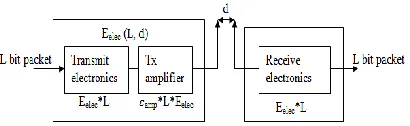
Energy dissipation for radio hardware takes place at transmitter consisting of transmitter electronics and transmit amplifier. Energy dissipation takes place at receiver radio electronics. Both the free space and multipath fading channel models are used depending upon the distance between the
International Journal of Research (IJR)
e-ISSN: 2348-6848, p- ISSN: 2348-795X Volume 2, Issue 09, September 2015Available at http://internationaljournalofresearch.org
Figure 1: Model for energy dissipation
Free space model is used if the distance between the transmitter and the receiver is less than threshold value. Multipath fading model is used if the distance between the transmitter and receiver is greater than threshold value. In transmitter amplifier, the value of α=2 is used, for free space channel model, whereas in case of for multipath fading model α=4 is used. Energy required for transmitting L bits at a distance d with threshold d0 is given by:
𝐸𝑇𝑥 𝐿, 𝑑 = 𝐸𝑒𝑙𝑒𝑐 ∗ 𝐿 + 𝐸𝑎𝑚𝑝(𝐿, 𝑑) (3.1)
where, Eamp is the amplifier energy
consumption and can be expressed in terms of εfs or
εmp. . Energy required for transmitting L bits at a
distance d with threshold d0 is given by:
𝐸𝑇𝑥 𝐿, 𝑑
𝐸𝑒𝑙𝑒𝑐 ∗ 𝐿 + 𝐿 ∗ 𝑑2∗ 𝜀𝑓𝑠 , 𝑑 < 𝑑0
𝐸𝑒𝑙𝑒𝑐 ∗ 𝐿 + 𝐿 ∗ 𝑑4∗ 𝜀𝑚𝑝, 𝑑 > 𝑑0
(3.2)
𝑑𝑜 = 𝜀𝜀𝑓𝑠
𝑚𝑝 (3.3)
To receive L messages bits, radio energy expenditure is given by:
𝐸𝑅𝑥 = 𝐸𝑒𝑙𝑒𝑐 ∗ 𝐿 (3.4)
IV. Proposed work
It is assumed S sensor nodes with n numbers are randomly placed in the network field. The ith sensor is given by Si. The Network Model follows
these assumptions:
1. BS and sensor nodes are permanent after deployment. BS is positioned far away from the sensing field.
2. A rechargeable gateway is positioned at the centre of sensing field which is fixed after deployment.
3. Sensing field consists of identical sensor nodes having same energy capabilities.
4. Each node has different unique identifier (ID).
Figure 2: Network model
The sensor nodes have huge data to process before transfer it to the base station. Due to this, there is a need of aggregating the data into a small set consisting of important information. A gateway node is deployed at the middle of the network field to improve the network lifetime and throughput. Gateway node collects the data from CHs and nearby sensor nodes and aggregates this data and finally, sends it to the BS. The expenditure of gateway is much lower as compared to the expenditure of the sensor node. The proposed algorithm consists of five phases which are discussed below:
i) Initial Phase
Initially nodes are scattered in the network area which are identical in nature. In order to collect the information about the sensor nodes, the BS sends the HELLO packet to all the sensor nodes. In response sensor nodes forward their position to the BS. Then BS measures the distance of each node and keeps it in the BS node data table. The node data table store node ID, remaining energy of node, position of node and its distance to BS and gateway.
ii) Setup Phase
International Journal of Research (IJR)
e-ISSN: 2348-6848, p- ISSN: 2348-795X Volume 2, Issue 09, September 2015Available at http://internationaljournalofresearch.org
four logical regions. Region one (R1) nodes forward its data directly to the base station because of its small distance from the BS. The second region (R2) nodes forward its data directly to the gateway which aggregates the data and forward it to the BS. Region R1 and R2 are also called as non-clustered region. All the sensor nodes which are placed away from BS and gateway, are divided into two equal regions and known as clustered regions.
iii) CH Selection
In third phase, the network is alienated into regions by the BS. Each node decides whether to become CH for existing round or not.. This choice of the node is based on suggested proportion of number of CHs in the network and number of times a particular node has become a CH before. This process is based on random number between 1 and 0. If the number is less than threshold then the node become CH for current round. Initially all the sensor nodes have same initial energy, after that CHs are formed based on Energy Consumption Rate (ECR) of each node. ECR is given by
ECR= 𝐸𝑖𝑛𝑡 −𝐸𝑟
𝑟 −1 (4.1)
where Eint is initial energy and Er is residual
energy of each node. r is current round. In the next round CH will be created based on the value of ECR in the earlier round. The node having smallest amount value of ECR in the earlier round will be nominated as CH in the next round.. Previous round CH will not be chosen as CH for current round due to large ECR as compared to the other cluster members in a cluster. The threshold is given by
𝑇(𝑛) =
𝑃∗𝐸𝐶𝑅
1−𝑃(𝑟𝑚𝑜𝑑𝑃1) , 𝑖𝑓 𝑛 ∈ 𝐶 0 , 𝑜𝑡ℎ𝑒𝑟𝑤𝑖𝑠𝑒
(4.2)
where P is desired percentage of CH, r is current round; C is set of nodes not elected as CH in the current round. Initially all the sensor nodes have
same initial energy, after that CHs are formed based on Energy Consumption Rate (ECR) of each node. After the choice of CHs in each region, CH update their role to the nodes which are near to it. After that CH send control packet to all nodes. Then nodes send reply to CHs. The nodes which are nearest to a CH become a cluster member of that CH.
iv) Scheduling
After Cluster Head (CH) has been formed, CH planned Time Division Multiple Access (TDMA) arrangement for their cluster members. Sensor nodes in the cluster broadcast their sensed data in its own pre-planned time slot. Otherwise nodes go into idle state to save their energy. Nodes switch ON its transmitter during transmission time due to which energy dissipation of each sensor node decreases.
v) Steady state phase
In steady state phase, all the nodes in a cluster send their data to the CH. After receiving the data by CH, CH aggregates the data and forwards it to the gateway node. Then gateway node collects the data from CHs, aggregates the data and forward it to the BS.
V. Performance Evaluation
In this review the performance of proposed protocol and evaluate it with existing protocol in WSN, known as LEACH, M-GEAR.
i) Simulation Results
In proposed protocol considered a network field is 100m × 100m which consists of 100 nodes which are randomly distributed. A gateway which is fixed after deployment is positioned at the middle of sensing field and BS is positioned far away from the sensing field. Packet size is 4000 bits. E0 is the
International Journal of Research (IJR)
e-ISSN: 2348-6848, p- ISSN: 2348-795X Volume 2, Issue 09, September 2015Available at http://internationaljournalofresearch.org
proposed protocol are compared with LEACH and M-GEAR protocols.
Table 1: Simulation parameters
ii) Simulation Results and Analysis
In this subsection, simulation results are explained. Extensive simulations are carried out and the results are compared with LEACH and M-GEAR protocol.
System lifetime
The definition of system lifetime can be used to find out how alive a system is. There are many lifetime definitions, such as the time when the First Node Dies, time when the Last Node Dies, the time when half of the nodes die or the time that the network breaks in two or more segments. The most common definition of the lifetime is used in this work, the time of FND and LND.
Figure: Comparison of the alive nodes for 100m x 100m network with 100 nodes
Throughput
The number of packets received as compared to the packets sent to the BS referred as throughput.
From the Table 3 we can conclude that due to increase in stability, the throughput of ECR based multihop routing protocol is large as compared to
LEACH and M-GEAR protocol. The M-GEAR protocol increases the throughput 5 times to that of LEACH protocol. But the throughput of ECR-based Multihop routing protocol is more than that of the M-GEAR.
Table 4: Comparison of Packets sent to BS
Protocol Name Packets sent to
BS
LEACH 27854
M-GEAR 107524
ECR based Multihop
Routing protocol 145860
Remaining Energy
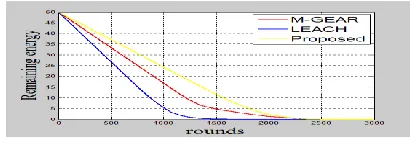
Remaining Energy is defined as the total amount (in joules) of remaining energy at the end of each round. The initial energy of each in the network is 0.5J. So, the total energy of the network is 50J. From Figure 5.5 it is shown that ECR based Multihop routing protocol yields smallest amount of energy consumption as compared to that of GEAR and LEACH.
Figure Comparison of Remaining Energy for 100m x 100m network with 100 nodes
VI. Conclusion
International Journal of Research (IJR)
e-ISSN: 2348-6848, p- ISSN: 2348-795X Volume 2, Issue 09, September 2015Available at http://internationaljournalofresearch.org
network is divided into four logical regions. Two regions (R1, R2) transmit the data directly to the BS. Other two regions (R3, R4) are divided into clusters uses multihop communication. In regions R3, R4 CHs are chosen on the basis of the value of ECR in the earlier round. The node which has least value of ECR in the existing round node becomes CH in the next round. Simulation results shows that ECR based multihop protocol performs better than the existing protocols such that LEACH, M-GEAR.
Acknowledgement
The authors are grateful to the department of electronics and communication, Punjabi University Patiala; Research Lab, University College of Engineering, Patiala.
References
[1] Sasikumar , Anitha, “Performance Evaluation of Heterogeneous-HEED Protocol for Wireless
Sensor Networks”in the proceedings
ofInternational Journal of Advanced Research in Computer and Communication Engineering Vol. 3, Issue 2, February 2014.
[2] Manjeshwar, and Agrawal, “TEEN: A Routing Protocol for Enhance efficiency in wireless sensor networks”, in IEEE transactions on Computer Society, Washington, 2001.
[3] Mao, Chengfa , Guihai and Jie ,“EECS:An Energy Efficient Clustering Scheme in Wireless Sensor Networks” In the proceedings of 24th IEEE Conference in Performance, Computing, and Communication Conference (IPCCC), pp.01-21, December 17, 2005.
[4] Alemu, Koh, Kim,“A Hierarchical Multi-Parent Cluster Based Data Aggregation Framework for WSNs”, in the proceedings ofInternational Conference on Complex, Intelligent and Software Intensive Systems,2010
[5] Heinzelman, Chandrakasan and Balakrishnan, “Energy-Efficient communication Protocol for Wireless Micro sensor Networks," in the proceedings of the 33rd Hawaii International Conference on System Sciences (HICSS'00),
January 2000.
[6] Manjeshwar, and Agrawal, “TEEN: A Routing Protocol for Enhance efficiency in wireless sensor networks”, in IEEE transactions on Computer Society, Washington, 2001.
[7] Rehman, Javaid, Manzoor, Hafeez, AIqbal and M. Ishfaq, “Energy consumption Rate based Stable Election Protocol (ECRSEP) for WSNs,” in the proceedings of International Workshop on Body Area Sensor Networks (BASNet), Vol.19, ISSN: 932-937, 2013.
[8] Alla, Ezzati, Hssane, Hasnaousi, “Hierarchical adaptive balanced energy efficient routing protocol (HABRP) for heterogeneous wireless sensor networks.