doi:10.1136/oem.58.12.811
2001;58;811-817
Occup. Environ. Med.
M Kivimäki, J Vahtera, J E Ferrie, H Hemingway and J Pentti
problems in employees: a prospective study
Organisational downsizing and musculoskeletal
http://oem.bmj.com/cgi/content/full/58/12/811
Updated information and services can be found at:
These include:
References
http://oem.bmj.com/cgi/content/full/58/12/811#otherarticles
8 online articles that cite this article can be accessed at:
http://oem.bmj.com/cgi/content/full/58/12/811#BIBL
This article cites 31 articles, 10 of which can be accessed free at:
Rapid responses
http://oem.bmj.com/cgi/eletter-submit/58/12/811
You can respond to this article at:
service
Email alerting
top right corner of the article
Receive free email alerts when new articles cite this article - sign up in the box at the
Topic collections
(1298 articles)
Occupational Health
Articles on similar topics can be found in the following collections
Notes
http://journals.bmj.com/cgi/reprintform
To order reprints of this article go to:
http://journals.bmj.com/subscriptions/
go to:
Occupational and Environmental Medicine
Organisational downsizing and musculoskeletal
problems in employees: a prospective study
M Kivimäki, J Vahtera, J E Ferrie, H Hemingway, J Pentti
Abstract
Objectives—To study the association be-tween organisational downsizing and sub-sequent musculoskeletal problems in employees and to determine the associ-ation with changes in psychosocial and behavioural risk factors.
Methods—Participants were 764 munici-pal employees working in Raisio, Finland before and after an organisational down-sizing carried out between 1991 and 1993. The outcome measures were self reports of severity and sites of musculoskeletal pain at the end of 1993 and medically cer-tified musculoskeletal sickness absence for 1993–5. The contribution of changes in psychosocial work characteristics and health related behaviour between the 1990 and 1993 surveys was assessed by adjust-ment.
Results—After adjustment for age, sex, and income, the odds ratio (OR) for severe musculoskeletal pain between major and minor downsizing and the corresponding rate ratios for musculoskeletal sickness absence were 2.59 (95% confidence inter-val (95% CI) 1.5 to 4.5) and 5.50 (3.6 to 7.6), respectively. DiVerences between the mean number of sites of pain after major and minor downsizing was 0.99 (0.4 to 1.6). The largest contribution from changes in work characteristics and health related behaviour to the association between downsizing and musculoskeletal problems was from increases in physical demands, particularly in women and low income employees. Additional contribu-tory factors were reduction of skill discre-tion (relative to musculoskeletal pain) and job insecurity. The results were little diVerent when analyses were confined to initially healthy participants.
Conclusions—Downsizing is a risk factor for musculoskeletal problems among those who remain in employment. Much of this risk is attributable to increased physical demands, but adverse changes in other psychosocial factors may also play a part.
(Occup Environ Med2001;58:811–817)
Keywords: ocupational health; musculoskeletal disor-ders; downsizing
Organisational downsizing (reduction of per-sonnel by businesses and other organisations) has become an important aspect of modern working life.1 2
In the United States, for exam-ple, 43 million jobs were erased between 1979
and 1995, and in one third of all households, a family member had been laid oV during this period.2
Downsizing can be a risk to the health of those who remain in employment.3–7
How-ever, there is a lack of studies investigating potential psychosocial and behavioural mecha-nisms linking downsizing and health outcomes. Musculoskeletal problems are among the most common causes of disability in workers across occupational groups.8–11
There is also a rising trend in work related musculoskeletal problems.12 13
The aetiology of musculoskeletal disorders is multifactorial.14–23
Risk factors include high work demands, job insecurity, low job control, smoking, and vigorous exercise. These factors have also been associated with
Main messages
x Earlier research on the health eVects of organisational downsizing has paid little attention to development of musculo-skeletal disorders.
x Downsizing is a risk factor for musculo-skeletal problems among those who remain in employment.
x This risk involves men and women irrespective of socioeconomic status. The eVect was stronger in those with pre-existing musculoskeletal problems, but was also found in initially healthy employ-ees.
x Much of the adverse eVect of downsizing on musculoskeletal health is attributable to increasing work demands arising from work force reductions.
x Adverse changes in other psychosocial factors—such as job control and job insecurity—may also contribute to musculoskeletal morbidity after downsiz-ing.
Policy implications
x Those making decisions about organisa-tional downsizing should be aware of the potential negative consequences of this managerial strategy to health of employ-ees.
x Measures to prevent increasing numbers of musculoskeletal problems among staV may decrease excess morbidity relative to downsizing.
x Heightened work demands seems to be a main contributor to the association be-tween downsizing and musculoskeletal problems.
University of Helsinki, Department of Psychology, PO Box 13, FIN 00014 University of Helsinki, Finland
M Kivimäki
Finnish Institute of Occupational Health, Turku, Finland
J Vahtera J Pentti
University College London Medical School, Department of Epidemiology and Public Health, London, England
JE Ferrie H Hemingway
Kensington and Chelsea and Westminster Health Authority, Department of Research and Development, London, England
H Hemingway
Correspondence to: Dr M Kivimäki
downsizing or organisational restructur-ing.7 24 25
Sickness absence records are impor-tant indicators of health in working populations and an association between downsizing and musculoskeletal sickness absence has already been found.5 26
However, sickness absence for musculoskeletal problems may be influenced by the physical demands of the job, the severity of disability, and the culture of absence behav-iour. Self reports of musculoskeletal problems do not face such work based constraints. As far as we are aware, no previous study on downsiz-ing has considered both self reported and record based outcomes.
The longitudinal Raisio study is uniquely able to investigate associations between down-sizing, changes related to work and other areas of life, and musculoskeletal problems. It focused on municipal staVin the service of the Finnish town of Raisio before and after the most severe economic decline in Finland since the first world war. Unemployment rose from 3% in 1990 to 16% in 1993 and was still 15% in 1995.27
The average reduction of days worked in Raisio was 15% between 1991 and 1993 but there was considerable variation between occupational groups.5 7
Only a slight (4%) increase in days worked between 1993 and 1995 followed the downsizing.
The objectives of this study were (a) to determine the association between downsizing and musculoskeletal problems, measured with self reported and sickness absence data, and (b) to identify psychosocial and behavioural mechanisms underlying this association. We hypothesised that such mechanisms may in-clude increased work demands, high job insecurity, and loss of job control. Further-more, we tested whether smoking and vigorous exercise, as attempts at coping, may increase the likelihood of musculoskeletal problems relative to downsizing.
Methods
PARTICIPANTS
The cohort was the same as that used in our previous study of downsizing.7
It comprised 189 male and 575 female municipal employees who had responded in 1990 and 1993 to surveys designed to assess characteristics of work, social relations, and health related behaviour. Participants represented 78% of the
eligible population—that is, those permanent, full time, Raisio employees in continuous employment for at least 6 months in both 1991 and 1993. The mean age was 41 (range 20–62) in men and 42 (range 21–60) years in women. Twenty nine per cent were higher grade white collar workers (managers, physicians, teach-ers), 45% lower grade white collar workers (technicians, registered nurses, oYce workers), and 26% blue collar workers (cleaners, mainte-nance workers, kitchen assistants). Data cov-ered 936 person-years of follow up for men and 2800 person-years of follow up for women during the 5 year study period from 1991 to 1995.
Participants were representative of the eligi-ble population from which they did not diVer in terms of age (41 years in both groups), sex (75% and 73% women respectively), socioeco-nomic status (76% white collar and 26% blue collar workers in both groups), and musculo-skeletal sickness absence (mean rate 17.5 and 17.2 spells/100 years respectively).
DESIGN
We obtained baseline information about sever-ity and sites of musculoskeletal pain, psychoso-cial work characteristics, and health related behaviour from a survey in 1990. Baseline musculoskeletal sickness absences were de-rived from the 1991 records. Exposure to downsizing was indicated from reduction of days worked in each job category between 1991 and 1993. Outcomes were severity of musculo-skeletal pain and sites of musculomusculo-skeletal pain, measured by a survey carried out in November 1993, and musculoskeletal sickness absences obtained from records related to the years 1993 to 1995. Potential contributors to the associ-ation between downsizing and these outcomes included changes in psychosocial work charac-teristics and health related behaviour measured by the two surveys in 1990 and 1993 (box).
DOWNSIZING
We constructed an ecological measure of the extent of downsizing during the 3 years in each of the job categories in which the respondents worked.5 7
Information obtainable from the employer’s records for all periods included dates of starting work, and where appropriate, ending work; job titles; and dates on which
Study design
Year Measurements Source of data
1990–1 Demographics Employer’s records (1990–1)
(baseline information) Work characteristics and health behaviour Survey (November 1990) Musculoskeletal pain Survey (November 1990)
Sickness absence due to musculoskeletal disorders Records from occupational healthcare unit (1 January–31 December 1991)
1991–3 Reduction in the sum of days worked in diVerent job categories* Employer’s records (1 January–31 December 1991 and 1 January–31 December 1993) (downsizing)
1993–5 Work characteristics and health behaviour Survey (November 1993) (explanatory factors and
outcome variables)
Musculoskeletal pain Survey (November 1993)
Sickness absence due to musculoskeletal disorders Records from occupational healthcare unit (1 January–31 December 1995)
*Sum of days worked refers to the sum of days included in all work contracts minus the sum of days legitimately spent away from work (on leave, laid oV, maternity leave, sickness absence). Extent of downsizing is percentage of reduction in the sums of days worked between 1991 and 1993.
each period of absence began and ended. We calculated the number of days worked by sub-tracting days equivalent to number of days oV work, irrespective of cause, from total possible working days, for each job category in 1991 and in 1993. Job categories were based on the classification of occupations by Statistics Fin-land (32 occupational groups). Percentage reductions in the number of days worked from 1991 to 1993 were calculated for each job cat-egory, as a measure of the extent of downsizing. Categories of minor (<8%), intermediate (8%–18%) and major (>18%) downsizing were used as in our earlier study on all cause absence in the same cohort.7
Categories of minor and major downsizing also corre-sponded with those used in the previous study on the eligible population.5
A more detailed description of the measure is given elsewhere.5
MUSCULOSKELETAL PROBLEMS
Three indicators of musculoskeletal problems were used: (a) status of severe musculoskeletal pain; (b) number of sites of musculoskeletal pain; and (c) number of recorded spells of musculoskeletal sickness absence.
Assessment of severe musculoskeletal pain was based on a visual analogue scale.28
Partici-pants indicated the intensity of such pain on a 100 mm line by placing a mark between state-ments of “no pain” and “the greatest imagina-ble pain” during the past 7 days. A dichoto-mous measure of severe pain identified cases from marks 55 mm or less from the ultimate pain end. This cut oVpoint is 15% tighter than that used to detect pain in previous research29 and allows enough cases to examine the eVect of downsizing on severe pain in the present cohort.
The number of sites of musculoskeletal pain was measured by the Nordic musculoskeletal questionnaire.30 31
It asks about problems, such as ache, pain, and discomfort, arising in nine body areas (neck, shoulders, elbows, wrists or hands, upper back, lower back, hips or thighs or buttocks, knees, and ankles or feet). A continu-ous measure of the number of reported sites of pain during the past 12 months in the 1993 survey was the outcome (range 0—9). Initially healthy cohort was defined as those with no reported sites of musculoskeletal pain during the past 7 days in the 1990 survey.
Earlier research shows that organisational downsizing increases the risk of medically cer-tified sickness absence but not self cercer-tified sickness absence.5
Thus, this paper deals with medically certified absences relating to all those diagnoses which belong to the main cat-egory of musculoskeletal disorders in the inter-national classification of diseases (ICD), 1977 revision.32
Illustrative diagnoses are osteo-arthritis, rheumatoid osteo-arthritis, sciatica, and lumbago. We grouped all periods of musculo-skeletal sickness absence that occurred before downsizing in 1991 and all such periods that occurred after downsizing in 1993–5. We checked records for inconsistencies, and com-bined any overlapping or consecutive periods of sickness absence.
Data on sick leaves were collected from computer based records kept by the Raisio occupational healthcare unit. They include data for each employee on when sick leave began and ended and the diagnosis in coded form. All certificates relating to sick leaves, irrespective of place of issue, had to be forwarded for recording. For periods of ab-sence of up to 3 days, employees could complete their own certificates. Such absences were not included in the present study. For absences of more than 3 days, which were the focus of this study, medical certificates are required.
The three indicators of musculoskeletal problems were moderately interrelated (Pear-son correlation between self reported indica-tors r=0.45; correlations of severity and number of sites of musculoskeletal pain to musculoskeletal sickness absence were 0.31 and 0.32, respectively, p<0.001 in all cases).
POTENTIAL EXPLANATORY FACTORS
We used information obtained by question-naire surveys in 1990 and 1993 about those adverse changes in characteristics of work and health behaviour which have been found to be related to downsizing in the present cohort7
: physical work demands (one item, Standard Survey by Statistics Finland)33
; aspects of job control, such as skill discretion (four item scale, Cronbach’sá reliability 0.78) and opportuni-ties to participate in decision making (three item scale; Cronbach’sá0.76)34
; job insecurity (five item scale from the standard survey by Statistics Finland, Cronbach’s á 0.87)33
; and smoking (current smoker v not). We also measured vigorous exercise (>1 hours a week of vigorous exercise)35
which has been associ-ated with organisational restructuring in earlier studies.6
OTHER VARIABLES
Other variables, measured at baseline, were sex, age, and socioeconomic status, as indi-cated by income (median split for highvlow income; median incomes were 126 000 and 114 000 FIM/year for men and women, respectively).7
STATISTICAL ANALYSES
Number of musculoskeletal sickness absence spells and person-years of follow up, as well as severity and sites of musculoskeletal pain were calculated for each employee. Poisson regression models were fitted to data with musculoskeletal sickness absence.5 36
Logistic regression analyses were conducted with severe musculoskeletal pain (a dichotomous variable). For several sites of musculoskeletal pain (a continuous variable), analysis of variance (ANOVA) was used.
estimated diVerences between means (95% CIs) after major and intermediate versus minor downsizing using the Dunnett test for multiple comparisons.37
The eVect of downsizing on work character-istics, treated as continuous variables, was studied by analyses of variance and its eVect on dichotomous variables, the health related behaviour, by logistic regression. Means and ORs of these factors after downsizing were adjusted for their values before downsizing.
Linear trends and interactions with sex, income, and baseline health were tested in associations of downsizing with musculo-skeletal problems and other variables.
To study how the association between down-sizing and musculoskeletal problems contrib-uted to changes in work characteristics and health related behaviour, a two step adjustment strategy was applied.7 38
Firstly, musculo-skeletal problems after downsizing were ad-justed for each characteristic age, income, sex, and work and health related behaviour before downsizing. Next, we included into these mod-els the level of each characteristic after downsizing. A higher reduction in the eVect of downsizing on musculoskeletal problems after the inclusion indicates a higher contribution as an explanatory factor. Tests were made sepa-rately for men and women and for employees with high and low income.
All the analyses were carried out for the entire cohort and for the initially healthy cohorts (those who had no musculoskeletal problems before downsizing). For logistic and Poisson models we used the GENMOD procedure and
for analysis of variance the GLM procedure in the SAS program package.
Results
EFFECTS OF DOWNSIZING
There was a highly significant linear relation between downsizing and musculoskeletal prob-lems across all outcomes (table 1). After adjustment for age, sex, and income, the ORs for severe musculoskeletal pain between major and minor downsizing and the corresponding rate ratio for musculoskeletal sickness absence were 2.6 and 5.5, respectively. Major downsiz-ing was associated with about one symptom area more than minor downsizing. The rela-tions did not significantly vary between sexes or income groups, except for the number of sites of musculoskeletal pain in which the trend was not significant for high income employees.
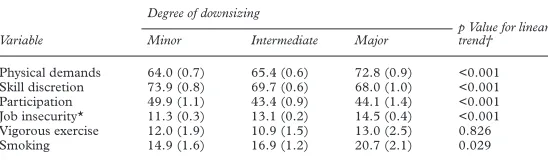
Associations between downsizing and char-acteristics of work and health related behaviour are shown in table 2. Major downsizing was related to increased levels of physical demands, job insecurity, and smoking, and decreased levels of skill discretion and participation in decision making. There were only two diV er-ences between sexes or income groups in these linear trends. The eVect of downsizing on physical demands was stronger in low income employees than in high income employees and its eVect on participation was stronger among women than among men. However, in all these cases the association was significant (p=0.038– <0.001). Downsizing was not related to vigor-ous exercise.
TEST OF EXPLANATORY FACTORS
The test of explanatory factors involved all those characteristics of work and health related behaviour significantly associated with down-sizing (tables 3–5). Although the association between downsizing and musculoskeletal prob-lems did generally not diVer between the sexes and income groups, it is possible that contribu-tors to this association were not the same for these groups. For this reason, tests of explana-tory factors were conducted separately for male, female, low income, and high income employees. We did not analyse vigorous exercise as it was not related to downsizing. Participation in decision making and smoking were associated with downsizing but they did not aVect the relation between downsizing and musculoskeletal problems.
We have omitted the level “intermediate downsizing” from tables 3–5 because this information is redundant in supporting our conclusions. As the comparison between mod-els 1 and 2 in table 3 shows, additional adjust-ment for physical demands after downsizing attenuated the association between downsizing and severe musculoskeletal pain in all groups. This indicates that increases in physical demands may partially underlie the associ-ation. Attenuation was 59% in men and 24%– 36% in other groups. Adjustment for covariates of skill discretion and job insecurity attenuated the association in women and low income employees. Simultaneous adjustment for all Table 1 EVect of downsizing on musculoskeletal problems adjusted for age, sex, and
income
Indicator of musculoskeletal problems
Degree of downsizing
Crude values
Adjusted ratio / diVerence (95% CI)
p Value for linear trend§
Severe pain* Minor 20 1.00
Intermediate 26 1.48 (0.9 to 2.4)
Major 39 2.59 (1.5 to 4.5) <0.001
Sites of musculoskeletal pain† Minor 2.77 0.00
Intermediate 3.31 0.29 (−0.2 to 0.7) Major 4.14 0.99 (0.4 to 1.6) <0.001
Sickness absence rate‡ Minor 4.8 1.00
Intermediate 16.6 2.11 (1.7 to 3.9)
Major 39.5 5.50 (3.6 to 7.6) <0.001
*Crude values are percentages of cases. Adjusted ORs (95% CIs) are reported.
†Crude values are mean numbers of sites. Adjusted diVerences between means (95% CIs) are reported.
‡Crude values are absence rates/100 person-years. Adjusted RRs (95% CIs) are reported. §The trend was dependent on income for sites of musculoskeletal pain (p=0.018) but otherwise independent of sex and income.
Table 2 Mean percentages (SEMs) of work characteristics and percentages (SE) of health related behaviour after downsizing adjusted for values before downsizing
Variable
Degree of downsizing
p Value for linear trend† Minor Intermediate Major
Physical demands 64.0 (0.7) 65.4 (0.6) 72.8 (0.9) <0.001 Skill discretion 73.9 (0.8) 69.7 (0.6) 68.0 (1.0) <0.001 Participation 49.9 (1.1) 43.4 (0.9) 44.1 (1.4) <0.001 Job insecurity* 11.3 (0.3) 13.1 (0.2) 14.5 (0.4) <0.001 Vigorous exercise 12.0 (1.9) 10.9 (1.5) 13.0 (2.5) 0.826 Smoking 14.9 (1.6) 16.9 (1.2) 20.7 (2.1) 0.029
*Measured only after downsizing and therefore no adjustment for job insecurity at baseline. †The trend was dependent on income in physical demands (p=0.005) and on sex in participation (p=0.044) but otherwise independent of income and sex.
these covariates reduced the association be-tween downsizing and musculoskeletal pain by 60% and 54% in women and low income employees, respectively. Although adjustment for job insecurity also aVected the association in men, controlling simultaneously for physical demands and job insecurity did not lead to extra attenuation in the association.
Adjustment for physical demands attenuated the association between downsizing and number of sites of musculoskeletal pain more than 20% in all groups (table 4). Adjustment of skill discretion reduced this association in men and adjustment of job insecurity in low income employees. As can be seen in table 5, adjustment for physical demands aVected the association between downsizing and musculoskeletal sick-ness absence only in women and low income employees, leading to 17%–20% reductions in the association. In men, adjustment for job inse-curity also attenuated this association.
INITIALLY HEALTHY POPULATION
To explore whether downsizing was associated with incidence of musculoskeletal problems, we conducted analyses for initially healthy sub-cohorts. At baseline, there were 604 employees with no severe musculoskeletal pain, 353 employees with no sites of musculoskeletal pain, and 686 employees with no musculo-skeletal sickness absence. There was a linear
trend across all three indicators of musculo-skeletal problems (p<0.01). After adjustment for age, sex, and income, OR for severe musculoskeletal pain between major and minor downsizing and the corresponding rate ratios (RRs) for musculoskeletal sickness absence were 2.25 (95% CI 1.1 to 4.6) and 3.34 (95% CI 2.1 to 5.4), respectively. Major downsizing was associated with over a half symptom area more than minor downsizing.
Downsizing was also associated with changes in each characteristic of work but not with changes in health related behaviour. In most cases, tests of explanatory factors led to results similar to those for all participants. The only exceptions were that job insecurity did not contribute to the relation between downsizing and severe pain in men and that decreased skill discretion did not contribute to this relation in women.
Discussion
This longitudinal study took advantage of a natural experiment by following up the same people before any rumour of downsizing and after downsizing. Our data provide robust evidence that downsizing is associated with increased musculoskeletal problems. This has already been found for musculoskeletal sickness absence, but the evidence from self reporting is Table 3 OR (95% CI) for severe musculoskeletal pain between major v minor downsizing by sex and income (in all cases the OR for minor downsizing was 1.00)
Population
Covariate
Physical demands Skill discretion Job insecurity
Model 1 Model 2 Model 1 Model 2 Model 1 Model 2
Men 5.78 (1.1 to 26.2) 2.96 (0.6 to 14.9) 6.22 (1.3 to 28.8) 5.90 (1.3 to 27.8) 6.01 (1.3 to 27.0) 5.46 (1.2 to 25.8)
Women 1.80 (0.9 to 3.6) 1.51 (0.7 to 3.1) 2.48 (1.3 to 4.8) 2.24 (1.1 to 4.4) 2.51 (1.3 to 4.8) 2.34 (1.2 to 4.5)
High income employees 4.00 (1.4 to 11.5) 3.27 (1.1 to 9.7) 4.02 (1.4 to 11.4) 3.93 (1.4 to 11.1) 4.16 (1.5 to 11.7) 3.86 (1.3 to 11.2) Low income employees 2.26 (0.8 to 6.1) 1.92 (0.7 to 5.4) 3.43 (1.3 to 9.1) 2.85 (1.1 to 7.7) 3.20 (1.2 to 8.4) 2.91 (1.1 to 7.7)
Model 1 is adjusted for age, income, and covariate before downsizing, with the exception of job insecurity which was not measured at baseline. Model 2 is additionally adjusted for covariate at the end of downsizing.
Italicsare used to point out attenuation >10% in the eVect of major downsizing in model 2 compared with that in model 1. A higher attenuation indicates a higher contribution of the covariate as an explanatory factor.
Table 4 DiVerence in mean (95% CI) number of sites of musculoskeletal pain between major v minor downsizing by sex and income (in all cases the mean diVerence for minor downsizing was 0.00)
Population
Covariate
Physical demands Skill discretion Job insecurity
Model 1 Model 2 Model 1 Model 2 Model 1 Model 2
Men 1.07 (−0.2 to 1.1) 0.84 (−0.5 to 2.2) 0.97 (−0.4 to 2.3) 0.86 (−0.5 to 2.1) 1.12 (−0.2 to 2.4) 1.05 (−0.3 to 2.4) Women 0.51 (−0.2 to 1.2) 0.29 (−0.4 to 1.0) 0.80 (0.1 to 1.5) 0.80 (0.1 to 1.5) 0.91 (0.2 to 1.6) 0.87 (0.2 to 1.5) High income employees 1.13 (0.3 to 2.0) 0.89 (−0.0 to 1.8) 1.42 (0.6 to 2.3) 1.42 (0.5 to 2.3) 1.55 (0.7 to 2.4) 1.53 (0.7 to 2.4) Low income employees 0.25 (−0.8 to 1.3) 0.11 (−0.9 to 1.2) 0.27 (−0.8 to 1.3) 0.21 (−0.9 to 1.3) 0.31 (−0.8 to 1.4) 0.18 (−0.9 to 1.3)
Explanations as in table 3.
Table 5 Ratio (95% CI) of rates of musculoskeletal sickness absence between major v minor downsizing by sex and income (in all cases the rate ratio for minor downsizing was 1.00)
Population
Covariate
Physical demands Skill discretion Job insecurity
Model 1 Model 2 Model 1 Model 2 Model 1 Model 2
Men 5.62 (2.9 to 10.8) 5.96 (2.9 to 12.3) 5.16 (2.7 to 10.0) 5.31 (2.7 to 10.4) 5.96 (3.1 to 11.5) 5.18 (2.6 to 10.2)
Women 6.40 (3.1 to 13.4) 5.30 (2.5 to 11.2) 7.49 (3.6 to 15.5) 7.08 (3.4 to 14.7) 8.22 (4.0 to 16.9) 8.08 (3.9 to 16.6) High income employees 5.26 (2.4 to 11.7) 5.68 (2.4 to 13.3) 5.97 (2.7 to 13.2) 6.64 (3.0 to 14.9) 6.84 (3.1 to 15.0) 7.39 (3.3 to 16.7) Low income employees 5.33 (2.6 to 11.0) 4.44 (2.1 to 9.3) 5.69 (2.8 to 11.7) 5.26 (2.6 to 10.9) 6.17 (3.0 to 12.6) 5.88 (2.9 to 12.0)
new and important, as they are not work meas-ures. Also, the present study provides new infor-mation about mechanisms linking downsizing with musculoskeletal problems.
The eVect of downsizing on musculoskeletal problems in those remaining in employment was obvious across the three diVerent indica-tors of musculokeletal problems, in men and women and also in the initially healthy subcohort. Downsizing was associated with reported severity and sites of musculoskeletal pain immediately after staV reductions. The association was even stronger relative to musculoskeletal sickness absences measured for an extended period covering two subse-quent years after downsizing. Sickness absence is considered as one of the best measures of musculoskeletal disability in working popula-tions.39
In this study, all the spells of musculo-skeletal sickness absence were certified by a doctor.
In low income employees and women, increases in physical demands accounted for from one fifth to over one third of the eVect of downsizing on musculoskeletal problems across all the outcomes under study. In male and high income employees, increased physical demands contributed to the association be-tween downsizing and subjective experiences of musculoskeletal problems but not to sick-ness absence. Increased physical demands probably imply pathophysiological mecha-nisms related to heightened exposure to physi-cal risk factors such as lifting, twisting, and bending.40–43
Low income employees (cleaners, nursing auxiliaries, and kitchen workers) have physically strenuous work with high exposure to such physical risk factors for musculo-skeletal problems,44 45
and a higher proportion of these employees are women than men. This may partially explain the more significant role of physical demands in women.
Results for the other explanatory factors were not as robust as those related to physical demands. Reduction of skill discretion partially explained the eVects of downsizing on self reported musculoskeletal problems but not on sickness absence or in high income employees. The mechanism by which skill discretion may influence musculoskeletal problems is not known. It is possible that it involves control over physical demands at work.8 44 46
This is probably not more than a partial explanation of the present results because the combined eVect of physical demands and skill discretion clearly exceeded that found related to physical de-mands alone.
Job insecurity may produce a stress response increasing muscle tension, a factor with the potential to increase musculoskeletal prob-lems.12 47
In men with pre-existing disease, job insecurity played a more pronounced part than in women. The contribution of job insecurity may have been stronger if those with non-permanent contracts had been included in the study or if the downsizing had aVected perma-nent employees more than it did.3 4 6 48
In Rai-sio, only employees without permanent con-tracts of employment lost jobs.49
As usual in the public sector in Finland and other countries,
staV numbers were reduced through retire-ment, by not filling vacancies, and by not hiring cover for those absent from work.49
We found no support for increased smoking and vigorous exercise as behavioural pathways linking downsizing and musculoskeletal prob-lems within the time frame of this study. Major downsizing was associated with increased prevalence of smoking, supporting earlier find-ings on organisational restructuring.25
METHODOLOGICAL CONSIDERATION
To reflect accurately the true changes in days worked, our measure of downsizing took into account reductions due to sickness absence as well as other days legitimately spent away from work, finishing work, and new work contracts. Excluding sickness absence from the measure of downsizing yielded similar estimates for the eVect of downsizing on musculoskeletal sick-ness absence (excess risk after major downsiz-ing was 5.6 (95% CI 3.7 to 8.6)). Relations between exposure and outcome are therefore unlikely to have overestimated the eVects of downsizing. Moreover, the significant associa-tions between downsizing and self reported musculoskeletal pain were unaVected by any such possible confounding.
Although several potential pathways were identified, almost half of the relation between downsizing and musculoskeletal problems re-mained unexplained. This may be due to several reasons. Firstly, the measurement of the potential explanatory factors was much more open to error than the measurement of down-sizing and musculoskeletal sickness absence, which were both derived from daily based reg-istered data, although the two other measures of musculoskeletal problems were similarly self reports. Secondly, the relation between down-sizing and musculoskeletal problems may be partially explained by factors not measured in this study, such as increased sleeping problems, lifting, and carrying. Thirdly, it is not clear whether inability to identify explanatory fac-tors of downsizing among the sample of high income employees reflect true diVerences between socioeconomic groups or practical constrains of the data. Major downsizing was not as common in this group as among low income respondents. However, a significant interaction between downsizing and income on physical demands and musculoskeletal pain indicates that the eVects of downsizing may vary by socioeconomic position.
Conclusions
As a conclusion, this natural experiment provides evidence of an association between downsizing and the development of musculo-skeletal problems, and identifies potential link-ing mechanisms. We showed that downsizlink-ing significantly increases risk of musculoskeletal problems among those who remain in employ-ment. Concomitant increase in physical work demands contributed to this risk, particularly in women and low income employees. Reduc-tion of skill discreReduc-tion was also a potential explanatory factor but only in relation to self
reported indicators of musculoskeletal prob-lems. In men, job insecurity played a notable part among those with musculoskeletal prob-lems before downsizing. If indeed downsizing continues to be a significant trend within industrialised countries for the foreseeable future, as has been suggested,1
then those mak-ing decisions should be aware of these negative consequences of this managerial strategy.
MK was the principal investigator and together with JV designed and conducted the study and wrote the paper. JEF and HH contributed to the writing of the paper, helped in the data analysis, and advised in the interpretation and presentation of the results. JP developed the downsizing measure and helped in data analysis. MK is supported by the Academy of Finland (project No 44968), JV by the Finnish Work Environment Fund, JEF by the Economic and Social Research Council (L 128 25 1046), and HH by a Public Health Career Scientist Award from the Department of Health during the preparation of this work. We thank Dr Marja Lampio from the occupational health-care unit in Raisio; and all participating municipal employees.
1 Hurrell JJ. Editorial.Am J Public Health1998;88:1012–3. 2 Cascio WF. Learning from outcomes: financial experiences
of 311 firms that have downsized. In: MK Gowing, JD Kraft, JC Quick, eds. The new organizational reality. Washington: American Psychological Association, 1998: 55–70.
3 Beale N, Nethercott S. Certificated sickness absence in industrial employees threatened with redundancy. BMJ
1988;296:1508–10.
4 Ferrie JE, Shipley MJ, Marmot MG,et al. Health eVects of anticipation of job change and non-employment: longitudi-nal data from the Whitehall II study.BMJ1995;311:1264– 9.
5 Vahtera J, Kivimäki M, Pentti J. EVect of organisational downsizing on health of employees.Lancet1997;350:1124– 8.
6 Ferrie JE, Shipley MJ, Marmot MG,et al. An uncertain future: the health eVects of threats to employment security in white-collar men and women.Am J Public Health1998;
88:1030–6.
7 Kivimäki M, Vahtera J, Pentti J,et al. Factors underlying the eVect of organisational downsizing on the health of employees: a longitudinal cohort study of changes in work, social relations and health behaviours.BMJ2000;320:971– 5.
8 Klaukka T, Sievers K, Takala J. Epidemiology of rheumatic disease in Finland in 1964–76.Scand J Rheumatol1982;47: 5–13.
9 OYce of Population Censuses and Surveys, Martin J, Melzer H,et al.OPCS surveys of disability in Great Britain; report 1 (prevalence of disability among adults). London: The Stationery OYce, 1988.
10 Feeney A, North F, Head J,et al. Socioeconomic and sex diVerentials in reason for sickness absence from the White-hall II study.Occup Environ Med1998;55:91–8. 11 Guo H-R, Tanaka S, Halperin WE, et al. Back pain
prevalence in US industry and estimates of lost workdays.
Am J Public Health1999;89:1029–35.
12 Hales TR, Bernard BP. Epidemiology of work related musculoskeletal disorders. Occup Disorder Management
1996;27:679–709.
13 Leijon M, Hensing G, Alexanderson K. Gender trends in sick-listing with musculoskeletal symptoms in a Swedish county during a period of rapid increase in sickness absence.Scand J Soc Med1998;26:204–13.
14 Linton SJ. An overview of psychosocial and behavioral fac-tors in neck-and-shoulder pain.Scand J Rehabil Med1992;
32:67–78.
15 Bongers PM, de Winter CR, Kompier MAJ,et al. Psychoso-cial factors at work and musculoskeletal disease.Scand J Work Environ Health1993;19:297–312.
16 Houtman ILD, Bongers PM, Smulders PGW,et al. Psycho-social stressors at work and musculoskeletal problems.
Scand J Work Environ Health1994;20:139–45.
17 Leino PI, Hänninen V. Psychosocial factors at work in rela-tion to back and limb disorders.Scand J Work Environ Health1995;21:134–42.
18 Skov T, Borg V, Orhede E. Psychosocial and physical risk factors for musculoskeletal disorders of the neck, shoul-ders, and lower back in salespeople.Occup Environ Med
1996;53:351–6.
19 Hemingway H, Shipley M, Stansfeld S,et al. Are risk factors for atherothrombotic disease associated with back pain sickness absence? The Whitehall II study.J Epidemiol Com-munity Health1999;53:197–203.
20 Toomingas A, Theorell T, Michélsen H,et al. Associations between self-rated psychosocial work conditions and
musculoskeletal symptoms and signs.Scand J Work Environ Health1997;23:130–9.
21 Hemingway H, Shipley MJ, Stansfeld S, et al. Sickness absence from back pain, psychosocial work characteristics and employment grade among oYce workers.Scand J Work Environ Health1997;23:121–9.
22 Stansfeld S, Head J, Ferrie J. Short-term disability, sickness absence, and social gradients in the Whitehall II study.Int J Law Psychiatry1999;22:425–39.
23 Elovainio M, Sinervo T. Psychosocial stressors at work, psy-chosocial stress and musculoskeletal symptoms in the care for the elderly.Work Stress1997;11:351–62.
24 Ferrie JE Shipley MJ, Marmot MG,et al. The health eVects of major organisational change and job insecurity.Soc Sci Med1998;46:243–54.
25 Ferrie JE, Shipley MS, Marmot MG,et al. Job insecurity in white-collar workers: towards an explanation of associa-tions with health.J Occup Health Psychol2001;2:26–42. 26 Marmot MG, Feeney A, Shipley M,et al. Sickness absence
as a measure of health status and functioning: from the UK Whitehall II study.J Epidemiol Community Health1995;49: 124–30.
27Statistical yearbook of Finland. Helsinki: Statistics Finland, 1998.
28 Million R, Hall W, Nilsen KH, et al. Assesment of the progress of the back-pain patient. 1981 Volvo Award in Clinical Science.Spine1982;7:204–12.
29 Vahtera J, Uutela A, Pentti J. The eVects of objective job demands on registered sickness absence spells: do personal, social, and job-related resources act as moderators?Work Stress1996;19:286–308.
30 Kuorinka I, Jonsson B, Kilbom A,et al. Standardised nordic questionnaires for the analysis of musculoskeletal symp-toms.Appl Ergon1987;18:233–7.
31 Dickinson CE, Campion K, Foster AF,et al. Questionnaire development: an examination of the Nordic musculo-skeletal questionnaire.Appl Ergonomics1992;23:197–201. 32 World Health Organisation.International classification of
dis-eases, 1977 revision. Geneva: WHO, 1977.
33 Lehto A-M.Työelämän laatu ja tasa-arvo tuotannossa (Qual-ity of working life and equ(Qual-ity). Helsinki: Statistics Finland, 1991.
34 Kivimäki M, Vahtera J, Thomson J,et al. Psychosocial factors predicting employee sickness absence during economic decline.J Appl Psychol1997;82:858–72. 35 Kujala UM, Kaprio J, Sarna S,et al. Relationship of
leisure-time physical activity and mortality.JAMA1998;279:440– 4.
36 SAS Institute. SAS technical report P-243, SAS/STAT software: the GENMOD procedure, release 6.09.Cary, NC: SAS Institute, 1993.
37 Winer BJ.Statistical principles in experimental design. London: McGraw-Hill, 1971.
38 Baron RM, Kenny DA. The moderator-mediator variable distinction in social psychological research: conceptual, strategic, and statistical considerations.J Personality Soc Psychol1984;51:1173–82.
39 Spitzer WO, LeBlanc FE, Dupuis M. Scientific approach to the assessment and management of activity related spinal disorders: a monograph for clinicians: report of the Quebec Task Force on Spinal Disorders.Spine1987;12:1–59. 40 Theorell T, Harms-Ringdahl K, Ahlberg-Hulten G,et al.
Psychosocial job factors and symptoms from the locomotor system—a multicausal analysis.Scand J Rehabil Med1991;
23:165–73.
41 Kuorinka I, Forcier L, eds. Work related musculoskeletal disorders: a reference book for prevention. London: Taylor and Francis, 1995.
42 Bernard BP.Musculoskeletal disorders and workplace factors: a critical review of epidemiologic evidence for work related musculoskeletal disorders of the neck, upper extremity, and low back. Washington, DC: US Department of Health and Human Services, Public Health Service, Center for Disease Control, and National Institute of Occupational Safety and Health, 1997.
43 Wickström GJ, Pentti J. Occupational factors aVecting sick leave attributed to low back pain.Scand J Work Environ Health1998;24:145–52.
44 Skovron M. Epidemiology of low back pain.Ballerie’s Clini-cal Rheumatology 1992;6:559–73.
45 Vahtera J, Pentti J.Employees in the storm of economy: develop-ment of psychosocial work environdevelop-ment between 1990–7. Helsinki: Finnish Institute of Occupational Health, 1999. 46 Walsh K, Varnes N, Osmond C,et al. Occupational causes
of low back pain.Scand J Work Environ Health1989;15:54– 9.
47 Lundberg U, Kadefors R, Melin B,et al. Psychophysiologi-cal stress and EMG activity of the trapezius muscle.Int J Behav Med1994;1:354–70.
48 Cobb S, Kasl SV.Termination: the cconsequences of job loss. Cincinatti: National Institute for Occupational Safety and Health, 1977.