Tap Changing in Parallel Operated
Transformers Using SCADA
Rolga Roy
1, SyamaSasi J
2,
Jouhara Assainar
3Assistant Professor, Dept of EEE, Sree Buddha College of Engineering for Women, Elavmthitta, Kerala, India 1 UG Student, Dept. of EEE, Sree Buddha College of Engineering for Women, Elavmthitta, Kerala, India 2 UG Student, Dept. of EEE, Sree Buddha College of Engineering for Women, Elavmthitta, Kerala, India 3
ABSTRACT: Voltage control is an essential part of the electric energy transmission and distribution system to maintain proper voltage limit at the consumer’s terminal. The steady and rapid growth of electric system throughout the country has made increased flexibility in voltage control. To meet the increased demands on the power system two or more transformers are connected in parallel. Voltage fluctuations cause a serious problem during parallel operation of transformers. On load tap changer is used to regulate the system voltage while the transformer is delivering the normal load by varying the turn’s ratio. When several on load regulated transformers supply in parallel, their behaviour under the action of regulators would be unstable. The parallel operation can be done more effectively with the supervisory control selector mode with the aid of the transmitting control signals in between the transformer as per the control command. This paper describes about the operation of tap changing of parallel connected transformers using SCADA software.
KEYWORDS: on-load tap changer, voltage regulator, Power System Control, Voltage Control, Power Transformers, Tap Changer, Remote Control, and SCADA
I.INTRODUCTION
A transformer is essentially a static electromagnetic device consisting of two or more windings which link with a common magnetic field. One of these windings, the primary, is connected to an alternating voltage, source; an alternating flux is produced whose amplitude depends on the primary voltage and the number of turns. It must be understood that a transforms is not an energy conservation device but a device that transforms electrical energy from one or more primary ac circuits to one or more secondary ac circuits with changed values of voltage and current. The main reason for extensive use of ac power systems is an account of transformers. This is because the transformers allow the power to be transferred from the most economical generator voltage the most economical transmission voltage and power utilization at the most suitable voltage required for different application. The transformers are connected in parallel to compensate the increased demand on the power system. For this two or more transformers are operated in parallel to supply the load. The transformers connected in parallel are operated and controlled, with the help of Master Follower scheme of operation. The existing system is Remote Tap Changer Control Cubicle (RTCC), which control the tap changing of parallel connected transformers from the control room near the yard. From the study of the tap changing operation of transformers using RTCC mode of control, it is clear that it has many drawbacks. So a more efficient method has to be adopted. The SCADA software can be used for that purpose because it has many advantages over other methods of control. SCADA is the acronym for Supervisory control and Data Acquisition. SCADA refers to the combination of telemetry and data acquisition.
II. LITERATURE SURVEY
SCADA stands for Supervisory Control And Data Acquisition. As the name indicates, it is not a full control system, but rather focuses on the supervisory level. As such, it is a purely software package that is positioned on top of hardware to which it is interfaced, in general via Programmable Logic Controllers (PLCs), or other commercial hardware modules. SCADA systems are used not only in most industrial processes: e.g. steel making, power generation (conventional and nuclear) and distribution, chemistry, but also in some experimental facilities such as nuclear fusion. The size of such plants range from a few 1000 to several 10 thousands input/output (I/O) channels. The acquisition of data, the processing of those data for use by the operator, and operator control of remote devices are the fundamental building blocks upon which all modern utility control systems are based. The systems to accomplish these functions are known as Supervisory Control and Data Acquisition (SCADA) systems.
The master station displays the acquired data and also allows the operator to perform remote control tasks. SCADA software can be divided into two types. Proprietary or open companies develop proprietary software to communicate to their hardware. These systems are sold as “turn-key” solutions. By the use of SCADA software, the parallel operation and tap changing can be controlled from a distant place more accurately with high stability of transformers under consideration. So the use of SCADA is considered as an efficient tool for parallel operation of transformers and it has many advantages over the conventional RTCC mode of control.
The drive of modern SCADA systems is to provide instrumentation and RTUs/PLCs for asset or process solutions that can be easily managed and to provide operational benefits from the SCADA host down to the instrumentation, not just in terms of controlling and retrieving data but also engineering, implementing, operating and maintaining these assets. It develops and employs open standards to further ease the integration of assets within a SCADA system using best practices defined by open groups and not a single manufacturing entity. This will in turn reduce the cost of owning SCADA. It also provides secure environments for SCADA systems and the assets or processes by not only providing technology solutions but by implementing a series of practices and procedures.
III. CHANGER CONTROL CUBICLE SYSTEM
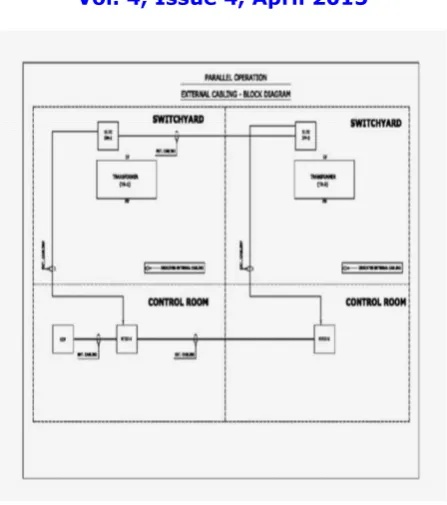
Parallel operation is by an arrangement in which the primaries of two or more transformers are connected to supply the same load. The transformers are connected in parallel to compensate the increased demand on the power system. For this two or more transformers are operated in parallel to supply the load. The transformers connected in parallel are operated and controlled by the same single V.R.R unit, with the help of Master Follower scheme of operation.
Figure 1: external block diagram using RTCC
IV.SUPERVISORY CONTROL AND DATA ACQUISITION
SCADA is the acronym for Supervisory control and Data Acquisition. SCADA refers to the combination of telemetry and data acquisition. . SVADA encompasses the collecting of the information, transferring it back to the central site carrying out any necessary analysis and control and then displaying that information on a number of operator screens or displays [2].
A SCADA System consists of a number of Remote Terminal Units (or RTUs) collecting filed data and sending that data back to a master station van a communication system. The master station displays the acquired data and also allows the operator to perform remote control tasks. SCADA software can be divided into two types. Proprietary or open companies develop proprietary software to communicate to their hardware. These systems are sold as “turn-key “solutions. Often in SCADA systems the RTU (Remote Terminal Unit) is located at a remote location. This distance can vary from tens of meters to thousands of Kilometres. One of the most cost-effective ways \of communicating with the RTU over long distances can be by dialup telephone connection. With this system the devices needed are a PC, two dialup modems and the RTU (assuming that the RTU has a built in COM part.) The modems are put in the auto-answer mode and the RTU can dial into the PC or the PC can dial the RTU. The software to do this is readily available from RTU manufacturer’s line Modems are used to connect RTUs to a network over a pair of wires. These systems are usually fairly short (Up to 1 Kilometre) and use FSK (frequency Shift keying) to communicate.
V. SCADA CONTROL
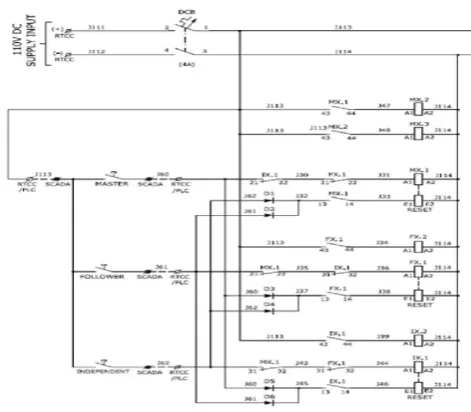
The Latch &Delatch (Reset) coils of a latch relay shall not be energized simultaneously, because it will damage the latch relay. Circuit is designed such that simultaneous energizing of Latch &Delatch coils by using its on N/O contact in the de-latching coil circuit. Circuit is so designed that a master pulse from SCADA will delatch Independent & Flower Latch relays and a follower signal from SCADA will delatch master & independent latch relays. For energizing a Master latch relay the follower latch Relay & Individual latch Relay shall be in de energized state. (De-latching of a Latch Relay is only possible through its on N/O contact). Blocking diodes (D1-D6) are used in the Latch Relay Delatching (Reset) coil circuit for blocking the energisation of the De-latching coil in the reverse direction during Master/Follower/Independent selection from SCADA. The interposing relay structure is shown in the figure 2.
Figure 2: Interposing relay
SCADA operation ensures supervisory electrical control for the parallel operation. The difference here is that we are using supervisory control panel for the controlling the parallel operation. Parallel control of tap changers is by means of a conventional group scheme, in which each unit can be selected to Independent-Off-Follower or Master by means of a sequence selector switch (SSS) situated in the RTCC, and through interposing relay for supervisory operation from SCADA. On putting the SSS of Master unit in the Master position and follower unit in the follower position. The OSR of all follower units will get supply through the OSS of Master unit and the OSS of respective Follower unit. When OSR of all the follower units are energized, the OSR of the Master unit will get supply through the NO contacts of the OSR relays of the follower units. Operation of OSR of all the units will close their NO contacts in the coil circuits of relay RL/LC in all the units and the tap changer will be ready for parallel operation. If the tap switch of any one follower unit is out of step with the master unit. Auxiliary relay OSR of all the units will de-energize thus the timer relay OST of the follower unit which has fallen out of step will operate after the present time, giving an out of step indication. Further tap changing operation is possible only after the removal of fault or after isolating the faulty unit by putting the switch SSS of that unit in off position. Any unit may chose as master unit, and a tap changing signal given by that unit is given to all other units in the parallel group simultaneously. The master unit is then restrained from further tap changing until all units in the group have completed their tap change and have synchronized with the master unit.
operating mode on the SSS, starting from the OFF position, which resets all modes of selection latching relay via an OFF relay offer.
Put selector switch provided in OLTC DM viz. CSS in ‟Remote” position. Put Selector switch in RTCC viz RSS in ‟Remote” or ‟SCADA” according to the mode of operation. Put selector switch in RTCC viz. SSS in ‟Master” for master unit and in ‟Follower” for the following unit. Relay ABR of the follower units will energies through the OSS (out of step switch in OLTC DM) of the master and follower units. The RRPB and RLPB push buttons of the Master unit is coming in the circuit only through the ABR contact (N/O) of the following unit. Contactors ARR and ARL (Auxiliary Relay Raise and Auxiliary Relay Lower) are used for Master and Follower Raise and Lower operation. For individual operation Raise/Lower signal is directly going to the OLTC DM. For Master/Follower operation Raise/Lower signal is issued through contacts of ARR and ARL Energizing of ARR and ARL during parallel operation for Master and Follower units is as explained below. ARR (Auxiliary Relay for Raise) is for Raise operation and ARL (Auxiliary Relay Lower) for Lower operation which is provided for each RTCC, After the Selection of Master and Follower units, Raise/Lower signal is given from the Master unit. ARR/ARL of master unit will be energized through the contacts of SSS and for the follower unit these wire numbers are interconnected to the follower unit ARR/ARL, of the follower unit is energized by the control supply fed by the master unit.
VI. RESULT
According to the comparison study of the RTCC mode of control with SCADA system, it can be concluded that the SCADA control have many advantages over RTCC mode. The main advantages of SCADA compared to RTCC are: minimize fault response time, reduce planned downtimes, isolate and precisely locate faults, reduce failures / unplanned downtimes, reduce operations overhead, reduce manpower requirement, maximize (achieve expected) equipment life time, public safety, site safety etc. So RTCC can be replaced by using SCADA for the tap changing operation of parallel operated transformers.
VII. CONCLUSION
Transformers are connected in parallel to meet the increasing loads in the power system. The parallel operation of tap changing transformers is done by using the RTCC technique. We have studied in detail about the control of parallel operation of tap changing transformers from RTCC. But there were many drawbacks and the system became more complex. So the parallel operation can be done more efficiently with the supervisory control selector mode with the aid of the transmitting control signals in between the transformers as per the control command. Thus all the transformers can be operated parallel with the automatic system called SCADA. Therefore by accepting control command, the transformers are made to synchronize. So the need for a control circuit for parallel operation of transformers using SCADA is necessary for industrial purposes and for power system operations. The other methods used for the tap changing operations of parallel connected transformers are –STATCOM based method, Artificial neural network (ANN)based method [4],Micro controller method [5] etc. In this methods the STATCOM based and ANN based control are more advanced and efficient than the SCADA control method.
REFERENCES
[1] K.J. Sagastabeitia, Z. Aginako, A.J. Mazón and I. Zamora “Remote Control System for Transformers with On-Load Tap Changer” [2] VahidaBahaa Hassan, Nabil Litayem, MohyieldinAzzam,”Recent Trends in SCADA and Power Factor Compensation on Low Voltage
Power Systems for Advanced Smart Grid “,International Journal of Recent Development in Engineering and Technology , Volume 3, Issue 1, July 2014.
[3] Khin Thu Zar Win, HlaMyoTun,”Design and Implementation of SCADA System Based Power Distribution for Primary Substation (Control System)”. International Journal of Electronics and Computer Science Engineering,ISSN- 2277-1956
[4] Fakhrul Islam, JoarderKamruzzaman and Guojun. Lu “Artificial Neural Network for parallel transformers tap-changer control for closed primary bus connection”