On the Disadvantages of Pairing-based Cryptography
Zhengjun Cao1, Lihua Liu2,∗
Abstract. Pairing-based cryptography (PBC) has many elegant properties. It is claimed that PBC can offer a desired security level with smaller parameters as the
general elliptic curve cryptography (ECC). In the note, we remark that this view is misleading. Suppose that an elliptic curve E is defined over the field Fq. Then ECC
is working with elements which are defined over Fq. But PBC is working with the
functions and elements defined overFqk, wherek is theembedding degree.
The security of PBC depends directly on the intractable level of either elliptic curve discrete log problem (ECDLP) in the group E(Fq) or discrete log problem (DLP) in
the groupF∗qk. That means PBC protocols have to work in a running environment with
parameters of 1024 bits so as to offer 80 bits security level. The shortcoming makes
PBC lose its competitive advantages significantly.
Keywords. elliptic curve cryptography; bilinear-pairing based cryptography; in-putting parameters; working parameters; embedding degree.
1
Introduction
In 1985, N. Koblitz [19] and V. Miller [20] introduced elliptic curve cryptography independently. Since then, ECC has been extensively investigated. In the late 1990’s, a few companies included some elliptic curve protocols in their security products. The security of ECC is based directly on
the intractablity of ECDLP. Parings derived from elliptic curves, including Weil paring [24] and Tate paring [15], have been used to reduce ECDLP to DLP [22].
In 2000, Joux [18] proposed one round protocol for tripartite Diffie-Hellman key agreement protocol using Weil pairing. This is the first instance to show that pairings can be used for “good”. In Crypto 2001, Boneh and Fracklin [6] proposed a fully functional identity-based encryption scheme
from Weil Pairing. After that, paring-based cryptography has gotten a full development [1-14], because it has many beautiful and elegant properties. It is widely believed that PBC can offer
a desired security level with smaller parameters. For example, Boneh-Boyen short signatures [2], Boneh-Boyen-Shacham short group signatures [5], Boneh-Shacham-Lynn short signatures [11], and Boneh-Sahai-Waters traitor tracing schemes [12]. In fact, this view is misleading. Suppose that an
1Department of Mathematics, Shanghai University, Shanghai, China. 2Department of Mathematics, Shanghai
elliptic curve E is defined over the finite field Fq. Then ECC is working with elements which are
defined over the base field Fq (its parameters have size O(logq) bits). But PBC is working with
the functions and elements defined over the extension fieldFqk (its parameters have sizeO(klogq) bits), wherekis the embedding degree.
The security of PBC depends directly on the intractable level of either ECDLP in the group
E(Fq) or DLP in the groupF∗qk. This gives us a dilemma. On the one hand, to ensure the immunity to the Weil and Tate pairing attacks, it requires that the imbedding degreek >20 if the ordernof
the base pointP satisfying n >2160. On the other hand, it requires k≤6 to ensure the efficiency of pairing computations in PBC protocols. This means the underlying field Fq is large enough so
that the DLP inF∗qk is considered intractable. In a word, PBC protocols have to work in a running environment with parameters of 1024 bits, not 160 bits as supposed (someone has confused the inputting-parameter’s size with the working-parameter’s size), so as to offer 80 bits security level.
The shortcoming makes PBC lose its competitive advantages significantly.
2
The Weil pairing over finite fields
Definition 1. An elliptic curve E over a finite fieldFq is defined by an equation
E:y2+a1xy+a3y =x3+a2x2+a4x+a6
where a1, a2, a3, a4, a6 ∈Fq and4 6= 0, where4is the discriminant of E and is defined as follows: 4 = −d22d8 −8d34−27d26 + 9d2d4d6, where d2 = a21 + 4a2, d4 = 2a4 +a1a3, d6 = a23 + 4a6, d8 =
a21a6+ 4a2a6−a1a3a4+a2a23−a24.
IfL is any extension field of Fq, then the set ofL-rational points on E is
E(L) ={(x, y)∈L×L:y2+a1xy+a3y−x3−a2x2−a4x−a6= 0} ∪ {∞}
where∞is the point at infinity. The number of points in the groupE(Fq), denoted by #E(Fq), is
called the order ofE overFq. Hasse’s theorem provides tighter bounds for #E(Fq).
Theorem 1. (Hasse) Let E be an elliptic curve defined over Fq. Then
q+ 1−2√q ≤#E(Fq)≤q+ 1 + 2 √
q.
Let n be a prime and coprime to the characteristic of Fq. Suppose n divides #E(Fq). Then
there exists an-torsion group [24]
E(Fqk)[n] :={P ∈E(Fkq)|nP =O},
where the numberkis called the embedding degree which is the smallest positive integer such that
Theorem 2. Let E be an elliptic curve overFq and let nbe a prime dividing#E(Fq). Suppose
that n does not divide (q−1) and that gcd(n, q) = 1. Then the n-torsion group E[n]⊂E(Fqk) if
and only if n divides(qk−1).
The structure of n-torsion group E(Fqk)[n] is described by the following relation
E(Fqk)[n]∼= (Z/nZ)×(Z/nZ).
That means #E(Fqk)[n] = n2. The Weil pairing is defined on the n-torsion group E(Fqk)[n], not on anyn-order group G⊂E(Fq).
Letµnbe the group ofnth roots of unity. Clearly,µn⊂Fqk, but µn 6⊂Fqj forj= 1,· · · , k−1. Definition 2. The Weil pairing is a map
en:E(Fqk)[n]×E(Fqk)[n]→µn
with the following properties:
1. Linearity: If P, Q, R∈E(Fqk)[n], then
en(P +Q, R) =en(P, R)en(Q, R),
en(P, Q+R) =en(P, Q)en(P, R).
2. Alternating: If P ∈E(Fqk)[n], then en(P, P) = 1. This, along with linearity, implies that if P, Q∈E(Fqk)[n], then en(Q, P) =en(Q, P)−1.
3. Non-degeneracy: If O 6=P ∈E(Fqk)[n], there exists Q∈E(Fqk)[n] such thaten(P, Q)6= 1.
4. Compatibility: If P ∈E(Fqk)[mn] andQ∈E(Fqk)[n], then emn(P, Q) =en(mP, Q).
5. Galois action: LetP, Q∈E(Fqk)[n] and σ∈Gal(Fqk/Fq), then en(P, Q)σ =en(Pσ, Qσ).
To construct a concrete Weil pairing, we need the following equivalent definition [21]:
Definition 3 Let n >1 be an integer and let D1,D2 be divisors on an elliptic curve, E, with disjoint supports, such thatnD1, nD2 ∼0. This means that there are functionsf1 and f2 such that
nDi =div(fi) for i= 1,2. The Weil pairing is defined as
en(D1,D2) =
f1(D2)
f2(D1)
.
Warning. Most literatures use the notationE[n] to denote then-torsion group, which does not
3
Miller’s algorithm for computing pairings
In order to calculate the Weil pairing, one should evaluatef(D), where div (f) =n([P]−[O]). In 1985, Miller [21] gave an explicit algorithm for calculating the Weil pairing. Of course, it can be used to calculate the Tate pairing, because it is also defined on the n-torsion group.
Let E be an elliptic curve over the field K and P, Q ∈ E(K). Let LP,Q be the normalized
function, such thatLP,Q= 0 is the equation of the line passing throughP and Q(or the equation
of the tangent line to the curve ifP =Q). Then
div(LP,Q) = [P] + [Q] + [−(P+Q)]−3[O].
Let
hP,Q :=
LP,Q LP+Q,−(P+Q)
.
We have div (hP,Q) = [P] + [Q]−[P+Q]−[O].
Letf0,P =f1,P = 1.Inductively, for n >0, define fn+1,P :=fn,P hP,nP,
we have
div (fn,P) =n[P]−(n−1)[O]−[nP].
It is easy to find that
fm+n,P =fm,Pfn,PhmP,nP, fmn,P =fm,Pn fn,mP =fn,Pm fm,nP.
This means the calculation of fn,P(Q) resembles exponentiation and it can be done in O(logn)
point additions onE/K.
Using the constructed functions, we obtain the following formulas [21].
Proposition 1. Suppose that T is a point in E(K) different from P, Q, Q−P, and O. Then [P]−[O]∼[P +T]−[T], and the supports of[Q]−[O] and[P+T]−[T]are disjoint. We have
en(P, Q) =
fn,Q(T)fn,P(Q−T) fn,P(−T)fn,Q(P +T)
.
Proposition 2. Let E/K be an elliptic curve, P, Q∈E(K)[n], and P 6=Q. Then
en(P, Q) = (−1)n
fn,P(Q) fn,Q(P) .
Warning. The functions fn,P, fn,Q must be calculated in the group E(K) where the field K
4
Disadvantages of pairing-based cryptography
4.1 Large working parameters
It is well-known that ECC schemes are public-key mechanisms that provide the same functionality
as RSA schemes. However, a desired security level can be attained with significantly smaller parameters in ECC systems. For example, a 160-bit elliptic curve key provides the same level of security as a 1024-bit RSA parameter. Smaller parameters in ECC systems consequently save much
power, bandwidth and storage, and bring a good speed.
The working parameters for an elliptic curve scheme describe an elliptic curve E over Fq, a
base point P ∈ E(Fq), and its order n. The parameters should be chosen so that the ECDLP is
resistant to all known attacks. Usually, we selectE so that #E(Fq) is prime or almost prime, that
is, #E(Fq) =hn wherenis prime and his small (e.g.,h= 1,2,3 or 4). That means the size of the
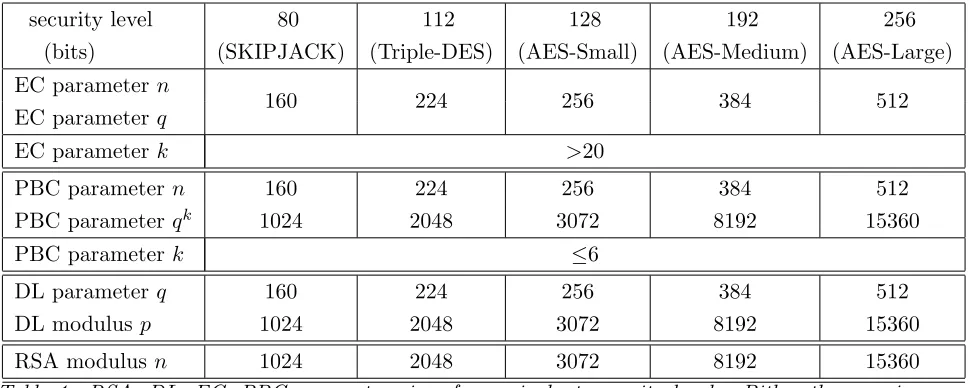
working parameterq in an ECC scheme is approximately equal to the size of n. To avoid the Weil and Tate pairing attacks, one should ensure thatndoes not divide qk−1 for all 1≤k≤20. The
parameter size comparisons in Table 1 is adapted from [17].
security level 80 112 128 192 256
(bits) (SKIPJACK) (Triple-DES) (AES-Small) (AES-Medium) (AES-Large)
EC parametern
EC parameterq 160 224 256 384 512
EC parameterk >20
PBC parametern 160 224 256 384 512
PBC parameterqk 1024 2048 3072 8192 15360
PBC parameterk ≤6
DL parameterq 160 224 256 384 512
DL modulusp 1024 2048 3072 8192 15360
RSA modulus n 1024 2048 3072 8192 15360
Table 1. RSA, DL, EC, PBC parameter sizes for equivalent security levels. Bitlengths are given
for the DL parameter q and the EC parameter n, and the RSA modulus n and the DL modulus p, respectively.
As we know, pairing-based cryptography protocols require that:
• the base pointP ∈E(K) has a sufficiently large prime ordernsuch that ECDLP inE(K) is
intractable;
• DLP inK∗ is intractable in order to resist the MOV reduction attacks [22];
• it is efficient to compute pairings inE(K).
into account the very long and complicated programming code for PBC systems (seePBC 0.5.14, maintained by Ben Lynn, released on Jun 14, 2013) we find that PBC schemes are far slow than
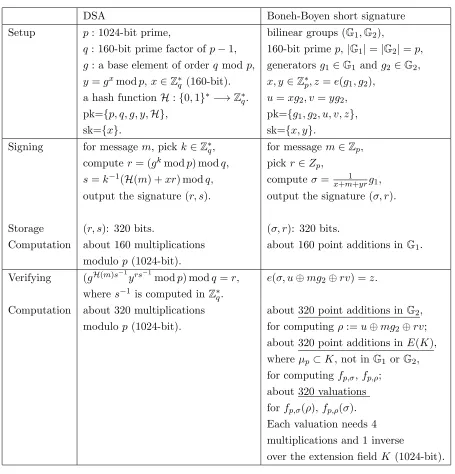
its DL counterparts. Smaller inputting parameters in PBC systems can not truly bring them a good speed. We refer to the following Table 2 for the concrete comparisons between DSA and
Boneh-Boyen short signature [2].
DSA Boneh-Boyen short signature
Setup p: 1024-bit prime, bilinear groups (G1,G2),
q: 160-bit prime factor ofp−1, 160-bit prime p,|G1|=|G2|=p,
g: a base element of orderq mod p, generators g1 ∈G1 and g2 ∈G2,
y=gxmodp, x∈Z∗q (160-bit). x, y∈Z∗p, z=e(g1, g2), a hash functionH:{0,1}∗ −→
Z∗q. u=xg2, v=yg2, pk={p, q, g, y,H}, pk={g1, g2, u, v, z}, sk={x}. sk={x, y}.
Signing for messagem, pickk∈Z∗q, for message m∈Zp, computer= (gkmodp) modq, pick r∈Zp,
s=k−1(H(m) +xr) modq, compute σ= x+m1+yrg1, output the signature (r, s). output the signature (σ, r).
Storage (r, s): 320 bits. (σ, r): 320 bits.
Computation about 160 multiplications about 160 point additions in G1.
modulop (1024-bit).
Verifying (gH(m)s−1yrs−1modp) modq =r, e(σ, u⊕mg2⊕rv) =z. wheres−1 is computed inZ∗q.
Computation about 320 multiplications about 320 point additions in G2,
modulop (1024-bit). for computing ρ:=u⊕mg2⊕rv; about 320 point additions in E(K), where µp ⊂K, not inG1 orG2, for computing fp,σ,fp,ρ;
about 320 valuations forfp,σ(ρ),fp,ρ(σ).
Each valuation needs 4 multiplications and 1 inverse
over the extension fieldK (1024-bit).
Table 2: Comparisons between DSA and Boneh-Boyen signature
Remark. Taking into account the time delay for processing the long and complicated
4.2 The controversial setting of master key in PBC schemes
We know most PBC schemes have to set a master key for generating users’ private keys. That is to say, each user’s private key is not truly exclusive in theory, although there are some suggestions
for alleviating this problem by introducing more key-generating centers. The inherent drawback of PBC indeed counteracts the benefits from ID-based public keys and bilinear property of parings.
5
Difficulties of implementing PBC schemes
To the best of our knowledge, there were few industrial products being integrated with paring-based cryptosystems. The reasons for this situation could be summarized as follows: (1) the pairing computation is hard to understand for most engineers; (2) the issue of key escrow in PBC
does not exist with the current PKI system; (3) the heavy group operation of PBC really lowers the advantages that gained from smaller key size. In view of these difficulties, frankly speaking, we
do not think it is possible for PBC to practically replace the position of RSA or ElGamal in the next twenty years.
For the current status of “applied” paring-based cryptography, we refer to the following links.
PBC Library [http://crypto.stanford.edu/pbc/]; pbc-0.5.14 (Released on Jun 14, 2013).
JPBC Library [http://gas.dia.unisa.it/projects/jpbc/faq.html]; v2.0.0 (Released on Dec 04, 2013).
TinyPairing [http://www.cs.cityu.edu.hk/~ecc/TinyPairing/]. TinyPairing v0.1
(Re-leased on Oct 09, 2009).
Jmiracl [https://dsl-external.bbn.com/tracsvr/openP3S/wiki/jmiracl\].
6
Conclusion
The proposal of ID-based public key, suggested by Shamir [23] in 1984, aimed originally to mitigate the burden of key management. Thirty years later, we find the burden is not as heavy as one
imagined before. The current PKI system works well. In some ways, the ID-based public key cryptography has become a pure academic issue. Thus, pairing-based cryptography shall lose its
competitive advantages although it looks very beautiful. Just as the saying goes: “Beautiful flowers produce no fruits”.
References
[2] D. Boneh and X. Boyen. Short Signatures without Random Oracles, Journal of Cryptology, 21(2), pp. 149-177, 2008.
[3] D. Boneh, X. Boyen.Efficient Selective Identity-Based Encryption Without Random Oracles. J. Cryptology 24(4): 659-693, 2011.
[4] D. Boneh, X. Boyen and E. Goh.Hierarchical Identity Based Encryption with Constant Size Ciphertext, In proceedings of Eurocrypt 2005, Lecture Notes in Computer Science, Vol. 3494, pp. 440-456, Springer-Verlag, 2005.
[5] D. Boneh, X. Boyen and H. Shacham.Short Group Signatures, In proceedings of Crypto’04, Lecture Notes in Computer Science, vol. 3152, pp. 41-55, Springer-Verlag, 2004.
[6] D. Boneh and M. Franklin.Identity-Based Encryption from the Weil Pairing. In proceedings of Crypto 2001. Lecture Notes in Computer Science, vol. 2139, pp. 213-229. Springer-Verlag, 2001.
[7] D. Boneh, C. Gentry, B. Lynn, H. Shacham. Aggregate and Verifiably Encrypted Signatures from Bilinear Maps. In proceedings of Eurocrypt 2003, Lecture Notes in Computer Science, vol. 2656, PP. 416-432, Springer-Verlag, 2003.
[8] D. Boneh and M. Hamburg. Generalized Identity Based and Broadcast Encryption Schemes, In proceedings of Asiacrypt 2008, Lecture Notes in Computer Science, vol. 5350, 455-470, Springer-Verlag, 2008.
[9] D. Boneh, A. Raghunathan and G. Segev. Function-Private Identity-Based Encryption: Hid-ing the Function in Functional Encryption. In proceedings of Crypto 2013, Lecture Notes in Computer Science, Vol. 8043, pp. 461-478, Springer-Verlag, 2013.
[10] D. Boneh, A. Raghunathan and G. Segev.Function-Private Subspace-Membership Encryption and Its Applications. In proceedings of Asiacrypt 2013, Lecture Notes in Computer Science, Vol. 8269, pp. 255-275, Springer-Verlag, 2013.
[11] D. Boneh, H. Shacham and B. Lynn. Short Signatures from the Weil Pairing, Journal of Cryptology, Vol. 17, No. 4, pp. 297-319, 2004.
[12] D. Boneh, A. Sahai and B. Waters. Fully Collusion Resistant Traitor Tracing with Short Ciphertexts and Private Keys. In proceedings of Eurocrypt 2006, Lecture Notes in Computer Science, Vol. 4004, pp. 573-592, Springer-Verlag, 2006.
[13] D. Boneh, R. Canetti, S. Halevi and J. Katz.Chosen-Ciphertext Security from Identity-Based Encryption. SIAM J. Comput. 36(5): 1301-1328, 2007.
[14] J. Coron. A Variant of Boneh-Franklin IBE with a Tight Reduction in the Random Oracle Model. Des. Codes Cryptography 50(1): 115-133, 2009.
[15] I. Blake, G. Seroussi and N. Smart. Advances in Elliptic Curve Cryptography, Cambridge University Press, 2005.
[16] R. Balasubramanian and N. Koblitz. The Improbability that an Elliptic Curve has Sub-exponential Discrete Log Problem under the MenezesCOkamotoCVanstone Algorithm. J. Cryp-tology, 11, pp. 141C145, 1998.
[18] A. Joux. A One Round Protocol for Tripartite Diffie-Hellman, In proceedings of fourth algo-rithmic number theory symposium, Lecture Notes in Computer Science, Vol. 1838, Springer-Verlag, pp. 385-394, Springer-Springer-Verlag, 2000.
[19] N. Koblitz.Elliptic Curve Cryptosystems. Mathematics of Computation, 48:203C209, 1987.
[20] V. Miller.Use of Elliptic Curves in Cryptography, In proceedings of Crypto’85, Lecture Notes in Computer Science, vol. 218, 417C426, Springer-Verlag, 1986.
[21] V. Miller.The Weil Pairing, and Its Efficient Calculation, J. Cryptology (2004) 17: 235C261.
[22] A. Menezes, T. Okamoto and S. Vanstone.Reducing Elliptic Curve Logarithms to Logarithms in a Finite Field, IEEE Transactions on Information Theory 39(5): 1639-1646, 1993.
[23] A. Shamir.Identity-based Cryptosystems and Signature Schemes, In proceedings of Crypto’84, Lecture Notes in Computer Science, Vol. 196, pp. 47-53, Springer-Verlag, 1984.