Examining a Technology Acceptance Model of
Internet Usage by Academics within Thai
Business Schools
By
Napaporn Kripanont
B.A. (Accounting), Chulalongkorn University, Thailand M.S. (Accounting), Thammasat University, Thailand
M.C.I.S. (Information Systems), Cleveland State University, U.S.A.
This thesis is presented in fulfilment of the requirements of the degree of
Doctor of Philosophy
School of Information Systems Faculty of Business and Law
Victoria University
Melbourne, Australia
DECLARATION
I, Napaporn Kripanont, declare that the PhD thesis entitled “Examining a Technology Acceptance Model of Internet Usage by Academics within Thai Business Schools” is no more than 100,000 words in length, exclusive of tables, figures, appendices, references and footnotes. This thesis contains no material that has been submitted previously, in whole or in part, for the award of any other academic degree or diploma. Except where otherwise indicated, this thesis is my own work.
ABSTRACT
Information Technology has been a significant research area for some time, but its nature has changed considerably since the Internet became prominent just over a decade ago. Many researchers have studied and proposed theories and models of technology acceptance in order to predict and explain user behaviour with technology to account for rapid change in both technologies and their environments. Each theory or model has been proposed with different sets of determinants and moderators and most of them have been developed in the U.S. It is therefore questioned whether the theories and models of technology acceptance that have been developed, modified, and extended in the U.S. can be used in other countries, especially in Thailand. It is also questioned whether there might be other determinants and moderators that also play important roles in this specific environment.
This thesis (1) reviewed literature in respect of nine prominent theories and models, (2) reviewed previous literature about IT acceptance and usage within four contexts of study, (3) investigated the extent to which academics use and intend to use the Internet in their work, (4) investigated how to motivate academics to make full use of the Internet in their work, (5) investigated to what extent using the Internet helps in improving academics’ professional practice, professional development and quality of working life, (6) formulated a research model of technology acceptance regarding Internet usage by Thai academics, and (7) generated and validated the research model that best describes Thai academics’ Internet usage behaviour and behaviour intention. These last two objectives represent the main focus of the thesis.
Questionnaire survey method was used to collect primary data from 927 academics within Business Schools in 20 Public Universities in Thailand. The survey yielded 455 usable questionnaires, with a response rate of 49%. Statistical analysis methods and Structural Equation Modelling with AMOS version 6.0 were used to analyse data.
42.6% in usage behaviour in other tasks, 55.7% in behaviour intention in teaching and 59.8% in behaviour intention in other tasks.
From the findings, three core determinants: perceived usefulness, perceived ease of use and self-efficacy significantly determined usage behaviour in teaching. Two core determinants: perceived usefulness and self-efficacy significantly determined usage behaviour in other tasks. Finally, usage behaviour significantly influenced behaviour intention. In addition three moderators: age, e-university plan and level of reading and writing, impacted the influence of key determinants toward usage behaviour. Only two moderators: age and research university plan, impacted the influence of usage behaviour toward behaviour intention. The rest including gender, education level, academic position, experience and Thai language usage did not impact the influence of the key determinants toward usage behaviour and did not impact the influence of usage behaviour toward behaviour intention.
TABLE OF CONTENTS
PAGE
DECLARATION
………...iABSTRACT
………...iiTABLE
OF CONTENTS
………...ivLIST OF TABLES
………...xiiLIST OF FIGURES
………...xviPUBLICATIONS ASSOCIATED WITH THIS THESIS
………...xxiGLOSSARY OF TERMS
………...xxiiLIST OF ABBREVIATIONS
………xxxACKNOWLEDGEMENTS
……….xxxiiCHAPTER 1: INTRODUCTION……….1
1.1Background to the Research……….1
1.2Research Problem……….3
1.3Objectives of the Study………5
1.4Significance of the Study……….6
1.4.1 Individual Level………6
1.4.2 Organisational Level……….7
1.4.3 National Level………..8
1.5Contributions of the Research………..9
1.6Scope of the Study………..10
1.7Definition of Key Terms……….11
1.8Structure of the Thesis………12
1.9Summary……….13
CHAPTER 2: INTERNET TECHNOLOGY……….15
2.1 Introduction………15
2.2 Internet Definition………..15
2.3 The Creation of the Internet………...16
2.4 The Internet Today……….17
2.5 Internet Usage and the population of the World………18
PAGE
2.7 Internet Access………...25
2.8 Impact of the Internet on People’s lives……….26
2.9 Impact of the Internet on Education………...26
2.10 The Future of the Internet………...28
2.11 The Internet in Thailand………...28
2.12 Impact of the Internet on Education in Thailand………..30
2.13 Summary………...31
CHAPTER 3: THAI PUBLIC UNIVERSITIES AND BUSINESS
SCHOOLS………...32
3.1 Introduction………....32
3.2 Background of Thailand………...32
3.3 Thai Culture………... 33
3.4 Thai Universities……….33
3.4.1 Types of Higher Education Institutions………...33
3.4.2 Coordination of Higher Education………..35
3.4.3 Institutional Governance……….36
3.5 Thai Public Universities……….37
3.5.1 University Staff………...37
3.5.2 Enrolment………40
3.5.3 Admission to Public University………...41
3.6 Business Schools within Thai Public Universities……….41
3.6.1 Business Schools……….41
3.6.2 Academic Staff………41
3.7 Internet Technology in Thai Public Universities………...42
3.8 Summary………44
CHAPTER 4: TECHNOLOGY ACCEPTANCE THEORIES
AND MODELS………..45
4.1 Introduction………..45
4.2 Innovations Diffusion Theory (IDT)………46
4.3 Social Cognitive Theory (SCT)………...47
PAGE
4.5 Theory of Planned Behaviour (TPB)………...50
4.6 Decomposed Theory of Planned Behaviour (DTPB)………..52
4.7 Technology Acceptance Model (TAM)………...53
4.8 Technology Acceptance Model 2 (TAM2)………..55
4.9 Augmented TAM or Combined TAM and TPB(C-TAM-TPB)………..57
4.10 Unified Theory of Acceptance and Use of Technology (UTAUT)……….58
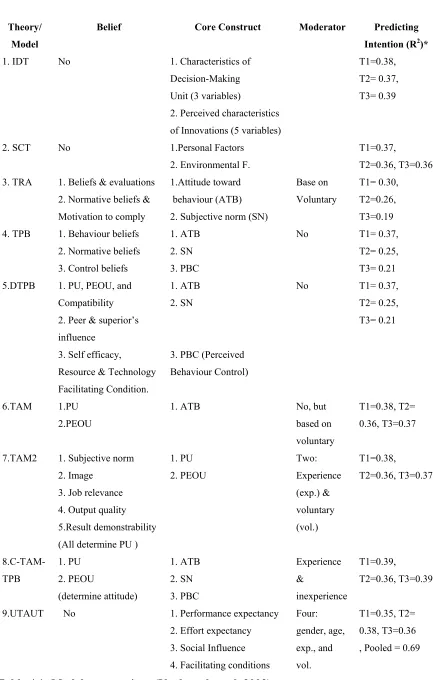
4.11 Comparison of Models in the Literature………. 59
4.11.1 TAM and TRA………..60
4.11.2 TAM, TPB and DTPB………..60
4.11.3 TPB and DTPB……….62
4.11.4 UTAUT and Other Theories……….63
4.12 Consideration of Moderators in the Literature……….66
4.12.1 Experience and Voluntariness………...66
4.12.2 Experience and Inexperienced Users………....67
4.12.3 Expectation Gap………....68
4.12.4 Age and Gender……….69
4.12.5 Culture Aspects……….69
4.13 Context Consideration………..70
4.13.1 Technology Context………..70
4.13.2 Individual Context……….72
4.13.3 Organisational Context………..72
4.13.4 Cultural Context………74
4.14 Dimension of Usage……….75
4.14.1 Temporal Dimension……….76
4.14.2 Mandatory or Voluntary Use……… ....76
4.15 Summary………...77
CHAPTER 5: THEORETICAL FRAMEWORK AND
HYPOTHESES………..78
5.1 Introduction………78
5.2 Research Objectives………...78
PAGE
5.4 Basic Concept of the The Theoretical Framework……….80
5.5 Theoretical Framework………..83
5.6 Direct Determinants………...85
5.6.1 Perceived Usefulness………..86
5.6.2 Perceived Ease of Use……….86
5.6.3 Social Influence………...87
5.6.4 Facilitating Conditions………88
5.6.5 Self-Efficacy………...88
5.7 User Behaviour………..89
5.7.1 Usage Behaviour……….90
5.7.2 Behaviour Intention………90
5.8 Individual Characteristics Moderators………..91
5.8.1 Gender, Age and Experience………..92
5.8.2 Education Level………..93
5.8.3 Academic Position………..94
5.9 Cultural Aspects Moderators……….95
5.9.1 E-university Plan...………96
5.9.2 Research University Plan...………...97
5.9.3 Level of Reading and Writing………...98
5.9.4 Thai Language………...98
5.10 Research Hypotheses………...99
5.10.1 Direct Path Hypotheses……….99
5.10.2 Moderating Hypotheses………..100
5.11 Measurement Items………102
5.11.1 Core Constructs………...102
5.11.2 Academic Work………..105
5.12 Summary………106
CHAPTER 6: RESEARCH METHODOLOGY………108
6.1 Introduction……….108
6.2 Research Process……….108
6.3 Research Design………..110
PAGE
6.4.1 Methodology Strategy………...112
6.4.2 Interview Method for Developing the Questionnaire….………..114
6.4.3 Questionnaire Method for the Main Survey …….………...115
6.5 Development of the Questionnaire...………...117
6.5.1 Preliminary Information Gathering………...117
6.5.2 Questionnaire Design………118
6.5.3 Pre-testings of the Questionnaire………..125
6.6 Pilot Survey……….126
6.7 Reliability Analysis of the Instrument………128
6.8 Validity of the Instrument………...130
6.8.1 Content Validity. ………..130
6.8.2 Construct Validity……….131
6.9 Population, Sample and Data Collection……….132
6.9.1 Population……….132
6.9.2 Sample Size………...133
6.9.3 Data Collection………..134
6.9.4 Response Rate………...138
6.10 Data Editing and Coding………139
6.11 Data Analysis………..141
6.11.1 T-test………142
6.11.2 Structural Equation Model (SEM)………...142
6.11.3 Multiple-Group Analysis Using AMOS………..148
6.11.4 Bootstrapping Procedures and Bollen-Stine Bootstrap Method……..148
6.11.5 Sample Size Requirements………..148
6.12 Data Management for Multivariate Data Analysis………149
6.12.1 Missing Data ………...149
6.12.2 Multivariate Outliers………...154
6.12.3 Multivariate Normality………155
6.12.4 Multicollinearity………..157
6.13 Generisability of the Findings………157
6.14 Ethics in this Research………158
PAGE
CHAPTER 7: PRELIMINARY DATA ANALYSIS……….160
7.1 Introduction………..160
7.2 Reliability Analysis………..160
7.3 Validity Analysis………..161
7.4 Demographic Data………...161
7.5 Background of Internet Usage……….164
7.5.1 Personal Internet Usage……….164
7.5.2 Internet Service and Internet Access Method………...165
7.6 Cross-Tabulation………..167
7.7 Cultural Aspects………...167
7.8 Actual Internet Usage and Intention to Use……….169
7.8.1 Internet Usage and Intention to Use on Average………..169
7.8.2 Majority of Internet usage and Intention to Use………170
7.9 How to Make Full Use of the Internet……….170
7.10 Professional Practice..………173
7.11 Personal Development………...173
7.12 Quality of Working Life………174
7.13 Different between Two Groups……….175
7.13.1 Gender……….175
7.13.2 Age………..177
7.13.3 Education Level………..177
7.13.4 Academic Position………..178
7.13.5 Experience………...178
7.14 Summary………179
CHAPTER 8: INTERNET ACCEPTANCE MODELLING………..181
8.1 Introduction………...181
8.2 Constructs of the Research Model………....182
8.3 Construct Reliability……….184
8.4 Discriminant Validity………...186
8.4.1 Five Exogenous Latent Constructs………187
PAGE
8.5 Measure of Fit………...192
8.6 Model Estimation………..195
8.6.1 Unstandardised and Standardised Estimates………..195
8.6.2 Squared Multiple Correlations (SMC)………...195
8.7 Internet Acceptance Model………...196
8.8 Multiple-Group Analysis………..208
8.8.1 Gender………209
8.8.2 Age……….216
8.8.3 Education Level……….223
8.8.4 Academic Position……….229
8.8.5 Experience……….236
8.8.6 E-university Plan………...244
8.8.7 Research University Plan………..252
8.8.8 Level of Reading and Writing ………..258
8.8.9 Thai Language………..265
8.9 Summary………..272
CHAPTER 9: CONCLUSIONS AND SUGGESTIONS………..281
9.1 Introduction………..281
9.2 Key Findings………....281
9.2.1 Demographic Characteristics………282
9.2.2 Background of Internet Usage………..284
9.2.3 The Internet Usage and Intention to Use on Average………...286
9.2.4 Majority of Internet Usage and Intention to Use………..286
9.2.5 Difference between the Two Groups………287
9.2.6 Motivations to Make Full Use of the Internet………...289
9.2.7 Professional Practice………...290
9.2.8 Professional Development………290
9.2.9 Quality of Working life……….290
9.3 The Internet Acceptance Model………...291
9.3.1 Results of Hypotheses testing………...293
9.3.2 Internet Acceptance Model without the Impact of Moderators……....296
PAGE
9.3.4 Summary of Key Findings………...300
9.4 Research Implications………...301
9.4.1 Theoretical Implications………....301
9.4.2 Methodology Implications……….305
9.4.3 Practical Implications………307
9.5 Limitations of the Study………...310
9.6 Suggestions for Further Research……….311
9.7 Summary………...311
REFERENCES………313
APPENDICES………..339
APPENDIX I………339
Part A: Questionnaire Survey………339
Part B: A Coding Sheet………..348
Part C: Missing Data Analysis………...353
APPENDIX II………..358
Part A: Descriptive Statistics……….358
Part B: Cross-Tabulation………360
Part C: Results of T-Tests………..364
APPENDIX III……….369
Part A: Sample Correlations, Standardised Residual Covariance, Implied Correlations for Investigating Discriminant Validity……….369
Part B: Sample Correlations, Standardised Residual Covariance for Internet Acceptance Model without the Impact of Moderators……..375
Part C: Nested Model Comparisons (Multiple-Group Analysis)………380
LIST OF TABLES
CHAPTER
2
PAGE
Table 2.1 Internet Usage and the Population of the World………. 19
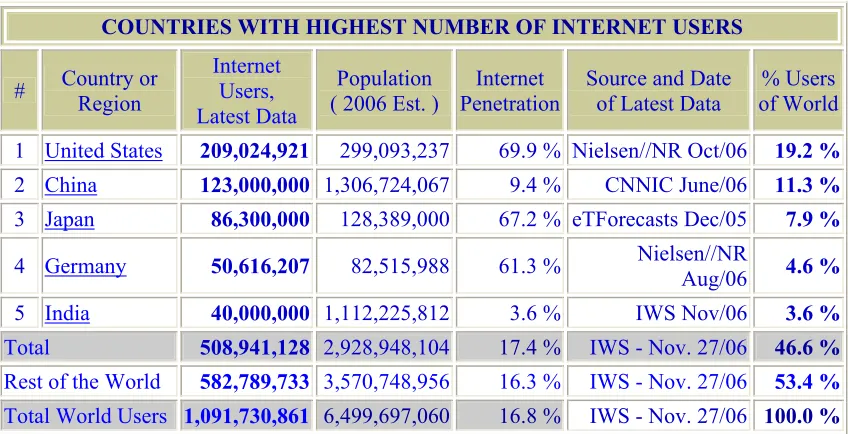
Table 2.2 Countries with Highest Number of Internet Users………...21
Table 2.3 Countries with Highest Internet Penetration Rate………21
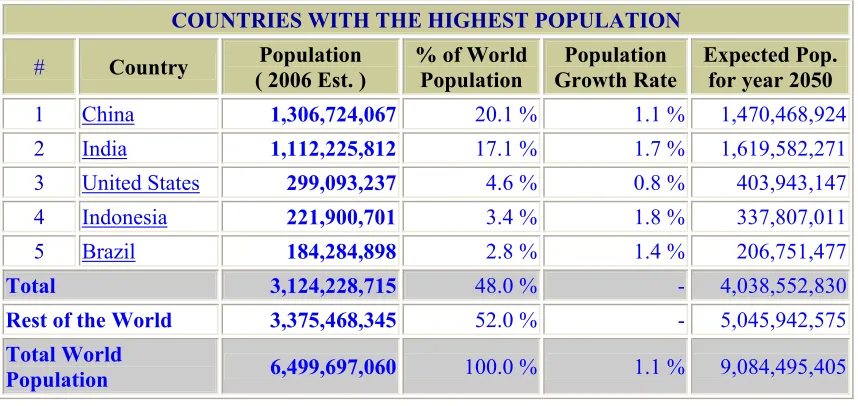
Table 2.4 Countries with the Highest Population……….22
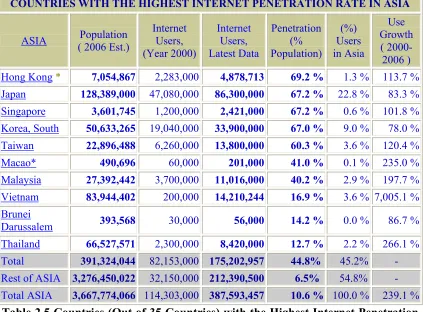
Table 2.5 Countries (Out of 35 Countries) with the Highest Internet Penetration Rate in Asia ………23
Table 2.6 Countries (Out of 35 Countries) with the Highest Number of Internet Users in Asia ……….23
CHAPTER 3
Table 3.1 Number of Academic Staff and Non-academic Staff in Public Universities………...38Table 3.2 Number of Academic Staff in Public Universities Classified by Academic Positions………39
CHAPTER 4
Table 4.1 Models Comparison ………65CHAPTER 5
Table 5.1 Item Used in Measurement of the Research Model for Five Key Core Constructs (determinants)………..104Table 5.2 Concepts (Key Determinants), Measurement Items (Indicators) and The Measurement Scales……… ...105
CHAPTER 6
Table 6.1 Basic Concepts in Research………114Table 6.2 Summary of Cronbach’ Alphas, Inter-Item Correlation and Item-to-Total Correlation Values in Pilot Study ………...129
Table 6.3 Summary of the Questionnaire Survey………...135
Table 6.4 Summary of Data Collection in Central Region ………137
PAGE
Table 6.6 Summary of Data Collection in EasternRegion ………...137
Table 6.7 Summary of Data Collection in North-Eastern Region………..138
Table 6.8 Summary of Data Collection in Southern Region ……….138
Table 6.9 Summary of Data Files in SPSS……….140
Table 6.10 Hierarchy of Five Models Generated by AMOS………146
Table 6.11 Statistical Techniques with Minimum Sample Size Requirements…148
CHAPTER 7
Table 7.1 Summary of Cronbach’s Alphas, Inter-Item Correlation, and Item-to-Total Correlation in the Main Survey………163Table 7.2 Demographic Characteristics of Academics………..164
Table 7.3 Background of Personal Internet Usage……….166
Table 7.4 Internet Service and Internet Access Method……….167
Table 7.5 Four Cultural Aspects……….169
Table 7.6 Frequencies (Mean) of Internet Usage and Intention to Use ……….171
Table 7.7 Majority of Internet Usage and Intention to Use………172
Table 7.8 Motivations to Make Full Use of the Internet………173
Table 7.9 Internet Usage Affected Academics’ Professional Practice.………..173
Table 7.10 Internet Usage Affected Academics’ Personal Development………174
Table 7.11 Internet Usage Affected Academics’ Quality of Working Life…….174
Table 7.12 Summary of T-Tests (Total Number of Items that were Significantly Different in Each Category)……….176
CHAPTER 8
Table 8.1 Nine Constructs in the Research Model ………183Table 8.2 Squared Multiple Correlations (SMC) of 21 Indicators in Five Exogenous Latent Constructs………...185
Table 8.3 Squared Multiple Correlations (SMC) for 20 Indicators in Four Endogenous Constructs………..185
Table 8.4 Correlations for Five Exogenous Latent Constructs………..189
Table 8.5 Correlations of Four Endogenous Latent Constructs………...191
Table 8.6 Summary of the Fit Measures Used in this Research………...194
PAGE Table 8.8 Parameter Summary for the Internet Acceptance Model after
Deleting Some Indicators………...202 Table 8.9 Regression Weights for the Internet Acceptance Model…………....204 Table 8.10 Squared Multiple Correlations for the Internet Acceptance Model...205 Table 8.11 Standardized Regression Weights for the Internet Acceptance
Model……….206 Table 8.12 Covariances for the Internet Acceptance Model………....207 Table 8.13 Regression Weights (Structural Weights Model) for Male and
Female Subjects……….215 Table 8.14 The Regression Weights for the Baseline Model
(Unconstrained Model), Younger Subjects Compared with Older Subjects and the Significant Different between Paths...222 Table 8.15 Regression Weights (Structural Weights Model) for Master
Degree and Doctoral Degree Subjects ………..228 Table 8.16 Regression Weights (Structural Weights Model) for
Lecturer and Higher Position Subjects………..235 Table 8.17 Regression weights (Structural Weights Model) for Low,
Moderate and High Experience Subjects………..243 Table 8.18 Regression Weights of the Baseline Model for Both
Groups (E-University Plan)………...251 Table 8.19 Regression Weights (the Baseline Model) for Both Groups
(Research University Plan)………258 Table 8.20 Regression Weights of the Baseline Model for Group1
Compared with Group2 (Level of Reading and Writing)…………..265 Table 8.21 Regression Weights (The Structural Weights Model) for
Both Groups (Thai Language)………...272 Table 8.22 Summary of the Influence of Determinants on Usage
Behaviour (Before the Impact of Moderators)………..277 Table 8.23 Summary of the Influence of Usage Behaviour on Behaviour
Intention (Before the Impact of Moderators)………277 Table 8.24 Summary of Moderating Hypotheses………278 Table 8.25 Summary of the Impact of Moderators on the
PAGE Table 8.26 Summary of the Impact of Moderators on the Influence of Usage
Behaviour toward Behaviour Intention Variables………280
CHAPTER 9
Table 9.1 Summary of the Significant Influence of Determinants on
Usage Behaviour………...294 Table 9.2 Summary of the Significant Influence of Usage
Behaviour on Behaviour Intention………295 Table 9.3 Summary of the Significant Impact of Moderators on the
Influence of Determinants on Usage Behaviour………...295 Table 9.4 Summary of the Significant Impact of Moderators on the
LIST OF FIGURES
CHAPTER 1
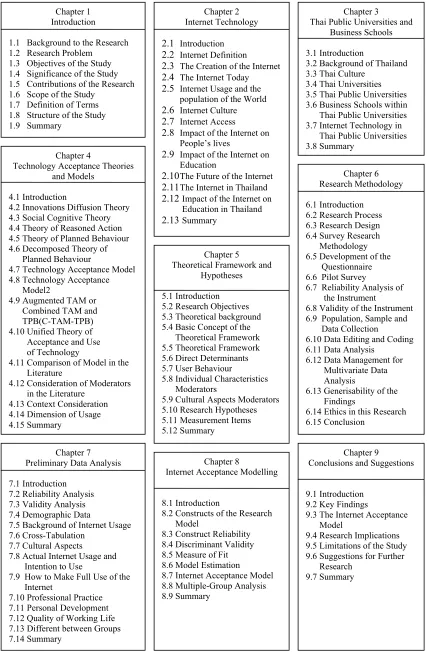
PAGEFigure 1.1 Structure of the Thesis……….14
CHAPTER 2
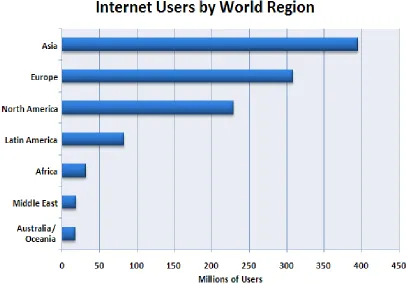
Figure 2.1 Internet Users by World Region………...20Figure 2.2 Internet Penetrations by World Region………20
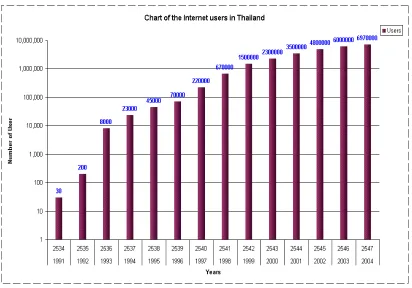
Figure 2.3 Chart of Internet Users in Thailand………..29
CHAPTER 4
Figure 4.1 A model of stages in the Innovation-Decision Process………47Figure 4.2 Social Cognitive Theory………...48
Figure 4.3 Theory of Reasoned Action (TRA) ……….49
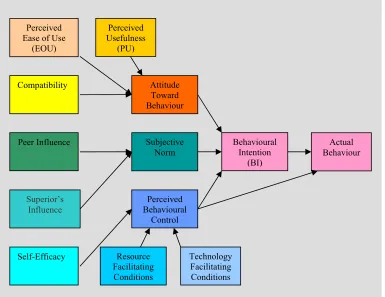
Figure 4.4 Theory of Planned Behaviour (TPB) Diagram……….51
Figure 4.5 Decomposed Theory of Planned Behaviour (DTPB)………...52
Figure 4.6 Technology Acceptance Model (TAM)………...55
Figure 4.7 TAM2 - Extension of TAM……….56
Figure 4.8 Augmented TAM (C-TAM-TPB)………....57
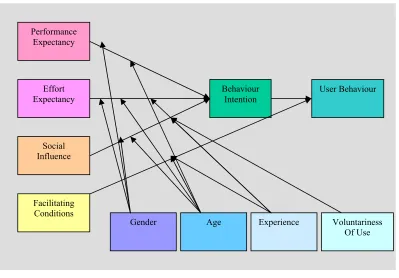
Figure 4.9 Unified Theory of Acceptance and Use of Technology (UTAUT)….59 Figure 4.10 Formation of the Research Model (Internet Acceptance Model – IAM) Based on Nine Theories/Models………..66
CHAPTER 5
Figure 5.1 Basic Concept of the Research Model………...83Figure 5.2 The Proposed Research Model……….85
CHAPTER 8
Figure 8.1 Standardised Estimates for Exogenous Latent Constructs………….189Figure 8.2 Standardised Estimates for Four Endogenous Latent Constructs…..191
Figure 8.3 The Proposed Research Model………..197
Figure 8.4 Initial Internet Acceptance Model with Unstandardised Estimates...199
Figure 8.5 Initial Internet Acceptance Model with Standardised Estimates…...200
PAGE Figure 8.7 Internet Acceptance Model with Standardised Estimates…………..203 Figure 8.8 The Baseline Model (Unconstrained Model)(Multiple-Group
Analysis) for Male Subjects with Unstandardised Estimates……….211 Figure 8.9 The Baseline Model (Unconstrained Model) (Multiple-Group
Analysis) for Female Subjects with Unstandardised Estimates…….212 Figure 8.10 The Constrained Model (Structural Weights Model) (Multiple-
Group Analysis) (Unstandardised Estimates) for Male Subjects…...213 Figure 8.11 The Constrained Model (Structural Weights Model) (Multiple-
Group Analysis) with Unstandardised Estimates for Female
Subjects………...214 Figure 8.12 The Baseline Model (Multiple-Group Analysis) for Younger
Subjects with Unstandardised Estimates………....217 Figure 8.13 The Baseline Model (Multiple-Group Analysis) for Older
Subjects with Unstandardised Estimates………....218 Figure 8.14 The Structural Weights Model (Multiple-Group Analysis)
(Unstandardised Estimates) for Younger Subjects………...219 Figure 8.15 The Structural Weights Model (Multiple-Group Analysis
(Unstandardised Estimates) for Older Subjects………..220 Figure 8.16 The Baseline Model (Multiple-Group Analysis) for Master
Degree Subjects with Unstandardised Estimates………...224 Figure 8.17 The Baseline Model (Multiple-Group Analysis) for Doctoral
Degree Subjects with Unstandardised Estimates………...225 Figure 8.18 The Structural Weights Model (Multiple-Group Analysis)
(Unstandardised Estimates) for Master Degree Subjects…………...226 Figure 8.19 The Structural Weights Model (Multiple-Group Analysis)
(Unstandardised Estimates) for Doctoral Degree Subjects………....227 Figure 8.20 The Baseline Model (Multiple-Group Analysis) for Lecturer
Subjects with Unstandardised Estimates………....231 Figure 8.21 The Baseline Model (Multiple-Group Analysis) for Higher
Position Subjects with Unstandardised Estimates………..232 Figure 8.22 The Structural Weights Model (Multiple-Group Analysis)
PAGE (Unstandardised Estimates) for Higher Position Subjects………….234 Figure 8.24 The Baseline Model (Multiple-Group Analysis) for Low
Experience Subjects with Unstandardised Estimates………237 Figure 8.25 The Baseline Model (Multiple-Group Analysis) for Moderate
Experience Subjects with Unstandardised Estimates………238 Figure 8.26 The Baseline Model (Multiple-Group Analysis) for High
Experience Subjects with Unstandardised Estimates………239 Figure 8.27 The Structural Weights Model (Multiple-Group Analysis)
(Unstandardised Estimates) for Low Experience Subjects…………240 Figure 8.28 The Structural Weights Model (Multiple-Group Analysis)
(Unstandardised Estimates) for Moderate Experience Subjects…....241 Figure 8.29 The Structural Weights Model (Multiple-Group Analysis)
(Unstandardised Estimates) for High Experience Subjects………...242 Figure 8.30 The Baseline Model (Multiple-Group Analysis) for
Acknowledged E-University Subjects with Unstandardised
Estimates………246 Figure 8.31 The Baseline Model (Multiple-Group Analysis) for
Unacknowledged E-University Subjects with Unstandardised
Estimates………247 Figure 8.32 The Structural Weights Model (Multiple-Group Analysis)
(Unstandardised Estimates) for Acknowledged E-University
Subjects………...248 Figure 8.33 The Structural Weights Model (Multiple-Group Analysis)
(Unstandardised Estimates) for Unacknowledged E-University
Subjects………..249 Figure 8.34 The Baseline Model (Multiple-Group Analysis) for
Acknowledged Research University Plan Subjects with
Unstandardised Estimates……….253 Figure 8.35 The Baseline Model (Multiple-Group Analysis) for
Unacknowledged Research University Plan Subjects with
Unstandardised Estimates………..254 Figure 8.36 The Structural Weights Model (Multiple-Group Analysis)
PAGE University Plan Subjects………255 Figure 8.37 The Structural Weights Model (Multiple-Group Analysis)
(Unstandardised Estimates) for Unacknowledged Research
University Plan Subjects………256 Figure 8.38 The Baseline Model (Multiple-Group Analysis) with
Unstandardised Estimates for Group 1(Level of Reading
and Writing is not an Obstacle)……….260 Figure 8.39 The Baseline Model (Multiple-Group Analysis) with
Unstandardised Estimates for Group 2(Level of Reading
and Writing is an Obstacle)………261 Figure 8.40 The Structural Weights Model (Multiple-Group Analysis)
(Unstandardised Estimates) for Group1 (Level of Reading
and Writing is not an Obstacle)………..262 Figure 8.41 The Structural Weights Model (Multiple-Group Analysis)
(Unstandardised Estimates) for Group2 (Level of Reading
and Writing is an Obstacle)………263 Figure 8.42 The Baseline Model (Multiple-Group Analysis) with
Unstandardised Estimates for Group1 (Thai Language is
not an Obstacle Subjects)………..267 Figure 8.43 The Baseline Model (Multiple-Group Analysis) with
Unstandardised Estimates for Group2 (Thai Language is
an Obstacle Subjects)……….268 Figure 8.44 The Structural Weights Model (Multiple-Group Analysis)
with Unstandardised Estimates for Group1 (Thai language
is not an Obstacle Subjects)………...269 Figure 8.45 The Structural Weights Model (Multiple-Group Analysis)
with Unstandardised Estimates for the Second Group
PAGE
CHAPTER 9
Figure 9.1 Formation of the Research Model (Internet Acceptance
Model – IAM) Based on Nine Theories/Models ……….293 Figure 9.2 The Internet Acceptance Model without the Impact of Moderators..296 Figure 9.3 The Internet Acceptance Model (with the Impact of -
PUBLICATIONS ASSOCIATED WITH THIS
THESIS
Journal Article
Kripanont, N. 2006 “Using a technology acceptance model to investigate academic acceptance of the Internet”, Journal of Business Systems, Governance and Ethics (JBSGE), vol.1, no. 2, pp.13-28.
Conference Paper
GLOSSARY OF TERMS
Academic A full-time member of the instructional staff of a university and may mean, or be used interchangeably with the word “teacher”, “lecturer”, “instructor”, or “faculty member”.
Academic Work A work that relates to teaching and teaching related tasks within the University such as teaching in classes, providing a personal web-base for facilitating teaching, preparing teaching materials, writing teaching documents or texts. Moreover, academic work also covers research and administration tasks.
Attitude toward Behaviour It is previous attitude of a person toward performing that behaviour. People think about their decisions and the possible outcomes of their actions before making any decision to be involved or not involved in a given behaviour.
Autonomous Universities These universities will be external to the government administrative system but still under the direct supervision of the Minister of Education in Thailand. This means that autonomous universities will have their own system of personnel administration, finance, academic affairs, and general management appropriate to their characteristics and missions. However, these universities will still receive financial support from the government.
Behavioural Beliefs It is the likely outcomes of the behaviour and the evaluations of these outcomes. These beliefs produce a favourable or unfavourable attitude toward the behaviour.
Bootstrapping Procedure A versatile method for estimating the sampling distribution of parameter estimates in AMOS.
Compatibility The degree to which an innovation is perceived as consistent with the existing values, past experiences, and needs of the receivers.
Complexity The degree to which an innovation is perceived as relatively difficult to understand and use. The complexity of an innovation is negatively related to its rate of adoption.
Control Beliefs These beliefs indicate whether the person feels in control of the action in question and they give rise to perceived behavioural control.
Cross-Sectional Study A research study for which data are gathered just once (stretched though it may be over a period of days, weeks, or months) to answer the research question.
Culture A collective programming of the mind which distinguishes the members of one group or category of people from another. Culture is also defined as “the complete way of life of a people: the shared attitudes, values, goals, and practices that characterize a group; their customs, art, literature, religion, philosophy, etc.; the pattern of learned and shared behaviour among the members of a group”.
Culture Context The macro environment in which the investigated user acceptance behaviour may occur and the specific organisation is located.
Content Validity An aspect of validity assessing the correspondence between the individual items and the concept through ratings by expert judges, and pre-tests with multiple sub-populations or other means.
Construct Reliability An aspect of reliability measuring the internal consistency of a set of measures rather than the reliability of a single variable.
Convergent Validity It is synonymous with criterion validity and with correlational analysis, and is one way of establishing construct validity.
Dependent Variable It is a variable of primary interest to the study, also known as the criterion variable.
Discriminant Validity It is another way of testing construct validity. A measure has discriminant validity when it has a low correlation with measures of dissimilar concepts. In other words, discriminant validity reflects the extent to which the constructs in a model are different.
Endogenous Latent Construct A latent, multi-item equivalents to a dependent variable. It is a construct that is affected by other constructs in the model.
Exogenous Latent Construct A latent, multi-item equivalent of an independent variable. It is a construct that is not affected by any other construct in the model.
E-university Plan The acknowledgement of academics toward e-university plan (plan of the University to become an e-university in the future) may positively affect Internet usage of academics because they may prepare themselves for the future by changing their behaviour so as to increase the utilisation of the new communication technology (e.g. the Internet) compared with academics who did not acknowledge this plan. Therefore, the acknowledgement of e-university plan may impact the influence of determinants toward usage behaviour.
Facilitating Conditions The degree to which an individual believes that an organisational and technical infrastructure exists to support use of the system.
Ethics In business research, ethics refers to a code of conduct or expected societal norm of behaviour while conducting research.
Habit of Reading and Writing Since the national culture of Thai people tends to exhibit habits of not much reading and writing. This habit of Thai people sometimes does not encourage or support using the Internet. When someone uses the Internet it is essential to put effort especially into reading the information or occasionally writing (keying), for example when using email. Therefore, academic perception of whether their level of reading and writing are obstacles or not in using the Internet may impact on the influence of determinants toward usage behaviour.
Independent Variable A variable that influences the dependent or criterion variable and accounts for (or explains) its variance.
Individual Context Those essential characteristics of individual users that are related to technology usage. An individual may exhibit characteristics completely different from others in other organisations of from different cultures.
Information Technology Computer technology, both hardware and software, for processing and storing information, as well as communication technology including networking and telecommunications for transmitting information.
Generalisability The probability that the results of the research findings apply to other subjects, other groups, other settings and other conditions.
Longitudinal Study A research study for which data are gathered at several points in time to answer a research question.
Parsimony (Measure of Parsimony) A model high in parsimony (simplicity) is a model with relatively few parameters and relatively many degrees of freedom. On the other hand, a model with many parameters and few degrees of freedom is said to be complex or lacking in parsimony.
Methodology The strategy, plan of action, process or design lying behind the choice and use of particular methods and linking the choice and use of methods to the desired outcomes.
Moderating Variable The moderator or the moderating variable is one that has a strong contingent effect on the independent variable and dependent variable relationship. That is, the presence of a third variable (the moderating variable) modifies the original relationship between the independent and the dependent variables.
Moderating Hypotheses The hypotheses that will be tested for moderators .
Multicollinearity When the dependent variables are highly correlated this is referred to as multicollinearity.
Non-Government Officers Thai government has a policy to transfer all public universities and institutes to become Autonomous universities. So non-government officers are those new staff who began work in the Universities after the policy was inaugurated.
Normative Beliefs The perceived behavioural expectations of such important referent individuals or groups as the person's spouse, family, friends, and teacher, doctor, supervisor, and co-workers, depending on the population and behaviour studied. These beliefs result in perceived social pressure or subjective norm.
Observability The degree to which the results of an innovation are visible to others.
Organisational Context The specific environment where the individual works and the investigated technology acceptance takes place.
Perceived Ease of Use The degree to which a person believes that using a particular system would be free of effort.
Perceived Usefulness The degree to which a person believes that using a particular system would enhance his or her job performance.
Pilot Study The study conducts to detect weaknesses in design and instrumentation and to provide proxy data for selection.
Population The entire group of people that the researcher wishes to investigate. In this research it is academics within Business Schools in the Thai Public University Sector who have already had experience in using the Internet.
Pre-testing A trial run with a group of respondents for the purpose of detecting problems in the questionnaire instructions or design, whether the respondents have any difficulty understanding the questionnaire or whether there are any ambiguous or biased questions.
Questionnaire A pre-formulated written set of questions to which respondents record their answers, usually within rather closely defined alternatives.
Relative Advantage The degree to which an innovation is perceived as being better than the idea it supersedes, the degree of relative advantage is often expressed in economic profitability but the relative advantage dimension may be measured in other ways (e.g. social).
Reliability The extent to which research findings would be the same if the research were to be repeated at a later date, or with a different sample of subjects.
to use communication technologies (e.g. the Internet) to search for information for their research. On the other hand, academics who have not acknowledged this plan may concentrate only on teaching and not pay any attention to research.
Sample A sample is a subset of the population, comprising some members selected from the population.
Self-Efficacy An individual’s self-confidence in his/her ability to perform a behaviour.
Square Multiple Correlation It is used to measure the construct reliability. The square multiple correlation (SMC) is referred to an item reliability coefficient. It is the correlation between a single indicator variable and the construct it measures. In other words, SMC is the proportion of its variance that is accounted for by its predictors.
Social Influence The degree to which an individual perceives that other important persons believe he or she should use the system.
Structural Equation Modelling A multivariate technique combine aspects of multiple regression (examining dependence relationships) and factor analysis (representing unmeasured concepts-factors with multiple variables) to estimate a series of interrelated dependence relationships simultaneously.
Subjective Norm The social pressure exerted on the person or the decision maker to perform the behaviour. It refers to an individual’s perception about what other people think of his or her behaviour in question.
Thai Language The first or national language of the Thai people and it is one of the layers of culture and it is different to the main Internet language which is normally English. Moreover, databases developed in the Thai language are still not sufficient to support the demands of the Thai people especially in higher education.
Theoretical Framework A collection of theories and models from the literature which underpins a positivistic research study. It is a conceptual model of how the researcher theorises or makes logical sense of the relationships among the several factors that have been identified as important to the problem. The theoretical framework may be referred to as a conceptual framework or as the research model. These three terms are used interchangeably in this research.
The Internet A publicly available computer network consisting of a worldwide network of computer networks that use the TCP/IP network protocols to facilitate data transmission and exchange, its synonyms are cyberspace and Net.
Trialability The degree to which an innovation may be experimented with on a limited basis.
Validity The extent to which the data collected truly reflects the phenomenon being studied.
LIST OF ABBREVIATIONS
AGFI Adjusted Goodness-Of-Fit Index AM Alternative Model
AMOS Analysis of Moment Structures ARPA Advanced Research Projects Agency ATB Attitude Toward Behaviour
BI Behaviour Intention
BITEACH Behaviour Intention in Teaching BIOTASK Behaviour Intention in Other Tasks CFI Comparative Fit Index.
C-TAM-TPB Combined TAM and TPB (Augmented TAM) DF Degree of Freedom
DTPB Decomposed Theory of Planned Behaviour EM Expectation Maximisation
FC Facilitating Conditions GFI Goodness- of- Fit Index IT Information Technology
ICT Information and Communication Technology IDT Innovations Diffusion Theory
IAM Internet Acceptance Model IETF Internet Engineering Task Force IRC Internet Relay Chat
LANs Local Area Networks ML Maximum likelihood MG Model generating MAR Missing At Random
MCAR Missing Completely At Random MM Motivational Model
MPCU Model of PC utilization N Population
NSF National Science Foundation
NECTEC National Electronics and Computer Technology Centre NFI Normed Fit Index
OTASK Usage Behaviour in Other Tasks PBC Perceived Behaviour Control PEOU Perceived Ease Of Use PU Perceived Usefulness PD Professional Development PP Professional Practices
RFCs Requests for Comments Documents
RMSEA Root Mean Square Error of Approximation SC Strictly Confirmatory
SCT Social Cognitive Theory SE Self-efficacy
SI Social Influence
SMC Squared Multiple Correlations SEM Structural Equation Modelling SN Subjective Norms
TAM Technology Acceptance Model TAM2 Technology Acceptance Model 2 TEACH Usage Behaviour in Teaching TRA Theory of Reasoned Action TPB Theory of Planned Behaviour
TCP/IP Transmission Control Protocol/Internet Protocol TLI Tucker-Lewis coefficient Index
ULS Unweighted Least Squares
UTAUT Unified Theory of Acceptance and Use of Technology WANs Wide Area Networks
ACKNOWLEDGEMENTS
Among millions of people one may not have known so many people in one’s life. A few people that we have met are family, relatives, friends and other important people. It is always my belief that being in company with the “Wiseman” who has good merit is a blessing for one’s life. We will never forget that once in our life we have a good chance to meet these “Wise Beings”. Sometimes the words “Thank you very much” are not enough for their kindness in trying to help one pass the obstacles to the goal that one wants to achieve.
Studying for a PhD is like a long journey in sailing a ship across the ocean. It was necessary to put much of your effort, concentration, endurance and patience until the end of your journey; sometimes you do not know when! Even though we intended to cross the ocean, during this long journey anything could happen and may affect your determination. Without help and support from many people around you it may not be possible to finish your journey, your ship may become a wreck and sink to the bottom of the ocean. I would like to acknowledge these people, who I met as the “Wise Beings”, who not only have they high knowledge but also have given their good merits to other people that related to them.
I have always been very grateful when I remembered a story about one who has the “Great Spirit” with strong determination, great patience, great loving, great compassion, great generosity, and great willingness to help people that one associated with. I would like to tell this story which is the best story for me in motivating me in many respects in viewing and living with people around me.
At that time, the greatest angel in heaven felt disturbed by sensing the hardening of his comfortable seat. It became hard and did not ease to sit. It was a sign of a good living creature that was in trouble. The greatest angel looked upon the human world and saw the father squirrel. He managed to face the father squirrel and said “You are very stupid to do this because the sea never gets dry thus you could not help your children anyway.” The father squirrel replied “You are the one that is so stupid not me” “I don’t want to waste my time to talk with you – go away”. The greatest angel knew that he could never change the squirrel’s mind so he decided to help by taking three children from the sea alive and gave them to their father!
In the real world, there are a lot of good people who are very kind to other people just like in this story. I would like to express my gratefulness to these people. My thesis would not have been possible without these people.
I would like to give many thanks to all academics in Business Schools in the Thai Public University Sector that kindly participated in the survey and those staff in the secretarial offices that helped me to collect the questionnaires. Without these people, this survey would not have been a success.
I am fortunate to study at Victoria University, not only has it a beautiful name but the University also has academic staff who have beautiful minds to support their students in their study.
First, I would like to give my sincere thanks to Professor Colin Clark - Dean of Faculty of Business and Law, Dr Santina Bertone - Associate Dean of Research and Research Training, and Mr. Con Nikakis - Head of School of Information Systems, for their kind support related to my study. Without direct and indirect support from this management team I would not have been at this stage.
In addition, I often heard many students mentioned his kind support and they all agreed that “Dr Nick” was a very kind professor and always gave a helping hand to students.
I would like to thank Ms. Tina Jeggo who is a student advice officer - research. She is a very kind person. All students in the research room acknowledged her as a highly supportive person. She always helped all students when they needed help. Especially for me when I had any problems she kindly presented her support and helped me pass through these problems.
I owe special gratitude to Dr Stephen Burgess - a senior lecturer in the School of Information Systems. He has not only helped me from the start but also before the submission of my thesis. He spent his time in reading the draft of the thesis and provided valuable comments.
I am deeply blessed in two supervisors I have. Dr Rodney Turner is my co-supervisor. He is a lecturer at the School of Information Systems. He has good experience of many years in Statistics especially in Structural Equation Modelling with AMOS. He utilised his knowledge and experience in helping me pass through the difficulties with this specific statistics. Without his help and support it would not have been possible for me to make it within this period of time. I may stumble along the way with the SEM and AMOS and did not have any self-confidence that what I had done was correct.
I remembered a saying that “It is a blessing for anyone who has a teacher that is a person of high intelligence and who is high knowledgeable in various academic aspects”. Because of this I am very proud of my two supervisors since I knew that they both graduated from a good University with a Bachelor degree of Physics. In my opinion Physics is one area that is very difficult to study.
I also must note my appreciation to my best friends - Associate Professor Gallayanee Kitijit, Miss Kesinee Achanapornkul, and Dr Pannakarn Leepaiboon. They had always encouraged me to continue my study whenever I wished to quit. They also were the ones that always said “Be patient a little bit more to do - you are nearly there”.
My mother is always being there whenever I have a problem. She always pushed me to study at this level. Although she is rather old she still works very hard to take care of everything during my absence to study in Australia. However, despite the fact that she wanted me to graduate at this level she always complained to me and requested me to go back because she was very tired of taking care of everything on my behalf.
My dearest father had given great support since I was young. When I was around four years old he asked me whether I wanted to go to school yet. When I said “Yes” within a few days he brought me to the school during the semester after other students had already attended the school for a month (I still remembered that day). During my study in high school, he always bought me many external books in order to help me to practice in many difficult subjects. I remembered one day he gave me a set of maps of the world from the U.S. which showed the geographical appearance of each continent. They were very beautiful in colour and I could view and touch where there was a mountain and where there was a river. In that year I got a full score in the Geographic subject because I could remember everything by pictures. If he was still alive, I have no doubt that he would support me one way or another during my study at this level.
CHAPTER 1
INTRODUCTION
1.1
Background to the Research
As we live in the information age, an immense amount of information is readily available through powerful computers, which are connected through high speed data communication networks such as the Internet, Wide Area Networks (WANs), and Local Area Networks (LANs). The rapid rate of change in the business environment has continuously pushed the need for technologies and acceptance of these technologies at an accelerating rate. The new technologies are enabling organisations to be flatter, networked, and more flexible. Organisations in the 21st century inevitably make substantial investments in Information Technology (IT) in order to achieve competitive advantage, by spending enormous sums of money on computer hardware, software, communication networks, databases and specialised personnel. Consequently, Information Technology is not only commonly found in the workplace, but has also become pervasive in the home and in public areas (Martin, Brown, DeHayes, Hoffer & Perkins 2002).
The Internet, an important aspect of Information Technology, at present and in the future, seems to be the most useful technology for communication and obtaining information for individuals, organizations and countries. The Internet is an interconnected network of networks (Tatnall, Paull, Burgess & Davey 2003) and can help connect millions of computers and millions of users around the world by providing many interesting services at low expense (Davison, Burgess & Tatnall 2004). We therefore cannot help think that the world is getting smaller via the Internet. In spite of the fact that the growth in importance of the Internet is quite recent (Hyperdictionary 2006), the Internet is now very popular in many countries worldwide including in the U.S and Australia. Despite the popularity of the Internet, the Internet penetration rate (% of populations use the Internet) is still very low, accounting for only 16.8% of the population - 1,091.7 million from a total population of 6,499.7 million (Internet World Stats 2006c). There are many people in many countries, especially in developing countries that still have no chance to access the Internet. More particularly, in Thailand, the penetration rate is only 12.7 % (Internet World Stats 2006b) which is lower than the penetration rate of the world. Since the total population of Thailand is 66.5 million, Internet users make up only 8.4 million people. This rate has not changed considerably during the last few years. It also cannot be compared with the Internet penetration rate of the U.S.(70%) (Internet World Stats 2006d), Australia (70.7%) (Internet World Stats 2006a) and other countries in South East Asia such as Singapore (67.2%) and Malaysia (40.2%) (Internet World Stats 2006b).
In higher education, it is important for all academics to use the Internet more in their work as students will all have experience in using the Internet at the basic educational level of study according to the National ICT for Education Master Plan (2004-2006) (Office of the Education Council 2004). An understanding of how to promote academics to use the Internet more will be achieved by utilising the theories/models of technology acceptance as a theoretical base for investigating the key determinants that influence both experienced and inexperienced individuals to use the Internet. The model of technology acceptance is expected to have power in explaining and predicting usage of the technology and to provide a useful tool for top management of the universities to understand the determinants of usage behaviours in order to proactively design interventions (including training) targeted at user populations that may be less inclined to use the Internet in their work. It is hoped to help academics to gain more knowledge and experiences of using the Internet which will certainly help to prepare them to cope with any changes in the teaching and learning process. This in turn will affect students who will graduate from the universities. They will have more experience about using the Internet at the university level and it is hoped that these students will utilise their Internet experience in the work place. Consequently, it is also hoped to improve the Internet penetration rate of the country and thus help the country to cope with the rapidly changing environment in this information age.
1.2 Research Problem
theories/models should be revised, extended or modified to account for rapid change in both technologies and their environments. The major intention among the theories/model of technology acceptance being developed is similar because they are being developed in order to explain and predict usage behaviour of the technologies. For example, the major intention of TAM by Davis (1989) is generality and parsimony associated with behaviours across a broad range of computing technologies and user groups.
Most importantly, a great amount of the research has been conducted in the U.S. and only a limited number of studies have focused on the acceptance of technology outside North America (McCoy & Everard 2000). It can be noticed that among these well-known theories/models of technology acceptance, there are some inconsistencies among their key determinants and moderators. Because these inconsistencies were often found it is questioned whether there are only determinants such as perceive usefulness, perceived ease of use, subjective norm, and perceived behaviour control determine behaviour. In addition, whether there are only moderators such as age, gender, experience, and voluntariness. Perhaps there should be some other determinants and moderators that also play important roles with respect to technology acceptance especially in other technology and organisation contexts.
In addition, other than the inconsistencies among these well-known theories/models, it is further wondered whether these theories/models of technology acceptance that have been developed, modified, and extended in U.S. can be used in other cultures or countries, especially in Thailand. According to Ticehurst and Veal (2000), culture can also influence the outcomes of the research. Up to 80 percent of management research published to-date has been conducted by North American researchers on Americans and in American organisations. The findings of any research are not necessarily applicable to organisations in other countries such as in Australia or Thailand. It is clear that great care needs to be taken when extending the findings of business research conducted in other countries such as in the U.S. to Australia or Thailand or to other cultures.
addition, no evidence has been found in the research literature relating to a model of technology acceptance being developed in the context of the Thai Public University Sector by using individual academics as subjects and the Internet as the technology context. Thus developing a model of technology acceptance in Thai culture is important and necessary in order to promote usage of the technology in Thailand. It is therefore expected that the model being developed together with other key findings from this research will be applicable to higher education institutions in the country and will benefit not only individuals, organisations, and the country as a whole but could also be adapted and validated for other countries as well.
1.3 Objectives of the Study
This thesis is entitled “Examining a Technology Acceptance Model of Internet Usage by Academics within Thai Business Schools”. The aim of this study is to develop a model of technology acceptance that will have the power to demonstrate acceptance and usage behaviour of the Internet in Thai Business Schools by using academics within Business Schools in the Thai Public University Sector as subjects. A thorough understanding of the model may help practitioners to analyse the reasons for resistance toward the technology and would also help to take efficient measures to improve user acceptance/usage of the technology. According to Davis (1989) practitioners evaluate systems for two purposes, one is to predict acceptability, the other is to diagnose the reasons resulting in lack of acceptance and to take proper measures to improve user acceptance. The aim of this study leads to the development of the following specific research objectives.
2. To review previous literature about IT acceptance/adoption and usage within four contexts of study include technology, individual, organisational, and cultural contexts.
3. To investigate the extent to which Thai business academics use and intend to use the Internet in their work.
4. To investigate how to motivate Thai business academics to make full use of the Internet in their work.
5. To investigate to what extent using the Internet helps to improve academics’ professional practice, professional development and quality of working life.
6. To formulate a model of technology acceptance of Internet usage by Thai academics.
7. To validate and generate a research model that best describes Thai academics’ Internet usage behaviour and behaviour intention.
1.4
Significance of the Study
The findings from this research will be beneficial not only to individual academics, Business Schools, and the Thai Public University Sector, but also the country as a whole. In other words, this study will be very useful for three levels include the individual level, organisational level and the national level.
1.4.1
Individual Level
by planning the strategies to support Internet usage of academics, it is expected that they will use the Internet more in their work. Accessing the Internet will help by saving time and expense, such as by using email for communications, and accessing information and knowledge effectively world wide free of charge. In addition, teaching through technology will help in changing academics’ professional practice especially in the teaching and learning process. They can work more effectively, efficiently and productively, leaving more time for research and leisure. In turn the quality of their working life will be better, consequently helping the university to achieve its educational strategies and goals of quality, efficiency, and cost-effectiveness as well.
1.4.2 Organisational Level
Technologies will enable changes in teaching and learning processes (Leidner & Jarvenpaa 1995). Under the right circumstances, teaching through technology can have several advantages over traditional classroom teaching as learners are able to access high-quality teaching and learning at any time and any place. Also, well-designed multimedia learning materials can be more effective than traditional classroom methods because students can learn more easily and more quickly through illustration, animation, different structuring of materials, and increased control of and interaction with learning materials respectively (Bates 2000). According to Bates (2000), the benefits of using new technologies (including the Internet, email, presentation software, videoconferencing, the World Wide Web, multimedia, and CD-ROM) are :
1) To improve the quality of learning.
2) To improve students’ everyday IT skills they will need in their work and life. 3) To widen access to education and training.
4) To respond to the “technological imperative”. 5) To reduce the costs of education.
6) To improve the cost-effectiveness of education.
learning process. In higher education, it is true, according to Garvin (1993), that although universities create and acquire knowledge, they are seldom successful in applying that knowledge to their own activities. Because of the strategies of the National Plans and the benefits of teaching through technologies, the issue of how to make more and full use of the Internet by academics in their work is a significant issue for universities. In accordance with Bates (2000), faculty members usually have a good deal of independence and autonomy and play a central role in the work of universities. So if there is to be any change, especially in core activities of the university such as teaching and research, it is completely dependent on their support. Top management may dream visions and design plans, and deans and department heads may try to implement them, but without the support of faculty members nothing will change.
The findings from this research should help the universities to plan their strategies to support and motivate academics to use the Internet more in their work in order to prepare to cope with any changes in teaching and learning process if universities become e-Universities or change from a teaching orientation to become research oriented universities. The model generated from this research should provide a useful tool for top management at the universities to understand the determinants of usage behaviours in order to proactively design interventions (such as training) targeted at populations of users that may be less inclined to use the Internet in their work in order to prepare academics to gain more knowledge and experiences of using the Internet which in turn may help the university to achieve its educational goals and to help support Thai National Plans.
1.4.3 National Level
As mentioned, the critical issues of how to make full use of ICT in facilitating teaching and learning processes are of national concern. Thai National Plans have been issued to motivate and support ICT usage include:
1) National Education Plan (2002-2016) (Office of the Education Council 2004). 2) the National IT Policy (2001-2010) or IT 2010 (NECTEC 2001).
It is essential for all academics in higher education to use ICT, especially the Internet in order to cope with students who have already had Internet experience, at the basic educational level of study in the near future according to the National ICT for Education Master Plan. The model being generated from this research will provide information necessary in explaining what promotes Internet usage and what hinders usage. This research seems to be at the right time and at the right place. It is expected that this research will help support National Policies especially the policy to increase ICT usage as part of the teaching-learning process at all level of education and help support the strategies of e-Education according to National IT Policy.
1.5
Contributions of the Research
This research set out to make contributions to knowledge as follows:
1. It provides a big picture of relevant aspects of Internet technology in general and in Thailand in particular.
2. It provides a clear description of relevant aspects about Thai Business Schools, Thai Public University Sector and higher education in Thailand.
3. It provides a relatively clear description and understanding of models and theories of technology acceptance that has been synthesised from theoretical and practical viewpoints.
4. It provides the overall picture and details of Internet implementations in Business Schools of the Thai public university sector. It is hoped that the study will contribute to wider understanding regarding the Internet usage of Thai academics including their usage behaviour and intention to use the Internet in the future.
5. It illustrates the effects of some cultural aspects as moderators along with other moderators on the influence of key determinants toward usage behaviour and behaviour intention.
7. It provides a contribution to the knowledge of to what extent Internet usage helps improve academics’ professional practice, professional development and quality of working life.
8. A major contribution to the existing knowledge and literature is the application of Structural Equation Modelling (SEM). The application of SEM promotes a better quality of the research associated with technology acceptance in a cultural context. SEM has useful features, especially in modelling multivariate relations, and there are no widely and easily applied alternative methods of this kind (Byrne 2006).
9. The study contributes significantly to the global understanding of technology acceptance through the development of the research model in a Thai cultural context. This study presents the powerful “Internet Acceptance Model”, using academics’ actual usage and their intention to use the Internet by testing and verifying the theoretical framework along with practical applications in the environment of the Thai Public University Sector. This outcome is expected to be useful from an academic or scholarly standpoint and will enable other research studies in Thailand and also in other cultures.
1.6 Scope of the Study
This study targeted only full-time academics within Business Schools in the Public University Sector in Thailand. Total population of this study was comprised only of experienced users of the Internet.
This study focuses on usage behaviour of academics together with their intention to use the Internet in their work within Business Schools. These Business Schools were scattered around the country. Academics were asked to assess their current usage of the Internet together with a prediction of their future usages of the Internet associated with their work.
the type of courses/teaching subjects delivered by various faculties or schools from affecting Internet usage.
This study did not cover: (1) the Rajamangala University of Technology system comprises nine universities (35 campuses) and was formerly called Rajamangala Institute of Technology before being elevated to University status in 2005 (Wikipedia 2006b); (2) forty one Rajabhat Universities scattered around the country because they came from Rajabhat Institutes (Rajabhat Institute 2004) and just became universities in June 2004 in accordance with the Rajabhat University Act (Commission of Higher Education 2004); (3) Princess of Narathiwat University which was established very recently (Wikipedia 2006a); and (4) Nakhonphanom University which was established recently as well (Wikipedia 2006a).
1.7 Definition of Key Terms
The Internet is a publicly available computer network consisting of a worldwide network of computer networks that use the TCP/IP network protocols to facilitate data transmission and exchange, its synonyms are cyberspace and Net (WordNet Dictionary 2003).
Academic is a full-time member of the instructional staff of a university and may mean, or be used interchangeably with the word “teacher”, “lecturer”, “instructor”, or “faculty member”.
Academic work relates to teaching and teaching related tasks within the University such as teaching in classes, providing a personal web-base for facilitating teaching, preparing teaching materials, writing teaching documents or texts. Moreover, academic work also covers research and administration tasks (Rosenfeld, Reynolds & Bukatko 1992).