O R I G I N A L R E S E A R C H
Long Non-Coding RNA HULC Promotes the
Development of Breast Cancer Through Regulating
LYPD1 Expression by Sponging miR-6754-5p
This article was published in the following Dove Press journal:
OncoTargets and Therapy
Nan Wang1
Chaochao Zhong2
Mingti Fu3
Lin Li1
Fang Wang1
Pengwei Lv1
Mingzhi Zhu1
Youyi Xiong1
Hailong Mi1
Yuanting Gu1
1Department of Breast Surgery, The First
Affiliated Hospital of Zhengzhou University, Zhengzhou 450052, Henan, People’s Republic of China;2Department of Emergency, The First People’s Hospital of Zhengzhou, Zhengzhou 450052, Henan, People’s Republic of China; 3Department of General Surgery, The
First Affiliated Hospital of Zhengzhou University, Zhengzhou 450052, Henan, People’s Republic of China
Introduction:Long non-coding RNAs (lncRNAs) were found to regulate many biological processes including cancer development, immunology and other diseases. LncRNA HULC was found to be oncogenes in many cancer progression. However, the role of HULC in the regulation of breast cancer remains unclear.
Methods:The expression of HULC and miR-6754-5p was examined by RT-PCR. Through knockdown of HULC, we found that the proliferation abilities coupled with migration and
invasion abilities were significantly decreased. And also, we verified that overexpression of
miR-6754-5p significantly decreased the proliferation ability of breast cancer cells.
Results: In this study, we found that lncRNA HULC was overexpressed in breast cancer tissues and cell lines compared to normal healthy breast tissues and normal breast cell line. Moreover, the high expression of HULC was associated with metastasis and malignancy of breast cancers. Mechanically, we found that HULC can bind to miR-6754-5p directly through complementary base pairing. Furthermore, we found that HULC regulates the expression of LYPD1 through sponging miR-6754-5p. Moreover, overexpression of LYPD1 can rescue the migration and invasion abilities of breast cancer cells decreased by knockdown of HULC or overexpression of miR-6754-5p.
Conclusion:Our study showed the role of HULC in promoting breast cancer development and explained the detailed molecular mechanisms.
Keywords:lncRNA HULC, breast cancer development, miR-6754-5p, LYPD1
Introduction
Breast cancer is the most common invasive cancer in women. Breast cancer may also
occur in men or children, or in pregnant women, but it is very rare.1 Adolescent
women’s breasts consist of fat, connective tissue and thousands of lobules that provide
milk for breastfeeding. In cancer, the body’s cells divide and grow uncontrollably. It is
excessive cell growth that causes cancer. Breast cancer usually begins in the inner layer of the duct, or in the lobules that supply milk, from which it can spread to other parts of
the body.2In recent years, the incidence of breast cancer in young women is increasing.
Breast cancer has very strong heterogeneity and complexity, so it is very important to
study the molecular mechanism of breast cancer development.3
Long non-coding RNAs (lncRNAs) were found to be longer than 200nt and had
little or noncoding potential.4 In recent years, many studies have proved that
lncRNAs can exert very important roles in many biological processes especially
cancer development.5–7 Highly upregulated in liver cancer (HULC) was firstly
Correspondence: Yuanting Gu
Department of Breast Surgery, The First Affiliated Hospital of Zhengzhou University, Erqi District, Zhengzhou 450052, People’s Republic of China Email [email protected]
OncoTargets and Therapy
Dove
press
open access to scientific and medical research
Open Access Full Text Article
OncoTargets and Therapy downloaded from https://www.dovepress.com/ by 118.70.13.36 on 25-Aug-2020
identified in liver cancer and was very highly expressed in
liver cancer cells.8,9Besides, many studies have found that
HULC can also act as oncogenes to promote many other cancer progressions, including ovarian carcinoma, prostate
cancer, chronic myeloid leukemia and so on.10–12However,
the function of HULC in the regulation of breast cancer progression remains unclear.
Ly6/PLAUR domain-containing protein 1 (LYPD1) is also known as Lynx2, a member of Lynx family of
neuro-transmitter receptor-binding protein.13LYPD1 was reported
to participate in the regulation of ovarian cancer and can act
as a novel prognostic marker for ovarian cancer.14And also,
LYPD1 was proved to be essential for the endothelial
net-work formation in bioengineered tissue.15 Moreover,
LYPD1 was indicated to be associated with breast cancer metastasis. However, the role of LYPD1 in the regulation of breast cancer development remains unclear.
In our study, we found that HULC was also highly expressed in breast cancers compared to normal healthy breast tissues. And also, decreased expression of HULC was associated with lower proliferation, migration and inva-sion abilities. Mechanically, we found that HULC can bind to miR-6754-5p and inhibit the expression of miR-6754-5p through forming complementary base pairing. Moreover, we found that miR-6754-5p can bind to LYPD1. Through sponging miR-6754-5p, HULC promoted the expression of LYPD1. Consistently, overexpression of miR-6754-5p or inhibiting of LYPD1 also decreased the proliferation, migra-tion and invasion of breast cancer cells.
Materials and Cells
Samples and Cell Lines
Human breast cancer samples and paired adjacent healthy breast tissues were obtained from 60 breast cancer patients
under surgery at The First Affiliated Hospital of Zhengzhou
University. All samples were kept in liquid nitrogen before use. This study was approved by the Ethics Committee of
The First Affiliated Hospital of Zhengzhou University. All
written informed consents were received from patients.
Cell Lines
Breast cancer cell lines: MCF-7, ZR-75-1, BT-20, MDA-MB -231 and one normal breast cell line: MCF-10A were obtained from American Type Culture Collection (ATCC, USA). MCF-7 and MDA-MB-231 cells were cultured in DMEM medium supplemented with 100 mg/mL streptomycin, 100 U/mL peni-cillin and 10% FBS; BT-20 cells and ZR-75-1 cells were
cultured in RPMI-1640 medium supplemented with
100 mg/mL streptomycin, 100 U/mL penicillin and 10% FBS. The culture medium of MCF-10A cells was M-171 medium and supplemented with mammary epithelial growth
factors (Invitrogen/Life Technologies, USA).6All cells were
cultured at 37°C in 5% CO2.
CCK8 Assay
MCF-7 cells and BT-20 cells were seed into 96-well plate to examine the proliferation abilities using CCK8 detec-tion kit (7 sea biotech, Shanghai, China) according to the
manufacturer’s instruction.
Quantitative Reverse Transcription-PCR
(qRT-PCR)
Total RNAs were extracted from tissues or cells using Trizol reagent. Then, RNAs were reverse-transcribed into cDNA using PrimeScript RT reagent Kit (Promega, Madison, WI, USA) according to the instruction of the kit. Finally, qRT-PCR assay was performed using SYBR Green PCR Master Mix reagents (Takara) in 7300 Real-Time PCR System (Applied Biosystems).
Transwell Assay
Cells were seeded into the Matrigel-coated chamber (BD Biosciences, Cowley, United Kingdom). The upper chambers were added with serum-free medium while the lower cham-bers were added with 10%FBS containing DMEM. After 24
hrs, cells in the lower chamber werefixed with 4%
parafor-maldehyde and then stained with 0.1% crystal violet.
Statistical Analysis
A Student’s t-test was used to analyze the differences
between the two groups. A one-way ANOVA followed
by a Tukey’s post hoc test was used for multiple
compar-isons. The effect of lncRNA HULC expression on overall survival was analyzed by Kaplan-Meier analysis and a log-rank test. GraphPad Prism 6 software was used to analyze all results. The results were expressed as mean ± SD. P <
0.05 was considered to be significant.
Results
Elevated Expression of lncRNA HULC in
Breast Cancer Tissues and Cell Lines Is
Associated with Poor Prognosis
LncRNAs were proved to promote many cancers develop-ment as oncogenes. However, the role of HULC in breast
OncoTargets and Therapy downloaded from https://www.dovepress.com/ by 118.70.13.36 on 25-Aug-2020
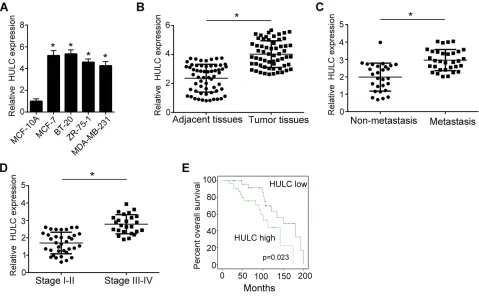
cancer development remains unclear. So, we wanted to explore the function of HULC in breast cancer progres-sion. Firstly, we found that the expression of HULC was remarkably higher in breast cancer cells, MCF-7, BT-20, ZR-75-1 and MDA-MB-231 relative to normal breast cell,
MCF-10A (Figure 1A). Besides, we also collected 60 pairs
of human breast cancer tissues and adjacent normal breast tissues. Through qRT-PCR analysis, we found that lncRNA HULC was very highly expressed in breast cancer
tissues compared to adjacent healthy tissues (Figure 1B).
Moreover, we also examined the expression of HULC in breast cancer tissues with metastasis and advanced stages, we observed that higher expression was associated with
metastasis and advanced stages (Figure 1C–D). To further
examine the overall survival rate of HULC, we performed Kaplan-Meier curve analysis. We divided the 60 samples into two groups based on the median expression of HULC (Table 1). Consistently, we found that lower HULC
expression possessed better overall survival (Figure 1E).
Taken together, we observed that HULC expression was
upregulated in breast cancer tissues and cell lines and associated with poor overall survival rate.
Knockdown of HULC Expression
Signi
fi
cantly Impairs Development of
Breast Cancer
As we showed above, we found that HULC was over-expressed in breast cancer tissues and cell lines. To explore the function of HULC in the regulation of breast cancer development, we constructed shRNAs of HULC (Figure 2A). Firstly, we examined the proliferation abil-ities of breast cancer cells using CCK8 assay after knock-down of HULC. We found that decreased HULC expression leads to decreased proliferation of MCF-7
cells and BT-20 cells (Figure 2B). And, we also performed
colony formation assay. Consistently, we observed that knockdown of HULC decreased the numbers of colonies
when compared to the negative control (Figure 2C). As the
expression of HULC was higher in metastasis and
Figure 1The expression of lncRNA HULC is higher in breast cancer tissues and cell lines. (A) Relative expression of HULC in breast cancer cell lines and normal breast cell line was examined by qRT-PCR. Breast cancer cell lines: MCF-7, BT-20, ZR-75-1, MDA-MB-231. Normal breast cell line: MCF-10A. Data were normalized to 18S and expressed as mean ± SD. (B) Relative expression of HULC in breast cancer tissues relative to adjacent normal breast tissues was examined by qRT-PCR. n=60. Data were normalized to 18S and expressed as mean ± SD. (C) Relative expression level of HULC was examined using qRT-PCR in breast cancer tissues with non-metastasis (n=35) and metastasis (n=25). Data were normalized to 18S and expressed as mean ± SD. (D) Relative expression level of HULC was examined using qRT-PCR in breast cancer tissues with stage I-II (n=28) or stage III-IV (n=37). Data were normalized to 18S and expressed as mean ± SD. (E) Overall survival rate of HULC was analyzed by Kaplan–Meier analysis coupled with log-rank test in breast cancer. Higher HULC expression level group (n=33). Lower HULC expression level group (n=27). (P=0.032). *P<0.05.
OncoTargets and Therapy downloaded from https://www.dovepress.com/ by 118.70.13.36 on 25-Aug-2020
advanced breast cancer tissues, so we wanted to explore if HULC regulated the migration and invasion of MCF-7 cells and BT-20 cells. To examine that, we performed
migration and invasion assay and observed significantly
less numbers of migration and invasion cells after
knock-down of HULC (Figure 2D–E). Collectively, we found
that HULC promoted the development of MCF-7 cells and BT-20 cells.
miR-6754-5p Is Sponged by HULC and
Regulates the Expression of HULC
Tofind the potential mechanism that HULC regulated the
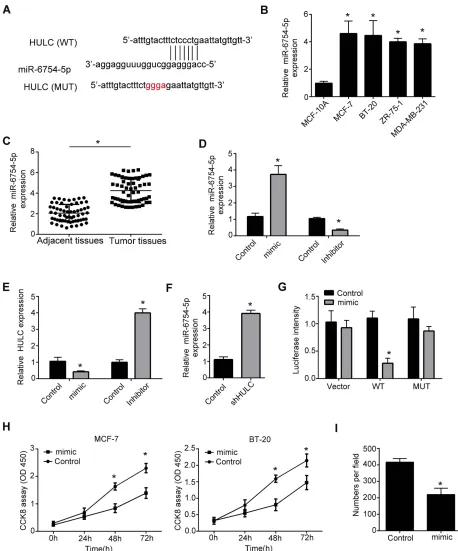
development of breast cancer, we performed bioinformatics analysis using HULC sequence. We found that HULC can form complementary base pairing with miR-6754-5p
directly (Figure 3A). Moreover, we found that the
expres-sion of miR-6754-5p was elevated in breast cancer cells
compared to normal breast cells (Figure 3B). And also,
miR-6754-5p was highly expressed in breast cancer tissues
compared to adjacent tissues (Figure 3C). To explore the
regulation between HULC and miR-6754-5p, we
con-structed miR-6754-5p mimic and inhibitor (Figure 3D).
Through transfection and qRT-PCR analysis, we observed
that overexpression of miR-6754-5p significantly decreased
HULC expression while inhibition of miR-6754-5p
remark-ably increased the expression of HULC (Figure 3E).
Moreover, we also found that knockdown of HULC
increased miR-6754-5p expression (Figure 3F). To validate
the interaction between HULC and miR-6754-5p, we per-formed luciferase reporter assay. We observed that the
luciferase intensity of WT-HULC was decreased after ecto-pic expression of miR-6754-5p while the luciferase
inten-sity of MUT-HULC did not change (Figure 3G). Finally, we
also wanted to explore if miR-6754-5p regulated the pro-liferation of breast cancer cells. We performed CCK8 assay and found that miR-6754-5p remarkably decreased prolif-eration abilities of MCF-7 cells and BT-20 cells examined
by CCK8 assay and colony formation assay (Figure 3H–I).
In sum, we found that HULC interacts with miR-6754-5p and miR-6754-5p can inhibit the progression of breast cancer.
LYPD1 Is a Potential Target for HULC
and miR-6754-5p in the Regulation of
Breast Cancer Progression
Tofind the potential target for HULC and miR-6754-5p, we
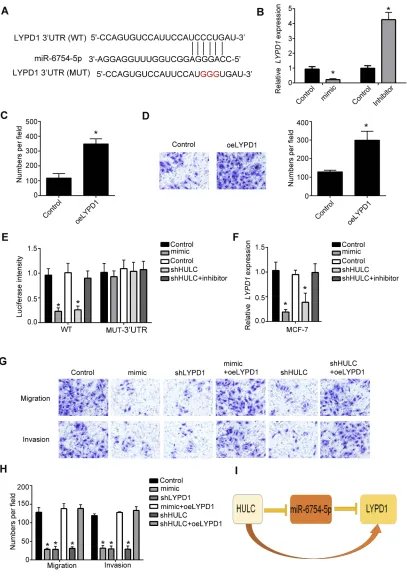
performed TargetScan7 analysis. We found that
miR-6754-5p can bind to LYPD1 directly (Figure 4A). Furthermore,
through qRT-PCR assay, we observed that overexpression of miR-6754-5p decreased the expression of LYPD1 while inhibition of miR-6754-5p increased LYPD1 expression
significantly (Figure 4B). Then, we found that
overexpres-sion of LYPD1 could significantly increase the proliferation
abilities and migration abilities (Figure 4C-D). Moreover,
to validate the interaction between miR-6754-5p and LYPD1, we performed luciferase assay and proved that ectopic expression of miR-6754-5p or knockdown of
HULC significantly decreased the luciferase intensity of
WT-HULC. And also, inhibition of miR-6754-5p coupled with knockdown of HULC can rescue the luciferase inten-sity of WT-HULC decreased by knockdown of HULC (Figure 4E). Moreover, the expression level of LYD1 was consistent with the luciferase intensity of WT-HULC (Figure 4F). To validate the relationship of HULC, miR-6754-5p and LYPD1 in regulating breast cancer develop-ment, we performed migration and invasion assay. We observed that ectopic expression of miR-6754-5p,
knock-down of HULC or knockknock-down of LYPD1 significantly
decreased the migration and invasion of breast cancer cells while overexpression of miR-6754-5p after overex-pression of LYPD1 or overexoverex-pression of LYPD1 after knockdown of HULC can rescue the decreased migration
and invasion of breast cancer cells (Figure 4G–H).
Collectively, we showed that lncRNA HULC promoted breast cancer development through miR-6754-5p/LYPD1 axis (Figure 4I).
Table 1 Correlation Between HULC Expression and Clinicopathological Features in 60 Patients with Breast Cancer
Variables Low (n=30) High (n=30) P-Value
Age, years 0.397
>60 15 13
≤60 17 15
Gender 0.746
Male 14 15
Female 15 16
TNM stage 0.024
I-II 19 16
III-IV 15 20
Lymph node metastasis 0.037
Yes 13 19
No 13 15
OncoTargets and Therapy downloaded from https://www.dovepress.com/ by 118.70.13.36 on 25-Aug-2020
Figure 2Knockdown of HULC significantly decreased the progression of breast cancer cells. (A) Relative expression of HULC in MCF-7 cells and BT-20 cells was examined by qRT-PCR after knockdown of HULC. Data were normalized to 18S and expressed as mean ± SD. (B) The proliferation abilities of MCF-7 cells and BT-20 cells were detected by CCK8 assays after knockdown of HULC. Data were expressed as mean ± SD. (C) Colony formation assays were performed to measure the proliferation ability of MCF-7 cells and BT-20 cells after transfecting HULC knockdown plasmids or negative control. Data were expressed as mean ± SD. (D) Migration abilities of MCF-7 cells and BT-20 cells were measured by transwell assays after knockdown of HULC. Data were expressed as mean ± SD. (E) Invasion abilities of MCF-7 cells and BT-20 cells after knockdown of HULC were measured by transwell assays. Data were shown as mean ± SD. *P<0.05.
OncoTargets and Therapy downloaded from https://www.dovepress.com/ by 118.70.13.36 on 25-Aug-2020
Figure 3LncRNA binds to miR-6754-5p through direct complementary base pairs. (A) Schematic representation of the predicted target site for HULC and miR-6754-5p. (B) Relative expression of miR-6754-5p in breast cancer cell lines and normal breast cell line was measured by qRT-PCR. Breast cancer cell lines: MCF-7, ZR-75-1, BT-20, MDA-MB-231. Normal breast cell line: MCF-10A. Data were normalized to 18S and expressed as mean ± SD. (C) Relative expression of miR-6754-5p in breast cancer tissues relative to adjacent normal breast tissues was examined by qRT-PCR. n=60. Data were normalized to 18S and expressed as mean ± SD. (D) Relative expression of miR-6754-5p in MCF-7 cells was measured by qRT-PCR after transfecting miR-6754-5p mimics or inhibitors. Data were normalized to 18S and expressed as mean ± SD. (E) Relative expression of HULC in MCF-7 cells was measured by qRT-PCR after transfecting miR-6754-5p mimics or inhibitors. Data were normalized to 18S and expressed as mean ± SD. (F) Relative expression of miR-6754-5p in MCF-7 cells was measured by qRT-PCR after transfecting HULC knockdown plasmid or negative control. Data were normalized to 18S and expressed as mean ± SD. (G) Luciferase reporter assay was performed to examine the interaction between HULC and miR-6754-5p. WT: HULC-WT; MUT: HULC-MUT. Mimic: miR-6754-5p mimics. Data were expressed as mean ± SD. (H) The growth rates of MCF-7 cells and BT-20 cells were measured by CCK8 assays after overexpression of miR-6754-5p. Data were shown as mean ± SD. (I) Colony formation assays were performed to measure the proliferation ability of MCF-7 cells after overexpressing of miR-6754-5p. Data were expressed as mean ± SD.*P<0.05.
OncoTargets and Therapy downloaded from https://www.dovepress.com/ by 118.70.13.36 on 25-Aug-2020
Figure 4HULC promotes the expression of LYPD1 by miR-6754-5p. (A) Schematic representation of the predicted target site for miR-6754-5p and LYPD1. (B) Relative expression ofLYPD1in MCF-7 cells was measured by qRT-PCR after transfecting miR-6754-5p mimics or inhibitors. Data were normalized to 18S and expressed as mean ± SD. (C) Colony formation assays were performed to measure the proliferation ability of MCF-7 cells after overexpressing of LYPD1. Data were expressed as mean ± SD. (D) Transwell assays were performed to measure the proliferation ability of MCF-7 cells after overexpressing of LYPD1. Data were expressed as mean ± SD. (E) Luciferase reporter assay was performed to examine the interaction between LYPD1 and miR-6754-5p after transfecting indicated plasmids. WT: LYPD1-WT; MUT: LYPD1-MUT. Data were expressed as mean ± SD. (F) Relative expression ofLYPD1in MCF-7 cells was measured by qRT-PCR after transfecting indicated plasmids. Data were normalized to 18S and expressed as mean ± SD. (G–H) Migration and invasion abilities of MCF-7 cells were detected by transwell assays after transfecting indicated plasmids. Data were shown as mean ± SD. (I) Frame diagram of the relationship between the HULC, LYPD1 and miR-6754-5p. *P<0.05.
OncoTargets and Therapy downloaded from https://www.dovepress.com/ by 118.70.13.36 on 25-Aug-2020
Discussion
Breast cancer is a common malignant tumor in women,
which seriously threatens women’s physical and mental
health.16 The etiology of breast cancer is not completely
clear.17Moreover, studies have found that there are certain
regularities in the occurrence of breast cancer.18 So, it is
important to discover the potential mechanisms that reg-ulate the progression of breast cancer.
LncRNAs were proved to play vital functions in many
cancer progression including breast cancer.19,20For
exam-ple, Shi SJ and colleagues found that lncRNA-ATB can promote the invasion and metastasis cascade of breast
cancer.21 And also, Li Z and colleagues proved that
lncRNA ANCR impairs the migration and invasion of
breast cancer cells through the degradation of EZH2.22
Though there are many researches focusing on the regula-tion of breast cancer by lncRNAs, there are still some problems need to be solved.
lncRNA HULC is firstly identified in liver cancer. It
was proved that the expression of lncRNA HULC is
sig-nificantly elevated in liver cancer compared to normal
liver tissues.23–25 And also, lncRNA HULC was proved
to promote the progression of liver cancer.26,27 Besides,
there are other evidences that proved lncRNA HULC
participates in the regulation of other cancers.28–30 Chen
S and colleagues observed that lncRNA HULC partici-pates in the regulation of epithelial ovarian carcinoma by
targeting ATG7 and ITGB1.31 And also, Kong D and
colleagues discovered that lncRNA HULC promotes apop-tosis of osteosarcoma cells and inhibits the proliferation, migration and invasion of osteosarcoma cells by sponging
miR-122.32 However, the role of lncRNA HULC in
reg-ulating breast cancer remains unknown.
In this study, we found that lncRNA HULC is highly expressed in breast cancer tissues and cell lines. Moreover, we discovered that HULC promotes breast
cancer cells’ proliferation, migration and invasion by
sponging miR-6754-5p. miR-6754-5p was reported to inhibit the progression of non-small lung cancer through
regulated by lncRNA LINC00978.33 In our study, we
firstly reported the role of miR-6754-5p in the regulation
of breast cancer. Furthermore, the functions of miR-6754-5p in regulating other cancers still need to be explored.
Disclosure
The authors report no conflicts of interest in this work.
References
1. Ennour-Idrissi K, Ayotte P, Diorio C. Persistent organic pollutants and breast cancer: a systematic review and critical appraisal of the literature.Cancers (Basel).2019;11. doi:10.3390/cancers11081063 2. De Cicco P, Catani MV, Gasperi V, Sibilano M, Quaglietta M,
Savini I. Nutrition and breast cancer: a literature review on preven-tion, treatment and recurrence. Nutrients. 2019;11. doi:10.3390/ nu11071514
3. Gardezi SJS, Elazab A, Lei B, Wang T. Breast cancer detection and diagnosis using mammographic data: systematic review. J Med Internet Res.2019;21:e14464. doi:10.2196/14464
4. Guo CJ, Zhang W, Gershwin ME. Long noncoding RNA lncKdm2b: a critical player in the maintenance of group 3 innate lymphoid cells. Cell Mol Immunol.2018;15:5–7. doi:10.1038/cmi.2017.55 5. Fu J, Dong G, Shi H, et al. LncRNA MIR503HG inhibits cell
migration and invasion via miR-103/OLFM4 axis in triple negative breast cancer. J Cell Mol Med. 2019;23:4738–4745. doi:10.1111/ jcmm.14344
6. Kong Q, Qiu M. Long noncoding RNA SNHG15 promotes human breast cancer proliferation, migration and invasion by sponging miR-211-3p.Biochem Biophys Res Commun.2018;495:1594–1600. doi:10.1016/j.bbrc.2017.12.013
7. Kong X, Duan Y, Sang Y, et al. LncRNA-CDC6 promotes breast cancer progression and function as ceRNA to target CDC6 by spong-ing microRNA-215. J Cell Physiol. 2019;234:9105–9117. doi:10.1002/jcp.v234.6
8. Yu X, Zheng H, Chan MT, Wu WK. HULC: an oncogenic long
non-coding RNA in human cancer. J Cell Mol Med.
2017;21:410–417. doi:10.1111/jcmm.12956
9. Wang BG, Lv Z, Ding HX, et al. The association of lncRNA-HULC polymorphisms with hepatocellular cancer risk and prognosis.Gene.
2018;670:148–154. doi:10.1016/j.gene.2018.05.096
10. Feng H, Wei B, Zhang Y. Long non-coding RNA HULC promotes proliferation, migration and invasion of pancreatic cancer cells by
down-regulating microRNA-15a. Int J Biol Macromol.
2019;126:891–898. doi:10.1016/j.ijbiomac.2018.12.238
11. Wang YF, Zhang S, Li XQ, Wang Y. Expression of lncRNA HULC in cervical cancer and its correlation with tumor progression and patient survival.Eur Rev Med Pharmacol Sci.2016;20:3987–3991. 12. Wang J, Ma W, Liu Y. Long non-coding RNA HULC promotes
bladder cancer cells proliferation but inhibits apoptosis via regulation of ZIC2 and PI3K/AKT signaling pathway. Cancer Biomark.
2017;20:425–434. doi:10.3233/CBM-170188
13. Egerod KL, Holst B, Petersen PS, et al. GPR39 splice variants versus antisense gene LYPD1: expression and regulation in gastrointestinal tract, endocrine pancreas, liver, and white adipose tissue. Mol Endocrinol.2007;21:1685–1698. doi:10.1210/me.2007-0055 14. Sandow JJ, Rainczuk A, Infusini G, et al. Discovery and validation of
novel protein biomarkers in ovarian cancer patient urine.Proteomics Clin Appl.2018;12:e1700135. doi:10.1002/prca.v12.3
15. Masuda S, Matsuura K, Shimizu T. Inhibition of LYPD1 is critical for endothelial network formation in bioengineered tissue with human cardiacfibroblasts. Biomaterials. 2018;166:109–121. doi:10.1016/j. biomaterials.2018.03.002
16. Guerra RL, Castaneda L, de Albuquerque RCR, et al. Patient preferences for breast cancer treatment interventions: a systematic review of discrete choice experiments.Patient.2019. doi:10.1007/s40271-019-00375-w 17. Savva C, Adhikaree J, Madhusudan S, Chokkalingam K. Oncogenic
osteomalacia and metastatic breast cancer: a case report and review of the literature. J Diabetes Metab Disord. 2019;18:267–272. doi:10.1007/s40200-019-00398-y
18. Farahmand M, Monavari SH, Shoja Z, Ghaffari H, Tavakoli M, Tavakoli A. Epstein-barr virus and risk of breast cancer: a systematic review and meta-analysis. Future Oncol. 2019. doi:10.2217/fon-2019-0232
OncoTargets and Therapy downloaded from https://www.dovepress.com/ by 118.70.13.36 on 25-Aug-2020
19. Guan Y, Bhandari A, Xia E, Yang F, Xiang J, Wang O. lncRNA FOXD3-AS1 is associated with clinical progression and regulates cell migration and invasion in breast cancer. Cell Biochem Funct.
2019;37:239–244. doi:10.1002/cbf.v37.4
20. Liu H, Deng ZH, Han F, Xia YY, Liu QH, Sato M. Time-frequency analysis of air-coupled GPR data for identification of delamination between pavement layers.Constr Build Mater.2017;154:1207–1215. doi:10.1016/j.conbuildmat.2017.06.132
21. Shi SJ, Wang LJ, Yu B, Li YH, Jin Y, Bai XZ. LncRNA-ATB promotes trastuzumab resistance and invasion-metastasis cascade in breast cancer. Oncotarget. 2015;6:11652–11663. doi:10.18632/ oncotarget.3457
22. Li Z, Hou P, Fan D, et al. The degradation of EZH2 mediated by lncRNA ANCR attenuated the invasion and metastasis of breast cancer. Cell Death Differ. 2017;24:59–71. doi:10.1038/cdd. 2016.95
23. Shen X, Guo H, Xu J, Wang J. Inhibition of lncRNA HULC improves hepaticfibrosis and hepatocyte apoptosis by inhibiting the MAPK signaling pathway in rats with nonalcoholic fatty liver disease. J Cell Physiol. 2019;234:18169–18179. doi:10.1002/ jcp.28450
24. Wang Y, Chen F, Zhao M, et al. The long noncoding RNA HULC promotes liver cancer by increasing the expression of the HMGA2 oncogene via sequestration of the microRNA-186. J Biol Chem. 2017;292:15395–15407. doi:10.1074/jbc.M117. 783738
25. Du Y, Kong G, You X, et al. Elevation of highly up-regulated in liver cancer (HULC) by hepatitis B virus X protein promotes hepatoma cell proliferation via down-regulating p18. J Biol Chem.
2012;287:26302–26311. doi:10.1074/jbc.M112.342113
26. Hammerle M, Gutschner T, Uckelmann H, et al. Posttranscriptional destabilization of the liver-specific long noncoding RNA HULC by the IGF2 mRNA-binding protein 1 (IGF2BP1). Hepatology.
2013;58:1703–1712. doi:10.1002/hep.26537
27. Wang J, Liu X, Wu H, et al. CREB up-regulates long non-coding RNA, HULC expression through interaction with microRNA-372 in liver cancer.Nucleic Acids Res.2010;38:5366–5383. doi:10.1093/nar/gkq285 28. Zhong Y, Chen Z, Guo S, et al. TUG1, SPRY4-IT1, and HULC as valuable prognostic biomarkers of survival in cancer: a PRISMA-compliant meta-analysis.Medicine (Baltimore). 2017;96: e8583. doi:10.1097/MD.0000000000008583
29. Lu D, Wei HX, Zhang J, et al. Part 1: notch-sparing gamma-secretase inhibitors: the identification of novel naphthyl and benzofuranyl amide analogs.Bioorg Med Chem Lett.2016;26:2129–2132. doi:10.1016/j. bmcl.2016.03.040
30. Kang M, Sang Y, Gu H, et al. Long noncoding RNAs POLR2E rs3787016 C/T and HULC rs7763881 A/C polymorphisms are asso-ciated with decreased risk of esophageal cancer. Tumour Biol.
2015;36:6401–6408. doi:10.1007/s13277-015-3328-z
31. Chen S, Wu DD, Sang XB, et al. The lncRNA HULC functions as an oncogene by targeting ATG7 and ITGB1 in epithelial ovarian carcinoma.Cell Death Dis.2017;8:e3118.
32. Kong D, Wang Y. Knockdown of lncRNA HULC inhibits prolifera-tion, migraprolifera-tion, invasion, and promotes apoptosis by sponging miR-122 in osteosarcoma. J Cell Biochem. 2018;119:1050–1061. doi:10.1002/jcb.26273
33. Li X, Ren Y, Zuo T. Long noncoding RNA LINC00978 promotes cell proliferation and invasion in nonsmall cell lung cancer by inhibiting miR67545p. Mol Med Rep. 2018;18:4725–4732. doi:10.3892/ mmr.2018.9463
OncoTargets and Therapy
Dove
press
Publish your work in this journal
OncoTargets and Therapy is an international, peer-reviewed, open access journal focusing on the pathological basis of all cancers, potential targets for therapy and treatment protocols employed to improve the management of cancer patients. The journal also focuses on the impact of management programs and new therapeutic
agents and protocols on patient perspectives such as quality of life, adherence and satisfaction. The manuscript management system is completely online and includes a very quick and fair peer-review system, which is all easy to use. Visit http://www.dovepress.com/ testimonials.php to read real quotes from published authors.
Submit your manuscript here:https://www.dovepress.com/oncotargets-and-therapy-journal
OncoTargets and Therapy downloaded from https://www.dovepress.com/ by 118.70.13.36 on 25-Aug-2020