PREDICTING PROBLEM GAMBLING AMONG POKER MACHINE
PLAYERS FROM COPING STYLES AND MOTIVATIONAL FACTORS
Nicole McBain & Keis Ohtsuka
School of Psychology (F089) Victoria University
PO Box 14428 Melbourne, Vic 8001 Australia
Telephone: +61 3 9919 5098 Facsimile: +61 3 9919 4324 E-mail: [email protected]
McBain, N., & Ohtsuka, K. (2001). Predicting problem gambling among poker machine players from coping styles and motivational factors.In A. Blaszczynski (Ed.), Culture and gambling phenomenon: The
proceedings of the11th National Conference of the National Association for Gambling Studies, Sydney (pp. 225 – 240). Alphington, Australia: The National Association for Gambling Studies.
Abstract
This study explored (a) whether gamblers’ coping styles could successfully predict problem gambling within a poker machine playing population across Victoria; and (b) whether adding motivational factors to the prediction model comprising coping style variables could improve the prediction of problem gambling. One hundred eighty-nine poker machine gamblers (108 males, 81 females) aged between 18 and 65 years (Male M = 33.13, SD = 11.32; females M = 34.08, SD = 13.58) completed questionnaires comprising demographic questions, a version of the South Oaks Gambling Screen (Lesieur & Blume, 1993), the Coping Scale for Adults (Frydenberg & Lewis, 1993), and the Maroondah Assessment Profile for Problem Gambling (G-MAP) (Loughnan, Pierce, & Sagris-Desmond, 1999). Multiple regression analyses revealed that sex, marital and occupational status, and four coping styles significantly predicted problem gambling by accounting for 28.1% of the variance. The addition of motivational factors significantly added to the prediction of problem gambling. Sex and occupational status, coping styles, when combined with five motivation variables (beliefs about winning, feelings, situations, attitudes to self & social) accounted for 50.9% of the variance. These results highlight the importance of considering demographics, coping styles and motivational factors for the early detection of problem gambling.
Introduction
Pathological gambling shares many of the same features with alcoholism including withdrawal symptoms, dependency, loss of control and mood and behavioural changes (Blaszczynski, Winter & McConaghy, 1986; Blume, 1987). Further, McCormick (1987) asserts that pathological gamblers tend to have personality dimensions that resemble those of alcoholics; therefore it may be beneficial to explore variables, which have been found to contribute to the prediction of alcoholism, to observe whether they can be used to predict problem gambling on poker machines.
alcohol intake could be successfully predicted by determining individuals coping styles (Bonin, McCreary, & Sadava, 2000; McKee, Hinson, Wall, & Spriel, 1998). Maisto, Connors and Zywiak (2000) suggest that the less an individual uses productive coping skills the more likely they will be to use substances to cope. Johnson and Pandina (2000) argue that negative (non-productive) and positive ((non-productive) coping styles are important variables when trying to explain problem drinking behaviours.
Of the limited research that has been conducted on coping styles in relation to pathological gambling it has been found that individuals who favour a non-productive coping style may initially use poker machine gambling as a way to solve their problems. However, it is not long until this initial harmless and happy symbiosis creates feelings of emptiness and depression that reinforces the need for the symbiotic relationship to the poker machine. This in turn creates a vicious cycle and problem gambling behaviours (Haustein & Schurgers, 1992).
It has been found that pathological gambling is in part due to a maladaptive coping strategy (Blaszczynski, McConaghy & Frankova, 1990; Jacobs, 1986;) A case study by Blaszczynski, Hyde and Sandanam (1991) showed that in a specific case involving a 23 year old male who had previously suffered head injuries and in turn suffered from social isolation and boredom, later developed a pathological gambling disorder established as a result of a maladaptive coping strategy.
Those who are predisposed to a high use of a non-productive coping style, or low use of a productive style may be at risk of developing gambling problems. In research using 154 homeless U.S. military veterans conducted by Castellani, Wootton, Rugle, Wedgeworth, Prabucki and Olson (1996) pathological gamblers were shown to demonstrate higher levels of poor coping than individuals without a gambling problem.
Although coping can be measured in many different ways and by using different measures, some of which look at problem and emotion focused coping, while others look at positive and negative coping (Carver, Scheier, & Weintraub, 1989). The Adult Coping Scale (ACS-SF) is purported to be the only scale that successfully measures the coping dimensions ‘Independently Dealing with the Problem’, ‘Non-Productive’, ‘Sharing’ and ‘Optimism’ (Frydenberg & Lewis, 1997).
The present study is based on the assumption that an individual’s predisposition to particular coping styles will influence the coping strategies enforced when an individual is exposed to triggering factors or experiences problems in their lives, with the strategies enforced being an attempt to restore equilibrium to an individual’s life.
The aim of the present study was to explore whether a model containing defined coping styles could be used to successfully predict possible problem gamblers, within a poker machine playing population across Victoria. The level of individuals’ problem gambling behaviour will be assessed by the South Oaks Gambling Screen (SOGS) (Lesieur & Blume, 1993).
Although knowing an individual’s predisposition to particular coping styles will help predicting problem gambling, some research suggests claim that it is motivational factors that influence an individual’s involvement in gambling activities (Browne, 1989; Chantal, Vallerand, & Vallieres, 1995). Therefore, the information on triggering motivational factors that lead people to gamble will further add to prediction of problem gambling.
The G-MAP is used in a clinical, counselling and research setting to provide insight into the reasons behind individuals’ problem gambling behaviours. Although the instrument was developed using a problem gambling population for use with anyone with a mild, moderate or severe gambling problem the scale also serves as a relevant tool to identify groups of motivational factors which influence individuals’ gambling behaviours in a social gambling population. Therefore for the purpose of the present study the G-MAP will be used to identify individuals motivations for poker machine gambling. According to the G-MAP (Loughnan, Pierce & Sagris-Desmond, 1999) individual’s motivations for gambling can be split into five broad groups. These groups are ‘Beliefs about Winning’, ‘Feelings’, ‘Situations’, ‘Attitudes to Self’ and ‘Social’.
Regarding ‘feelings’, pathological gamblers have been clinically described as easily bored (Taber, 1985; Brown, 1986; McCormick, 1987; Castellani & Rugle, 1995). Individuals participating in a study conducted by Blaszczynski, Wilson and McConachy (1986) reported that many gamblers do so in order to reduce their dysphoric mood, and to cheer themselves up.
Individuals who regularly play poker machines experience higher levels of excitement and arousal than those individuals who play less frequently (Dickerson & Adcock, 1987), which would explain why feelings such as arousal and excitement are often believed to be motivating factors of gambling behaviour (Anderson & Brown, 1987; Dickerson, Hinchy, England, Fabre & Cunningham, 1992). It has been shown that some gamblers report experiencing good feelings, even euphoria while gambling (McCormick, 1987).
A gambler’s ‘situation’ (as measured by G-MAP) may also be a relevant motivational factor. Results from a therapy project involving the study of 60 pathological gamblers over three years showed that half of the individual’s involved in the project had experienced problems of separation and loss, while over a third of individuals had formed a marriage or other close relationship at the same time as their gambling career had commenced (Haustein & Schurgers, 1992). Other factors that precipitate problem gambling are the death of a family member or birth of a child (Bolen & Boyd, 1968).
Whitman-Raymond (1988) views pathological gambling as a defense mechanism, believing that some individuals who have experienced unresolved previous losses gamble excessively to try to avoid further loss. It has been shown that it is not unusual for pathological gamblers to have experienced serious turmoil or crisis in their lives before the onset of their problem gambling (Taber, McCormick & Ramirez, 1987).
Problem gambling behaviours are often a reflection of an individual’s ‘attitudes to self’ (another motivational factor measured by G-MAP), stemming from a low self image, feelings of inferiority (McCormick, 1987; Jacobs, 1988), or the belief that things have been bad in the past, therefore will be bad in the future (McCormick, 1987). For some gamblers, the experience of unavoidable loss that accompanies gambling serves a way to punish themselves (Taber, McCormick & Ramirez, 1987).
The final motivational group assessed by G-MAP is ‘social’ factors. An important motivation for gambling which has been reported, is the desire to participate in a social activity (Dumont & Ladouceur, 1990). Graham and Lowenfeld (1986) suggest that there is a need to place more attention on social factors within problem gambling research.
It would appear that coping and motivational factors are both important and should be combined to explore their joint effectiveness in the prediction of problem gambling. This was examined in the present study which explored whether problem gambling could be better predicted if the model contained both coping styles and different groupings of motivational factors, that may influence poker machine gambling.
Firstly, it was hypothesised that the level of problem gambling (measured by the SOGS) can be predicted by a participant’s gender, marital and occupational status, along with their use of different coping styles (measured by the ACS-SF).
Method
Participants
A total of 202 adult participants aged between 18 and 65 years completed the survey for this study. The data from 13 of these participants have been omitted from the results because of unreliable (due to intoxication etc.), inconsistent or incomplete data. The remaining 189 respondents comprised 108 males (M Age = 33.14 years, SD = 11.32 years) and 81 females (M Age = 34.09 years, SD = 13.58 years).
Respondents were selected using a convenience sampling technique from 11 different gaming venues throughout Victoria, including a Casino. Gaming venues were chosen for the point of data collection so that a larger number of poker machine gamblers could be surveyed. Approximately 85% of the poker machine gamblers who were approached wished to participate in the survey.
Measures
All participants were administered a survey containing a demographic questionnaire and a modified version of the South Oaks Gambling Screen (Lesieur & Blume, 1993), which was modified by replacing some of the culturally irrelevant gambling activities within the scale, with activities that would be relevant to Australian gamblers. Participants’ were also administered the Short Form Coping Scale for Adults (Frydenberg & Lewis, 1997) and the G-MAP Maroondah Assessment Profile for Problem Gambling (Loughnan, Pierce & Sagris-Desmond, 1999).
Demographic Data. Demographic information included each participant’s date of birth, gender, marital status, occupational status and suburb of residence. Information regarding the language spoken within a participant’s home, and the culture that the participant identified with was also collected.
Problem Gambling Behaviour. A modified version of the South Oaks Gambling Screen (SOGS) was used as an indicator of problem gambling within this study. For the purpose of the current study, and in accordance with the work of Gambino, Fitzgerald, Shaffer, Rennerand and Courtnage (1993) and Trevorrow and Moore (1998), participants who answered ‘yes’ to 0 or 1 of the scored questions on the SOGS were defined as having no gambling problems. Participants’ who answered ‘yes’ to 2, 3 or 4 of the scored questions on the SOGS were defined as having potential mild to moderate gambling problems. In line with Trevorrow and Moore’s (1998) definition, a participant answering ‘yes’ to 5 or more on the SOGS will be conservatively defined as a possible problem gambler.
Any participant who indicated that he or she had never played poker machines, either at a Casino, pub or sporting club was classified as a non gambler in relation to poker machine playing. The data from these participants was then omitted from the results, regardless of their other gambling activities.
5-point Likert scale where 1= Doesn’t apply or is not used at all, 2 = Used very little, 3= Used sometimes, 4= Used often and 5 = Used a great deal. The last two items on the scale included an optional ‘not cope’ question also measured on the same 5-point Likert scale, and an open response item, which asked respondents to write down anything that they do to cope, other than those things mentioned in the proceeding items. The 19 items (18 structured and one optional) contained in the ACS-SF create four scales that discriminate between coping behaviours.
The first scale measures the coping dimension, “Independently Dealing with the Problem,” comprised the following strategies: Focus on Solving the Problem, Seek Relaxing Diversions, Physical Recreation, Humour, Work Hard, Protect Self, and Improve Relationships. (Cronbach alpha = .65).
The second scale measures the “Non-productive Coping” dimension including Worry, Wishful Thinking, Not Cope, Ignore the Problem, Tension Reduction, Keep to Self and Self Blame (Cronbach alpha = .73)
Finally, the Adult Coping Scale measures another two scales, ‘Optimism’ which includes Focus on the Positive, Seek Relaxing Diversions, Wishful Thinking and Seeking Spiritual Support, and ‘Sharing’ contained Seek Social Support, Seek Professional Help, Social Action and Keep to Self. However, both of these scales should be viewed with caution because of their relatively low Cronbach alpha coefficients of internal consistency of 0.45 (Optimism) and 0.42 (Sharing).
Motivational Factors for Gambling. The G-MAP Maroondah Assessment Profile for Problem Gambling (G-MAP) is a reliable and valid self-report inventory (Loughnan, Pierce, & Sagris-Desmond, 1999) comprising 85 structured items, which assess 17 factors associated with problem gambling. The 85 items are rated by the respondent using a 5-point Likert scale where 0= Does not apply to me at all, 1= Applies to me a little, 2= Applies to me moderately, 3= Applies to me strongly and 4= Applies to me very strongly.
The 17 factors examined by the G-MAP were divided into 5 broad groups. Group 1 ‘Beliefs about Winning’, explores the respondent’s beliefs on how to win money at gambling and comprises the factors Control, Prophecy and Uninformed (Cronbach alpha = .82). Group 2 ‘Feelings’, explores respondent’s emotional states which may be influencing their gambling behaviour and comprises of the factors, Good Feelings, Relaxation, Boredom and Numbness (Cronbach alpha = .89). Group 3 ‘Situations’, explores the respondent’s situational states which may be influencing their gambling behaviours, and comprises of the factors Oasis, Transition, Desperation and Mischief (Cronbach alpha = .77). Group 4 ‘Attitudes to Self’, explores respondent’s attitudes toward themselves, and how this may relate to their gambling behaviour. This group comprises of the factors Low Self Image, Winner, Entrenchment and Harm to Self (Cronbach alpha = .77). Group 5 ‘Social’ contains the factors Shyness and Friendship (Cronbach alpha = .80)
Procedure
patrons would be completely voluntary and that all venues, proprietors and patrons would be guaranteed confidentiality.
In total, 42 gaming venue managers were approached, with only four agreeing to allow the survey of patrons within their venue. Therefore, participants were also approached and surveyed outside seven additional gaming venues as they were departing. Data was collected over four months, with venues being visited at a variety of times and days. When surveying within a venue gaming patrons were not interrupted whilst playing a poker machine, they were approached while waiting to play a particular machine or on completion of a playing session.
Potential participants were approached by the researcher and asked if they would like to participate in a study looking at factors that influence poker machine gambling within Victoria. If the potential participant displayed interest, the researcher provided the participant with an explanation sheet briefly outlining the study, accompanied by an explanation that the survey would take approximately 25 to 30 minutes of their time. Patrons were also advised that all results would be kept confidential, that participation was completely voluntary and that if they wished to, they were free to cease involvement at any time during survey administration.
Patrons who wished to participate in the study were then asked to take a seat away from direct contact with the venues poker machines, and were asked to read and sign a consent form. Participants were then administered on the spot, a survey containing demographical questions, a modified version of the South Oaks Gambling Screen, the Short Form Coping Scale for Adults and finally the G-MAP Maroondah Assessment Profile for Problem Gambling, all of which have been previously described in this report.
Results
All statistical tests used an alpha level of .05. Of the 189 valid cases within this data set, 99 (52.4%) participants answered ‘yes’ to either 0 or 1 of the scored questions on the SOGS. These participants were therefore classified as having no gambling problems. Further 49 (25.9%) participants answered ‘yes’ to 2,3 or 4 of the questions on the SOGS. These participants were therefore classified as having possible mild to moderate gambling problems. Finally, the remaining 41 (21.7%) participants answered ‘yes’ to 5 or more questions on the SOGS and identified as possible problem gamblers.
Differences due to gender, marital and occupational status on SOGS scores were examined. The sample of the current study consisted 108 male (M=33.14 years of age, SD=11.32 years) and 81 female (M=34.09 years, SD=13.58 years) participants aged between 18 and 65 years. Males scored significantly higher (M = 2.87, SD = 2.95) than females (M = 1.79, SD = 2.15) on SOGS, t(186.85) = 2.91, p = .004.
Next, the effect of daily activities and occupation on problem gambling was examined. The sample included 136 employed (72%), 20 students (10.6%), 16 people performing home duties (8.5%), 13 unemployed (6.9%), and 4 retired (2.1%). Participants’ occupational status was regrouped into two categories. Participants who were employed or studying were reclassified ‘structured day’ (n = 156), while others who have more flexibility in organising their daily routine were reassigned into ‘flexible day’ (n = 33). The participants with flexible daily routine scored significantly higher on SOGS (M = 4.00, SD = 3.45) than those with structured daily routine (M = 2.07, SD = 2.38), t(38.69) = 3.07, p = .004.
After examining the differences in SOGS scores for participants according to their gender, marital and occupational status, it would appear that the consideration of these variables might be important when attempting to construct a model designed to successfully predict problem gambling.
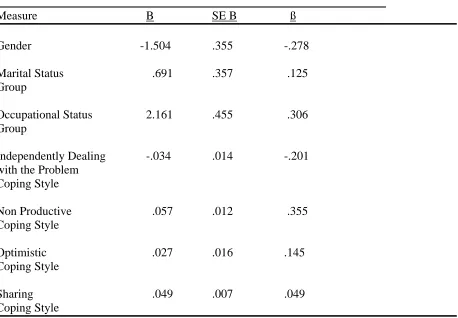
Therefore, in order to test the first hypothesis and identify whether problem gambling (measured by the SOGS) can be predicted by determining a participant’s level of use of different coping styles (measured by the Short Form Coping Scale for Adults). A standard multiple regression analysis (p = .05 for inclusion) was performed, using the aforementioned demographics (gender, marital group and occupational group) and four coping styles (Independently Dealing with the Problem, Non-Productive Coping, Sharing and Optimism) as predictor variables (see Table 1).
Table 1
Summary of Standard Multiple Regression Analysis for Demographic and Coping Style Variables Predicting the South Oaks Gambling Screen Score (n=189)
_________________________________________________________________
Measure B SE B ß
Gender -1.504 .355 -.278
Marital Status .691 .357 .125
Group
Occupational Status 2.161 .455 .306
Group
Independently Dealing -.034 .014 -.201
with the Problem Coping Style
Non Productive .057 .012 .355
Coping Style
Optimistic .027 .016 .145
Coping Style
Sharing .049 .007 .049
It was found that the three demographic variables together with the four coping styles significantly predicted problem gambling as measured by the SOGS, F (7,181)=11.52, p<.001. These seven variables account for almost one third (28.1%) of the total variance in the scores on the SOGS (Adjusted R2=.281).
Analysis of this model showed both gender (t(181) =-4.24, p<.001) and occupational group (t(181) =4.75, p<.001) as independent predictors of problem gambling as measured by the SOGS, revealing that male participants’ tended to obtain higher scores on the SOGS than female participants’, and that participants with an ‘unstructured day’ tended to obtain higher scores on the SOGS than participants who had a ‘structured day’.
Analysis also revealed a tendency for participants ‘without a significant other’ to score higher on the SOGS than participants with a ‘significant other’ (t(181) =1.94, p =.054, ns), but this variable was not found to be a statistically significant independent predictor of problem gambling as measured by the SOGS.
Of the coping styles, it was found that both ‘Independently Dealing with the Problem’ (t(181) =-2.37, p<.05) and ‘Non-productive Coping’ (t(181) =4.84, p<.001) were independent predictors of problem gambling as measured by the SOGS. Lower scores on the ‘Independently Dealing with the Problem’ coping style and higher scores on the ‘Non-productive’ coping style indicated higher scores on the SOGS. However, the ‘Optimistic’ coping style (t(181) =1.67, p>.05, ns) and ‘Sharing’ coping style (t(181) =.71, p>.05, ns) were not found to be significant independent predictors of problem gambling as measured by the SOGS scores.
It was further hypothesised that motivational factors (as measured by G-MAP) significantly add to the prediction of problem gambling (as measured by SOGS) when combined with the information on coping styles and demographic data. To test this hypothesis standard multiple regression analysis (p =.05 for inclusion) was once again performed.
In order to maintain case-to-predictor ratio at a reasonable level, the analysis performed to test this second hypothesis included only the independently significant demographics (gender and occupational group) and coping styles (‘Independently Dealing with the Problem’ and ‘Non-Productive Coping’) from the first model.
It was found that the two significant demographic variables, two significant Coping Style variables together with the five motivational group variables, significantly predicted problem gambling as measured by the SOGS, F(9,179)=22.63, p<.01. These significant demographic variables, significant coping styles, and motivation groups account for over half (50.9%) of the total variance in the scores on the SOGS (Adjusted R2=.509). The summary statistics from this analysis is shown in Table 2.
Table 2
Summary of Standard Multiple Regression Analysis for Demographic, Coping Style and Motivation Variables Predicting the South Oaks Gambling Screen Score (n=189)
_________________________________________________________________
Measure B SE B ß
Gender -.550 .309 -.101
Group
Independently Dealing -.012 .009 -.072 with the Problem
Coping Style
Non Productive .021 .010 .133
Coping Style
Beliefs about Winning .053 .025 .172
Feelings .038 .023 .185
Situations .105 .033 .387
Attitudes .027 .029 .088
Social -.096 .040 -.214
_________________________________________________________________
Analysis of the second model revealed that the demographic variable occupational group (t(179) =2.36, p<.05) was an independent predictor of problem gambling. Gender, however (t(179) =-1.78, p>.05, ns) was not found to be a statistically independent significant variable within this model.
Of the coping styles the ‘Non-productive Style’ (t(179) =2.15, p<.05) was shown to be an independent predictor of problem gambling, while ‘Independently Dealing with the Problem’ (t(179) =-1.32, p>.05, ns) was not. Higher scores on the Non-productive Coping Style predict higher scores on the SOGS.
Examination of the motivational groups revealed that ‘Beliefs about Winning’ (t(179) =2.11, p<.05), ‘Situations’ (t (179) =3.14, p<.01) and ‘Social’ factors (t(179) =-2.41, p<.05) were all independent predictors of Problem Gambling while ‘Feelings’ (t(179) =1.70, p>.05, ns) and ‘Attitudes to Self’ (t(179) =.93, p>.05, ns) were not. Higher scores on the groups ‘Beliefs about Winning’ and ‘Situations’ and lower scores on the group ‘Social’ indicated higher scores on the SOGS.
The increment in the proportion of variance obtained by the removal of nonsignificant demographics and coping styles, and the addition of five motivational groups within the second stage of the model, was found to be significant, F (2,179)=42.84, p<.01.
Discussion
gambling to a model containing information on coping styles, and demographics, would significantly increase the prediction of problem gambling.
The first stage of this prediction model, incorporating coping styles along with gender, marital and occupational status significantly predicted participants level of problem gambling. The model accounted for almost one third of the variance in individuals’ problem gambling scores. These results are in line with the work of Bonin, McCreary and Sadava (2000) as well as McKee, Hinson, Wall and Spriel (1998) who suggest that various coping behaviours significantly predict problem drinking.
The relationship between gender and gambling behaviour supported by the present study is consistant with the work Moore and Ohtsuka (1997) who believe that gender can be used as a reliable predictor of problem gambling. Similarly, research conducted by Bolen and Boyd (1968) and (Lesieur & Blume, 1987) who report marital and employment difficulties as influencing factors of problem gambling, are consistent with the present results.
Analyses of this model revealed that the demographic variables gender and occupational group were statistically significant independent predictors of problem gambling, specifically that male participants’ tended to obtain higher scores on the SOGS than female participants’, and that participants with an ‘unstructured day’ tended to obtain higher scores on the SOGS, than participants who had a ‘structured day’.
Regarding gender, these findings are in line with research by Volberg and Steadman (1988), who conducted research into problem gambling and discovered that 64% of the problem or pathological gamblers within the study population were males. However, the present findings are in contrast to the results from a study conducted by Ohtsuka, Bruton, DeLuca and Borg (1997) who found that females were just as likely as males to be poker machine problem gamblers.
The finding that an ‘unstructured’ daily routine predicted problem gambling (and remained a statistically significant independent predictor of problem gambling in the second stage of the model) lends support to the work of Castellani, Wootton, Rugle, Wedgeworth, Prabucki and Olsen (1996) who also found a link between unstructured daily activities and problem gambling with 50% of the pathological gamblers within their study being unemployed.
Analysis of these results also revealed a tendency for participants ‘without a significant other’ to score higher on the SOGS than participants with a ‘significant other’, but this variable was not found to be a statistically significant independent predictor of problem gambling. Conflicting findings also exist in the literature. Lesieur and Blumes (1987) suggest that separation, divorce and unemployment are related to the onset of problem gambling, while Volberg and Steadman (1988) report that until the onset of problem gambling individuals are mostly regarded as highly employable individuals with stable family lives.
The role of marital status as a predictor of problem gambling is therefore unclear, and remains unresolved in the present study. This question may require further investigation.
However, the ‘Optimistic’ and ‘Sharing’ coping style were not found to be significant independent predictors of problem gambling.
These statistically significant findings for ‘Independently Dealing with the Problem’ and ‘Non-Productive’ coping support results from studies conducted by Castellani, Wootton, Rugle, Wedgeworth, Prabucki and Olsen (1996) that reported lower levels of productive coping in a group of veterans with gambling problems.
Furthermore, these results support the findings of Johnson and Pandina (2000) and Maisto, Connors and Zywiak (2000) which suggest that the more that an individual employs a negative or non productive coping style, the greater the likelihood of the individual becoming a problem drinker.
Regarding the second stage of the proposed prediction model, it was found that the incorporation of motivational factors into a model containing significant demographic variables (gender & occupational group), and significant coping styles (‘Independently Dealing with the Problem’ & ‘Non-Productive’) significantly added to the prediction of participants problem gambling.
This model accounted for over half of the variance in problem gambling scores, lending support to research by Chantel, Vallerand and Vallieres (1995) proposing that motivation is a key determinant of gambling behaviour.
Examination of the motivational groups revealed that ‘Beliefs about Winning’, ‘Situations’ and ‘Social’ factors were all statistically significant independent predictors of problem gambling, while ‘Feelings’ and ‘Attitudes to Self’ were not. Higher scores on the groups ‘Beliefs about Winning’ and ‘Situations’ and lower scores on the group ‘Social’ indicated higher scores on the SOGS.
The finding that ‘Beliefs about Winning’ is a statistically significant predictor of problem gambling supports the work of Moore and Ohtsuka (1999a) who suggest that young problem gamblers beliefs about winning are reliable predictors of problem gambling behaviours. Whitman-Raymond (1988) reported that the majority of problem gamblers within his study had suffered losses prior to the development of their problem gambling behaviour, which is consistent with the fact that ‘Situations’ were found to be a statistically significant independent predictor of problem gambling within the second prediction model.
The significant finding for ‘Social’ factors as a proposed predictor variable within this model, lends support to Dumont and Landouceur (1990) findings that suggest that individuals gamble in order to take part in social activities.
Statistically nonsignificant contribution of the factors ‘Feelings’ was contrary to Anderson and Brown’s (1987) and McCormick’s (1987) assertions that feelings while gambling are important influencing factors in the development of problem gambling behaviours, with many individuals gambling because of the good feelings and euphoria they experience during play.
Of the nine variables included within this second stage of the model, the only demographic variable found to be a statistically significant independent predictor of problem gambling was ‘Occupational Group’, with this result continuing to support the findings of Castellani, Wootton, Rugle, Wedgeworth, Prabucki and Olsen (1996) as mentioned earlier.
However, as mentioned earlier ‘Gender’ was no longer found to be a statistically significant independent predictor of problem gambling after applying the second stage of the prediction model. The literature is also inconclusive on the gender issue. It is difficult to compare previous findings with those of the present study as the former did not combine coping styles and multiple motivational factors along with these demographic details. Overall it seems more likely that factors other than gender are responsible for predicting problem gambling behaviour and that gender may act as a surrogate when certain motivational factors are not accounted for. That is, the problem gambling may be due to the effect that gender has on motivational, or other interrelated variables rather than gender per se.
Also, regarding the coping styles within the second stage of the model, ‘Non-productive’ coping style was shown to be an independent predictor of problem gambling, while ‘Independently Dealing with the Problem’ was not. Higher scores on the ‘Non-productive Coping Style’ indicated higher scores on the SOGS.
The significant result obtained by the ‘Non-Productive’ coping style remained in line with studies such as Johnson and Pandina (2000) and Maisto, Connors and Zywiak (2000), but the altered finding of the ‘Independently Dealing with the Problem’ coping style in the second stage of the model fails to support to the findings of the previously mentioned study by Castellani, Wootton, Rugle, Wedgeworth, Prabucki and Olsen (1996).
The results obtained within the present study are of particular interest as this is the first time that the effect of specific demographics, coping styles and multiple motivational groups have been treated as complementary variables and have been explored within the one model.
Finally, the increment in the proportion of variance obtained by the removal of insignificant demographic variables and coping styles and the addition of five motivational groups within the second stage of the model, was found be statistically significant. This statistically significant increment in the proportion of variance between the first and second model supports the use of the second model (which combines motivational factors with coping styles and demographics), over the first model (containing coping styles and demographics alone).
There are however several limitations to this study. Firstly, the data collected for this study did not evenly represent poker machine gamblers throughout Victoria. The researcher attempted to survey patrons from all areas of Victoria, with venues in the Western, Eastern, Southern and Northern suburbs being visited, but due to time constraints and the limited availability of participants, many rural areas remained under represented. Therefore, caution should be taken before generalising about the results of this study to include all Victorians, and further research should be conducted with special attention being directed towards venues and patrons within rural Victoria.
consistency for both coping styles are relatively low. Therefore, further research may benefit from the use of the Long Form of the Coping Scale for Adults (Frydenberg & Lewis, 1997) to minimise measurement error.
Regardless of its limitations however, the results of this study highlight the importance of considering demographics, coping styles and motivational factors when trying to detect gambling problems. In particular, these results have shown that demographic details such as ‘Gender’, ‘Occupational’ and ‘Marital’ status; coping styles such as ‘Non-Productive’ and ‘Independently Dealing with the Problem’; and motivational factors such as ‘Beliefs about Winning’, ‘Situations’ and ‘Social’ are useful predictors of problem gambling.
References
Anderson, G., & Brown, R.I.F. (1987). Some applications of reversal theory to the explanation of gambling and gambling addictions. Journal of Gambling Behavior, 3,179-189.
Blaszczynski, A., Hyde, J., & Sandanam, J. (1991). Pathological gambling secondary to brain trauma. Journal of Gambling Studies, 7, 65-71.
Blaszczynski, A., McConaghy, N., & Frankova, A. (1990). Boredom proneness in pathological gambling. Psychological Reports, 67, 35-42.
Blaszczynski, A., Wilson, A.C., & McConaghy, N. (1986). Sensation seeking and pathological gambling. British Journal of Addiction, 81, 113-117.
Blaszczynski, A.P., Winter, S.W., & McConaghy, N. (1986). Plasma endorphin levels in pathological gambling. Journal of Gambling Behavior, 2, 3-14.
Blume, S. (1987). Compulsive gambling and the medical model. Journal of Gambling Behavior, 3, 237-247.
Bolen, D.W., & Boyd, W. (1968). Gambling and the gambler: A review and preliminary findings. Archives of General Psychiatry, 18, 617-630.
Bonin, M.F., McCreary, D.R., & Sadava, S.W. (2000). Problem drinking behavior in two community based samples of adults: Influence of gender, coping, loneliness, and depression . Psychology of Addictive Behaviors, 14, 151-161.
Brown, R.I.F. (1986). Arousal and sensation-seeking components in the general explanation of gambling and gambling addictions. The International Journal of Addictions, 21, 1001-1016.
Browne, B.R. (1989). Going on tilt: Frequent poker players and control. Journal of Gambling Behavior, 5, 3-21.
Carver, C.S., & Scheier, M.F. (1994). Situational coping and coping dispositions in stressful transaction. Journal of Personality and Social Psychology, 66, 184-195.
Castellani, B., & Rugle, L. (1995). A comparison of pathological gamblers to alcoholics and cocaine misusers on impulsivity, sensation seeking, and craving. International Journal of Addictions, 30 (3), 275-289.
Castellani, B., Wootton, E., Rugle, L., Wedgeworth, R., Prabucki, K., & Olson, R. (1996). Homelessness, negative affect, and coping among veterans with gambling problems who misused substances. Psychiatric Services, 47, 298-299.
Chantal, Y., Vallerand, R.J., & Vallieres, E.F. (1995). Motivation and gambling involvement. Journal of Social Psychology, 135, 755-763.
Dickerson, M.G., & Adcock, S. (1987). Mood, arousal and cognitions in persistent gambling: Preliminary investigation of a theoretical model. Journal of Gambling Behaviour, 3, 3-15.
Dickerson, M., Hinchy, J., England, S.L., Fabre, J., & Cunningham, R. (1992). On the determinants of persistent gambling behavior. I. High-frequency poker machine players. British Journal of Psychology, 83, 237-248.
Dumont, M., & Ladouceur, R. (1990). Evaluation of motivation among video players. Psychological Reports, 66, 95-98.
Frydenberg, E. & Lewis, R. (1994). Coping with different concerns: Consistency and variation in coping strategies used by adolescents. Australian Psychologist, 29, 45-48.
Frydenberg, E., & Lewis, R. (1997). Coping scale for adults: Administrator’s manual, research edition. Melbourne, Victoria: Australian Council for Educational Research.
Gambino, B., Fitzgerald, R., Shaffer, H., Rennerand, J., & Courtnage, P. (1993). Perceived family history of problem gambling and scores on SOGS. Journal of Gambling Studies, 9, 169-184.
Graham, J. R., & Lowenfeld, B. H. (1986). Personality dimensions of the pathological gambler. Journal of Gambling Behavior, 2, 58-67.
Haustein, J., & Schurgers, G. (1992). Therapy with male pathological gamblers: Between self help group and group therapy: Report of a developmental process. Journal of Gambling Studies, 8, 131-142.
Jacobs, D. F. (1986). A general theory of addictions: A new theoretical model. Journal of Gambling Behaviour, 2, 15-31.
Johnson, V., & Pandina, R.J. (2000). Alcohol problems among a community sample: Longitudinal influences of stress, coping, and gender. Substance Use & Misuse, 35, 669-686.
King, K.M. (1990). Neutralizing marginally deviant behavior: Bingo players and superstition. Journal of Gambling Studies, 6 (1), 43-61.
Lesieur, H.R., & Blume, S. (1987). The South Oaks Gambling Screen (SOGS): A new instrument for the identification of pathological gamblers. American Journal of Psychiatry, 144, 1184-1188.
Lesieur, H.R., & Blume, S. (1993). Revising the South Oaks Gambling Screen in different settings. Journal of Gambling Studies, 9 (3), 213-223.
Loughnan, T., Pierce, M., & Sagris-Desmond, A. (1996). G-MAP clinical tool and potential research instrument. Presented at the 7th Annual conference of the National Association of Gambling Studies, Adelaide.
Loughnan, T., Pierce, M., & Sagris-Desmond, A. (1999). G-MAP: The maroondah assessment profile for problem gambling, administrator’s manual. Melbourne, Victoria: Adult Council for Education and Research.
Maisto, S.A., Connors, G.J., & Zywiak, W.H. (2000). Alcohol treatment, changes in coping skills, self-efficacy, and levels of alcohol use and related problems 1 year following treatment initiation. Psychology of Addictive Behaviours, 14, 257-266.
McCormick, R.A. (1987). Pathological gambling. A parsimonious need state model. Journal of Gambling Behavior, 3, 257-263.
McKee, S.A., Hinson, R.E., Wall, A.M., & Spriel, P. (1998). Alcohol outcome expectancies and coping styles as predictors of alcohol use in young adults. Addictive Behaviors, 23, 17-22.
Moore, S.M., & Ohtsuka, K. (1997). Gambling activities of young Australians: Developing a model of behaviour. Journal of Gambling Studies, 13, 207-236.
Moore, S.M., & Ohtsuka, K. (1999a). Beliefs about control over gambling among young people, and their relation to problem gambling. Psychology of Addictive Behaviors, 13, 339-347.
Moore, S.M., & Ohtsuka, K. (1999b). The prediction of gambling behaviour and problem gambling from attitudes and perceived norms. Social Behavior and Personality, 27, 455-466.
Ohtsuka, K., Bruton, E., DeLuca, L., & Borg, V. (1997). Sex differences in pathological gambling using gaming machines. Psychological Reports, 80, 1051-1057.
Orford, J., Morison, V., & Somers, M. (1996). Drinking and Gambling: A comparison with implications for theories of addiction. Drug and Alcohol Review, 15, 47-56.
Taber, J.I. (1985). Pathological gambling: The initial screening interview. Journal of gambling behavior, 1, 23-34.
Taber, J.I., McCormick, R.A., & Ramirez, L.F. (1987). The prevalence and impact of major life stressors among pathological gamblers. International Journal of Addictions, 22, 71-79.
Volberg, R.A., & Steadman, H.J. (1988). Refining prevalence estimates of pathological gambling. American Journal of Psychiatry, 145 (4), 502-505.