759 CONTROLLING THE PERFORMANCE OF MDPSK IN BAD SCATTERING CHANNELS
Arafat Zaidan1 Basim Alsayid2
ABSTRACT
This paper describes a modification of the conventional M-ary Differential Phase Shift Keying MDPSK scheme. This method reduces the number of phases which improves the performance of the system by applying a mathematical method from the combinatorial theory called Balanced
Incomplete Block Design BIB-design. It is a coding modulation technique in which the signal is represented by a set of phases selected and controlled by the encoder. Each block is transmitted
serially or in parallel with equal energy.
Key Words:MDBSK; Nakagami-m; Bad scattering channels; BIB-design.
INTRODUCTION
Physical limitations on wireless channels present a fundamental technical challenge to reliable
communications. Bandwidth limitations, propagation loss, noise, interference, and multi-path fading make the wireless channel a narrow pipe that does not readily accommodate rapid flow of data. Transmit diversity schemes use processing at the transmitter to spread information across the
antennas.
BIB design is a collection of b blocks, formed by the arrangement of v distinct elements, satisfying the following conditions (Bose and Manvel, 1986): each block contains w elements, each element
occurs in r blocks and each pair of elements occurs together in λ blocks. This arrangement of element is called a BIB design with parameters (v, b, r, w, λ). There are two basic relations among
these parameters,
vr
bw (1)
1 College of Engineering and Technology Palestine Technical University, Palestine 2 College of Engineering and Technology Palestine Technical University, Palestine
Journal of Asian Scientific Research
760
v1
rw1
(2)
The number of blocks and the number of repetitions of a particular element are given by
1
1
w w
v v
b (3)
1 1
w v
r (4)
A special case of BIB design when λ = 1, it is called Steiner systems, Sw
v,k , where k is thenumber of bits per symbol. Only some values of v and w are possible to insure integer numbers of b
and r where v must be
1
mod
w ww
v (5)
The BIB-MDPSK is an arrangement of v phases into b waveforms, each waveform contains w
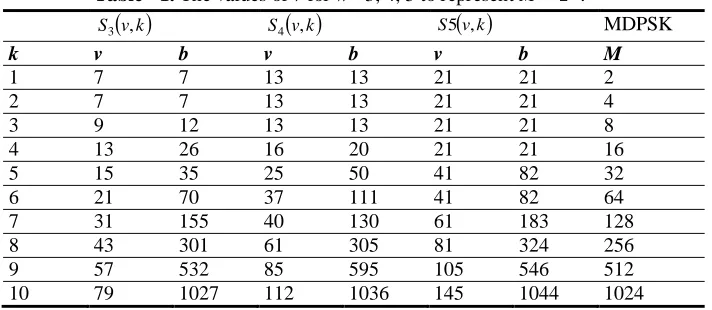
distinct phases. Every single phase in a waveform can be used in the transmission of r different waveforms, and every pair of phases occurs in λ waveforms. (Bose and Manvel, 1984), Table 1 shows the admissible values of v for different w, required to represent M=2k waveforms for
BIB-MDPSK. A comparison between these values to these required by conventional MDPSK modulation is illustrated. (Mobbaiden, 2000)
From this table, it is clear that BIB-MDPSK have some advantages rather than MDPSK such as the lower number of phases v than M which will improve the BER. Also, increasing the distance
between the elements will also make good improvements.
Table - 1. The values of v for w =3, 4, 5 to represent M=2k .
vkS3 , S4
v,k S5
v,k MDPSKk v b v b v b M
1 7 7 13 13 21 21 2
2 7 7 13 13 21 21 4
3 9 12 13 13 21 21 8
4 13 26 16 20 21 21 16
5 15 35 25 50 41 82 32
6 21 70 37 111 41 82 64
7 31 155 40 130 61 183 128
8 43 301 61 305 81 324 256
9 57 532 85 595 105 546 512
10 79 1027 112 1036 145 1044 1024
This paper studies the performance and determine the advantages and limitations of diversity
applied to a modulation/coding scheme using MDPSK signals. This modulation/coding scheme is referred to as BIB-MDPSK, and is implemented based on balanced incomplete block design
761 paper is organized as follows: in Section 2, we present the system model. The probability of error is
introduced in Section 3, and the channel model is presented in Section 4, then the numerical results are compared with conventional MDPSK and presented in Section 5. Finally, Section 6 presents the conclusions of our study.
SYSTEM MODEL
Figure- 1. Block diagram of BIB-MDPSK transmitter
Figure 1 shows the transmitter block diagram. The transmitter selects, according to the input data, a block of w elements from the Sw
v,k . Then, the v-DPSK modulator divides equally its energy intothe signal corresponding to the elements forming the selected block, transmitting a signal consists of w phases, each of them corresponds to a certain element of the input block. (Atkin and Corrals, 1989) The transmitted output signal xi
t is
w k t f j w iit uk t kT e c
x 1 2 (6) where: -w T T s
w (7)
- w is the number of phases to represent the ith signal. - fc is the carrier frequency
- uikis the k
th
phase transmitted in the ith signal
The signal xi
t is to be send over multi-path frequency non-selective Nakagami-m fading channelswith impulse response.
j
e
c (8)
The received signal for the L channel is
w k l i t f j j l w i l k c lk t kT e e z
u t r 1 , 2
(9)
where zik,l is the AWGN associated with the k
th
phase on the ith signal over the lth channel.
The receiver will consist of L branches, each of them consists of a matched filter (matched to fc)
and a differential detector. After that, all the branches are summed, before inserted to a phase
detector to get the estimated transmitted block Bˆithen, the block design decoder recovers the data
Block
Selector
vkSw ,
v-DPSK
Modulator
762 stream back. The block diagram of the transmitted MDPSK based on BIB design receiver is shown
in Fig. 2
Figure -2.Block diagram of BIB-MDPSK receiver
PROBABILITY OF EROR
Probability of error calculations To insure that the signal is correct, all the w phases in the block must be correct, so, (Papoulis, 2002)
i1 scorrect i2iscorrect iwiscorrect
c P i
P (10)
The probability that ij is correct is:
iscorrect
P
ij ijis transmitted
Pij ij (11)
substituting equation (11) in equation (10), we have
iw iw i2 i2 2 i1 i1 1 iw i i c P P (12)because all the decisions are independent, we can write equation (12) as:
wi
c P
P 1i1i1 (13)
The probability of error is The probability that one chip of the block is in error can be treated as the ordinary probability of error calculation for the conventional MDPSK given in equation (14)
v i o i i r be P r R
K W P
1
, (14)
Phase Detector BIB Detector + tfj ce 2 c f j e 2
w T dt 0 . Tw x + tfj ce 2 c f j e 2Tw x Correlator2 Correlator 1 + tfj ce 2 c f j e 2
Tw x
CorrelatorL
+
763 FADING CHANNEL MODEL
When we transmit a signal over a radio channel, it travels over multi-path channels. Each path is a time varying random process. The large number of paths make it possible to represent the channel
impulse response as a complex valued Gaussian random process according to the central limit theorem. If the impulse response has zero mean, the envelope of the channel response at any time
has a Rayleigh probability density function (PDF) and a uniformly distributed phase over the interval
0,2
(Proakis, 1995). But if the impulse response in no longer with zero mean,Nakagami-m distribution is presented as a statistical model for the envelope of the channel
response. The PDF of Nakagami-m is (Proakis, 1995).
2 2 1 2/ , 0
m e m
m
f (15)
where: is the absolute value of the impulse response. is the mean square of
. is the gamma functionm0.5 is the fading parameter
Nakagami-m distribution is the most general case that fits the practical measurements of the envelope of the channel impulse response. Special cases of Nakagami-m distribution is when m =
0.5 and m = 1 which represent a one-sided Gaussian distribution and Rayleigh distribution respectively. Also, under certain conditions, Rician and log-normal distributions may be obtained
from Nakagami-m distribution.
RESULT AND DISCUSSION
Figure 2 shows the microstructure of SS440C steel in (a) as-received and (b) as-quenched steel.
The as-received sample had been treated through the annealing process at 1040oC. This treatment results in the formation of ferrite matrix and carbide particles. In this section, We’ll show that
BIB-vDPSK has some improvements compared with the conventional MDPSK. When using Ks= 10, we
have 1024 phases per symbol in conventional MDPSK and 79, 112 and 145 phases in BIB-MDPSK for w = 3, 4 and 5 respectively. So, we expect improvement because there are reduction in phase
numbers. There are many factors that affect the performance of the system when transmitting in a wireless channel. In case of Nakagami-m channel, the fading factor m is one of the most effective factors. In Fig. 3, a comparison between MDPSk and BIB-vDPSK has been shown for different
values of fading parameter. It is clear that all of the BIB design cases are much better than MDPSK specially when w = 3. This is because the system will treat the BIB design model as a 79-DPSK
764 Figure-3.BIB-vDPSK vs. MDPSK for different fadings.
In Fig. 4, we did the same plotting but for different diversity levels of the multi-path channel. We tested the system for a single bath and 3 paths. It has been shown the diversity gave enhancement
in the behavior, and BIB-vDPSK still better that MDPSK.
Figure -4.BIB-vDPSK vs. MDPSK for different diversities
The same thing is done in Fig. 5, but for different correlation values. Correlation factor gives an idea about the multi-path channels to know how much the different paths are correlated to each other. Correlation values are the element for the covariance matrix of the channel.
765 CONCLUSION
Balanced incomplete block design is studied and applied to the MDPSK modulation to form an important modulation/coding technique, which improve the performance of the MDPSK
modulation by reducing the bit error rate by reducing the number of transmitted phases. This modulation/coding technique have been studied over Nakagami-m fading channels, and its
performance is better than the conventional MDPSK with less complexity.
ACKNOLEDGMENT
Authors would like to thank Palestine Technical University for sponsoring this work.
REFERENCES
Atkin, G. and H. Corrals, 1989. An efficient modulation/coding scheme for mfsk system on bandwidth constrained channels. IEEE J. on Selected Areas in Comm., 17(9).
Bose, R. and B. Manvel, 1984. Combinatorial theory. New York: John Willy and Sons.
Bose, R. and B. Manvel, 1986. Introduction to combinatorial theory. New York: John Willy and Sons.
Mobbaiden, A., 2000. Combined coding modulation scheme for multiple carrier phase shift keying signals: Performance evaluation and applications. Jordan Univ. for Science and Tech. Papoulis, A., 2002. Probability, random variables and stochastic processes. Mcgraw hill. 4 Edn.