International Journal in Commerce, IT and Social Sciences
Volume 5 Issue 07, July 2018 ISSN: 2394-5702 Impact Factor: 4.218
Journal Homepage: http://ijmr.net.in, Email: [email protected] Double-Blind Peer Reviewed Refereed Open Access International Journal
72
International Journal in Commerce, IT and Social Sciences http://ijmr.net.in, Email: [email protected]TRAINING AND DEVELOPMENT AS STRATEGIC HR FUNCTION: A STUDY OF HR
EXECUTIVES
Mr. Surender Jeet Raj
Senior V.P. HR, Newgen Software Technologies, New Delhi
Dr. Manoj K.Sharma
Professor, University Business School, Panjab University, Chandigarh
ABSTRACT
Training and development is an integral part of HR function in the changing business environment.
!6 items scale has been formulated in the present study which has been tested for its reliability. The
technique of factor analysis has been used to identify important items of T&D and chi square test
applied to examine if there exists any association between age, experience and designation of 302
HR executives from whom the information was collected
Economists have viewed training and employee development as a means of engaging the
commitment of employees to the enterprise (Rainbird, 1994; Heyes and Stuart,1996)
Reynolds (2004) points out , training has a complementary role to play in accelerating the
Learning. It should be reserved for situation that justify a more directed , expert led approach rather
than viewing it as a comprehensive and all pervasive people development.
In the dynamic world of business, the objectives keep on changing which calls for proper
identification of learning needs of workforce. Then proper planned training programs need to be
established. In this what techniques are to be used what facilities are to be provided and at which
location .The in house training or help of outside trainer is required are to be identified by HR.
There has to proper implementation of the training programme and then its proper evaluation is
required by HR.
The training and development needs of any organisation needs following steps
Define learning objectives
Decide on Content
Decide on methods of delivery
Establish Training needs
The role of training and development in increasing the competitive advantage as compared to
others is well documented. The employee quality of a particular organization is bound to give it
International Journal in Commerce, IT and Social Sciences
Volume 5 Issue 07, July 2018 ISSN: 2394-5702 Impact Factor: 4.218
Journal Homepage: http://ijmr.net.in, Email: [email protected] Double-Blind Peer Reviewed Refereed Open Access International Journal
73
International Journal in Commerce, IT and Social Sciences http://ijmr.net.in, Email: [email protected] customer requirement. Training‟s role has broadened from its traditional focus on teaching skillsand knowledge, to linking training to business needs, and to using training to create and share
knowledge. Core competency of a firm can be preserved via investment in Training and
development. Boxall and Purcell suggest that „Human Resource planning can be traced back to
better people employed in the organizations with better processes‟
The best form of a firm‟s assets are skills set and they could not be easily replicated by the
competitors but as environment and technology changes , they need constant upgrading for training
to be source of competitive advantage, because competitive advantage in the basis of market
responsiveness , product and service quality, differentiation products and technological innovation.
Training improves the performance of employees, which in turn improves the firm‟s financial
performance. Another paper titled Three Strategic training roles authored by Ralph Catanello and
John Redding, there is a lack of link between training and strategy and to drive proper performance
training should be linked to a company‟s strategic business plan.
We can make the training and development count as a strategic HR tool by the following ways.
Look for improvement in scores on your Employee Perception Survey against leadership related
questions. This is a direct indicator of a positive change of your leadership program.
If you are able to identify successors for leadership position, it is true reflection of improved
leadership programs.
A thorough analysis, clear cut objectives, well-though out design, robust assessment and a
seasoned facilitator can contribute to an effective training intervention.
For face to face training observe the reaction of the participants through the responses to various
exercises done in class and or tests administered in class, or his behavioural changes.
Conduct small exercises at work, which show the impact of learning through implementation and
results, which would reflect on the score card /Goal sheet.
Training and development play an important role in the effectiveness of organisations and to the
experiences of people in work. Training has implications for productivity, health and safety at
work and personal development. All organisations employing people need to train and develop
their staff. Most organisations are cognisant of this requirement and invest effort and other
resources in training and development. Such investment can take the form of employing specialist
training and development staff and paying salaries to staff undergoing training and development.
Investment in training and development entails obtaining and maintaining space and equipment. It
also means that operational personnel, employed in the organisation‟s main business functions,
such as production, maintenance, sales, marketing and management support, must also direct their
attention and effort from time to time towards supporting training development and delivery. This
International Journal in Commerce, IT and Social Sciences
Volume 5 Issue 07, July 2018 ISSN: 2394-5702 Impact Factor: 4.218
Journal Homepage: http://ijmr.net.in, Email: [email protected] Double-Blind Peer Reviewed Refereed Open Access International Journal
74
International Journal in Commerce, IT and Social Sciences http://ijmr.net.in, Email: [email protected] terms of the organisation‟s main business. However, investment in training and development isgenerally regarded as good management practice to maintain appropriate expertise now and in the
future. (Dr. Andrew Shepherd)
The purpose of training and management development programs is to improve employee
capabilities and organizational capabilities. When the organization invests in improving the
knowledge and skills of its employees, the investment is returned in the form of more productive
and effective employees. Training and development programs may be focused on individual
performance or team performance. The creation and implementation of training and management
development programs should be based on training and management development needs identified
by a training needs analysis so that the time and money invested in training and management
development is linked to the mission or core business of the organization (Watad & Ospina, 1999).
Employees at different stages of life need different kinds of training and different kinds of
development experiences. Although a business degree might prepare students for their first job,
they will need to gain knowledge and skills through education and experience as they progress
through their career.
Impact of training and development on performance can be seen from various studies. Hitt, R
(2001) found that training investment first generates a negative effect on results, which later
becomes positive as far as the transfer of knowledge to the post is concerned. Kock and Mc Grath
(1996) does not directly analyse the relationship of training with performance, instead it uses a
personnel development index that showed a slightly significant effect on work productivity
measures by net sales per employee. Ubeda, G. (2005) finds a significant relationship with the
productivity, which accounts for an average period of maturation of the higher training investment.
In some studies such as Tzafrirs (2005), it is assumed that the investment in the training can
produce some negative effects: Example, cost on company, employer does not achieve a reciprocal
commitment on the part of the employee.
Training and development programmes have faced various Challenges, as Phillips J.J and Pulliam
P.F (1997) in the article on “The seven key Challenges facing Training and Development” states.
The Training & Development is crucial aspect of HR for any organisation but HR has to develop it
a key tool for its success and which can make HR as key strategic partner in business. This can be
achieved by HR team ensure that training and development are in improving performance of
employees in particular by giving proper training and conducive work environment for employees
to show good results. It is HR function which has to fix business and people related problems and
by making organisation versatile. This can be achieved by HR staff involvement in measurement
International Journal in Commerce, IT and Social Sciences
Volume 5 Issue 07, July 2018 ISSN: 2394-5702 Impact Factor: 4.218
Journal Homepage: http://ijmr.net.in, Email: [email protected] Double-Blind Peer Reviewed Refereed Open Access International Journal
75
International Journal in Commerce, IT and Social Sciences http://ijmr.net.in, Email: [email protected] The proper Training and Development courses are to be developed and designed by HR keeping inview the individual employees needs and they have to be in consonance with organisational or
business needs of the company. This in turn will ensure proper synergy between the employees and
employer. The short term courses which are to be properly designed to educate and improve the
knowledge of the employees as well skill enhancements and attitude building and changing soft
skills needs to be designed by strategic HR business partner only. HR needs to evolve regular
training needs for all business stake holders like vendor‟s development, suppliers training and
development needs. The impact of training initiative of HR function needs to properly evaluated.
On many fronts the evaluation by the participants themselves at the end of the program is one way
of evaluation, while formal evaluation through examination /tests after the program is other
methods of evaluating the training and development program.
HR function has to oversee that training and development contents are aligned with the broad
business strategies. Moreover, it is pertinent that employees are often held responsible for their
own learning and development. It is often seen that branch heads/ managers are held accountable
for their subordinates learning & development needs and requirements, which in turn are to be
monitored by HR function only.
OBJECTIVES AND METHODOLOGY OF THE STUDY
1. To identify the important components of training and development schemes to make T&D as a
Strategic HR function.
2. To study if any association exists between age, Experience and Designation of HR executives
and various T&D program as Strategic HR function.
The present study is primarily based on field survey and data collected through structures
questionnaire based on 18 items scale, based on qualitative interaction done with 50 practionnaire
HR professionals. In all 302 respondents data was analysed .The reliability test was done and
Cronbach's Alpha came out to be .863 for all the 16 items, which is sufficient. The details of all
selected 16 items are given in Table 1. The technique of factor analysis was used to derive
important factors of T&D. The chi square test was applied to test if any association exists between
various items of T&D and Age, Experience and Designation of HR executives. The data was
International Journal in Commerce, IT and Social Sciences
Volume 5 Issue 07, July 2018 ISSN: 2394-5702 Impact Factor: 4.218
Journal Homepage: http://ijmr.net.in, Email: [email protected] Double-Blind Peer Reviewed Refereed Open Access International Journal
76
International Journal in Commerce, IT and Social Sciences http://ijmr.net.in, Email: [email protected]Table 1 Details of 16 items of T&D
Training & Development(T&D)
T&D_1A HR team ensures that T&D Program are effective in Improving Performance
T&D_1B Performance improvement can be done by fixing business and people related
problems by undertaking T&D Program.
T&D_1C Performance improvement can be done by making organization versatile by
undertaking T&D Program
T&D_2 The HR staff involvement in measurement and evaluation is done by staff
members trained for the job.
T&D_3A The Training and Development program consists of courses designed to meet
individual needs.
T&D_3B The Training and Development program consists of courses designed to meet
business needs.
T&D_3C The Training and Development program consists of courses designed are usually
shot seminar type.
T&D_3D The Training and Development program consists of courses designed to educate
and improve knowledge/skills/attitude.
T&D_3E The Training and Development program consists of courses designed
vendor/partner training
T&D_4A The Impact of Training & Development initiative is evaluated Sometimes but not
always.
T&D_4B The Impact of Training & Development initiative are evaluated by
participants at the end of the program
T&D_4C The Impact of Training & Development initiative are evaluated
Testing/Examination during/after the program
T&D_4D The Impact of Training & Development initiative are evaluated
Post course assessment or business results
T&D_5 Training and Development activities are aligned with business strategies.
T&D_6 Employees are held responsible for their own learning and development.
T&D_7 Managers are held accountable for their subordinates learning and development
International Journal in Commerce, IT and Social Sciences
Volume 5 Issue 07, July 2018 ISSN: 2394-5702 Impact Factor: 4.218
Journal Homepage: http://ijmr.net.in, Email: [email protected] Double-Blind Peer Reviewed Refereed Open Access International Journal
77
International Journal in Commerce, IT and Social Sciences http://ijmr.net.in, Email: [email protected]Table 2 Scale: ALL VARIABLES OF TD
Case Processing Summary
N %
Cases
Valid 302 100.0
Excludeda 0 .0
Total 302 100.0
a. List wise deletion based on all variables in
the procedure.
Table 3
Reliability Statistics
Cronbach's
Alpha
N of Items
.863 16
RESULTS AND ANALYSIS
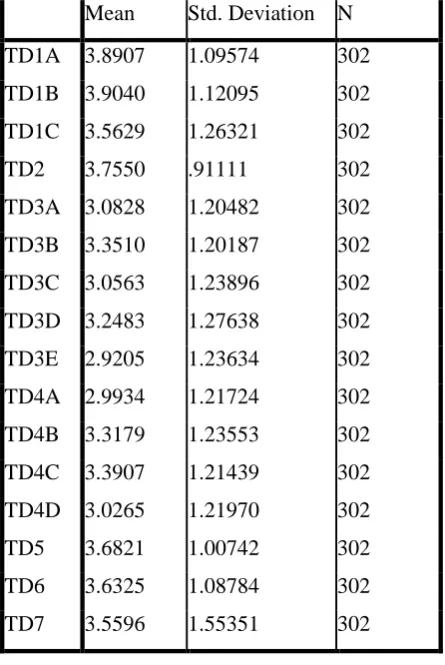
Table 4 Descriptive Statistics of T&D items Item Statistics
Mean Std. Deviation N
TD1A 3.8907 1.09574 302
TD1B 3.9040 1.12095 302
TD1C 3.5629 1.26321 302
TD2 3.7550 .91111 302
TD3A 3.0828 1.20482 302
TD3B 3.3510 1.20187 302
TD3C 3.0563 1.23896 302
TD3D 3.2483 1.27638 302
TD3E 2.9205 1.23634 302
TD4A 2.9934 1.21724 302
TD4B 3.3179 1.23553 302
TD4C 3.3907 1.21439 302
TD4D 3.0265 1.21970 302
TD5 3.6821 1.00742 302
TD6 3.6325 1.08784 302
International Journal in Commerce, IT and Social Sciences
Volume 5 Issue 07, July 2018 ISSN: 2394-5702 Impact Factor: 4.218
Journal Homepage: http://ijmr.net.in, Email: [email protected] Double-Blind Peer Reviewed Refereed Open Access International Journal
78
International Journal in Commerce, IT and Social Sciences http://ijmr.net.in, Email: [email protected] From the Table 4 it is very clear all the 16 items pertaining to t &D are considered very importantby the HR executives, as the values of all 16 items are 3 and above. This means executives agree to
the fact that T&D should be important and integral part of HR function in promoting T&D
activities of the employee‟s fir long term success of the organizations.
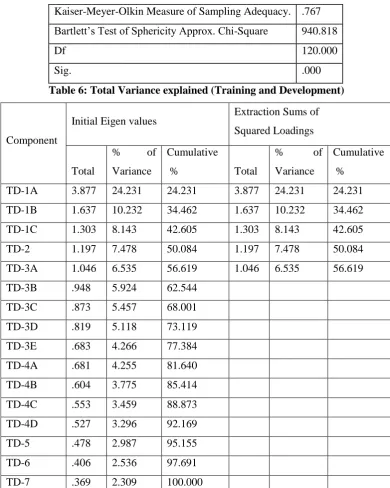
Table 5 shows the KMO measure of sampling adequacy is 0.767 which is a good measure
indicating adequacy of sample for conducting factor analysis. The chi square value is 940.818 with
significance value of 0.000 which again shows goodness of fit.
Table 5 KMO and Bartlett’s Test
Kaiser-Meyer-Olkin Measure of Sampling Adequacy. .767
Bartlett‟s Test of Sphericity Approx. Chi-Square 940.818
Df 120.000
Sig. .000
Table 6: Total Variance explained (Training and Development)
Component
Initial Eigen values Extraction Sums of
Squared Loadings
Total
% of
Variance
Cumulative
% Total
% of
Variance
Cumulative
%
TD-1A 3.877 24.231 24.231 3.877 24.231 24.231
TD-1B 1.637 10.232 34.462 1.637 10.232 34.462
TD-1C 1.303 8.143 42.605 1.303 8.143 42.605
TD-2 1.197 7.478 50.084 1.197 7.478 50.084
TD-3A 1.046 6.535 56.619 1.046 6.535 56.619
TD-3B .948 5.924 62.544
TD-3C .873 5.457 68.001
TD-3D .819 5.118 73.119
TD-3E .683 4.266 77.384
TD-4A .681 4.255 81.640
TD-4B .604 3.775 85.414
TD-4C .553 3.459 88.873
TD-4D .527 3.296 92.169
TD-5 .478 2.987 95.155
TD-6 .406 2.536 97.691
TD-7 .369 2.309 100.000
International Journal in Commerce, IT and Social Sciences
Volume 5 Issue 07, July 2018 ISSN: 2394-5702 Impact Factor: 4.218
Journal Homepage: http://ijmr.net.in, Email: [email protected] Double-Blind Peer Reviewed Refereed Open Access International Journal
79
International Journal in Commerce, IT and Social Sciences http://ijmr.net.in, Email: [email protected] Table 6 shows the total variance explained by five factors, i.e., 56.619%. The table also shows thatfactor 1 explains 24.231% variance and factor 2 explains 10.232% variance, factor 3 explains
8.143% variance, factor 4 explains 7.478% variance and factor 5 explains 6.535% variance.
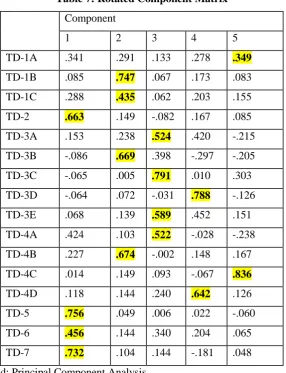
According to table 18 which is the rotated component matrix, five factors have been extracted
which are as follows:
Factor 1: TD-2, TD-5, TD-6, TD-7
Factor2TD-1B,TD-1C,TD-3BTD-4B
F3: TD-3A, TD-3C, TD-3E, TD-4A
F4: TD-3D, TD-4D
F5: TD-1A, TD-4C
Table 7: Rotated Component Matrix
Component
1 2 3 4 5
TD-1A .341 .291 .133 .278 .349
TD-1B .085 .747 .067 .173 .083
TD-1C .288 .435 .062 .203 .155
TD-2 .663 .149 -.082 .167 .085
TD-3A .153 .238 .524 .420 -.215
TD-3B -.086 .669 .398 -.297 -.205
TD-3C -.065 .005 .791 .010 .303
TD-3D -.064 .072 -.031 .788 -.126
TD-3E .068 .139 .589 .452 .151
TD-4A .424 .103 .522 -.028 -.238
TD-4B .227 .674 -.002 .148 .167
TD-4C .014 .149 .093 -.067 .836
TD-4D .118 .144 .240 .642 .126
TD-5 .756 .049 .006 .022 -.060
TD-6 .456 .144 .340 .204 .065
TD-7 .732 .104 .144 -.181 .048
Extraction Method: Principal Component Analysis.
Rotation Method: Varimax with Kaiser Normalization.
International Journal in Commerce, IT and Social Sciences
Volume 5 Issue 07, July 2018 ISSN: 2394-5702 Impact Factor: 4.218
Journal Homepage: http://ijmr.net.in, Email: [email protected] Double-Blind Peer Reviewed Refereed Open Access International Journal
80
International Journal in Commerce, IT and Social Sciences http://ijmr.net.in, Email: [email protected] Factor 1: TD-2 (The HR staff involvement in measurement and evaluation is done by staffmembers trained for the job), TD-5 (Training and Development activities are aligned with business
strategies), TD-6 (Employees are held responsible for their own learning and development), TD-7
(Managers are held accountable for their subordinates learning and development progress)
Factor 2: TD-1B (Performance improvement can be done by fixing business and people related
problems by undertaking T&D Program), TB-1C (Performance improvement can be done by
making organization versatile by undertaking T&D Program), TD-3B (The Training and
Development program consists of courses designed to meet business needs), TD-4B (The Impact
of Training & Development initiative are evaluated by participants at the end of the program)
Factor 3: TD-3A (The Training and Development program consists of courses designed to meet
individual needs), TD-3C (The Training and Development program consists of courses designed
are usually shot seminar type), TD-3E (The Training and Development program consists of courses
designed vendor/partner training), TD-4A (The Impact of Training & Development initiative are
evaluated Sometimes but not always)
Factor 4: TD-3D (The Training and Development program consists of courses designed to educate
and improve knowledge/skills/attitude), TD-4D (The Impact of Training & Development initiative
are evaluated Post course assessment or business results)
Factor 5: TD-lA (HR team ensures that T&D Program are effective in Improving Performance),
TD-4C (The Impact of Training & Development initiative are evaluated Testing/Examination
during/after the program)
Table 6-8 shows the relationship between Age, Experience and Designation of HR executive with
16 items pertaining to T&D
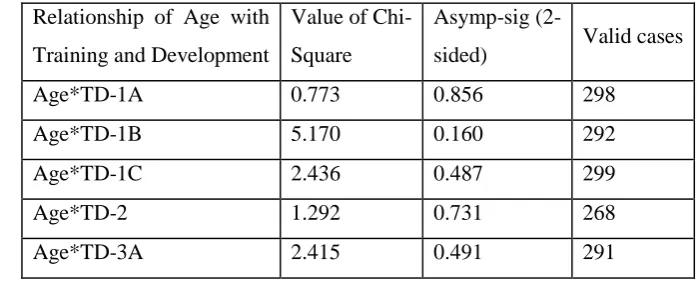
It is seen that in case of TD_3E (T&D designed to vendor/partner training) has a significant
association with age of HR executives. Summarily evaluation part of T&D _4C has significant
association with age. Both managers and employees are made responsible for success of training.
(TD-6 andTD-7) .For other 12 items there is no association with age.
Table 8 of Age with dimensions of Training and Development
Relationship of Age with
Training and Development
Value of Chi-
Square
Asymp-sig (2-
sided) Valid cases
Age*TD-1A 0.773 0.856 298
Age*TD-1B 5.170 0.160 292
Age*TD-1C 2.436 0.487 299
Age*TD-2 1.292 0.731 268
International Journal in Commerce, IT and Social Sciences
Volume 5 Issue 07, July 2018 ISSN: 2394-5702 Impact Factor: 4.218
Journal Homepage: http://ijmr.net.in, Email: [email protected] Double-Blind Peer Reviewed Refereed Open Access International Journal
81
International Journal in Commerce, IT and Social Sciences http://ijmr.net.in, Email: [email protected]
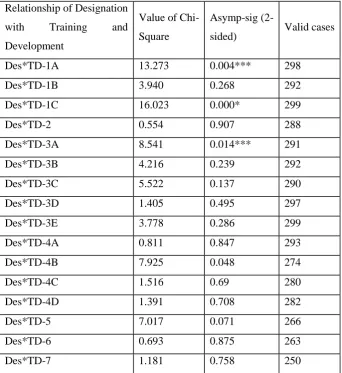
Table 9 Relationship of Designation with dimensions of Training and Development
Relationship of Designation
with Training and
Development
Value of Chi-
Square
Asymp-sig (2-
sided) Valid cases
Des*TD-1A 13.273 0.004*** 298
Des*TD-1B 3.940 0.268 292
Des*TD-1C 16.023 0.000* 299
Des*TD-2 0.554 0.907 288
Des*TD-3A 8.541 0.014*** 291
Des*TD-3B 4.216 0.239 292
Des*TD-3C 5.522 0.137 290
Des*TD-3D 1.405 0.495 297
Des*TD-3E 3.778 0.286 299
Des*TD-4A 0.811 0.847 293
Des*TD-4B 7.925 0.048 274
Des*TD-4C 1.516 0.69 280
Des*TD-4D 1.391 0.708 282
Des*TD-5 7.017 0.071 266
Des*TD-6 0.693 0.875 263
Des*TD-7 1.181 0.758 250
Age*TD-3B 1.317 0.725 292
Age*TD-3C 7.409 0.060 290
Age*TD-3D 4.211 0.240 297
Age*TD-3E 12.742 0.005** 299
Age*TD-4A 3.168 0.366 293
Age*TD-4B 3.101 0.376 274
Age*TD-4C 8.622 0.046* 286
Age*TD-4D 11.951 0.003*** 282
Age*TD-5 3.506 0.220 268
Age*TD-6 8.949 O.030** 263
International Journal in Commerce, IT and Social Sciences
Volume 5 Issue 07, July 2018 ISSN: 2394-5702 Impact Factor: 4.218
Journal Homepage: http://ijmr.net.in, Email: [email protected] Double-Blind Peer Reviewed Refereed Open Access International Journal
82
International Journal in Commerce, IT and Social Sciences http://ijmr.net.in, Email: [email protected] Only three items namely TD-1A, 1C and 3A have shown significant association with designationwhile for other 13 items there is no association between the designation of employees and T&D
schemes. Thus all items are uniformly important across all levels of designations.
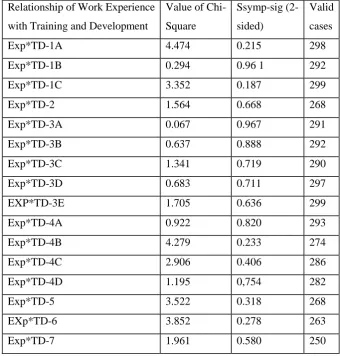
Table 10 Relationship of Work Experience with dimensions of Training and Development
From the table 10 it is clear that no item of T&D have any association with the experience of HR
executives. This again shows that most of items of T&D are not relationship with the level of
experience. In other words whether HR executives are young or old they equally feel T&D as
being important domain of HR function which needs to be groomed in any organization
irrespective of demographics of people as it is considered crucial for success of any organizations.
CONCLUSIONS AND RECOMMENDATIONS
The study has identified 16 items to represent various facets of T&D programs .All 16 have been
found to be very important part of HR function. All 16 have classified into five major components,
and all five are equally important in explaining the variance across programs. But the first
component cold explains 24 % of variance. The most important items of first factor are directly
linked to HR function being given a strategic role. For example item 2 pertains to involvement of Relationship of Work Experience
with Training and Development
Value of Chi-
Square
Ssymp-sig (2-
sided)
Valid
cases
Exp*TD-1A 4.474 0.215 298
Exp*TD-1B 0.294 0.96 1 292
Exp*TD-1C 3.352 0.187 299
Exp*TD-2 1.564 0.668 268
Exp*TD-3A 0.067 0.967 291
Exp*TD-3B 0.637 0.888 292
Exp*TD-3C 1.341 0.719 290
Exp*TD-3D 0.683 0.711 297
EXP*TD-3E 1.705 0.636 299
Exp*TD-4A 0.922 0.820 293
Exp*TD-4B 4.279 0.233 274
Exp*TD-4C 2.906 0.406 286
Exp*TD-4D 1.195 0,754 282
Exp*TD-5 3.522 0.318 268
EXp*TD-6 3.852 0.278 263
International Journal in Commerce, IT and Social Sciences
Volume 5 Issue 07, July 2018 ISSN: 2394-5702 Impact Factor: 4.218
Journal Homepage: http://ijmr.net.in, Email: [email protected] Double-Blind Peer Reviewed Refereed Open Access International Journal
83
International Journal in Commerce, IT and Social Sciences http://ijmr.net.in, Email: [email protected] HR in proper measurement of T&D programs and fixing of responsibilities on both employees andmanagers for learning and development. This again calls for strategic HR strategic role in
promoting the overall success of organizations.
REFERENCES
Catalanello R and Redding J, 1989. Three strategic training roles. Training and development
Journal, December, 1989, 51-54.
Gupta R, Sahoo C, 2014. Role of training towards competitive advantage. Indian Journal of
training and development, January-March, 2014, 32-40.
Book (Michael Armstrong
http://www.bersin.com/blog/post/2012/02/Recruitment-is-NOT-Talent-Acquisition.aspx
http://www.alignmark.com/blog/bid/41615/Talent-Acquisition-Measuring-Quality-of-Hires-Versus-Quantity
http://www.alignmark.com/cost-of-turnover-calculator/
https://www.recruiter.com/i/talent-acquisition-manager/