IJEDR1603007
International Journal of Engineering Development and Research (www.ijedr.org)38
A Comparative Study of Noising And Denoising
Technique In Image Processing
1Nancy Singla,2Kamal 1Research scholar,2Director,
1Department of Electronics and Communication Engineering 1Emax institute of technology & mang, Ambala,India
________________________________________________________________________________________________________
Abstract -Images are often corrupted by noise. For visual quality as well as for satisfactory extraction of important features from the images, denoising of the images is necessary. It is an unavoidable pre-processing step for many applications such as image compression, segmentation, identification, fusion, object recognition etc. Many successful algorithms have been proposed over the past few decades for image denoising. Impulse noise reduction or removal is a very active research area of image processing. Denoising of an image is an essential step in many image processing applications.The purpose of image denoising is to get a clear version of a noisy image.
IndexTerms - Image processing, Noising, Denoising.
________________________________________________________________________________________________________
I.INTRODUCTION
Digital images are indivisible parts of many applications. Acquirement [1] processing, and transmission of images, especially when perform in cost-effective ways, generate unwanted artifacts. For example, digital images in use by consumer digital cameras endure from thermal sensor noise, demo sacking noise and quantization noise. The problem of image denoising (noise reduction) is one of the oldest in the field, and is still receiving considerable concentration from the research area because of ever-increasing demand for reasonably priced high-quality media as well as its role as a pre-processing step for image segmentation, compression, etc. Due to high spatial being without a job of natural images, local averaging of the pixels considerably reduce the noise while preserve the original structure of the image. The obtainable denoising algorithms range from low loyalty, computationally reasonably priced (e.g., location invariant mean filtering) to complicated high quality ones such as wavelet-based filtering, nonlocal means filtering, PDE-based methods and vector median filtering. Good denoising presentation of these methods, however, comes at a substantial computational cost, prohibiting their application in reasonably priced embedded systems, such as consumer digital camera’s image processing unit, whose processing power is limited by near to the ground cost and battery power consumption. Most of the existing denoising methods function on gray-scale images. These methods, however, can be readily used for color image denoising by their application to each of the color channels that create up the input color image.
II. RELATED WORK
Vicente D. Estruch [2] proposed a good statistic for detecting impulsive noise in colour images. A new geometric localisation algorithm on a 5 × 5 window is presented that is robust against increases in impulsive noise and able to retain details of fine lines and edges. It divides the 5 × 5 window in nine 3 × 3 sub windows containing the central pixel and computes the ROD m statistic with m = 4 over each sub window. If there are at least three sub windows with small RODm then the pixel is considered not corrupt. From this statistic, an alternating filter is proposed that is applied on pixels marked as noisy. The VMF is performed on these pixels. Different options have been studied before defining an optimal configuration for the filter obtaining, in general, the computational complexity lower than the VMF. Experimental results show that the proposed method has competitive performance and can efficiently reduce impulsive noise in colour images while retaining edges and details.
Keiichiro Shirai[13] proposed a new denoising method based on the spectral line for the remote sensing field. Hyperspectral image denoising using a spectral line vector field uses the correlation among spectral information in the local region. The vectors are obtained by local spectral component decomposition followed by iterative filtering steps. Filtering the spectral line component and residual component gives significant effects in reducing the noise and smoothing results the image. Moreover, the use of local spectral components contributes to achieving better results compared with the result of the stand-alone conventional method. The experiment demonstrated that the proposed method successfully achieved competitive performance compared to other powerful denoising methods. However, the increase in noise power and the number of channels processed affects the complexity of achieving more accurate spectral line vector estimation. Future work may involve solving this computational complexity.
IJEDR1603007
International Journal of Engineering Development and Research (www.ijedr.org)39
Sajjad Mohsin [15] proposed a hybrid filter whose sequence is determined via an optimization algorithm dubbed as cuckoo search algorithm. Comparisons are made among different denoising algorithms and evaluated in terms of PSNR and IQI. The technique proposed in this paper has enhanced the presentation of filters by using them in a series. This paper has explore the CSA as an optimization tool and considered the behaviour of different denoising algorithms on different kinds of noises at various noise intensities. The proposed approach outperforms other approaches in removing Gaussian, salt and pepper and speckle noises. On average, 5–28 % rise in PSNR is measured for different noises having changeable intensities. Besides, when compared with GA, there is an average improvement in PSNR of around 18% which doubles in certain cases 3-D images by applying 3-D filters. Though PSNR of the denoised images has been greater than before with the proposed method, it could be enhanced through the help of nonlinear filters, wavelets and transforms.Igor Djurovic [16] proposed an application of the BM3D algorithm to the decision-based/adaptive median filter output for filtering salt and pepper noise. The BM3D filter through the proposed switching regulation brings reasonably observable and quantifiable gain through respect to the decision based adaptive median filters. This research is a step in application of non-local and shaping filters to salt and pepper and other type of spontaneous noise from digital images. Also, the proposed technique can be measured as an addition of the BM3D to challenging salt-and pepper noise environment. Similar extensions and combinations of the BM3D with other filters are probably possible but they remain for further make inquiries. In any case, we strongly consider with the intention of one of the most important directions in an actual digital image processing field is scheming procedures for combining different, well-developed, filters and their function to other problems external of the originally considered area.
III.NOISINGTECHNIQUE
a. Impulse Noise
Impulse noise [2] is introduced into digital images during processes of acquisition and transmission. The process of impulse noise corruption affects only some pixels in an image and remains the remainder unchanged. The noise usually changes one or more color components of a pixel and replaces the original values. The most common types of impulse noise models consider that the impulse is either an extreme value in the range of the signal (fixed-value impulse noise); or a random value uniformly distributed within the range of the signal (random value impulse noise).Consequently, since impulse noise can be seen as an unusual or unexpected value, methods based on the theory of robust statistics, such as the median filter (MF), or its generalization to the multichannel case, the vector median filter (VMF), have been widely used to decrease impulsive noise. Vector processing has proved suitable for processing color images since it takes into account correlation between color channels in the image. Given that the filtering operation in classic filters is performed on each pixel of the image regardless of whether it is noisy or not, the resulting images usually suffer blurred edges and loss of detail; so that the overall quality is significantly degraded. A spontaneous idea to solve this problem is proposed that enables switching between applying a pixel filter or not – depending on whether noise is detected or not.
b. Gaussian Noise
Gaussian noise [8] is statistical noise following Gaussian probability density and introduce in the image at the time of acquiring of image. While this noise follows Gaussian distribution and hence in common it can be removed nearby averaging operation. Common choice used for removing gaussian noise is classic linear filter such as Gaussian filter, this is accepted method to remove Gaussian noise, however this filter has a inclination to blur edges which may cause information loss in various visually important areas. The field of image restoration [3] (sometimes referred to as image deblurring or image de-convolution) is worried with the reconstruction or evaluation of the unspoiled image from a blurred and noisy one. Essentially, it tries to carry out an operation on the image with the reason of the inverse of the imperfections in the image configuration system, by using the accessible information of the dreadful conditions process. The Process mainly disgrace the image are motion, blurring, Gaussian noise, salt and pepper noise and impulsive noise. The various methods of image restoration have been studied by many researchers. Color image restoration has been more often than not investigated in three main branches: image denoising in the presence of Gaussian noise, image deconvolution in the occurrence of Gaussian noise and impulse noise.
IV.IMAGEFILTERING
1. Adaptive Filtering
Adaptive Median [4] is a “decision-based” or “switching” filter with the purpose of first identifies possible noisy pixels and then replaces them using the median filter or its variants, though leaving all other pixels unaffected. This filter is good at detecting noise even at a far above the ground noise level. The adaptive structure of this filter ensures with the intention of most of the impulse noises are detected even at a far above the ground noise level provided with the purpose of the window size is large enough. The performance of AMF is good at subordinate noise density levels, due to the fact that here are only fewer corrupted pixels that are replaced through the median values. At higher noise densities, the number of replacements of dishonored pixel increases significantly; increasing window size will provide better noise removal performance; however, the dishonored pixel values and replaced median pixel values are less connected. The adaptive median filter (AMF) adopts adaptive window size and performs well at low noise density, but the filter window size has to be expanded when the noise density increases which may lead to blurring the image.
2. Median Filtering
IJEDR1603007
International Journal of Engineering Development and Research (www.ijedr.org)40
larger window size and insufficient noise suppression for small window size. Median filters are identified for their capability to remove impulse noise without damaging the edges. Median filters are known for their capability to remove impulse noise as well as preserve the edges. The main drawback of a standard median filter[7] is that it is efficient only for low noise densities. At high noise densities, SMFs frequently exhibit blurring for large window sizes and insufficient noise suppression for small window sizes. However, nearly everyone of the median filters operate uniformly across the image and thus tend to modify both noise and noise-free pixels. Accordingly, the effective removal of impulse often leads to images with blurred and distorted features. Ideally, the filtering be supposed to be applied only to corrupted pixels while leaving uncorrupted pixels intact. Applying median filter absolutely across the entire image as practiced in the conventional schemes would certainly modify the intensities and remove the signal details of uncorrupted pixels.3. Vector median filters
Vector median filters [12] are primarily designed for noise reduction in color images. There are various vector median filtering techniques, within which the one called hybrid vector filtering is closely related with this work. A hybrid filter utilizes a number of sub-filters of different types and defines the output as a linear or nonlinear combination of the input vectors. For example, the extended vector median filter combines the VMF with linear filtering. Near edges this filter behaves like the VMF, while in smooth areas it behaves like the arithmetic mean filter (AMF). The main disadvantage of the hybrid filters is that the output is often the artifact. Although there are various sub-filters in a hybrid filter, only one sub-filter is chosen for a certain image part (e.g., in EVMF, the VMF for the edge areas while the AMF for the smooth areas). Consequently, this kind of the filters is termed as "hybrid" not "ensemble".
4. Unsymmetric Trimmed Median Filter
Alpha Trimmed Mean Filtering (ATMF) is a symmetrical filter[7] where the trimming is symmetric at also end. In this procedure, still the uncorrupted pixels are also trimmed. This leads to loss of image details and blurring of the image. In order to overcome this disadvantage, an Unsymmetric Trimmed Median Filter (UTMF) is proposed. In this UTMF, the selected 3x 3 window elements are arranged in either increasing or decreasing order. Then the pixel values 0’s and 255’s in the image (i.e., the pixel values responsible for the salt and pepper noise) are removed from the image. Subsequently the median value of the remaining pixels is taken. This median value is used to replace the noisy pixel. This filter is called trimmed median filter because the pixel values 0’s and 255’s are removed from the selected window. This procedure removes noise in better way than the ATMF.
5. Hybrid Filtering
Noise is the most annoying problem[9] in image processing. One way to get rid of this problem is the development of such a robust algorithm that can perform the processing tasks in presence of noise. The other way is to design a filtration process to eliminate the noise from images while preserving its features, edges and details. Noise introduces random variations into image that fluctuate the original values to some different values. Causes which may introduce noise to images include flaws in data transmission, imperfect optics, sensor malfunctioning, processing techniques and electronic interference .Mathematical morphology is a methodology specifically designed for the analysis of geometrical structures in an image by interested it through small patterns called structuring elements. The resultant image operators are nonlinear and found functional for many applications like edge detection object segmentation, noise suppression and exploring geometrical structures of images.
6. Iterative guided filtering
Recently, several techniques to enhance the quality of flash/no-flash image[10] pairs have been projected. At the same time as the flash image is better exposed, the lighting is not soft, and generally results in specularities and unnatural appearance. In the meantime, the no-flash image tends to have a relatively low signal-to-noise ratio (SNR) at the same time as containing the natural ambient lighting of the scene. The key idea of flash/no-flash photography is to create a original image that is closest to the look of the real scene by having details of the flash image at the same time as maintaining the ambient clarification of the no-flash image. Eisemann and Durand used bilateral filtering to give the flash image the ambient tones from the no-flash image removed flash artifacts, but did not test their method on top of no-flash images containing severe noise. As different to a visible flash used by recently Krishnan and Fergus used both near-infrared and near-ultraviolet illumination for low light image improvement. Their so-called “dark flash” provides high-frequency detail in a less disturbing way than a visible flash does even though it results in incomplete color information.
7. Bilateral filtering
Bilateral filtering is another non-linear filtering method[11] which can be regarded as an extended version of the low pass Gaussian filtering. In essence, it is a simple arrangement of a domain filter, similar to the Gaussian filter, and a range filter which is a Gaussian function of local intensity difference. The main idea is that only perceptually analogous colors are averaged mutually to keep away from unpredicted colour combination in images. Barash unified anisotropic diffusion and non-linear bilateral filtering as an additional effective edge preserving filtering technique. However, one of the main limitations of bilateral filtering so as to the range filter coefficients rely heavily on actual pixel intensity values, as it does not take into explanation any regional characteristics, which may in turn have been partial by noise therefore potentially resulting in smoothed textured regions. 8. Trilateral filter
IJEDR1603007
International Journal of Engineering Development and Research (www.ijedr.org)41
trilateral filter contains spatial, radio-metric, and impulsive components. A third weighting function, the impulsive component based on a rank-order statistic of unconditional differences (ROAD), removes high frequency impulse noise. The resulting trilateral filter performs fine in removing assorted noise as well as in removing impulse noise. Another trilateral filter was presented for high contrast images and meshes.V. HUMAN VISUAL SYSTEM
The Human Visual System (HVS) [5] is the end user of most image in sequence. Therefore, any imaging system that strives to reflect human image processing needs should be designed with the characteristics of the HVS taken into consideration. This will ensure that resources are not wasted and are utilized for processing only those information that are relevant for the HVS. Color image denoising is much more complicated than denoising monochrome image because of the redundancy and the complementary information within the color bands. Moreover, the traditional methods do not consider the psychology of color image perception of human beings and so are inadequate. In this paper, the properties of HVS model are taken into account, leading to a modified approach to color image denoising. The CIELAB color space is used in the denoising process as it closely resembles the human eye perception of color images. Adaptive wavelet thresholding techniques have been used to denoise each of the chromatic and achromatic channels of the CIELAB color space. The compensation for the varying contrast sensitivity of the HVS with respect to varying spatial frequency is done by assigning different weights to the sub-bands known as Invariant Single Factor (ISF).
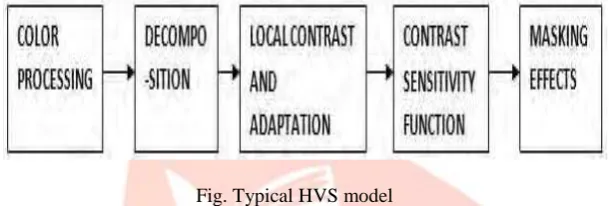
Typical HVS Model
HVS model accounts for a number[5] of psychophysical effects. They are typically implemented in a sequential process as shown in Fig
Fig. Typical HVS model
In the first step of the processing chain, the image is transformed into one acromatic and two chromatic channels. During the second stage, the image is decomposed into multiple channels that are tuned to different range of spatial frequencies and orientation as HVS bases its perception on it. The human contrast perception in complex images varies with the local image content. According toWeber-Fechner Law, HVS responds more to the local variations of the surrounding background than the absolute luminance. Contrast is the measure of this relative variation. Contrast sensitivity function parameterize the decreasing sensitivity of HVS for higher frequency. Masking occurs while a stimulus that is able to be seen by itself cannot be detected due to the presence of another. The opposite effect is known as facilitation.
VI.CONCLUSION
In order to effectively remove random-valued impulse noise superimposed on color images. In the field of digital image processing impulse noise removal from color images is one of the most challenging tasks for researchers. We study the denoising algorithm to removes the gaussian noise and salt and pepper noise efficiently.
REFERENCES
[1] Mehdi Teimouri, Ehsan Vahedi, Alireza Nasiri Avanaki, “An Efficient Denoising Method For Color Images” 1-4244-0779-6/07/$20.00 ©2007 IEEE.
[2] Bernardino Roig, Vicente D. Estruch “Localised rank-ordered differences vector filter for suppression of high-density impulse noise in colour images” IET Image Process., 2016, Vol. 10, Iss. 1, pp. 24–33.
[3] S.Muthukumar,P.Pasupathi,S.Deepa“An efficient Color Image Denoising method for Gaussian and Impulsive Noises with blur removal” 978-1-4244-5967-4/10/$26.00 ©2010 IEEE.
[4] K.Aiswarya,V.Jayaraj,D.Ebenezer “A New Switching-Based Median Filtering Scheme and Algorithm for Removal of High Density Salt and Pepper Noise in Images” 2010 Second International Conference on Computer Modeling and Simulation pp;409-413
[5] R. H. Laskar, S. Baishya “Color Image Denoising In Wavelet Domain Using Adaptive Thresholding Incorporating the Human Visual System Model” 6th International Conference on Electrical and Computer Engineering ICECE 2010, 18-20 December 2010, Dhaka, Bangladesh pp;498-501.
[6] Yanyan Wei, Shi Yan, Ling Yang “An Improved Median Filter for Removing Extensive Salt and Pepper Noise”2014 International Conference on Mechatronics and Control (ICMC) July 3 - 5, 2014, Jinzhou, China pp;897-901.
IJEDR1603007
International Journal of Engineering Development and Research (www.ijedr.org)42
[8] Mayank Tiwari “Image Denoising using Spatial Gradient Based Bilateral Filter and Minimum Mean Square ErrorFiltering”Eleventh International Multi-Conference on Information Processing-2015 (IMCIP-2015) pp; 638 – 645.
[9] Isma Irum“ A Nonlinear Hybrid Filter for Salt & Pepper Noise Removal from Color Images” Comsats Institute of Information Technology Vol.13,February 2015 pp;79-86.
[10]Hae-Jong Seo and Milanfar, “Robust flash denoising/deblurring by iterative guided filtering” EURASIP Journal on Advances in Signal Processing 2012 pp;1-19.
[11]Nasir Rajpoot “A multiresolution framework for local similarity based image denoising” Sciverse Science Direct (2012) pp;2938–2951.
[12]Ling Zhong, Yun Zhang “An Ensemble Vector Median Filter For Color Image Denoising” 2010 11th Int. Conf. Control, Automation, Robotics and Vision Singapore, 7-10th December 2010 pp;2485-2490..
[13]Mia Rizkinia, Keiichiro Shirai, Local Spectral Component Decomposition for Multi-Channel Image Denoising IEEE Transaction on Image Processing, Vol. 25, NO. 7, July 2016
[14]Xin Zhang and Ruiyuan Wu “Fast Depth Image Denoising And Enhanceent Using A Deep Network”2016 IEEE pp.2499-2503.
[15]Memoona Malik, Faraz Ahsan, Sajjad Mohsin “Adaptive image denoising using cuckoo algorithm” Soft Comput (2016) pp:925–938.