Proceedings of Recent Advances in Natural Language Processing, pages 344–353,
Fully Automated Fact Checking Using External Sources
Georgi Karadzhov1, Preslav Nakov2, Llu´ıs M`arquez2, Alberto Barr´on-Cede˜no2, and Ivan Koychev1 1Sofia University “St. Kliment Ohridski”, Bulgaria
2Qatar Computing Research Institute, HBKU, Qatar
[email protected],{pnakov, lmarquez, albarron}@hbku.edu.qa [email protected]
Abstract
Given the constantly growing proliferation of false claims online in recent years, there has been also a growing research interest in automatically distinguishing false ru-mors from factually true claims. Here, we propose a general-purpose framework for fully-automatic fact checking using exter-nal sources, tapping the potential of the en-tire Web as a knowledge source to con-firm or reject a claim. Our framework uses a deep neural network with LSTM text encoding to combine semantic kernels with task-specific embeddings that encode a claim together with pieces of potentially-relevant text fragments from the Web, tak-ing the source reliability into account. The evaluation results show good performance on two different tasks and datasets: (i) ru-mor detection and (ii) fact checking of the answers to a question in community ques-tion answering forums.
1 Introduction
Recent years have seen the proliferation of decep-tive information online. With the increasing ne-cessity to validate the information from the Inter-net,automatic fact checkinghas emerged as an im-portant research topic. It is at the core of multi-ple applications, e.g., discovery of fake news, ru-mor detection in social media, information veri-fication in question answering systems, detection of information manipulation agents, and assistive technologies for investigative journalism. At the same time, it touches many aspects, such as cred-ibility of users and sources, information veracity, information verification, and linguistic aspects of deceptive language.
In this paper, we present an approach to fact-checking with the following design principles: (i) generality, (ii) robustness, (iii) simplicity, (iv) reusability, and (v) strong machine learning modeling. Indeed, the system makes very few as-sumptions about the task, and looks for support-ive information directly on the Web. Our system works fully automatically. It does not use any heavy feature engineering and can be easily used in combination with task-specific approaches as well, as a core subsystem. Finally, it combines the representational strength of recurrent neural net-works with kernel-based classification.
The system starts with a claim to verify. First, we automatically convert the claim into a query, which we execute against a search engine in order to obtain a list of potentially relevant documents. Then, we take both the snippets and the most rel-evant sentences in the full text of these Web doc-uments, and we compare them to the claim. The features we use are dense representations of the claim, of the snippets and of related sentences from the Web pages, which we automatically train for the task using Long Short-Term Memory net-works (LSTMs). We also use the final hidden layer of the neural network as a task-specific embedding of the claim, together with the Web evidence. We feed all these representations as features, together with pairwise similarities, into a Support Vector Machine (SVM) classifier using an RBF kernel to classify the claim as True or False.
Figure1presents a real example from one of the datasets we experiment with. The left-hand side of the figure contains a True example, while the right-hand side shows a False one. We show the original claims from snopes.com, the query generated by our system, and the information retrieved from the Web (most relevant snippet and text selection from the web page). The veracity of the claim can be inferred from the textual information.
ahttp://www.snopes.com/2015/09/16/ahmed-mohamed/
bhttp://www.businessinsider.com/ahmed-mohamed-arrested-irving-texas-clock-bomb-2015-9 chttp://www.snopes.com/chipotle-closing/
dhttp://www.chicagotribune.com/business/ct-chipotle-burger-restaurant-20160728-story.html
Figure 1: Example claims and the information we use to predict whether they are factually true or false.
Our contributions can be summarized as follows:
• We propose a general-purpose light-weight framework for fully-automatic fact checking using evidence derived from the Web.
• We propose a deep neural network with LSTM encoding to combine semantic kernels with task-specific embeddings that encode a claim together with pieces of potentially-relevant text fragments from the Web, taking the source reliability into account.
• We further study factuality in community Question Answering (cQA), and we create a new high-quality dataset, which we release to the research community. To the best of our knowledge, we are the first to study factual-ity of answers in cQA forums, and our dataset is the first dataset specifically targeting factu-ality in a cQA setting.
• We achieve strong results on two different tasks and datasets —rumor detection and fact checking of the answers to a question in community question answering forums—, thus demonstrating the generality of the ap-proach and its potential applicability to dif-ferent fact-checking problem formulations.
The remainder of this paper is organized as fol-lows. Section 2 introduces our method for fact checking claims using external sources. Section3
presents our experiments and discusses the results. Section4describes an application of our approach to a different dataset and a slightly different task: fact checking in community question answering forums. Section5presents related work. Finally, Section 6 concludes and suggests some possible directions for future work.
2 The Fact-Checking System
Given a claim, our system searches for support in-formation on the Web in order to verify whether the claim is likely to be true. The three steps in this process are (i) external support retrieval, (ii) text representation, and (iii) veracity prediction. 2.1 External Support Retrieval
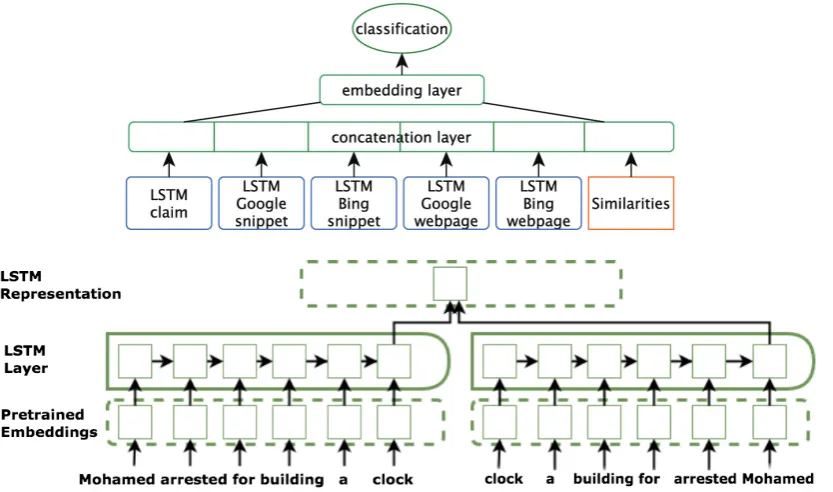
Figure 2: Our general neural network architecture (top) and detailed LSTM representation (bottom). Each blue box in the top consists of the bi-LSTM structure in the bottom.
As we aim to develop a general-purpose fact checking system, we use an approach for query generation that does not incorporate any features that are specific to claim verification (e.g., no tem-poral indicators).
We rank the words by means oftf-idf. We com-pute theidf values on a 2015 Wikipedia dump and the English Gigaword.1 Potthast et al.(2013)
sug-gested that a good way to perform high-quality search is to only consider the verbs, the nouns and the adjectives in the claim; thus, we exclude all words in the claim that belong to other parts of speech. Moreover, claims often contain named entities (e.g., names of persons, locations, and or-ganizations); hence, we augment the initial query with all the named entities from the claim’s text. We use IBM’s AlchemyAPI2 to identify named
entities. Ultimately, we generate queries of 5–10 tokens, which we execute against a search engine. We then collect the snippets and the URLs in the results, skipping any result that points to a domain that is considered unreliable.3Finally, if our query
has returned no results, we iteratively relax it by dropping the final tokens one at a time.
1catalog.ldc.upenn.edu/ldc2011t07 2www.ibm.com/watson/alchemy-api.html 3We created such a list by manually checking the 100
most frequent domains in the results, which we accummu-lated across many queries and experiments.
2.2 Text Representation
Next, we build the representation of a claim and the corresponding snippets and Web pages. First, we calculate three similarities (a) between the claim and a snippet, or (b) between the claim and a Web page: (i) cosine withtf-idf, (ii) cosine over embeddings, and (iii) containment (Lyon et al.,
2001). We calculate the embedding of a text as the average of the embeddings of its words; for this, we use pre-trained embeddings from GloVe ( Pen-nington et al., 2014). Moreover, as a Web page can be long, we first split it into a set of rolling sentence triplets, then we calculate the similarities between the claim and each triplet, and we take the highest scoring triplet. Finally, as we have up to ten hits from the search engine, we take the maxi-mum and also the average of the three similarities over the snippets and over the Web pages.
2.3 Veracity Prediction
Next, we build classifiers: neural network (NN), support vector machines (SVM), and a combina-tion thereof (SVM+NN).
NN. The architecture of our NN is shown on top of Figure 2. We have five LSTM sub-networks, one for each of the text sources from two search engines: Claim, Google Web page, Google snip-pet,Bing Web page, andBing snippet. The claim is fed into the neural network as-is. As we can have multiple snippets, we only use the best-matching one as described above. Similarly, we only use a single best-matching triple of consecutive sen-tences from a Web page. We further feed the net-work with the similarity features described above. All these vectors are concatenated and fully con-nected to a much more compact hidden layer that captures the task-specific embeddings. This layer is connected to a softmax output unit to classify the claim as true or false. The bottom of Figure2
represents the generic architecture of each of the LSTM components. The input text is transformed into a sequence of word embeddings, which is then passed to the bidirectional LSTM layer to obtain a representation for the full sequence.
SVM. Our second classifier is an SVM with an RBF kernel. The input is the same as for the NN: word embeddings and similarities. However, the word embeddings this time are calculated by aver-aging rather than using a bi-LSTM.
SVM + NN. Finally, we combine the SVM with the NN by augmenting the input to the SVM with the values of the units in the hidden layer. This represents a task-specific embedding of the input example, and in our experiments it turned out to be quite helpful. Unlike in the SVM only model, this time we use the bi-LSTM embeddings as an input to the SVM. Ultimately, this yields a combi-nation of deep learning and task-specific embed-dings with RBF kernels.
3 Experiments and Evaluation 3.1 Dataset
We used part of the rumor detection dataset cre-ated by Ma et al.(2016). While they analyzed a claim based on a set of potentially related tweets, we focus on the claim itself and on the use of sup-porting information from the Web.
The dataset consists of 992 sets of tweets, 778 of which are generated starting from a claim on
snopes.com, whichMa et al.(2016) converted into a query. Another 214 sets of tweets are tweet clusters created by other researchers (Castillo et al.,2011;Kwon et al.,2013) with no claim be-hind them.Ma et al.(2016) ignored the claim and did not release it as part of their dataset. We man-aged to find the original claim for 761 out of the 778snopes.com-based clusters.
Our final dataset consists of 761 claims from
snopes.com, which span various domains in-cluding politics, local news, and fun facts. Each of the claims is labeled as factuallytrue(34%) or as afalserumor (66%). We further split the data into 509 for training, 132 for development, and 120 for testing. As the original split for the dataset was not publicly available, and as we only used a subset of their data, we had to make a new training and test-ing split. Note that we ignored the tweets, as we wanted to focus on a complementary source of in-formation: the Web. Moreover, Ma et al. (2016) used manual queries, while we use a fully auto-matic method. Finally, we augmented the dataset with Web-retrieved snippets, Web pages, and sen-tence triplets from Web pages.4
3.2 Experimental Setup
We tuned the architecture (i.e., the number of lay-ers and their size) and the hyper-parametlay-ers of the neural network on the development dataset. The best configuration uses a bidirectional LSTM with 25 units. It further uses a RMSprop optimizer with 0.001 initial learning rate, L2 regularization with
λ=0.1, and 0.5 dropout after the LSTM layers. The size of the hidden layer is 60 withtanhactivations. We use a batch of 32 and we train for 400 epochs. For the SVM model, we merged the develop-ment and the training dataset, and we then ran a 5-fold cross-validation with grid-search, looking for the best kernel and its parameters. We ended up selecting an RBF kernel withc= 16andγ =0.01.
3.3 Evaluation Metrics
The evaluation metrics we use are P (precision), R (recall), and F1, which we calculate with respect
to the false and to the true claims. We further re-port AvgR (macro-average recall), AvgF1
(macro-average F1), and Acc (accuracy).
4All the data, including the splits, is available at
False Claims True Claims Overall
Model P R F1 P R F1 AvgR AvgF1 Acc
SVM + NN 84.1 86.3 85.2 71.1 67.5 69.2 76.9 77.2 80.0
NN 79.6 92.5 85.5 77.8 52.5 62.7 72.5 74.1 79.2
SVM 75.0 86.3 80.2 60.7 42.5 50.0 64.4 65.1 71.7
allfalse 66.7 100.0 80.0 – 0.0 0.0 50.0 40.0 66.7 alltrue – 0.0 0.0 33.3 100.0 50.0 50.0 25.0 33.3
Table 1: Results on therumor detection datasetusing Web pages returned by the search engines.
3.4 Results
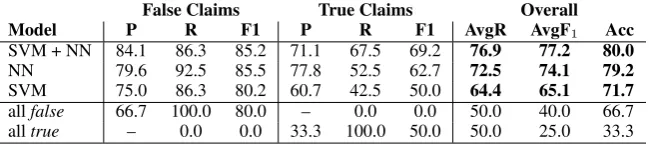
Table1 shows the results on the test dataset. We can see that both the NN and the SVM models improve over the majority class baseline (all false rumors) by a sizable margin. Moreover, the NN consistently outperforms the SVM by a margin on all measures. Yet, adding the task-specific embed-dings from the NN as features of the SVM yields overall improvements over both the SVM and the NN in terms of avgR, avgF1, and accuracy. We
can see that both the SVM and the NN overpre-dict the majority class (false claims); however, the combined SVM+NN model is quite balanced be-tween the two classes.
Table2compares the performance of the SVM with and without task-specific embeddings from the NN, when training on Web pages vs. snip-pets, returned by Google vs. Bing vs. both. The NN embeddings consistently help the SVM in all cases. Moreover, while the baseline SVM using snippets is slightly better than when using Web pages, there is almost no difference between snip-pets vs. Web pages when NN embeddings are added to the basic SVM. Finally, gathering ex-ternal support from either Google or Bing makes practically no difference, and using the results from both together does not yield much further im-provement. Thus, (i) the search engines already do a good job at generating relevant snippets, and one does not need to go and download the full Web pages, and (ii) the choice of a given search engine is not an important factor. These are good news for the practicality of our approach.
Unfortunately, direct comparison with respect to (Ma et al.,2016) is not possible. First, we only use a subset of their examples: 761 out of 993 (see Section3.1), and we also have a different class dis-tribution. More importantly, they have a very dif-ferent formulation of the task: for them, the claim is not available as input (in fact, there has never been a claim for 21% of their examples); rather an example consists of a set of tweets retrieved using
manuallywritten queries.
Model External support AvgR AvgF1 Acc
SVM + NN Bing+Google; pages 76.9 77.2 80.0
SVM Bing+Google; pages 64.4 65.1 71.7
SVM + NN Bing+Google; snippets 75.6 75.6 78.3
SVM Bing+Google; snippets 68.1 69.0 74.2
SVM + NN Bing; pages 77.5 77.0 79.2
SVM Bing; pages 66.9 67.5 72.5
SVM + NN Bing; snippets 76.3 76.4 79.2
SVM Bing; snippets 68.8 69.7 75.0
SVM + NN Google; pages 73.1 74.2 78.3
SVM Google; pages 63.1 63.8 71.7
SVM + NN Google; snippets 73.1 74.2 78.3
SVM Google; snippets 65.6 66.6 73.3
baseline (all false claims) 50.0 40.0 66.7
Table 2: Results using an SVM with and without task-specific embeddings from the NN on the Ru-mor detection dataset. Training on Web pages vs. snippets vs. both.
In contrast, our system is fully automatic and does not use tweets at all. Furthermore, their most im-portant information source is the change in tweets volume over time, which we cannot use. Still, our results are competitive to theirs when they do not use temporal features.
Figure 3: Example from the cQA forum dataset.
4 Application to cQA
Next, we tested the generality of our approach by applying it to a different setup: fact-checking the answers in community question answering (cQA) forums. As this is a new problem, for which no dataset exists, we created one. We augmented with factuality annotations the cQA dataset from SemEval-2016 Task 3 (CQA-QA-2016) (Nakov et al.,2016). Overall, we annotated 249 question– answer, orq-a, pairs (from 71 threads): 128 factu-ally true and 121 factufactu-ally false answers.
Each question in CQA-QA-2016 has a sub-ject, a body, and meta information: ID, cate-gory (e.g.,Education, andMoving to Qatar), date and time of posting, user name and ID. We se-lected only the factual questions such as “What is Ooredoo customer service number?”, thus filter-ing out all (i) socializing, e.g., “What was your first car?”, (ii) requests for opinion/advice/guidance, e.g., “Which is the best bank around??”, and (iii) questions containing multiple sub-questions, e.g., “Is there a land route from Doha to Abud-habi. If yes; how is the road and how long is the journey?”
Next, we annotated for veracity the answers to the retained questions. Note that in CQA-QA-2016, each answer has a subject, a body, meta information (answer ID, user name and ID), and a judgment about how well it addresses the ques-tion of its thread: GOOD vs. POTENTIALLYUSE -FUL vs. BAD. We only annotated the GOOD an-swers.5 We further discarded answers whose
fac-tuality was very time-sensitive (e.g., “It is Friday tomorrow.”, “It was raining last week.”)6, or for
which the annotators were unsure.
5See (Nakov et al.,2017a) for an overview of recent
ap-proaches to finding GOOD answers for cQA.
6Arguably, many answers are somewhat time-sensitive,
e.g., “There is an IKEA in Doha.” is true only after IKEA opened, but not before that. In such cases, we just used the present situation as a point of reference.
Label Answers
+ FACTUAL- TRUE 128
− FACTUAL- PARTIALLYTRUE 38
− FACTUAL- CONDITIONALLYTRUE 16
− FACTUAL- FALSE 22
− FACTUAL- RESPONDERUNSURE 26
− NONFACTUAL 19
TOTAL 249
+POSITIVE 128
−NEGATIVE 121
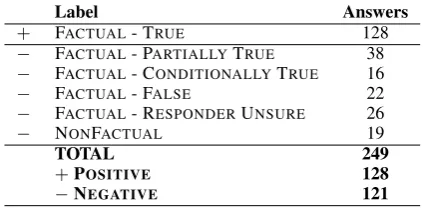
Table 3: Distribution of the answer labels.
We targeted very high quality, and thus we did not use crowdsourcing for the annotation, as pi-lot annotations showed that the task was very dif-ficult and that it was not possible to guarantee that
Turkers would do all the necessary verification, e.g., gathering evidence from trusted sources. In-stead, all examples were first annotated indepen-dently by four annotators, and theneach example
was discussed in detail to come up with a final la-bel. We ended up with 249 GOOD answers to 71 different questions, which we annotated for factu-ality: 128 POSITIVE and 121 NEGATIVE exam-ples. See Table3for details.
We further split our dataset into 185q–a pairs for training, 31 for development, and 32 for test-ing, preserving the general positive:negative ratio, and making sure that the questions for the q–a
pairs did not overlap between the splits.
Figure3presents an excerpt of an example from the dataset, with one question and three answers selected from a longer thread. Answera1contains
false information, whilea2anda3 are true, as can
be checked on an official governmental website.7
We had to fit our system for this problem, as here we do not have claims, but a question and an answer. So, we constructed the query from the concatenation of q and a. Moreover, as Google and Bing performed similarly, we only report re-sults using Google. We limited our run to snippets only, as we have found them rich enough above (see Section 3). Also, we had a list of reputed and Qatar-related sources for the domain, and we limited our results to these sources only. This time, we had more options to calculate similarities compared to the rumors dataset: we can compare againstq,a, andq–a; we chose to go with the lat-ter. For the LSTM representations, we use both the question and the answer.
7https://www.moi.gov.qa/site/english/
False Claims True Claims Overall
Model P R F1 P R F1 AvgR AvgF1 Acc
SVM + NN 72.2 76.5 74.3 73.3 68.8 71.0 72.7 72.7 72.7
SVM 70.6 70.6 70.6 68.8 68.8 68.8 69.7 69.7 69.7
NN 61.1 64.7 62.9 60.0 56.3 58.1 60.5 60.5 60.6
allfalse 51.5 100.0 68.0 – 0 0 50.0 34.0 51.5
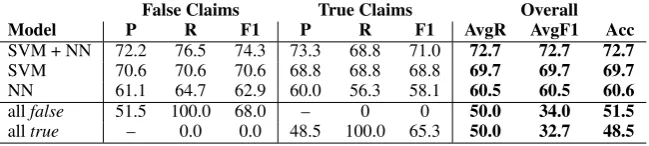
alltrue – 0.0 0.0 48.5 100.0 65.3 50.0 32.7 48.5 Table 4: Results on the cQA answer fact-checking problem.
Table 4 shows the results on the cQA dataset. Once again, our models outperformed all baselines by a margin. This time, the predictions of all mod-els are balanced between the two classes, which is probably due to the dataset being well balanced in general. The SVM model performs better than the NN by itself. This is due to the fact that the cQA dataset is significantly smaller than therumor de-tectionone. Thus, the neural network could not be trained effectively by itself. Nevertheless, the task-specific representations were useful and com-bining them with the SVM model yielded consis-tent improvements on all the measures once again.
5 Related Work
Journalists, online users, and researchers are well aware of the proliferation of false information on the Web, and topics such as information credibility and fact checking are becoming increasingly im-portant as research directions. For example, there was a recent 2016 special issue of the ACM Trans-actions on Information Systems journal on Trust and Veracity of Information in Social Media ( Pa-padopoulos et al., 2016), there was a SemEval-2017 shared task on Rumor Detection ( Derczyn-ski et al.,2017), and there is an upcoming lab at CLEF-2018 on Automatic Identification and Veri-fication of Claims in Political Debates (Gencheva et al.,2017).
The credibility of contents on the Web has been questioned by researches for a long time. While in the early days the main research focus was on online news portals (Brill, 2001; Finberg et al.,
2002;Hardalov et al.,2016), the interest has even-tually shifted towards social media (Castillo et al.,
2011; Zubiaga et al., 2016; Popat et al., 2017;
Karadzhov et al.,2017), which are abundant in so-phisticated malicious users such as opinion manip-ulationtrolls, paid (Mihaylov et al.,2015b) or just perceived (Mihaylov et al.,2015a;Mihaylov and Nakov, 2016), sockpuppets (Maity et al., 2017),
Internet water army(Chen et al.,2013), and semi-nar users(Darwish et al.,2017).
For instance,Canini et al.(2011) studied the cred-ibility of Twitter accounts (as opposed to tweet posts), and found that both the topical content of information sources and social network structure affect source credibility. Other work, closer to ours, aims at addressing credibility assessment of rumors on Twitter as a problem of finding false information about a newsworthy event (Castillo et al., 2011). This model considers user repu-tation, writing style, and various time-based fea-tures, among others.
Other efforts have focused on news communi-ties. For example, several truth discovery algo-rithms are combined in an ensemble method for veracity estimation in the VERA system (Ba et al.,
2016). They proposed a platform for end-to-end truth discovery from the Web: extracting unstruc-tured information from multiple sources, combin-ing information about scombin-ingle claims, runncombin-ing an ensemble of algorithms, and visualizing and ex-plaining the results. They also explore two differ-ent real-world application scenarios for their sys-tem: fact checking for crisis situations and evalu-ation of trustworthiness of a rumor. However, the input to their model is structured data, while here we are interested in unstructured text as input.
Similarly, the task defined by Mukherjee and Weikum(2015) combines three objectives: assess-ing the credibility of a set of posted articles, es-timating the trustworthiness of sources, and pre-dicting user’s expertise. They considered a man-ifold of features characterizing language, topics and Web-specific statistics (e.g., review ratings) on top of a continuous conditional random fields model. In follow-up work,Popat et al.(2016) pro-posed a model to support or refute claims from
Our approach to fact checking is related: we ver-ify facts on the Web. However, we use a much simpler and feature-light system, and a different machine learning model. Yet, our model performs very similarly to this latter work (even though a di-rect comparison is not possible as the datasets dif-fer), which is a remarkable achievement given the fact that we consider less knowledge sources, we have a conceptually simpler model, and we have six times less training data thanPopat et al.(2017). Another important research direction is on us-ing tweets and temporal information for checkus-ing the factuality of rumors. For example, Ma et al.
(2015) used temporal patterns of rumor dynam-ics to detect false rumors and to predict their fre-quency. Ma et al. (2015) focused on detecting false rumors in Twitter using time series. They used the change of social context features over a rumor’s life cycle in order to detect rumors at an early stage after they were broadcast.
A more general approach for detecting rumors is explored by Ma et al.(2016), who used recur-rent neural networks to learn hidden representa-tions that capture the variation of contextual in-formation of relevant posts over time. Unlike this work, we do not use microblogs, but we query the Web directly in search for evidence. Again, while direct comparison to the work ofMa et al.(2016) is not possible, due to differences in dataset and task formulation, we can say that our framework is competitive when temporal information is not used. More importantly, our approach is orthogo-nal to theirs in terms of information sources used, and thus, we believe there is potential in combin-ing the two approaches.
In the context of question answering, there has been work on assessing the credibility of an an-swer, e.g., based on intrinsic information ( Baner-jee and Han,2009), i.e., without any external re-sources. In this case, the reliability of an answer is measured by computing the divergence between language models of the question and of the an-swer. The spawn of community-based question answering Websites also allowed for the use of other kinds of information. Click counts, link analysis (e.g., PageRank), and user votes have been used to assess the quality of a posted an-swer (Agichtein et al.,2008;Jeon et al.,2006; Ju-rczyk and Agichtein, 2007). Nevertheless, these studies address the answers’ credibility level just marginally.
Efforts to determine the credibility of an answer in order to assess its overall quality required the inclusion of content-based information (Su et al.,
2010), e.g., verbs and adjectives such assuppose
and probably, which cast doubt on the answer. Similarly,Lita et al.(2005) used source credibility (e.g., does the document come from a government Website?), sentiment analysis, and answer contra-diction compared to other related answers.
Overall,credibilityassessment for question an-swering has been mostly modeled at the feature level, with the goal of assessing the quality of the answers. A notable exception is the work of (Nakov et al.,2017b), where credibility is treated as a task of its own right. Yet, note thatcredibility
is different fromfactuality(our focus here) as the former is a subjective perception about whether a statement is credible, rather than verifying it as true or false as a matter of fact; still, these notions are often wrongly mixed in the literature. To the best of our knowledge, no previous work has tar-geted fact-checking of answers in the context of community Question Answering by gathering ex-ternal support.
6 Conclusions and Future Work
We have presented and evaluated a general-purpose method for fact checking that relies on re-trieving supporting information from the Web and comparing it to the claim using machine learning. Our method is lightweight in terms of features and can be very efficient because it shows good per-formance by only using the snippets provided by the search engines. The combination of the rep-resentational power of neural networks with the classification of kernel-based methods has proven to be crucial for making balanced predictions and obtaining good results. Overall, the strong per-formance of our model across two different fact-checking tasks confirms its generality and poten-tial applicability for different domains and for dif-ferent fact-checking task formulations.