Proceedings of Recent Advances in Natural Language Processing, pages 536–542,
Classifying Frames at the Sentence Level in News Articles
Nona Naderi
Department of Computer Science University of Toronto Toronto, ON, M5S 3G4, Canada
Graeme Hirst
Department of Computer Science University of Toronto Toronto, ON, M5S 3G4, Canada
Abstract
Previous approaches to generic frame clas-sification analyze frames at the document level. Here, we propose a supervised based approach based on deep neural net-works and distributional representations for classifying frames at the sentence level in news articles. We conduct our ex-periments on the publicly available Me-dia Frames Corpus compiled from the U.S. Newspapers. Using (B)LSTMs and GRU networks to represent the meaning of frames, we demonstrate that our approach yields at least 14-point improvement over several baseline methods.
1 Introduction
Framing is generally conceptualized as a com-munication process to present an object or an is-sue. Various typologies are proposed for fram-ing, for example some associate frames with spe-cific issues (Entman (1993); Chong and Druck-man (2007)), while others such as Card et al. (2015) believe that framing should be per-ceived as non-issue-specific, and be analyzed with a fixed set of framing dimensions. We take de Vreese’s view that frames can be classified as ei-ther generic (issue-independent) or issue-specific (de Vreese (2005)). For example,economic ben-efits can be used as a generic frame for various issues; but the framemarriage is about more than procreationis specific to the issue of gay marriage. A single frame may relate to a complete text or only to shorter elements of a text, such as a para-graph or a single clause or sentence. Here, we fo-cus on identifying generic frames at the sentence level in the Media Frames Corpus (Card et al., 2015). We employ both uni- and bi-directional LSTMs and gated recurrent networks, which have
been used effectively to represent long sequences, to automatically learn frame representations.
In Section2, we summerize the previous work on computational analysis of framing. The prob-lem definition is introduced in Section3, followed by the data preparation (Section4). We describe the experimental setup in Section5. We then re-port the results in Section6, and finally conclude in Section7.
2 Related Work
Researchers have taken different approaches to op-erationalize the concept of framing. Some work used various kinds of topic models to analyze frames. Tsur et al. (2015) interpreted various con-texts of a specific topic as frames, and employed topic models and time series to infer them. In a similar study, Nguyen et al. (2015) modeled issues and frame topics using hierarchical topic models. They used bill texts, votes, and floor speeches of the U.S. Congress for their predictions. Baumer et al. (2015) investigated various lexical and syn-tactic features to characterize framing language in political news stories. They found that imagery, figurativeness, and other lexical features are im-portant in identifying framing language.
The prior work on the analysis of issue-specific frames mostly focused on a limited list of is-sues and frames. Boltuˇzi´c and ˇSnajder (2014) ad-dressed the task of tagging user postings with a pre-existing set of frames for the two topics of
Pledge of Allegianceandgay marriage. Their su-pervised classification model made use of entail-ment and semantic similarity features. To gen-eralize their earlier work for various topics, they subsequently presented an unsupervised model to recognize frames on the topics of abortion, gay rights, Obama, and marijuana by means of tex-tual similarity (Boltuˇzi´c and ˇSnajder, 2015). On
the same dataset, Hasan and Ng (2014) employed a probabilistic approach to classify forum posts based on users’ stance and reasons. In a simi-lar task, Misra et al. (2015) used a set of lexical and semantic similarity features to classify online forum discussions by “argument facets”. Naderi and Hirst (2016) analyzed frames across genres and extracted various frames specific to the gay-marriageissue from Canadian parliamentary pro-ceedings. Card et al. (2016) explored the use of persona features to classify entire news articles (on the issue ofimmigration) by their overall frames.
Various frames are used in news articles to per-suade the audience by establishing a point of view or supporting one. Frame detection at the sentence level helps in analyzing these persuasive strategies in more detail. Here, we investigate the use of recurrent neural networks for identifying generic frames at the sentence level.
3 Problem Definition
Given a text about a controversial issue, our goal is to classify each sentence that expresses a frame relating to the issue (and not just the entire text with a single frame, as Card et al. (2016) did). We use articles from the Media Frames Corpus (see section 4 below), and our objective in this work is to identify the generic frames expressed in the sentences of these texts.
The following example, an excerpt from an ar-ticle in the Media Frames Corpus (Card et al., 2015), is annotated with the primary frameQuality of lifeas the overall frame of the article. Individ-ual sentences are annotated with frames (shown in boldface) such asFairness and equalityand Cul-tural identity. The annotations do not always cover the entire sentence, for example, only the first part of the third sentence is annotated, and the second part is not. Additionally, in some cases, portions of texts are annotated with multiple frames. Example 1 Immigration1.0-171
[Overall frame of the article:Quality of life] Immigrants say bias is ’swift kick’ to citizenship [Fairness and equality]
When Eduardo Flores moved to Texas in 1981, he was content straddling two cultures: work-ing in the United States but retainwork-ing his Mex-ican citizenship [Cultural identity]. Now, the anti-immigrant sentiment spawned by Califor-nia’s Proposition 187 is making him have second thoughts [Cultural identity]: Flores wants a claim
Frame N N
I+S I
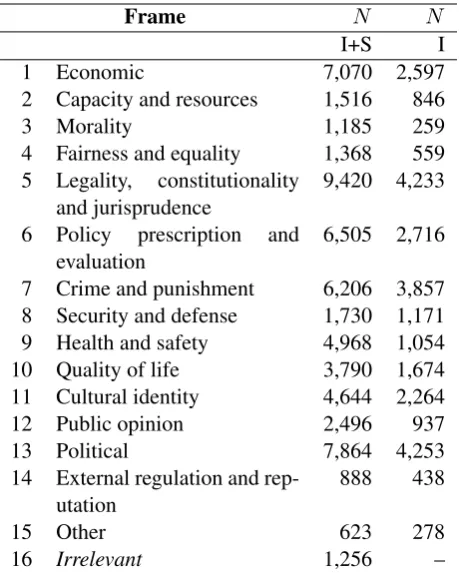
1 Economic 7,070 2,597
2 Capacity and resources 1,516 846
3 Morality 1,185 259
4 Fairness and equality 1,368 559 5 Legality, constitutionality
and jurisprudence 9,420 4,233 6 Policy prescription and
evaluation 6,505 2,716
7 Crime and punishment 6,206 3,857 8 Security and defense 1,730 1,171 9 Health and safety 4,968 1,054 10 Quality of life 3,790 1,674 11 Cultural identity 4,644 2,264
12 Public opinion 2,496 937
13 Political 7,864 4,253
14 External regulation and
rep-utation 888 438
15 Other 623 278
16 Irrelevant 1,256 –
Table 1: Frames and number of sentences for each (N), extracted from the Media Frames Corpus. I+S includes frames on immigration and smoking; I includes frames on only immigration
on the rights available in his adopted land. Legal immigrants like Flores throughout the Southwest have been applying for citizenship at record lev-els, and many say they want the right to vote to stop the spread of laws like Proposition 187. [ Le-gality, constitutionality and jurisprudence]
4 Data and Pre-processing
The Media Frames Corpus (Card et al.,2015) con-sists of news articles on three topics of immigra-tion, smoking, and same-sex marriage.1 In this corpus, each document is annotated with overall frame (this is what Card et al. (2016) used), and in each sentence, any text that cues a frame is also annotated with that frame, as seen in Example 1 above.
Table 2: The performance of different models for classification of 5 frames on both immigration and smoking (10-fold cross-validation).
Model Accuracy (%)
Majority Class (frame 5) 25.4
Uni-, bi-grams (tf-idf) 54.2
LDA 20-topics 53.3
LDA 50-topics 53.9
LDA 100-topics 53.2
Sum of vectors, pre-trained GloVe 60.2
fastText 62.0
LSTM (128 units) no pre-trained embeddings 10K 64.5
LSTM (128 units) GloVe 10K 66.7
LSTM (128 units) pre-trained GloVe 10K 67.5
BLSTM (128 units) no pre-trained embeddings 10K 64.6
BLSTM (128 units) GloVe 10K 66.8
BLSTM (128 units) pre-trained GloVe 10K 67.8
GRU (128 units) GloVe 10K 68.1
GRU (128 units) pre-trained GloVe 10K 68.7
Table 3: The performance of different mod-els for 16-way classification (15 frames plus the irrelevant category) (10-fold cross-validation); B(LSTM) and GRU models use pre-trained GloVe embeddings
Model Accuracy (%)
Majority Class (frame 5) 15.3
uni-, bi-grams (tf-idf) 38.7
50-topics 36.8
Sum of vectors, word2vec 43.2
Sum of vectors, GloVe 43.2
fastText 48.5
LSTM (128 units) 10K 52.1
BLSTM (128 units) 10K 52.5
GRU (128 units) 10K 53.7
the full vocabulary, but achieved a similar perfor-mance).
The baselines that we use are majority class and a random forest classifier6 with 90 trees trained with bag-of-words representations of the sentences. We use both unigrams and bigrams, weighted usingtf-idf. We further experiment with 20, 50, 100 topic features derived from the Gibbs-LDA++7implementation of Latent Dirichlet Allo-cation (LDA) (Blei et al.,2003). To represent the sentences with the topics, standard English stop-words were removed, and then tokens were lem-matized to their base form. To estimate the param-eters, we usedα = 50
K (K= number of topics) and
β = 0.001, and ran 1,000 Gibbs sampling itera-6Using scikit-learn (Pedregosa et al.,2011).
7http://gibbslda.sourceforge.net/
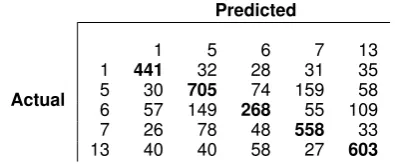
Table 4: Confusion matrix for GRU with GloVe (5 classes) specified with frame number
Predicted
Actual
1 5 6 7 13
1 441 32 28 31 35
5 30 705 74 159 58
6 57 149 268 55 109
7 26 78 48 558 33
13 40 40 58 27 603
tions and estimated the model at every 100 itera-tions.
Further, we trained a random forest classifier with sentence vectors obtained by summing the pre-trained word embeddings.
Additionally, we used the fastText (Joulin et al., 2016) classifier based on the skip-gram model, where each word is represented as a bag of char-actern-grams and the classification is performed through a hierarchical softmax.
6 Results and Discussion
Table 5: The performance of different models for classification of 5 frames on only immigration (10-fold cross-validation).
Model Accuracy (%) F1(%)
Majority Class (frame 13) 24.1 –
Uni-, bi-grams (tf-idf) 64.8 62.4
LSTM (128 units) GloVe 10K 70.5 69.9
LSTM (128 units) pre-trained GloVe 10K 70.5 70.2
BLSTM (128 units) GloVe 10K 70.0 69.7
BLSTM (128 units) pre-trained GloVe 10K 70.2 69.8
GRU (128 units) GloVe 10K 70.2 69.7
GRU (128 units) pre-trained GloVe 10K 71.2 70.7
Table 6: The performance of different models for 15-way classification on immigration set (10-fold cross-validation)
Model Accuracy (%) F1(%)
Majority Class (frame 13) 15.7 –
uni-, bi-grams (tf-idf) 49.7 44.5
LSTM (128 units) 57.7 56.0
BLSTM (128 units) 57.4 56.0
GRU (128 units) 58.7 57.1
mini-batches of 50 (we also experimented with smaller string length and mini-batches; however, the models achieved lower accuracies). On the combined set, the best accuracy (68.7%) was ob-tained by the GRU model using 300-dimension GloVe word vectors without being updated, 500 maximum string length with mini-batches of 50. This was slightly better than the results of uni-directional LSTM and bi-uni-directional LSTM mod-els, which achieve similar performance. We did not observe any performance improvement for the models when the word embeddings were updated. The models achieved very similar results with sig-moid and softmax functions. None of the mod-els that learned the embeddings on the fly outper-formed their counterparts initialized with GloVe embeddings, this shows that the semantics that are captured in word embeddings are useful for rep-resenting frames. The LSTM, BLSTM, and GRU models all outperformed the baseline random for-est classifier with sentence vectors obtained by summing the pre-trained word-embeddings, this shows that this baseline classifier cannot learn the sentence representation of frames.
Using the full vocabulary (about 30,000) did not impact the performance of the BLSTM model with GloVe embeddings. All LSTM, BLSTM, and GRU models yielded at least a 10-point
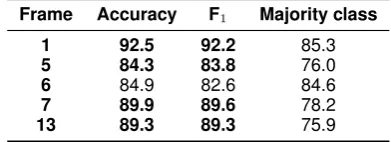
improve-Table 7: The performance of one-against the oth-ers classification achieved by GRU model on im-migration set (10-fold cross-validation)
Frame Accuracy F1 Majority class
1 92.5 92.2 85.3
5 84.3 83.8 76.0
6 84.9 82.6 84.6
7 89.9 89.6 78.2
13 89.3 89.3 75.9
ment over the random forest classifier trained with topics. A confusion matrix for the best-performing GRU model is shown in Table4. Thepolicy pre-scription and evaluationframe is often misclassi-fied as thelegality, constitutionality, and jurispru-dence frame, which can be expected, as these frames are more likely to have overlapping expres-sions.
Tables 5 and6 present the frame detection re-sults for the sets of 5 and 15 frames on immi-gration corpus respectively. LSTM and BLSTM models perform similarly on the immigration set as well. The best performance (71.2%) is achieved again by GRU model, which is about 6-point above the bag-of-words baseline.
One-against-others Classification We wanted to see how different frames were effected by the model, so we performed a one-against-others clas-sification, where each frame is tested against the rest of frames in the corpus. Table 7 presents the results. We only considered the five most fre-quent frames. Thepoliticalandcrime and punish-ment frames are recognized better than the other frames. While the training set for frame eco-nomicis smaller than the training set for legality
Amita Misra, Pranav Anand, Jean E. Fox Tree, and Marilyn A. Walker. 2015. Using summarization to discover argument facets in online idealogical [sic] dialog. In NAACL HLT 2015, The 2015 Confer-ence of the North American Chapter of the Associ-ation for ComputAssoci-ational Linguistics: Human Lan-guage Technologies, Denver, Colorado, USA, May 31 - June 5, 2015. pages 430–440.
Nona Naderi and Graeme Hirst. 2016. Argumenta-tion mining in parliamentary discourse. In Mat-teo Baldoni et al., editor, Principles and Practice of Multi-Agent Systems, Springer International Pub-lishing, pages 16–25.
Viet-An Nguyen, Jordan Boyd-Graber, Philip Resnik, and Kristina Miler. 2015. Tea Party in the house: A hierarchical ideal point topic model and its applica-tion to Republican legislators in the 112th Congress. In Proceedings of the 53rd Annual Meeting of the Association for Computational Linguistics and the 7th International Joint Conference on Natural Lan-guage Processing (Volume 1: Long Papers). Asso-ciation for Computational Linguistics, pages 1438– 1448.
F. Pedregosa, G. Varoquaux, A. Gramfort, V. Michel, B. Thirion, O. Grisel, M. Blondel, P. Pretten-hofer, R. Weiss, V. Dubourg, J. Vanderplas, A. Pas-sos, D. Cournapeau, M. Brucher, M. Perrot, and E. Duchesnay. 2011. Scikit-learn: Machine learning in Python. Journal of Machine Learning Research
12:2825–2830.
Jeffrey Pennington, Richard Socher, and Christo-pher D. Manning. 2014. GloVe: Global vectors for word representation. InEmpirical Methods in Nat-ural Language Processing (EMNLP). pages 1532– 1543.