84
Strength and Durability Studies on Concrete Containing
Foundry Sand and GGBS
Roshni K G
1, Vineeth P C
2Department of Civil Engineering1,2, PG Student1,Assistant Professor2, Universal Engineering College, Kerala, India,
Email:[email protected]1,[email protected]2
Abstract-This research was conducted to establish the effects of GGBFS and used foundry sand on strength and durability of concrete.This project is relevant as cost of the building material is increasing and availability of the material is decreasing, which leads to many environmental issues. Sand in the concrete was replaced by foundry sand and the cement was replaced by GGBFS in different proportions. Quarry sand was replaced by0, 15, 25, 35 and 45%, and cement was replaced at a percentage of 0, 30 and 50%. The strength and durability properties of the mixes were compared with the properties of conventional concrete mix. Strength tests such as compressive strength, split tensile strength, and durability properties such as sulphate attack, and water absorption tests were carried out.From the results it can be concluded that foundry sand and GGBS can be effectively used as replacing materials in concrete.
Index Terms-Foundry sand; GGBS; Strength; Durability
1. INTRODUCTION
Concrete is the most commonly used construction material because of its low cost, availability of raw materials, strength, and durability.Nowadays there is an enhanced development in construction, thus there is an increase in cost of construction materials. It is also due to the deficiency of materials from environmental sources. So search for some other materials is important which do not cause any environmental issues. It leads to the importance of this research in which the strength and durability properties of partially replaced concrete is made into study.
Foundry sand is high quality silica sand with uniform physical characteristics. It is a by-product of ferrous and non-ferrous metal casting industries, where sand has been used for centuries as a molding material because of its thermal conductivity. Foundries recycle and reuse the sand many times in a foundry. When the sand cannot be reused in the foundry, it is removed from the foundry and is called as foundry sand. The ground granulated blast furnace slag (GGBS) is a waste product from the iron manufacturing industry which may be used as a partially replacingmaterial of cement in concrete due to its cementing properties.
2. EXPERIMENTAL INVESTIGATION 2.1. Materials
2.1.1. Cement
Portlandpozzolana cementof 53 grade available in local market was used in the whole testing. Tests were conducted on cement to determine standard consistency, initial and final setting time, and specific
gravity as per IS 4031-1988. It was confirmed that the properties of cement is according to the specifications as per IS 12269-1987.
2.1.2. Coarse aggregate
The coarse aggregate chosen for Concrete was typically angular in shape, well graded, and smaller than maximum size suited for conventional concrete. The coarse aggregate used in the experiment were of 20mm size, and were tested as per IS: 2386-1963 (I, II and III) specifications.Specificgravity of coarse aggregate was found as 2.64.
2.1.3. Fine Aggregate
Fine aggregate used for experiment was locally available quarry sand conforming to grading zone II as per IS: 383-1970, and having specific gravity of 2.5 and fineness modulus 3.83. The maximum size of fine aggregate was taken as 4.75 mm.
2.1.4
.
Super PlasticizerA super plasticizer confirming to IS- 9103-1979 by trade name CONPLAST SP430 in the form of
sulphonated naphthalene polymer available in local
market was used. 2.1.5. Water
85 2.1.6
.Used
Foundry Sand (UFS)The foundry sand was collected from an iron industry inKolapully, Kerala. The specific gravity of Foundry sand was found as2.3. The testing was done as per IS: 383-1970. Sieve analysis results shows that it contains a good amount of finer particles. Sand used in foundries will have a sticky property, but when it exposed to continuous heating its sticky property get vanished which makes it a waste product from foundries.
Table 1. Physical properties of UFS
Property Results
Specific Gravity 2.3
Bulk Relative Density, kg/m3 2589
Absorption 0.45%
Moisture content 0.1-10.1
Fig.2. Foundry sand
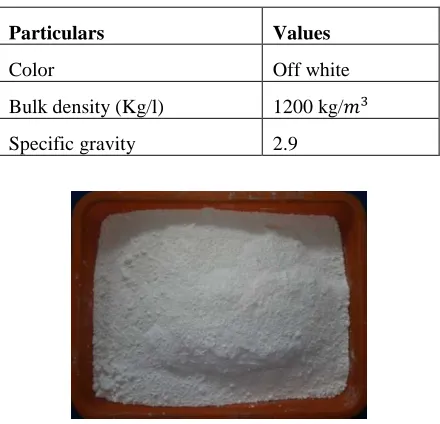
2.1.5 Ground Granulated Blast Furnace Slag (GGBS) The material was collected from an industry in Mathikare near Bangalore.It has very good cementitious property and proven as a good replacing material of cement.
Table 2. Physical properties of GGBS
Fig.2. GGBS
2.2. Design Mix Methodology
A cement concrete M30 mix was designed as per IS: 10262-1982. In present study fine aggregate was replaced by foundry sand at 0, 15, 25, 35, and 45 %, and cement was replaced at 0, 30, and 50%. The same mix design was used for all the mixes. Water content was fixed as 0.45. The design mix proportion is given in table 3. Weight of materials in m3 can be given as, Cement = 377.78 kg/m3
Fine Aggregate = 655 kg/m3 Coarse Aggregate = 1246 kg/m3 Water = 170 lit
Different mixed in the study are as follows Table 3. Types of concrete mixes
Mix
Quarr y sand (%)
Foundry sand (%)
Cement (%)
GGBS (%)
CM 100 0 100 0
FG-15-0 85 15 100 0
FG-25-0 75 25 100 0
FG-35-0 65 35 100 0
FG-45-0 55 45 100 0
FG-15-30 85 15 70 30
FG-25-30 75 25 70 30
FG-35-30 65 35 70 30
FG-45-30 55 45 70 30
FG-15-50 15 15 50 50
FG-25-50 25 25 50 50
FG-35-50 35 35 50 50
FG-45-50 45 45 50 50
2.3 Testing Methodology
2.3.1. Test Details
Minimum three numbers of samples were made for each mix. A total number of 156 samples were made for this project. Sizes of each sample are specified in table 4.
Table 4. Size of specimens
Tests Specimen size (mm)
Compression test 150×150×150 Split tensile test 300×150 Flexural test 100×100×500 Water absorption 150×150×150 Sulphate attack 100×100×100 Carbonation 200×100
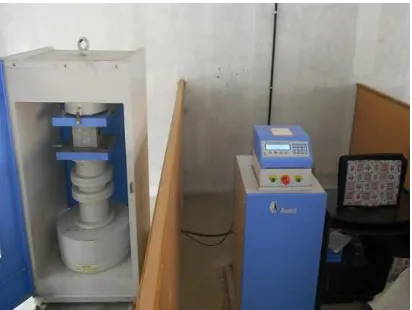
Testing of specimens for compressive strength and flexural strength were carried out according to
Particulars Values
Color Off white
Bulk density (Kg/l) 1200 kg/݉ଷ
88 3. CONCLUSION
From the test results we can summarize the following conclusions:
• The maximum strength was obtained for 25% foundry sand and 30% GGBS mix. • All mixes of 30% GGBS mixes shown a
good strength comparing with control mix. It is due to good packing of materials which indicates the pozzolanicproperties of GGBS provide strength to mix.
• As comparing with mixes without GGBS 30% GGBS mixes showed a good result. • Water absorption was more in replacing
material mixes as compared with control mix, but it was in the limit. So it is safe against water absorption
• The material replacing mixes showed a good resistance to sulphate attack than control mix. So these material mix can be effectively used in highly sulphate regions.
• As the percentage of GGBS increases carbonation also increases. It may be due to the chemical properties of GGBS. So it can only be used up to a limit.
• It can be concluded that replacing of fine aggregate with foundry sand is possible upto 35%, when GGBS is used to replace the cement upto 30%. Without GGBS only up to 25% replacement of fine aggregate is possible.
REFERENCES
[1] Ganesh, P. G.; Hyun, J. H.;Kim, Y.Y.(2014): Effects of foundry sand as a fine aggregate in concrete production. Construction and Building Materials, ScienceDirect, 35(5), pp. 687-692.
[2] Arivalagan, S. (2014): Sustainable Studies on Concrete with GGBS as a Replacement Material in Cement. Jordan Journal of Civil Engineering, 8 (3), pp. 263-270.
[3] Singh, G.; Siddique, R. (2012): Abrasion resistance and strength properties of concrete containing waste foundry sand (WFS). Construction and Building Materials, ScienceDirect, 28, pp. 421-426.
[4] Bhimani, D. R.; Pitroda, J.; Bhavsar, J. J. (2013): Used Foundry Sand: Opportunities For Development Of Eco-friendly Low Cost
Concrete. International Journal of Advanced Engineering Technology, 4 (1), pp. 63-66. [5] Sohail, M. D; Abdul W.; Khan, A. M.
(2013): A Study on the Mechanical Properties of Concrete by Replacing Sand with Waste Foundry Sand. International Journal of Emerging Technology and Advanced Engineering, 3 (11), pp. 83- 88. [6] Divsholi, B. S.; Lim, T. Y. D.; Teng, S.
(2014): Durability properties and microstructure of ground granulated blast furnace slag cement concrete. International journal of concrete structures and materials,8(2), pp. 157-164.
[7] Malagavelli, V.; Rao, P. N. (2010): High performance concrete with GGBS and Robo sand. International journal of Engineering science and technology, 2(10), pp. 5107-5113. [8] Siddique, R.; Aggarwal, Y.; Aggarwal, P.; Kadri, E.; Bennacer, R. (2011): Strength, durability, and micro-structural properties of concrete made with used-foundry sand (UFS). Construction and Building Materials,ScienceDirect, 25, pp. 1916-1925. [9] Siddique, R.; Shutter, G.; Noumowe, A.