AD-Classifier: Automatically Assigning Denotation Types to ominalizations
Aina Peris*, Mariona Taulé*, Gemma Boleda**, Horacio Rodríguez**
*CLiC, Centre de Llenguatge i Computació - University of BarcelonaGran Via de les Corts Catalanes 585, 08007 Barcelona {aina.peris, mtaule}@ub.edu
**TALP Research Center - Technical University of Catalonia Jordi Girona Salgado 1-3, 08034 Barcelona
{gboleda, horacio}@lsi.upc.edu
Abstract
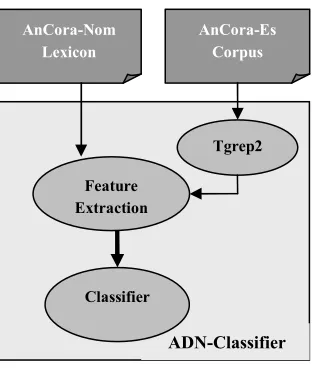
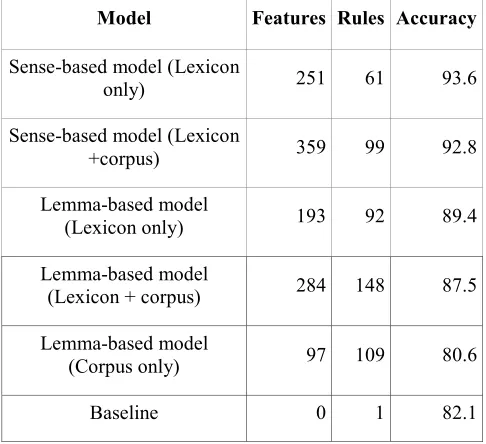
This paper presents the ADN-Classifier, an Automatic classification system of Spanish Deverbal Nominalizations aimed at identifying its semantic denotation (i.e. event, result, underspecified, or lexicalized). The classifier can be used for NLP tasks such as coreference resolution or paraphrase detection. To our knowledge, the ADN-Classifier is the first effort in acquisition of denotations for nominalizations using Machine Learning.We compare the results of the classifier when using a decreasing number of Knowledge Sources, namely (1) the complete nominal lexicon (AnCora-Nom) that includes sense distictions, (2) the nominal lexicon (AnCora-Nom) removing the sense-specific information, (3) nominalizations’ context information obtained from a treebank corpus (AnCora-Es) and (4) the combination of the previous linguistic resources. In a realistic scenario, that is, without sense distinction, the best results achieved are those taking into account the information declared in the lexicon (89.40% accuracy). This shows that the lexicon contains crucial information (such as argument structure) that corpus-derived features cannot substitute for.
1.
Introduction
This paper presents the ADN-Classifier, an Automatic
classification system of Spanish Deverbal
Nominalizations aimed at identifying its semantic denotation (i.e. event, result, underspecified, or lexicalized). The initial purpose of the ADN-classifier is to enrich the annotation of deverbal nominalizations in AnCora-Es corpus (Taulé et al., 2008) with this kind of information. Both the corpus and the machine learning experiments can give also more insight into the underlying linguistic question. Furthermore, the classifier can be used independently in other NLP tasks, such as coreference resolution or paraphrase detection. Regarding the first one, it is important to note that event and result nouns require different types of anaphoric pronouns in some languages. For instance, in Catalan the pronoun ‘ho’ refers to an event nominalization (‘La matriculació de tots
els alumnes es fa cada setembre. Ho permet l’entorn
informàtic de la universitat1) whereas ‘el/la’ refer to result
nouns (eg. ‘La construcció és molt innovadora. L’ha
dissenyada el millor arquitecte del moment’2). Therefore,
to have them classified can be useful to detect coreference chains. As for the second one, event nouns (but not result nouns) are paraphrases for full sentences, so this type of information can also be useful for paraphrase detection. In Peris et al. (2009) a set of experiments were carried out in order to detect the most relevant features for the denotative distinction between event and result nominalizations. In these experiments, the foundations of the automatic classification system presented here were set. However, the experiments were mainly based on information manually coded in the lexicon. This approach does not easily extend to nominalizations and examples
1
‘The inscription of the pupils is every Setember. This is permitted by the univerty’s software.’
2
‘The building is very innovative. It has been designed by the most famous architect at the moment’.
not covered in the lexicon. Here we evaluate to what extent this type of information can be recovered directly from the corpus AnCora-Es.
The paper is organized as follows. First, in section 2 we briefly discuss related work. Next, in section 3 we describe the ADN-Classifier, the different components and the resources used: AnCora-Es and AnCora-Nom. We then present in section 4 the results obtained. And finally, the main conclusions and final remarks are given in section 5.
2.
Related Work
Related work on the computational treatment of nominalizations goes mainly in two directions. The first one is automatically classifying semantic relations in noun phrases. Task 4 of Sem-Eval 2007 shows a wide variety of automatic methods aiming to the classification of semantic relations (Girju et al., 2009).
More specific works related to nominalizations are Girju et al. (2004) and Lapata (2002). The former distinguish 35 semantic relations within NPs in which either the head or the modifier noun is derived from a verb. Some of these semantic relations can be seen as thematic role/argument relations (AGENT, THEME, TEMPORAL, CAUSE, EXPERIENCER, LOCATION, and PURPOSE). The latter focuses on the task of interpreting the semantic
relations “subj” or “obj”3 between the nominalization and
its modifiers.
The second line of research consists of benefiting from verbal data to interpret, represent and assign semantic roles to nominalizations. Hull & Gomez (2000) design a series of algorithms that use verbal information (verbal senses and subcategorization frames) taking into account some specific noun constraints (specific order of noun arguments, constituents requirements for argument realization, different preposition in prepositional phrases
3
Figure 3: A partial parse tree from AnCora of the sentence “a_través_de denuncias puntuales se constatan aumentos del 50%”
(‘Through punctual claims increases of 50 % are observed’)
When building the lexicon, the different readings a
particular lemma shows in the corpus (say, event and
result) are identified and the examples corresponding to each reading are grouped in the lexical entry. In Figure 2, the aumento sense 2 that corresponds to a result reading is associated to two examples. Therefore, the properties found in any particular example are shared by the remaining examples of the relevant sense of the lemma. Since we have 817 lemmas and 3,077 examples, the average number of examples per lemma is 3.8.
Also, note that we have experimented with binarization and grouping of several of the features. Due to the excessive dispersion of the values in some features, we have grouped some of the values in order to facilitate the learning process. For example, in the sp feature, without grouping, the number of possible values is 101, which is too high. Two types of groupings have been considered: i) one that takes into account the number of the argument (Arg0, Arg1, Arg2, Arg3, Arg4, ArgM in addition to the no argument value, CN, thus, 7 possible values); and ii) a fine grained one, which incorporates to the code the preposition involved (Arg0-con, Arg0-de, etc.), giving rise to 60 possible values (for details, see Peris et al. 2009).
Features from the AnCora corpus. These features contain information that can be extracted directly from the syntactic tree of the corpus. Any information present in the treebank but not directly derived from the parse tree is not taken into account.
In Figure 3, a partial parse tree with all the associated morphosyntactic and semantic information is presented. From these trees we obtained the following features:
a) The corpus versions of the features from the lexicon
specified above: the type of specifier, the number (plural or singular), the constituent type of the complements.
b) Other contextual features such as tense and semantic
class of the main verb in the sentence; syntactic function of the nominalization; and whether the noun appears in a named entity.
For the extraction of features from the corpus, we use the Tgrep218 tool, which allows us to efficiently inspect the syntactic trees in a Treebank format. Below, we show an example of a tgrep2 rule that illustrates the extraction of the feature plural. The feature plural is very useful since is taken by the classifier as a rule for detecting result nominalizations:
tgrep2 -c AnCora_Es.tbf.t2c -a -l -w '(sn < ("grup.nom" < (n < /aumento/ < /num:p/)))'
This pattern can be paraphrased as “look for a NP (“sn”)
that dominates immediately a nominal group
(“grup.nom”), which, in turn, dominates a noun (“n”) with the lemma aumento that appears in plural (“num:p”). In the treebank shown in Figure 3, the tgrep2 rule above will set the plural feature to “True” since aumento appears in plural in the example, which is marked in the number attribute (cf. “num:p”).
Other tgrep2 rules will allow us to recognize the other corpus features. In Figure 3, the tgrep2 rules detect that in this example, the nominalization is not specified, that is, it does not have a determiner; the nominalization complement is a prepositional phrase introduced by the preposition “de”; the main verb in the sentence
18
http://tedlab.mit.edu/~dr/TGrep2/ (sp #arg:argM#func:cc#tem:adv#
(prep ##
(s #gen:c#lem:a_través_de#num:c#pos:sps00#postype:preposition#wd:a_través_de#)) (sn #entityref:nne#
(grup.nom #gen:f#num:p#
(n #gen:f#lem:denuncia#num:p#pos:ncfp000#postype:common#sense:16-col-05051294#wd:denuncias#) (s.a #gen:f#num:p#
(grup.a #gen:f#num:p#
(a #gen:c#lem:puntual#num:p#pos:aq0cp0#postype:qualificative#wd:puntuales#)))))) (morfema.verbal #func:pass#
(p #gen:c#lem:se#num:c#pos:p0000000#wd:se#)) (grup.verb ##
(v.els:b2#gen:c#lem:constatar#mood:indicative#num:p#person:3#pos:vmip3p0#postype:main#tense:present#wd:constatan#)) (sn #arg:arg1#entity:entity12#entityref:nne#func:suj#tem:pat#
(grup.nom #gen:m#num:p#
(n #gen:m#lem:aumento#num:p#pos:ncmp000#postype:common#sense:16-col-03984543#wd:aumentos#) (sp ##
(prep ##
(s #contracted:yes#gen:m#lem:del#num:s#pos:spcms#postype:preposition#wd:del#)) (sn #entityref:ne#ne:number#
(grup.nom #gen:m#num:s#
Another line of improvement will consist in relaxing the constraint on the full coverage using a threshold to remove the least accurate rules. This procedure may be useful for the automatic annotation of AnCora corpus.
6.
Acknowledgements
This research has received support from the projects
Text-Knowledge 2.0 (TIN2009-13391-C04-04),
AnCora-Nom (FFI2008-02691-E), AnCora-Net
(FFI2009-06497-E/FILO), KNOW2
(TIN2009-14715-C04-04) and OntoSem
(Hum2007-60599/FILO), from the Spanish Ministry of Science and Innovation, and the program Juan de la
Cierva (JCI-2007-57-1479) and a FPU grant
(AP2007-01028) from the Spanish Ministry of Education. We also thank three anonymous reviewers for their comments and suggestions.
7.
References
Alexiadou, Artemis (2001). The Functional Structure in -ominals. -ominalization and Ergativity. Amsterdam / Philadelphia. John Benjamins.
Aparicio Aparicio, Juan., Mariona Taulé & M.Antònia. Martí (2008). AnCora-Verb: A Lexical Resource for the
Semantic Annotation of Corpora. In Proceedings of
Language, Resources and Evaluation, LREC 2008. Marrakech, Morocco.
Eberle, Kurt, Gertrud Faaß & Ulrich Heid (2009). Corpus-based identification and disambiguation of reading indicators for German nominalisations. Corpus Linguistics 2009. Liverpool, UK.
Grimshaw, Jane (1990). Argument Structure. Cambridge, Massachussets: The MIT Press.
Girju, Roxana, Ana Maria Giuglea, Marian Olteanu, Ovidu Fortu, Orest Bolohan & Dan Moldovan (2004). Support Vector Machines applied to the Classification of Semantic Relations in Nominalized Noun Phrases. In Proceedings of HLT--AACL. Computational Semanticc Workshop. Boston, MA.
Girju, Roxana, Preslav Nakov, Vivi Nastase, Stan Szpakowicz, Peter Turney, & Deniz Yuret (2007). SemEval-2007 task 04: classification of semantic
relations between nominals. In SemEval '07:
Proceedings of the 4th International Workshop on Semantic Evaluations. Association for Computational Linguistics. Prague, Czech Republic.
Gurevich, Olga, Richard Crouch, Tracy Holloway King & Valeria De Paiva (2006). Deverbal Nouns in Knowledge Representation. In Proceedings of FLAIRS. Melbourne Beach, FL.
Hull, Richard D. & Fernando Gomez (2000). Semantic interpretation of deverbal nominalizations. In -atural Language Engineering. Cambridge University Press. Lapata, Maria. (2002). The Disambiguation of
Nominalizations. Computational Linguistics. Vol 23
(3). MIT Press.
Padó, Sebastian, Marco Pennacchiotti & Caroline Sporleder. (2008). Semantic role assignment for event nominalizations by leveraging verbal data. In
Proceedings of the 22nd International Conference on Computational Linguistics (Coling). Manchester. Peris, Aina & Mariona Taulé ( 2009). Evaluación de los
criterios lingüísticos para la distinción evento y resultado en los sustantivos deverbales. In Proceedings of the 1st International Conference on Corpus Linguistics (CILC-09), Murcia, Spain.
Peris, Aina, Mariona Taulé & Horacio Rodríguez (2009). Hacia un sistema de clasificación automática de
sustantivos deverbales. Procesamiento del Lenguaje
-atural, 43. Jaén, Spain.
Picallo, Carme (1999). La estructura del sintagma nominal: las nominalizaciones y otros sustantivos con complementos argumentales. In Bosque & Demonte (Eds.) Gramática Descriptiva de la Lengua Española. Real Academia Española. Espasa Calpe, Madrid, Spain.
Pustejovsky, James (1995). The Generative Lexicon.
Cambridge. MIT Press.
Quinlan, J. Ross (1993). C4.5: Programs for Machine
Learning. San Francisco. Morgan Kaufmann.
Taulé, Mariona., M.Antònia. Martí & Marta Recasens (2008). AnCora: Multilevel Annotated Corpora for
Catalan and Spanish. In Proceedings of Language,
Resources and Evaluation, LREC 2008. Marrakech, Morocco.
Witten, Ian H. & Eibe Frank (2005). Data Mining: