DiSCo — A German Evaluation Corpus for Challenging Problems in the
Broadcast Domain
Doris Baum
∗, Daniel Schneider
∗, Rolf Bardeli
∗, Jochen Schwenninger
∗,
Barbara Samlowski
†, Thomas Winkler
∗, Joachim K¨ohler
∗∗Fraunhofer IAIS
Sankt Augustin, Germany
{firstname.lastname}@iais.fraunhofer.de
†Institut f¨ur Kommunikationswissenschaften
University of Bonn Bonn, Germany [email protected]
Abstract
Typical broadcast material contains not only studio-recorded texts read by trained speakers, but also spontaneous and dialect speech, debates with cross-talk, voice-overs, and on-site reports with difficult acoustic environments. Standard approaches to speech and speaker recognition usually deteriorate under such conditions. This paper reports on the design, construction, and experimental analysis of DiSCo, a German corpus for the evaluation of speech and speaker recognition on challenging material from the broadcast domain. One of the key requirements for the design of this corpus was a good coverage of different types of serious programmes beyond clean speech and planned speech broadcast news. Corpus annotation encompasses manual segmentation, an orthographic transcription, and labelling with speech mode, dialect, and noise type. We indicate typical use cases for the corpus by reporting results from ASR, speech search, and speaker recognition on the new corpus, thereby obtaining insights into the difficulty of audio recognition on the various classes.
1.
Introduction
In order to develop robust methods for automatic multime-dia indexing and retrieval of broadcast data, a representa-tive evaluation corpus is needed to assess new approaches. Although there is ample demand for robust methods for in-dexing and retrieval of broadcast data, hardly any speech corpus exists covering both clean speech and more chal-lenging speech segments. Such a multi-purpose broadcast corpus should contain material reflecting common difficult acoustic conditions present in general broadcast data, such as spontaneous speech, background noise, and dialect, as well as clean studio material for comparison. It should also have a sufficient number of speakers to cover variations in speaking style and dialect and to be able to meaning-fully test speaker recognition systems. Although there are German speech corpora with broadcast data for a number of tasks (Grimm et al., 2008; Hecht et al., 2002), no cor-pus fulfilling all aforementioned requirements is currently available.
Also in other languages, evaluation corpora for rich tran-scription often focus on the broadcast domain (NIST, 2003; Galliano et al., 2006). Some of these corpora (NIST, 1999) deliberately exclude difficult material like sports broadcasts that has been judged as too difficult at the time of corpus creation. Incorporating material that is likely to become the next level of difficulty that can be managed is a main task for new speech recognition corpora. Annotating in depth to cover such effects is highly time-consuming, and thus such corpora usually comprise only a few hours of material (e.g. 3 hours for the NIST-RT03-BN-English corpus and 10 hours for the ESTER corpus).
This paper describes the design and characteristics of a new
speech and speaker evaluation corpus, DiSCo (Difficult Speech Corpus), with the goal of measuring and improving audio analysis performance on broadcast material beyond planned and clean speech data.
2.
Corpus Design
One of the key requirements for the corpus design was a good coverage of different types of serious programmes be-yond clean speech and planned speech broadcast news. As it was not feasible to record hundreds of different shows, common categories of programmes and typical speech, speaker and background noise characteristics of informa-tion shows were analysed. The major background noise and speech characteristics predefined several of the annota-tion classes described in detail in Secannota-tion 3. Furthermore, we used these characteristics and the relevant categories of programmes to select representative broadcasts in order to cover all important conditions. We recorded 18 hours of video material, comprising 29 broadcasts from 8 types of programmes. They fall into the following categories:
• Newsmostly have a formal and planned speaking style because texts are read by professional newscasters. They contain long passages of clean speech, which can be used for comparisons against more complicated data. During reports and commentaries from experts and politicians, however, background noise is often present, and in many cases news summaries are read against a background of music.
Table 1: Amount of material in DiSCo for the 8 programme types.
Programme Type Material Percentage (hh:mm)
News broadcasts 01:12 6%
Political interview shows 02:23 13% Sports commentaries 02:01 11%
Science shows 02:00 11%
Political talk shows 04:45 25%
Regional reports 01:30 8%
Foreign affairs reports 03:05 16% Television news magazines 01:45 9%
All 18:40 100%
• Sports commentariesfeature news from the world of sports, with German shows often focusing on foot-ball events. They contain interviews, sometimes with voice-over translations, as well as a considerable amount of audience and stadium noise. A difficulty they pose for spoken document retrieval is the higher out-of-vocabulary (OOV) rate due to the large num-ber of sports terms and foreign names of athletes not present in the speech recogniser’s dictionary.
• Science shows are often conducted in a planned speech style during the documentary part and in spon-taneous style during announcements and discussions. Background music is particularly prevalent here. Sim-ilar to sports commentaries, the technical terms and topics of science shows differ from those present in normal broadcast news training material, thus poten-tially increasing the OOV rate.
• Political talk shows contain debates of politicians, public figures and others, displaying passages of spon-taneous speech and considerable speaker overlap.
• Regional reports cover news from specific regions and thus have a lot of accented or dialectal mate-rial, often including on-scene interviews with noise or added music. Our corpus contains broadcasts from Bavaria, where the local dialect contrasts strongly with standard German.
• Foreign affairs reportsare similar in structure to re-gional reports. However, instead of dialect they con-tain a lot of foreign speech with voice-over transla-tions, adding more material with background speech to the corpus.
• Television news magazines contain a broad mix of material: prepared reports, often with background mu-sic and on-site interviews, planned speech announce-ments, spontaneous speech and speaker overlap, and background noise from the audience.
Table 1 shows the amount of material for each programme type in the corpus. All recorded material was manually segmented and orthographically annotated with Transcriber (Barras et al., 2001), according to a set of transcription rules
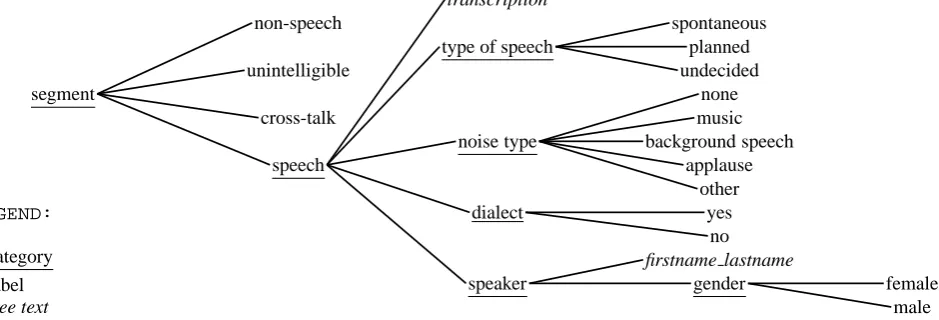
defined in advance. Non-speech, unintelligible speech, and cross-talk segments were labelled with special markers. The resulting annotations were then labelled with speech type, noise type, dialect usage, and speaker name. Figure 1 shows the steps of the annotation process and the possible labels for each category of annotation.
3.
Corpus Annotation
In the first phase of the annotation process, the corpus was segmented and transcribed by a professional typist. The program Transcriber used for this purpose provides a graphical interface that allows users to view and listen to the audio signal in question, create and move boundaries, and transcribe the resulting segments. The output file con-sists of an XML-structure containing points in time for the segment boundaries as well as the transcribed utterances. During transcription boundaries were placed at prompted speech pauses, speaker change and changes from and to dif-ferent types of non-speech. Separate segments were created for speech pauses with a minimum length of 0.5 seconds as well as for periods of untranscribable speech. Maximum length of speech segments was set at 20 seconds.
Segments not orthographically transcribed were marked as
• non-speech if they consisted of silence, mere back-ground noise or music only.
• unintelligible if they contained foreign speech or speech that was otherwise indiscernible or unintelli-gible to the transcriber.
• cross-talk if two or more speakers were talking si-multaneously in conversation so that no main speaker could be identified.
In order to avoid inconsistencies, we created guidelines to determine how the transcriber should deal with phenomena such as numbers, compound words, hesitations, contrac-tions, and mispronounced words. As the transcriptions had to model an ideal speech recognition output and conform to the conventions used in the pronunciation dictionary, no distinction was made between word pronunciation varia-tions due to dialect or speech style. Colloquial expressions or contractions were only included in the transcriptions if they were listed in the pronunciation dictionary. In gen-eral, the transcriptions contained little information below the level of standardised words. Speech disfluencies, how-ever, were transcribed as follows: A single tag was used to indicate hesitations such as ”um”, ”err” or ”hmm”. For stut-tered, mispronounced, or cut-off words, the intended word was transcribed and marked with an asterisk in order to al-low further analysis of these speech items. Repeated whole words were also repeated in the transcription.
Figure 1: Steps of transcription and annotation. Multiple labels are possible as long as attributes are not contradicting.
transcription
non-speech spontaneous
type of speech planned
unintelligible undecided
segment none
cross-talk music
noise type background speech
speech applause
other
LEGEND: dialect yes
no
category firstname lastname
label speaker gender female
free text male
and labels of all created segments. In this case, four tiers were used, each having a particular set of possible attributes with which the data could be classified. The various anno-tation levels were distributed among different annotators, allowing them to concentrate on one aspect only.
• Type of Speech: Here the possible labels were ”planned” and ”spontaneous”. Only read or thor-oughly prepared speech segments were classified as planned; others were tagged as ”spontaneous”. For unclear cases no label was given.
• Noise Type: In this tier, background noise was la-belled and subdivided into the categories ”music”, ”applause”, ”background speech” and ”other”. Seg-ments with no background noise were left unlabelled. Because of the heterogeneous nature of background noise, it was possible and often necessary to apply more than one label to a speech segment.
• Dialect: The decision here was binary. If segments were characterized by regional or foreign accents they were marked as ”dialect”; otherwise they were not la-belled. Dialect in this context was defined as an ac-cent sufficiently distinct to give an indication of the speaker’s place of origin.
• Speaker Names: Prominent speakers and other speakers known by name were identified in the anno-tations by forename and surname. Unknown speakers were labelled with a combination of the name and date of the program in which they appeared and numbered consecutively. Speaker gender was also encoded in this tier.
The terms used for the labels were chosen to represent the desired categories as closely as possible while at the same time remaining nontechnical and easily understandable by the annotators. Nonetheless, it proved difficult to avoid in-consistencies. Annotators were biased in their decisions by varying contexts as well as their own experience. For this reason, the annotation process was iterative. In order do define the labelling categories more clearly, we analysed a subset of the annotations and refined the annotation rules
detailing the type of data the categories should include. Where expedient, the annotations were then revised accord-ing to the new guidelines.
4.
Evaluation Plan
We prepared an evaluation plan for several interesting anal-ysis tasks in order to standardise future evaluations on the new corpus. This will enable the comparison of different approaches to the same problem using the exact same data and task setup. As a starting point, we identified three ar-eas of audio processing where DiSCo should serve as an evaluation corpus, which are defined as follows:
• Automatic speech recognition (ASR) is the task of transcribing each segment with the label speech, either producing a standard word transcription or sub-word units (such as syllables or phonemes).
• Spoken term detection (STD) is the task of searching for a written query in a set of spoken utterances. Spo-ken term detection is closely connected to automatic speech recognition.
• Speaker recognition (SR) predicts the name of the speaker of a given speech segment using a finite set of pre-defined speaker models. The system should de-tect whether the speaker is known or not, i.e., the set of possible speakers is not closed.
4.1. ASR and STD
Table 2: ASR and STD evaluation data.
Attributes Speech Utter- Query Material ances Occurr. (hh:mm)
planned, none 00:55 1364 268 planned, music 01:11 1789 317 planned, bg. speech 00:29 727 89 planned, applause 00:06 115 41 planned, dialect 00:13 318 54 spontan., none 01:55 2861 425 all speech segments 11:44 17152 2736
For evaluating the retrieval approaches, a query set was de-signed semi-automatically from the manual reference tran-scriptions. First, we applied the Term Selection Tool pro-vided by NIST1, which automatically extracted a set of queries from the training corpus. In order to augment the training set with more real-world queries, five individuals were asked to manually select ten queries from the tran-scription text. These 50 queries were added to the automat-ically generated list, yielding a total set of 501 queries. Ta-ble 2 shows the distribution of the query occurrences among the data sets.
4.2. Speaker Recognition
For the speaker recognition evaluation, we compiled differ-ent evaluation sets for assessing the effect of typical broad-cast background noise on speaker recognition performance, one for each noise category.
There are 1073 speakers in the corpus (772 male, 301 fe-male), with an average of approximately 1 minute of mate-rial (cleanandnoisy, also including crosstalk) per speaker. The apparent gender imbalance is typical for broadcast ma-terial, thus we did not try to alter the male/female-ratio in the test set. The amount of material available is un-evenly distributed, with only 183 speakers actually having a minute or more. The others are, for example, unnamed speakers from short street interviews, occuring only for a few seconds in one broadcast.
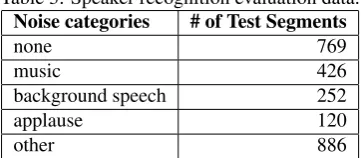
For speaker recognition evaluation, we selected a set of 70 (53 male, 17 female) test speakers which had sufficient clean (at least 30 seconds used for training) and noisy ma-terial. Many of these speakers are well-known politicians, anchorpeople, journalists, or celebrities. 897 of the other speakers were used as impostors. From each of the test speakers, we reserved at least 30 seconds of clean data for training the speaker models (see section 5.2.). From the re-maining data we selected the test material including clean and noise segments belonging to only one noise category using at most 5 segments per category and speaker. Cross-talk segments were not used for the evaluation. The respec-tive sets shown in Table 3 include both planned and sponta-neous speech. The average segment length is 2.3 seconds.
1
http://www.itl.nist.gov/iad/mig/tests/std/tools/
Table 3: Speaker recognition evaluation data.
Noise categories # of Test Segments
none 769
music 426
background speech 252
applause 120
other 886
Table 4: Word error rate (WER) and spoken term detection (STD) performance on the individual subsets.
Data Set WER Precision Recall
planned, none 26.4 % 0.96 0.85 planned, music 32.7 % 0.93 0.74 planned, bg. speech 32.6 % 0.89 0.75 planned, applause 63.5 % 0.88 0.34 planned, dialect 51.2 % 0.82 0.59 spontan., none 33.5 % 0.92 0.79
All speech segments 38.5 % 0.90 0.72
5.
Experimental Results
Based on the evaluation plan presented in Section 4. we evaluated the three tasks of ASR, STD, and SR as described below. The results give information about the challenge each task has to meet for the defined evaluation categories.
5.1. ASR and STD
We applied our large vocabulary German ASR decoder as described in (Schneider et al., 2008), using a vocabulary of 200k words. With the given large vocabulary, the OOV rate was 1.4%. For STD, we performed various word- and subword-based approaches as described in (Mertens and Schneider, 2009) and (Mertens et al., 2009).
Table 4 shows the ASR results on the individual subsets, as well as the results for word-based STD on the 1-best transcript. The best performance for ASR and STD is ob-tained for planned speech without any dialect and back-ground noise. The considered sources of degradation of WER and STD in this evaluation fall into two categories: additive noise (background speech, music, applause) and speaker induced mismatch (dialect, spontaneity). As the acoustic models and language models are mainly trained on planned speech of standard German, both speaker induced sources of mismatch yield to a decreasing performance for ASR and STD.
5.2. Speaker Recognition
speaker models were derived from the UBM with maxi-mum a posteriori (MAP) adaptation with at least 30 sec-onds of clean speech training material per speaker. The evaluation was done on the test segments described in Sec-tion 4.2..
Figure 2: DET-curves for the noise categories.
0.1 0.2 0.5 1 2 5 10 20 40
0.1 0.2 0.5 1 2 5 10 20 40
Miss probability (in %)
False Alarm probability (in %) Clean speech Other bg noise Background speech Music Applause
Table 5: Equal error rates for the noise categories (speaker models trained on clean data).
Test Material Noise Categories EER
none 8.4 %
music 16.8 %
background speech 13.7 %
applause 19.3 %
other 10.7 %
The equal error rates (EERs) and detection error trade-off curves (DET curves) given in Table 5 and Figure 2, respec-tively, show how typical broadcast noise decreases speaker recognition performance. Music and applause appear to be the greatest challenges, as they have the highest EERs (16.8% and 19.3%). Of those two, music is the more preva-lent problem: Although the degradation is not as strong, there is a lot more broadcast material with music in the background than with applause (cf. Table 2).
6.
Conclusion
A new speech corpus with a heterogeneous set of broad-cast data is presented. The corpus design is focused on covering a variety of different serious programmes in Ger-man including various typical and challenging conditions for speech analysis. Typical background noises, cross-talk situations, spontaneous speech, and dialect speech are cov-ered. We evaluated the effect of the major conditions on the task of automatic speech recognition, spoken term detec-tion, and speaker recognition. The evaluation demonstrates
that the presented corpus is very valuable for research and development in applications of speech and speaker recogni-tion for broadcast programmes beyond the rather controlled conditions of broadcast news with planned speech.
7.
Acknowledgment
The work presented here was funded by the German Fed-eral Ministry of Economy and Technology (BMWi) under the THESEUS project2.
8.
References
C. Barras, E. Geoffrois, Z. Wu, and M. Liberman. 2001. Transcriber: development and use of a tool for assist-ing speech corpora production. Speech Communication special issue on Speech Annotation and Corpus Tools, 33(1-2):5–22.
S. Galliano, E. Geoffrois, G. Gravier, J.-F. Bonastre, D. Mostefa, and K. Choukria. 2006. Corpus descrip-tion of the ester evaluadescrip-tion campaign for the rich tran-scription of french broadcast news. In Proceedings of the 5th international Conference on Language Resources and Evaluation (LREC 2006)., pages 315–320.
M. Grimm, K. Kroschel, and S. Narayanan. 2008. The Vera am Mittag German audio-visual emotional speech database. InIEEE International Conference on Multime-dia and Expo 2008, pages 865–868.
Robert Hecht, J¨urgen Riedler, and Gerhard Backfried. 2002. German broadcast news transcription. In7th In-ternational Conference on Spoken Language Processing (INTERSPEECH 2002), pages 1753–1756.
Timo Mertens and Daniel Schneider. 2009. Efficient sub-word lattice retrieval for german spoken term detection. InProceedings of the IEEE International Conference on Acoustics, Speech and Signal Processing, ICASSP 2009, pages 4885–4888. IEEE, April.
Timo Mertens, Daniel Schneider, and Joachim K¨ohler. 2009. Merging search spaces for subword spoken term detection. InInterspeech 2009.
NIST. 1999. The 1999 nist evaluation plan for recognition of broadcast news.
NIST. 2003. The rich transcription spring 2003 (rt-03s) evaluation plan.
Douglas A. Reynolds, Thomas F. Quatieri, and Robert B. Dunn. 2000. Speaker verification using adapted gaus-sian mixture models. InDigital Signal Processing, vol-ume 10, pages 19–41.
Daniel Schneider, Jochen Schon, and Stefan Eickeler. 2008. Towards large scale vocabulary independent spo-ken term detection: Advances in the Fraunhofer IAIS Audiomining System. In J. K¨ohler, M. Larson, F.M.G. Jong de, W. Kraaij, and R.J.F. Ordelman, editors, Pro-ceedings of the ACM SIGIR Workshop ”Searching Spon-taneous Conversational Speech” held at SIGIR ’08, Sin-gapore, July.
2