Lingua-Align: An Experimental Toolbox for Automatic Tree-to-Tree Alignment
J¨org Tiedemann
Department of Linguistics and Philology Uppsala University, Uppsala/Sweden [email protected]
Abstract
In this paper we present an experimental toolbox for automatic tree-to-tree alignment based on local classification and alignment in-ference. The aligner implements a recurrent architecture for structural prediction using history features and a sequential classification procedure. The discriminative base classifier uses a log-linear model which enables simple integration of various features extracted from the data. The Lingua-Align toolbox provides a flexible framework for feature extraction including contextual properties and implements several alignment inference procedures. Various settings and constraints can be controlled via a simple frontend or called from external scripts. Lingua-Align supports different treebank formats and includes additional tools for conversion and evaluation. In our experiments we can show that our tree aligner produces results with high quality and outperforms unsupervised techniques proposed otherwise. It also integrates well with another existing tool for manual tree alignment which makes it possible to quickly integrate additional training material and to run semi-automatic alignment strategies.
1.
Introduction
Most data-driven machine translation (MT) approaches are based on knowledge extracted from parallel corpora. In recent years one could see a shift towards the integration of syntactic information into such systems. This includes various syntax-enhanced approaches to statistical MT and also applies to example-based MT in which translation tem-plates can be extracted from aligned syntactic structures. There is a distinction between techniques that exploit lin-guistically motivated structures and the ones that induce syntactic mappings (for example synchronous grammars) from raw text specifically optimized for the task of trans-lation. In the grammar induction approach tree alignment is the result of training and is often based on existing word alignments (Chiang, 2007) or iterative re-estimation proce-dures (Wu, 1995; Saers et al., 2009). Linguistically moti-vated structures can be integrated in various ways, for ex-ample, by defining syntactic constraints in training (Zoll-mann and Venugopal, 2006; Chiang et al., 2008; Chiang et al., 2009). Other approaches rely entirely on the mapping between linguistic parse trees that can be extracted from parallel aligned treebanks (Poutsma, 2000; Vandeghinste and Martens, 2009). However, only a few resources ex-ist and most of them are created with a large human effort (Gustafson- ˇCapkov´a et al., 2007; Ahrenberg, 2007; Gonza-les et al., 2009). Therefore, techniques are required for the automatic alignment of parsed parallel corpora in order to produce appropriate amounts of training data.
In recent years some approaches to automatic tree align-ment have been proposed (see, e.g., (Zhechev and Way, 2008; Lavie et al., 2008)) mostly using automatic word alignment to induce links between non-terminal nodes. In this paper we describe a discriminative approach based on standard classification techniques and supervised learning for this task. Discriminative models in general have the ad-vantage that various feature can easily be integrated without considering the dependencies between them in the under-lying data structure. Usually a loss function is iteratively optimized over a set of labeled training data in order to
es-timate model parameters. For tree alignment we observed that small amounts of training data seem to be sufficient in order to obtain reasonable performance. This encour-aged us to further develop our toolbox which is described below. In this paper we include a description of the main concepts of our approach and some details of the imple-mentation and usage of the software which includes tools for handling treebank data in various formats and scripts for evaluation.
2.
Discriminative Tree Alignment
This section summarizes the general approach imple-mented in Lingua-Align. This includes a discussion of alignment features and link search strategies.2.1. The General Approach
Tree alignment is modeled as a structured classification task using a discriminative feature-based model. In our approach we decompose the structured prediction problem into local binary decisions based on local, contextual and history features. In particular, we build a standard log-linear model for binary classification predicting links aij
between node pairssiandtjfrom the source and the target
language tree, respectively:
P(aij|si, tj) =
1
Z(si, tj)
exp X
k
λkfk(si, tj, aij)
!
Here, fk(si, tj, aij) represent feature functions extracted
from the candidate nodes and their contexts and the cor-responding weights λk are learned in the training
normalize this count with the number of child nodes of the larger subtree. In classification we use link likelihoods as “soft counts” instead of local link decisions made by the classifier in order to incorporate uncertainties of the classi-fier. In training we may also include a variant of SEARN (Daum´e III, 2006) in order to reduce the label bias problem (van den Bosch, 1997) which is a known issue in recurrent prediction strategies (see also section 2.3.). This iterative strategy can be switched on or off using simple runtime pa-rameters. In a final step, we use the likelihoods of links predicted by the classifier in an additional inference proce-dure that performs the actual alignment (see section 2.4.). Using this general approach we are able to align any pair of tree structures without being bound to specific types of syn-tactic annotation and grammar formalisms. Furthermore, we may also switch off the history features and use a sim-ple greedy alignment strategy without bottom-up classifi-cation and well-formedness checks which would allow us to align even non-tree structures (for example dependency graphs) without changing the general approach. This flex-ibility makes our tree aligner a valuable resource for var-ious kinds of applications in which structural alignment is required. However, most of its power comes from the feature extraction which is optimized for certain types of data structures and the ability of the local classifier to learn appropriate predictions. In the next section we briefly de-scribe the features used in our current implementation.
2.2. Alignment Features
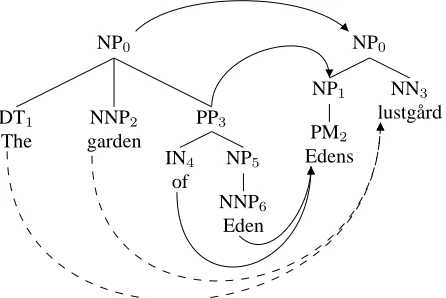
Any real-valued feature function can be integrated in the log-linear model we are using. Here, we give a brief overview of features that we currently support in Lingua-Align. For illustration purposes we will use the example in figure 1 taken from SMULTRON, a multilingual aligned treebank (Gustafson- ˇCapkov´a et al., 2007), which we will also use in our experiments described in section 4..
NP0
DT1 The
NNP2 garden
PP3
IN4 of
NP5
NNP6 Eden
NP0
NP1
PM2 Edens
NN3 lustg˚ard
Figure 1: Example tree alignment from SMULTRON (So-phie’s World, English-Swedish). The dashed lines refer to complementary links which are not part of the official tree-bank.
The first type of alignment features is similar to the lexical link scores introduced by (Zhechev and Way, 2008). This score combines lexical translation probabilities for given node pairs to form so-called inside scores (relations be-tween leaf nodes within the subtrees) and outside scores
(relations between leaf nodes outside of the current sub-trees). We use a similar definition as (Zhechev and Way, 2008) with a slight modification, replacing mean link scores with the maximum link score:
αinside(s|t) =
Y
si∈yield(s)
maxtj∈yield(t)P(si|tj)
αoutside(s|t) =
Y
si∈/yield(s)
maxtj∈/yield(t)P(si|tj)
The lexical translation probabilitiesP(si|tj) used above
are usually extracted from automatic word alignment. The inverse translation table withP(tj|si)probability
estima-tions can also be applied to compute inverse inside/outside scores, accordingly. In contrast to (Zhechev and Way, 2008), we use these four individual scores as separate fea-ture functions which makes it more flexible for the learning algorithm to adjust the importance of these values.
A second type of features uses existing word alignments di-rectly by computing link consistency scores for given tree node pairs. This score is simply the proportion of word alignments which are consistent with the chosen subtree pair among all the other ones involving words covered by these subtrees. Any kind of word alignment can be used to compute these scores. We usually apply the directional Viterbi alignments of IBM model 4 (produced by Giza++ (Och and Ney, 2003)) and symmetrized alignments pro-duced by Moses (Koehn et al., 2007) on top of the IBM models. For example, consider the following (mostly incor-rect) word alignment produced by Giza++ for the sentence pair from our example:
the garden of eden
NULL {} edens {1} lustg˚ard {2 3 4} edens lustg˚ard
NULL {} the {} garden {} of {} eden {1 2}
This would create the following features for some of the nodes in our example tree pair:
source target GIZAsrc2trg GIZAtrg2src
NNP6 PM2 0 0.5
NNP6 NN3 1/3 0.5
NP0 NP0 1 1
NP0 NP1 0.25 0.5
Table 1: Examples of word alignment features
A third type of features considers the positions of the nodes within the parse trees. Firstly, we define a tree-level
simi-larity score which compares the relative vertical positions
calculate relative positions by normalizing this value with the overall length of the sentence. Finally, we also com-pute the ratio of leafs dominated by the two tree nodes as another tree structure feature. Table 2 shows a number of such features extracted from the example tree pair above.
source target span-sim level-sim leaf-ratio
NNP6 PM2 0 1 1
NNP6 NN3 1 0.5 1
NP0 NP0 1 1 0.5
NP0 NP1 0.5 0.5 0.25
Table 2: Examples of tree structure features
The last type of base features considers labels in the parse trees – phrase structure categories for non-terminal nodes and part-of-speech labels for terminal nodes. These fea-tures are typically very important for the classification model but language-pair specific. Each of them is used as a binary feature and appropriate weights are learned from the training data. Other, similar types of labels can also easily be integrated, for example, dependency labels.
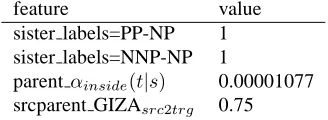
It is important to mention that all the features described above can also be extracted from any contextual node. We implemented a simple formalism to select features from ar-bitrary nodes connected with the current node pair. This is done by adding a prefix to the feature template speci-fying the movement that has to be performed before ex-tracting the corresponding feature value. For example, a prefix “parent” refers to moving to the immediate parent nodes of both, the source and the target language node. The prefix “srcparent” refers to a movement on the source lan-guage side only (similarly with “trgparent” for the target language tree). With the prefix “children” we may move to the daughter nodes and retrieve the mean of the accord-ing feature values. The prefix “sister” makes it possible to move to nodes with the same parent. Again there are vari-ants of these operations for moving on one side only. All these operations can be applied recursively, such that we can move, for example, to the “grandparent” node by spec-ifying a prefix “parent parent”. Corresponding features are only extracted if all movements can be carried out. Table 3 shows some possible contextual features of a particular pair of nodes extracted from our example trees.
feature value
sister labels=PP-NP 1 sister labels=NNP-NP 1
parentαinside(t|s) 0.00001077
srcparent GIZAsrc2trg 0.75
Table 3: Contextual features for node pairhDT1, NN3i
The use of contextual features is one way to implicitly in-tegrate structural dependencies in the alignment process. Note that contextual features may indicate negative cues even in cases where the same type of feature would rep-resent a positive one for the current node pair. For in-stance, a strong “srcsister GIZAsrc2trg” feature may
indi-cate that a link between a sister node on the source lan-guage side and the current target lanlan-guage node should be preferred over a link between the current node pair whereas the “GIZAsrc2trg” feature usually represents a positive cue
for the current node pair. It is up to the learning algorithm to adjust the parameters accordingly.
Finally, it is also allowed to combine base features like the ones above to create complex features in order to account for any non-linear correlation between them within the clas-sification task. Examples of complex features are combina-tions of category labels and word alignment scores or tree-span similarity scores combined with tree-level similarity scores. In case of real-valued features we simply multiply corresponding values. Other types of score combinations could be integrated as well but are not supported at the mo-ment.
Lingua-Align provides in this way a flexible framework for feature extraction for the tree alignment task supporting a set of base features that can be retrieved from any contex-tual node which may be combined with each other in vari-ous ways. Using this framework different experiments can easily be carried out and the alignment process can be ad-justed according to particular settings and needs (for exam-ple, adjusting alignment speed versus alignment quality or using the software with or without word alignment infor-mation).
2.3. Training the Local Classifier
Any standard classifier that supports real-valued features can be used for our task once appropriate features have been extracted from the data. In fact it would not require more than minor adjustments in the feature representation to call a different training and classification algorithm im-plemented in any kind of external machine learning pack-age or library. In our current setup we opted for a log-linear model and a maximum entropy classifier implemented in the freely available toolbox Megam (Daum´e III, 2004). This toolbox includes very efficient training procedure that allow fast experimentation with large feature sets. In fact the bottleneck in training (and testing) is not the local clas-sifier but the extraction of features from the data which of-ten requires quite a lot of tree traversal steps and other op-erations on the underlying data structure.
Basically we use standard settings for training the binary classifier using real-valued features and the conjugate gra-dient algorithm implemented in Megam. Other settings can be adjusted by adding appropriate arguments to the call of the external software. Future releases of Lingua-Align will probably support other binary classifiers and external ma-chine learning packages as well to make it possible to test various kinds of learning approaches.
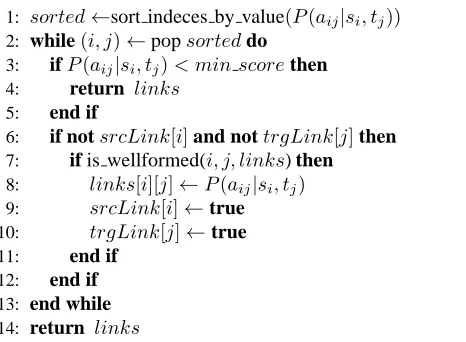
straints to allow multiple links per node by replacing line 6 in the algorithm above with “if not srcLink[i] or not
trgLink[j]then” and by adjusting the is wellformed func-tion accordingly. Other constraints can also easily be inte-grated which makes this strategy a very flexible approach for alignment inference.
2.4.3. Combined strategies
There are many other ways for inference with alignment heuristics like the greedy competitive approach. For exam-ple, one can define source-to-target matching algorithms with additional well-formedness constraints. Similarly this can be applied in the opposite direction. Further-more, directional alignments can be combined again us-ing heuristics similar to the ones applied in traditional word alignment using asymmetric IBM models (symmetrization heuristics such as intersection etc). Another strategy is to split alignment into several steps, for example aligning non-terminal nodes first and terminal nodes thereafter using well-formedness constraints in both steps. It is also possi-ble to use a restrictive alignment strategy first (for exam-ple the assignment algorithm with subsequent removal of non-wellformed links) followed by a relaxed strategy with less constraints. Furthermore, additional constraints can be added, for example, forcing the aligner to link nodes of the same type only (non-terminals with non-terminals and ter-minal nodes with terter-minal nodes). One may also skip the alignment of unary tree productions.
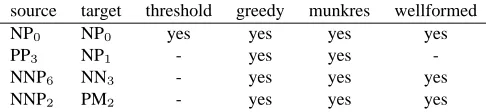
Lingua-Align implements a number of strategies and allows various combinations of constraints and cascaded align-ment steps. In this way, the alignalign-ment result can easily be adjusted according to one’s needs (focusing on preci-sion or recall, requiring complete alignment on one side or both sides, etc). Table 4 illustrates the impact of inference strategies by comparing links proposed by different base strategies for the example tree pair from figure 1 (none of the final alignments is really satisfactory).
source target threshold greedy munkres wellformed
NP0 NP0 yes yes yes yes
PP3 NP1 - yes yes
-NNP6 NN3 - yes yes yes
NNP2 PM2 - yes yes yes
Table 4: Alignments proposed by different inference strate-gies (threshold refers to the decisions made by the lo-cal classifier; munkres is the combinatorial assignment re-sult; wellformed is a greedy search strategy with well-formedness constraints)
3.
The Tree Aligner Package
Lingua-Align is a collection of Perl modules and a number of simple frontend scripts that can be used to call the train-ing and alignment procedures. The tree aligner is intended to be used on the command line supporting a variety of pa-rameters to adjust the behavior of the alignment process. The modular design makes it also straightforward to inte-grate Lingua-Align in other software and to extend it with additional modules. The library structure is divided into
modules that handle the interaction with the external classi-fier (training and classification), modules that manage vari-ous kinds of data formats (treebanks, parallel corpora, word alignments), modules for feature extraction and modules that perform different kinds of alignment inference algo-rithms. The implementation uses an object-oriented style to make it easy to extend the package.
The main frontend can be used for both training a new model and aligning a given parallel treebank. Command line arguments can be specified to set appropriate parame-ters for the training procedure and the alignment phase. The classification model is stored in a plain text file and can be re-used for any subsequent alignments. Another advantage of the discriminative approach is that the alignment of large treebanks can easily be run in parallel once the model has been trained. The main bottleneck is feature extraction but this can be done individually for each tree pair. In this way, many partitions of a treebank can be aligned simultaneously using the same alignment model.
<?xml version="1.0" ?> <treealign>
<treebanks>
<treebank id="en"
filename="SMULTRON_EN_Sophies_World.xml"/> <treebank id="sv"
filename="SMULTRON_SV_Sophies_World.xml"/> </treebanks>
<alignments>
<align author="Lingua::Align" type="fuzzy" prob="0.44271032770176010906"> <node node_id="s1_4" treebank_id="en"/> <node node_id="s1_2" treebank_id="sv"/> </align>
<align author="Lingua::Align" type="good" prob="0.75750083118538613647"> <node node_id="s1_502" treebank_id="en"/> <node node_id="s1_500" treebank_id="sv"/> </align>
<align author="Lingua::Align" type="fuzzy" prob="0.17420817390945234071"> <node node_id="s1_2" treebank_id="en"/> <node node_id="s1_1" treebank_id="sv"/> </align>
<align author="Lingua::Align" type="fuzzy" prob="0.28574840542833246371"> <node node_id="s1_501" treebank_id="en"/> <node node_id="s1_501" treebank_id="sv"/> </align>
</alignments> </treealign>
Figure 3: An example of the Tree Aligner Format
pro-vide appropriate files that match the sentences in the paral-lel treebank to be aligned.
The standard output format of Lingua-Align is similar to the one used by the Stockholm Tree Aligner (STA), a tool for manual alignment (Lundborg et al., 2007). Figure 3 shows a short example of the alignment format produced by our tool. This format is also expected for the training data and the default format for corpus encoding is TigerXML as it is for STA.
Using the same file conventions as STA makes it straight-forward to integrate manual and automatic tree alignment. This is especially useful for the rapid development of new training data and the manual inspection of automatic align-ment results. Furthermore, it is straightforward to use the result of automatic tree alignment in STA for manual post-editing in order to produce validated parallel treebanks in a semi-automatic way. A closer integration of the auto-matic aligner into the graphical interface of STA could be an interesting direction for future work (possibly in con-nection with an on-line learning algorithm for incremental improvements of the basic classifier).
Lingua-Align also supports two other treebank formats: AlpinoXML and Penn treebank format. These formats can directly be used by the alignment software. Conversion tools are also included to change the annotation from one format to another.
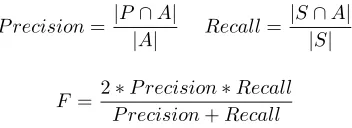
Finally, there is also a script for alignment evaluation. We use standard measures of precision, recall and balanced F-scores defined as follows:
P recision= |P∩A|
|A| Recall=
|S∩A| |S|
F =2∗P recision∗Recall
P recision+Recall
These metrics are adapted from the word alignment lit-erature (Och and Ney, 2003) using a distinction between “sure” (S) links and “possible” (P) links. In SMULTRON there is a distinction between “good” and “fuzzy” links. We interpret “good” links as “sure” and add “fuzzy” links to the set of “good” links to describe the set of “possible” links.A
refers to the links proposed by the system (without making a distinction between good and fuzzy links). The evalua-tion script computes these basic scores for a given align-ment and a given gold standard and also provides separate numbers for non-terminal and terminal nodes. An example output of the evaluation script can be seen in figure 41.
4.
Experiments
We tested our package with data taken from the SMUL-TRON treebank. In particular, we used the two chapters of “Sophie’s World” in Swedish and English to train and test various tree alignment models which includes 6,671 “good”
1Note that the proposed link type (“good” for links with
cer-tainty≥ 0.5and “fuzzy” for other links) does not influence the overall scores whereas it does for the individual scores of “good” and “fuzzy” links.
---precision (ALL/NT:NT) = 82.32 (1984/2410) recall (ALL/NT:NT) = 78.08 (1984/2541) balanced F (ALL/NT:NT) = 80.15
---precision (ALL/T:T) = 78.00 (2716/3482) recall (ALL/T:T) = 71.79 (2716/3783) balanced F (ALL/T:T) = 74.77
---precision (fuzzy/NT:NT) = 17.91 (65/363)
recall (fuzzy/NT:NT) = 11.82 (65/550) balanced F (fuzzy/NT:NT) = 14.24
---precision (fuzzy/T:T) = 6.91 (51/738)
recall (fuzzy/T:T) = 16.89 (51/302) balanced F (fuzzy/T:T) = 9.81
---precision (good/NT:NT) = 71.42 (1462/2047) recall (good/NT:NT) = 73.84 (1462/1980) balanced F (good/NT:NT) = 72.61
---precision (good/T:T) = 81.74 (2243/2744) recall (good/T:T) = 64.44 (2243/3481) balanced F (good/T:T) = 72.06
======================================= precision (all) = 79.77 (4700/5892)
recall (all) = 74.32 (4700/6324) recall (good) = 75.66 (4132/5461) recall (fuzzy) = 65.82 (568/863) ======================================= F (P_all & R_all) = 76.95
F (P_all & R_good) = 77.66
=======================================
Figure 4: Tree alignment evaluation
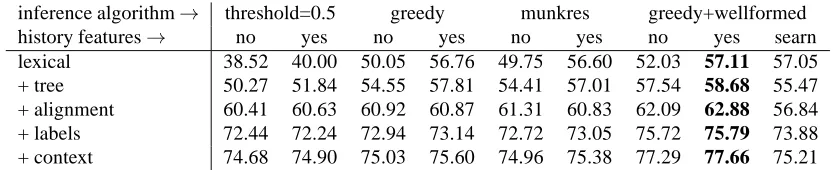
links and 1,141 “fuzzy” links between nodes in the parse trees of about 500 sentence pairs. We used the first 100 sentences for training and tested alignment quality on the remaining part of the corpus. In this way we use a larger portion of the corpus for evaluation in order to obtain re-liable scores. Alignment quality is measuered using preci-sion, recall and F-score as described above. The results are shown in table 5.
The tree aligner produces very promising results. The per-formance consistently improves when adding features to the model. The advantage of our feature-rich discrimina-tive approach can be seen when comparing the results with the performance of an unsupervised tree aligner. Running the subtree aligner described in (Zhechev and Way, 2008) on the same data set yields a balanced F-score of 57.57% which is similar to the scores we obtain when using the same lexical features. This scores is very low especially because of the size of the training data used for estimat-ing lexical translation probabilities. However, when usestimat-ing a larger model (adding the entire Europarl corpus (Koehn, 2005) to our data set) the performance of the unsupervised tree aligner improves only slightly to about 58.64% (mainly due to the obvious domain mismatch).
inference algorithm→ threshold=0.5 greedy munkres greedy+wellformed
history features→ no yes no yes no yes no yes searn
lexical 38.52 40.00 50.05 56.76 49.75 56.60 52.03 57.11 57.05
+ tree 50.27 51.84 54.55 57.81 54.41 57.01 57.54 58.68 55.47
+ alignment 60.41 60.63 60.92 60.87 61.31 60.83 62.09 62.88 56.84
+ labels 72.44 72.24 72.94 73.14 72.72 73.05 75.72 75.79 73.88
+ context 74.68 74.90 75.03 75.60 74.96 75.38 77.29 77.66 75.21
Table 5: Results (balanced F-scores) for different feature sets and inference algorithms (greedy competitive linking, Kuhn-Munkres assignment, greedy linking with additional well-formedness constraints and the same with SEARN learning).
We can see that the performance of the basic classifier is much below the other inference-based approaches when us-ing a limited set of features only. However, with increasus-ing amounts of features the base classifier catches up with the inference algorithms which demonstrates the power of the local feature-rich log-linear model even in this structured prediction task. Furthermore, our test data does not seem to suffer from the label bias problem. The performance actu-ally drops in all settings when applying our simplified ver-sion of SEARN training. This is probably due to the non-optimized fixed interpolation weight applied in our setup. We will investigate this strategy further in future work in order to see if we can obtain additional performance gains. The advantage of an inference-based approach can be seen when applying the well-formedness constraints which seems to be very important even in the feature-rich set-tings. The best performance is consistently achieved with the greedy search strategy using these constraints.
5.
Conclusions
Lingua-Align is a toolbox for automatic tree-to-tree align-ment that uses a local discriminative classification approach for a sequential alignment procedure. The toolbox includes a flexible framework for feature extraction from parallel treebanks supporting the extraction of contextual informa-tion and the integrainforma-tion of external tools for word align-ment. History features can be used in a recurrent classifi-cation architecture to approximate the complex structured prediction task. Several alignment inference algorithms are implemented that can be run on top of the predictions of the local classifier.
In our experiments we can show that small amounts of training data are sufficient to obtain a reasonable tree aligner model. We are currently using the toolbox to align large-scale parallel treebanks in an on-going project on syntax-based machine translation (Tiedemann and Kotz´e, 2009).
Lingua-Align also includes several tools for handling dif-ferent kinds of data formats and for the evaluation of tree aligment results. It also integrates well with an existing tool for manual tree alignment which makes it possible to visu-alize and manually correct automatic alignment results.
6.
References
Lars Ahrenberg. 2007. LinES: An English-Swedish paral-lel treebank. In Proceedings of the 16th Nordic
Confer-ence of Computational Linguistics (NODALIDA, 2007).
David Chiang, Yuval Marton, and Philip Resnik. 2008. Online large-margin training of syntactic and structural translation features. In EMNLP ’08: Proceedings of the
Conference on Empirical Methods in Natural Language Processing, pages 224–233, Morristown, NJ, USA.
As-sociation for Computational Linguistics.
David Chiang, Kevin Knight, and Wei Wang. 2009. 11,001 new features for statistical machine translation. In NAACL ’09: Proceedings of Human Language
Tech-nologies: The 2009 Annual Conference of the North American Chapter of the Association for Computational Linguistics, pages 218–226, Morristown, NJ, USA.
As-sociation for Computational Linguistics.
David Chiang. 2007. Hierarchical phrase-based transla-tion. Comput. Linguist., 33(2):201–228.
Hal Daum´e III. 2004. Notes on CG and LM-BFGS optimization of logistic regression. Paper available at
http://pub.hal3.name#daume04cg-bfgs,
implementation available at
http://hal3.name/megam/, August.
Hal Daum´e III. 2006. Practical Structured Learning
Tech-niques for Natural Language Processing. Ph.D. thesis,
University of Southern California, Los Angeles, CA, Au-gust.
T.G. Dietterich. 2002. Machine learning for sequential data: A review. In T. Caelli, editor, Structural, Syntactic,
and Statistical Pattern Recognition, volume 2396 of Lec-ture Notes in Computer Science, pages 15–30. Springer
Verlag.
Annette Rios Gonzales, Anne G¨ohring, and Martin Volk. 2009. A Quechua-Spanish parallel treebank. In
Pro-ceedings of TLT7.
Sofia Gustafson- ˇCapkov´a, Yvonne Samuelsson, and Martin Volk. 2007. SMULTRON (version 1.0) -The Stockholm MULtilingual parallel TReebank. http://www.ling.su.se/dali/research/smultron/index.htm. An English-German-Swedish parallel Treebank with sub-sentential alignments.
statistical machine translation. In Proceedings of ACL, Prague, Czech Republic.
Philipp Koehn. 2005. Europarl: A parallel corpus for sta-tistical machine translation. In Proceedings of MT
Sum-mit.
Harold W. Kuhn. 1955. The hungarian method for the as-signment problem. Naval Research Logistics Quarterly, 2:83–97.
Anagha Kulkarni and Ted Pedersen. 2008. Algo-rithm::Munkres - Perl extension for Munkres’ solution to classical assignment problem for square and rectangu-lar matrices. http://search.cpan.org/ tpederse/Algorithm-Munkres-0.08/lib/Algorithm/Munkres.pm.
Alon Lavie, Alok Parlikar, and Vamshi Ambati. 2008. Syntax-driven learning of sub-sentential translation equivalents and translation rules from parsed parallel corpora. In Proceedings of the ACL-08: HLT Second
Workshop on Syntax and Structure in Statistical Transla-tion (SSST-2), pages 87–95, Columbus, Ohio, June.
As-sociation for Computational Linguistics.
Joakim Lundborg, Torsten Marek, Ma¨el Mettler, and Mar-tin Volk. 2007. Using the Stockholm TreeAligner. In
Proceedings of the 6th Workshop on Treebanks and Lin-guistic Theories, pages 73–78, Bergen, Norway.
I. Dan Melamed. 2001. Empirical Methods for Exploiting
Parallel Texts. The MIT Press.
James Munkres. 1957. Algorithms for the assignment and transportation problems. Journal of the Society for
In-dustrial and Applied Mathematics, 5(1):32–38.
Franz Josef Och and Hermann Ney. 2003. A system-atic comparison of various statistical alignment models.
Computational Linguistics, 29(1):19–51.
Arjen Poutsma. 2000. Data-oriented translation. In
Pro-ceedings of the 18th conference on Computational lin-guistics, pages 635–641, Morristown, NJ, USA.
Associ-ation for ComputAssoci-ational Linguistics.
Markus Saers, Joakim Nivre, and Dekai Wu. 2009. Learn-ing stochastic bracketLearn-ing inversion transduction gram-mars with a cubic time biparsing algorithm. In
Pro-ceedings of the 11th Internationa Conference on Parsing Technology (IWPT), pages 29–32.
J¨org Tiedemann and Gideon Kotz´e. 2009. Building a large machine-aligned parallel treebank. In Proceedings of the
8th International Workshop on Treebanks and Linguis-tic Theories (TLT’08), pages 197–208. EDUCatt,
Mi-lano/Italy.
Antal van den Bosch. 1997. Learning to pronounce written
words: A study in inductive language learning. Ph.D.
thesis, Maastricht University.
Vincent Vandeghinste and Scott Martens. 2009. Top-down transfer in example-based mt. In Proceedins of the 3rd
Workshop on EBMT, pages 69–76.
Dekai Wu. 1995. Trainable coarse bilingual grammars for parallel text bracketing. In 3rd Annual Workshop on Very
Large Corpora, pages 69–82.
Ventsislav Zhechev and Andy Way. 2008. Automatic gen-eration of parallel treebanks. In Proceedings of the 22nd
International Conference on Computational Linguistics (CoLing), pages 1105–1112.
Andreas Zollmann and Ashish Venugopal. 2006. Syn-tax augmented machine translation via chart parsing. In
StatMT ’06: Proceedings of the Workshop on Statistical Machine Translation, pages 138–141, Morristown, NJ,