2.
Accelerated Particle Swarm Optimization (APSO) to Speech Enhancement
2.1 PSO: Advantages and Pseudo Code [7]
One of the most widely used swarm-intelligence-based algorithms owing to its simplicity and
flexibility, particle swarm optimization, or PSO, was developed by Kennedy and Eberhart in
1995 [8]. The PSO algorithm searches the space of an objective function by adjusting the
trajectories of individual agents, called particles, as the piecewise paths formed by positional
vectors in a quasi-stochastic manner. The movement of a swarming particle is composed of
two main components: a stochastic component and a deterministic component. Each particle
is attracted toward the position of the current global best g∗ and its own best location in
history, while at the same time it tends to move randomly.
When a particle finds a location that is better than any previously found locations, it
updates that location as the new current best for particle i. There is a current best for all n
particles at any time t during iterations. The aim is to find the global best among all the
current best solutions until the objective no longer improves or after a certain number of
iterations. The movement of particles is schematically represented in Figure 1, where (t)
is the current best for particle i , and g∗ ≈ min{ f (xi )} for (i = 1, 2, . . . , n) is the current global
best at t. moving toward the global best g∗ and the current best for each particle i.
The essential steps of the particle swarm optimization are summarized as the pseudo code
shown in Figure 2.
Figure 1. Schematic representation of the movement of a particle in PSO [7]
Figure 2. Pseudo code of Particle Swarm Optimization [7]
2.2 Implement the Simulated PSO using MATLAB
The simulated PSO is implemented by MATLAB code [9] and displays the following output.
Figure 3. The PSO algorithm searches the space of the “ackleysfcn” objective function and
reaches the convergence (generation = iteration)
2.3 Accelerated PSO (APSO)
The standard particle swarm optimization (PSO) uses both the current global best g∗ and the
individual best (t). However, there is no compelling reason for using the
individual best unless the optimization problem of interest is highly nonlinear and
multimodal.
A simplified version that could accelerate the convergence of the algorithm is to use only
the global best. This is the so-called accelerated particle swarm optimization (APSO)
which was developed by Xin-She Yang in 2008 [7]. A further improvement to the accelerated
PSO is to reduce the randomness as iterations proceed. That is to use a monotonically
(1)
or
(2)
where α0 = 0.5 to 1 is the initial value of the randomness parameter. Here t is the number of
iterations or time steps. is a control parameter.
2.4 APSO implementation
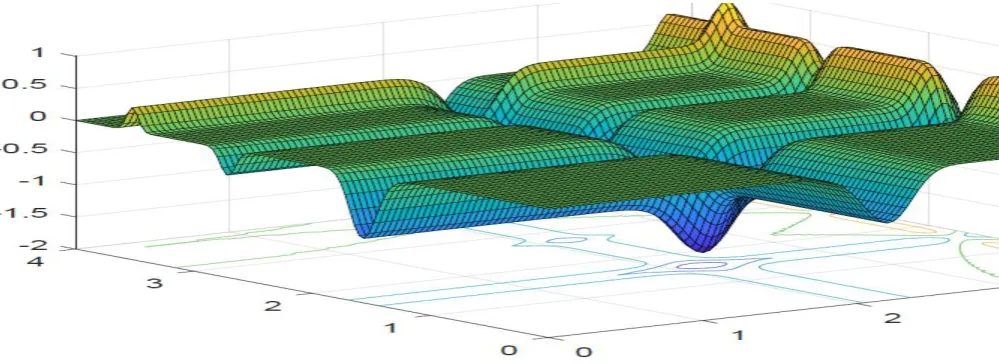
The implementation of the APSO was simulated using MATLAB code [10]. The total
number of particles = 10 and that of iterations = 10. The 2D “Michalewicz” objective
function is used. Two outputs are shown below.
Figure 5. Initial and final locations of 20 particles after 10 iterations.
2.5 APSO implementation results for speech enhancement
The proposed algorithm does not use individual best position for updating the new locations
and is capable of finding the solution in minimum number of iterations. Further, the
proposed APSO algorithm is converging faster compared to SPSO algorithm [3].
3. Gravitational Search Algorithm (GSA) for Speech Enhancement
3.1 Gravitational Search Algorithm (GSA)
Gravitational search algorithm (GSA) is an optimization algorithm based on the law of
gravity and mass interactions. This algorithm is based on the Newtonian gravity: "Every
particle in the universe attracts every other particle with a force that is directly proportional to
the product of their masses and inversely proportional to the square of the distance between
them" [11].
3.2 Gravitational Search Algorithm (GSA) Implementation
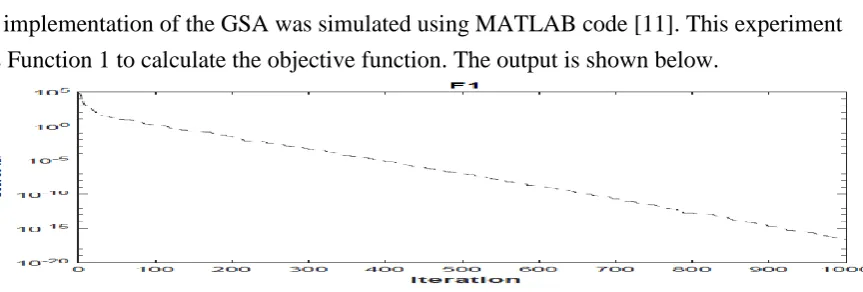
The implementation of the GSA was simulated using MATLAB code [11]. This experiment
uses Function 1 to calculate the objective function. The output is shown below.
Figure 6. This implementation of GSA uses Function 1 to compute the value of objective
function
3.3 GSA implementation results for speech enhancement [3]
The simulation results concluded that the performance of GSA algorithm is better when
compared to SPSO with respect to the speech quality and intelligibility.
Table 3. Comparison of intelligibility objective measure FAI
4. Hybrid PSOGSA for Speech Enhancement
4.1 PSOGSA
The objective measures that improved SNR, PESQ, FAI and WSS have got improvement in
hybrid PSOGSA algorithm when compared to the conventional GSA and standard PSO
algorithms. And it can be concluded that PSOGSA can more effectively reduce the
background noise of the noisy input speech [3]. The main idea of PSOGSA is to integrate the
ability of exploitation in PSO with the ability of exploration in GSA to synthesize both
algorithms’ strength. Some benchmark test functions are used to compare the hybrid
algorithm with both the standard PSO and GSA algorithms in evolving best solution [12].
4.2 PSOGSA Implementation
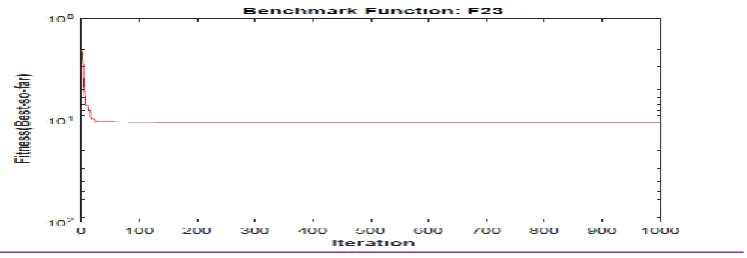
The implementation of the GSA was simulated using MATLAB code [13]. This experiment
uses Function 1 to calculate the objective function. The output is shown below.
4.3
PSOGSA Implementation Results for Speech Enhancement
The SNR levels of the input noisy signal for babble-type noise is set at −10 ,−5, 0 and 5 dB.
Results are averaged over 10 trail runs. The performance of the algorithms
is evaluated by computing SNRI measure, and the results are tabulated. There is 10 dB
improvement in PSOGSA when compared with that of SPSO algorithm. At all other noise
input SNR levels of noisy speech (−10, 0 and 5 dB), there is almost 6 dB improvement in
SNRI with PSOGSA when compared with that of SPSO. Throughout input SNR level, there
is almost 2 dB improvement in PSOGSA when compared with that of conventional GSA.
The performance of the algorithms is also evaluated by computing intelligibility objective
measure FAI [3],
5.
Bat Algorithm (BA) for Speech Enhancement
5.1
Bat Algorithm (BA)
Bat algorithm (BA) is one of the recently proposed heuristic algorithms imitating the
echolocation behavior of bats to perform global optimization. The superior performance of
this algorithm has been proven among the other most well-known algorithms such as genetic
algorithm (GA) and particle swarm optimization (PSO) [14, 15].
5.2
Bat Algorithm (BA) Implementation
The original version of this algorithm is suitable for continuous problems, so it cannot be
applied to binary problems directly. Here [14, 15], a binary version of this algorithm is available.
Figure 8. Implementation of the Binary version BA
5.3
Bat Algorithm (BA) Implementation results for speech enhancement
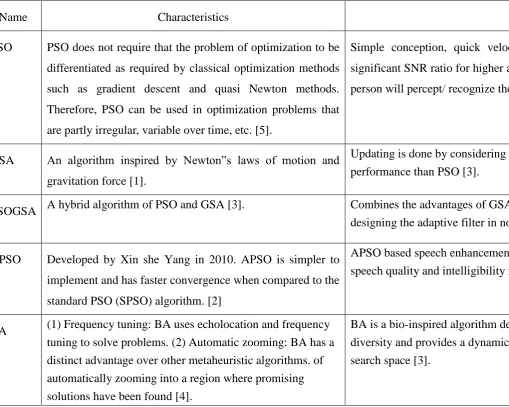
Other related simulation discussion on BA [3]: BA has yielded best solutions to the problem
of adaptive filtering in speech enhancement by providing a dynamic balance between the
exploration and exploitation of search space with an automatic zooming effect. With respect
![Figure 1. Schematic representation of the movement of a particle in PSO [7]](https://thumb-us.123doks.com/thumbv2/123dok_us/1091743.1137857/3.595.167.449.535.612/figure-schematic-representation-movement-particle-pso.webp)
![Figure 2. Pseudo code of Particle Swarm Optimization [7]](https://thumb-us.123doks.com/thumbv2/123dok_us/1091743.1137857/4.595.82.563.332.484/figure-pseudo-code-particle-swarm-optimization.webp)