Learning Script Participants from Unlabeled Data
Michaela Regneri∗ Alexander Koller† Josef Ruppenhofer‡ Manfred Pinkal∗
∗ Department of Computational Linguistics, Saarland University
{regneri,pinkal}@coli.uni-saarland.de
†Department of Linguistics, University of Potsdam
‡Department of Information Science and Language Technology, University of Hildesheim
Abstract
We introduce a system that learns the par-ticipants of arbitrary given scripts. This system processes data from web experi-ments, in which each participant can be re-alized with different expressions. It com-putes participants by encoding semantic similarity and global structural informa-tion into an Integer Linear Program. An evaluation against a gold standard shows that we significantly outperform two in-formed baselines.
1 Introduction
Scripts (Schank and Abelson, 1977) represent commonsense knowledge about the events that stereotypically constitute a certain activity. For in-stance, the “restaurant” script might specify that the patron enters, the waiter shows the patron to their seat, eventually the patron eats a plate of food, and so forth. There has always been agree-ment that script knowledge can be highly use-ful for a variety of applications in artificial intel-ligence and computational linguistics, including commonsense reasoning for text understanding (Cullingford, 1977; Mueller, 2004), information extraction (Rau et al., 1989) and automated sto-rytelling (Swanson and Gordon, 2008). But there is hardly an area where the discrepancy between the felt importance of a type of knowledge and the inability to provide any substantial amount of this knowledge for serious applications is greater.
Recently, several groups have tackled the prob-lem using unsupervised methods for learning script-like knowledge from text corpora or data obtained through web experiments (Chambers and Jurafsky, 2008; Chambers and Jurafsky, 2009; Regneri et al., 2010). For the first time, they open up a perspective to wide-coverage resources of script knowledge. However, each of these ap-proaches handles only specific aspects of script
information: Chambers and Jurafsky (2009) learn narrative schemas and their participants; they group verbs into schemas by virtue of shared par-ticipants assuming that this is an indicator for be-ing part of the same stereotypical activity, with-out knowing the actual scenarios. The system of Regneri et al. (2010) learns the temporal order of events occurring in specific stereotypical scenar-ios, but does not determine participants.
In this paper, we present a system that automat-ically learns sets of participants associated with specific scenarios. We take the approach of Reg-neri et al. as our starting point. In this earlier work, several experimental subjects described what hap-pens in a given scenario in a web experiment; the system then learns what event descriptions from different subjects refer to the same event, and how they are temporally ordered, using Multiple Se-quence Alignment (Durbin et al., 1998). The spe-cific problem we consider is to group the differ-ent noun phrases occurring throughout a script into equivalence classes, resulting in one class for each participant. Our solution combines diverse sources of information, including semantic similarity and structural information from the sequence align-ment, in an Integer Linear Program (Wolsey, 1998, ILP). The desired equivalence classes then cor-respond to an optimal solution of the ILP. We not only show that our system significantly out-performs a high-precision baseline, but also that it substantially exploits global structural informa-tion. The process is almost entirely unsupervised: We rely on annotated data only for training a hand-ful of similarity thresholds and for evaluation. We expect our approach to scale up and help obtain a broad-coverage knowledge base of scripts with participants through web experiments.
Plan of the paper.The paper starts by reviewing related work. We will then define the exact script learning problem we tackle here. Next, we show how participants can be learned, and then present
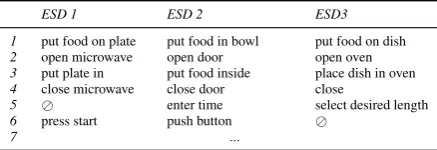
ESD 1 ESD 2 ESD3
1 put food on plate put food in bowl put food on dish
2 open microwave open door open oven
3 put plate in put food inside place dish in oven
4 close microwave close door close
5 enter time select desired length
6 press start push button
7 ...
Figure 1: Alignment for theMICROWAVEscenario.
the evaluation before we finally conclude.
2 Related Work
Many papers on scripts and their application per-spectives have been published in the seventies (Schank and Abelson, 1977; Barr and Feigen-baum, 1981). Script knowledge was manually modeled, and never exceeded a handful of do-mains and implementations operating on them.
Scenario frames in FrameNet (Baker et al., 1998) are another approach to modeling scripts and their participants. They describe how a stereo-typical activity is made up of smaller events (frames), which share roles (frame elements) spec-ifying people and objects involved in the events.
The supervised approach of Mani et al. (2006) learns temporal event relations from TimeBank (Pustejovsky et al., 2006).
All of these approaches rely on elaborate man-ual annotation efforts, and so it is unclear how they would scale to wide-coverage resources.
Chambers and Jurafsky (2008; 2009) exploit coreference chains and co-occurrence frequency of verbs in text corpora to extract narrative schemasdescribing sequences of events and their participants.1 Because this approach is fully un-supervised, its coverage is in principle unlimited. Each schema provides a family of verbs and ar-guments related by the same narrative context. Roughly speaking, event sequences are induced by grouping verbs in the same schema if they tend to share the same arguments. Within the schemas, events are represented as verbs, while the rela-tions between the verbs remain underspecified: Two verbs of a schema might describe the same, different or contradictory events. The aim here is not to collect data describing predetermined activ-ities, but rather to establish verb groups that share an (unknown) underlying scenario.
Regneri et al. (2010) (henceforth, RKP) pro-pose an alternative approach with complementary
1See http://cs.stanford.edu/people/nc/schemas
strengths and weaknesses. The starting point are specific scenarios, and human users answer ques-tions like “what happens in a restaurant?”. From the data collected in this way, a mining algorithm learns both which phrases describe the same sub-event and how these sub-sub-events are ordered tempo-rally. This guided way of learning script data pro-duces representations associated with known sce-narios, and also opens up the possibility of learn-ing about activities that are too stereotypical to be elaborated much in text corpora (and which thus can’t be induced from there). However, the ap-proach is limited by its reliance on scenarios that have to be determined beforehand. Tying in with this previous work, we compute participants using Integer Linear Programming to globally combine information from diverse sources. ILP has been applied to a variety of different problems in NLP (Althaus et al., 2004; Barzilay and Lapata, 2006; Berant et al., 2010), including coreference resolu-tion (Denis and Baldridge, 2007; Finkel and Man-ning, 2008).
3 Scripts and Participants
We formalize the problem of computing partic-ipants of a script as one of computing equiv-alence classes of mentions occurring in script-related event descriptions. In this respect our task is similar to coreference resolution.
Our algorithm takes the raw data and processed outputs of RKP as its starting point. The RKP data consist of a collection ofevent sequence de-scriptions (ESDs), each of which is written by one annotator to describe how a scenario plays out. RKP compute an alignment tableout of the ESDs (Fig. 1) using Multiple Sequence Alignment (Durbin et al., 1998, MSA). The columns of this alignment table represent the original ESDs, pos-sibly interspersed with some gaps (“”). The non-gaps in each row arealigned, and thus presumably describe the same event in the scenario (cf. open microwave,open door, andopen ovenin Fig. 1). The MSA algorithm assumes a cost function for substitutions (= aligning two non-gaps) and gap costsfor aligning gaps with non-gaps to compute the lowest-cost alignment of the ESDs.
some event description aparticipant description. Our system is intended to group participant de-scriptions into equivalence classes, which we call participant description sets(PDS).
4 Computing Participants
Learning participants from aligned ESDs is done in two steps: First, we identify candidate par-ticipant descriptions in event descriptions. Then, we partition the participant descriptions for each scenario into sets. The sets correspond to script-specific participants, their members are possible verbalizations of the respective participants.
4.1 Identifying participant descriptions
We consider participant descriptions to be the noun phrases in our data set, and thus reduce the task of their identification to the task of syntac-tic parsing. Parsing event descriptions is a chal-lenge because the data is written in telegraphic style (cf. Fig. 1). The subject (typically the pro-tagonist) is frequently left implicit, and nouns lack determiners, as instart microwave. In our experi-ments, we use the Stanford parser (Klein and Man-ning, 2003). Under the standard model, parsing ac-curacy for phrase structure trees is only 59% on our data (evaluated on 100 hand-annotated exam-ple sentences). The scores for dependency links between predicates and direct objects indicate how many noun phrase heads are correctly identified. Here the standard parser reaches 81%precision. The most frequent and most serious error is mis-classification of the phrase-initial verb (likestart) as a noun, which often leads to subsequent errors in the rest of the phrase.
Our available dataset of event descriptions is much too small to serve as a training corpus of its own. To achieve sufficient parsing accuracy, we combine and modify existing resources to build the parser model: we re-train the parser on a cor-pus consisting of the Penn Treebank (Marcus et al., 1993) and modified versions of the ATIS and Brown corpora (Dahl et al., 1994; Francis and Kucera, 1979). Modification consists in deleting all subjects in the sentences and deleting the de-terminers. To maintain accuracy on whole sen-tences, the original version of the modified corpora is added to the training set as well. The adapta-tion raises the accuracy for whole phrase structure trees to 72%, and the direct object link precision to90%.
Out of those parses, we can now extract all noun phrases for further processing. The last step for participant identification consists in adding the “implicit protagonist” whenever the subject posi-tion in the parse tree is empty.
4.2 Participant Description Sets
The next task consists in the actual learning of script participants, more specifically: We will pro-pose a method that groups participant descriptions occurring in the ESDs for a given scenario into participant description sets (PDSs) that comprise different mentions of one participant.
We assume that two token-identical participant descriptions always have the same word sense and represent the same participant, not only in one ESD, but across all event descriptions within a scenario. This extends the common “one sense per discourse” heuristic (Gale et al., 1992) with a “one participant per sense” assumption on top of that. The resulting loss of precision is only mini-mal, and we can take participant description types (PTs) rather than tokens to be basic entities, which drastically reduces the size of the basic entity set.
We also exploit structural information given in the alignment tables: If two PTs occur in aligned event descriptions, we take this as a piece of evi-dence that they belong to the same participant. In the example of Fig. 1, this supports identification of “time” and “desired length”.
We complement this structural indicator by se-mantic similarity information: In the example of Fig. 1, the identification of “bowl” and “dish” is supported by WordNet hyponymy. We use seman-tic similarity information in different ways:
• WordNet synonymy of PTs, as well as syn-onymy and direct hypsyn-onymy of the head of multiword PTs (like full can and full con-tainer) guarantee participant identity
• A WordNet based semantic similarity score is used as a soft indicator of participant identity
We combine all these information sources by modeling the equivalence-class problem as an In-teger Linear Program (Wolsey, 1998,ILP). An ILP computes an assignment of integer values to a set of variables, maximizing a given objective func-tion. Additional linear equations and inequalities can constrain the possible value assignments.
{pt1, . . . ,ptn} whether they belong to the same equivalence class. We model this in our ILP by in-troducing variablesxij which can take the values
0 or 1; ifxij takes the value 1 in a solution of the
ILP, this means that the tokens ofpti and the to-kens ofptj belong to the same PDS.
Objective function
We use the objective function to encode seman-tic similarity and structural information from the alignment. We require the ILP solver to maximize the value of the following linear term:
n
X
i,j=1,i6=j
(struc(pti, ptj)·sim(pti, ptj)−θ)·xij
(1)
sim(i, j)stands for the semantic similarity ofpti
andptj and is computed as follows:
sim(pti, ptj) =
lin(pti, ptj) +η ifptiandptj
are hyponyms lin(pti, ptj) otherwise
(2) For computing similarity, we use Lin’s (WordNet-based) similarity measure (Lin, 1998; Fellbaum, 1998), which performs better than several distributional measures which we have tried. Direct hyponymy is a particularly strong indicator; therefore we add the empirically determined constantηtosimin this case.
θis a cutoff which is also optimized empirically. Every pair with a similarity lower than θ adds a negative score to the objective function when its variable is set to1. In the final solution, pairs with a similarity score smaller thanθare thus avoided whenever possible.
struc(i, j)encodes structural information about
pti andptj, i.e. how tokens ofptiandptj are re-lated in the alignment table. Eq. 3 defines this:
struc(pti, ptj) =
λ+ ifptiandptjfrom
same row
λ− ifptiandptjfrom
same column and unrelated
1 otherwise
(3) If pti and ptj are aligned at least once (i.e., their enclosing event descriptions are paraphrase candidates),struc(i, j)takes a constant valueλ+
greater than 1, thus boosting the similarity ofpti
andptj. If the tokens ofpti andptj occur in the samecolumn(i.e., they are alternately used by the same subject in an ESD) and the two types have no direct WordNet link, struc(pti, ptj) takes a
con-stant value smaller than 1 (λ−) and lowers the similarity score. Both values are empirically op-timized.
Hard Constraints
We add a constraintxij = 1for a pairi, jif one of
the following conditions holds:
• ptiandptj share a synset in WordNet
• ptiandptj have the same head (likelaundry machineandmachine)
• pti andptj are both multiword expressions, their modifiers are identical and their heads are either synonyms or hyponyms
Furthermore, ifpti is the implicit protagonist, we add the constraintxij = 1ifptjis a first or second
person pronoun, andxij = 0otherwise.
Finally, we ensure that the ILP groups the par-ticipant types into equivalence classes by enforc-ing symmetry and transitivity. Symmetry is triv-ially encoded by the following constraint over all iandj:
xij =xji (4)
Transitivity can be guaranteed by adding the fol-lowing constraints for eachi, j, k:
xij+xjk−xik≤1 (5)
This is a standard formulation of transitivity, used e.g. by Finkel and Manning (2008).
5 Evaluation
SCENARIO PRECISION RECALL F-SCORE
full sem align base full sem align base full sem align base
LAUNDRY* 0.85 0.76 0.53 0.93 0.75 0.83 0.89 0.57 0.80 0.79 0.67 0.70
VENDING M.* 0.80 0.74 0.57 0.84 0.78 0.83 0.97 0.62 0.79 0.78 0.72 0.72
FAST FOOD 0.82 0.65 0.55 0.87 0.82 0.85 0.84 0.70 0.82 0.74 0.66 0.78
RETURN FOOD 0.80 0.78 0.53 0.88 0.44 0.52 0.63 0.34 0.57 0.62 0.57 0.49
COFFEE 0.85 0.77 0.53 0.92 0.80 0.81 0.98 0.68 0.82 0.79 0.68 0.78
FEED DOG 0.81 0.67 0.53 0.90 0.88 0.92 0.94 0.57 0.84 0.78 0.68 0.70
MICROWAVE 0.89 0.78 0.55 0.93 0.84 0.84 0.89 0.70 0.86 0.81 0.68 0.80
CREDIT CARD 0.90 0.82 0.60 0.94 0.54 0.54 0.64 0.40 0.67 0.65 0.62 0.56
MAIL LETTER 0.92 0.78 0.54 0.96 0.88 0.88 0.93 0.74 0.90 0.83 0.68 0.84
SHOWER 0.87 0.79 0.57 0.94 0.83 0.83 0.86 0.66 0.85 0.81 0.69 0.77
AVERAGE* 0.85 0.75 0.55 0.91 0.75 0.79 0.86 0.60 •0.79 •0.76 0.66 0.71
AVERAGE 0.86 0.76 0.55 0.92 0.75 0.77 0.84 0.60 •0.79 0.75 0.66 0.71 Figure 2: Results for the full system, the system without structural constraints (sem), the system with structural information only (align) and the naive baseline. Participant descriptions with the right head are considered correct. Starred scenarios have been used for parameter optimization,average*includes those scenarios, the unmarked average doesn’t. A black dot (•) means that the difference to the next lower baseline is significant withp <0.05. The difference between full and base is significant atp <0.001.
5.1 Gold Standard
We preprocessed the 10 evaluation scenarios by aligning them with the RKP algorithm. Two an-notators then labeled the 10 aligned scenarios, recording which noun-phrases referred to the same participant. Specifically, the labelers were shown, in order, the sets of aligned event de-scriptions. For instance, for the microwave script, they would first encounter all available alterna-tive descriptions for putting food on some dish. From each aligned description, the annotators ex-tracted the participant-referring NPs, which were then grouped into blocks of coreferent mentions. After all sets of component-event descriptions had been processed, the annotators also manually sorted the previously extracted blocks into coref-erent sets. Implicit participants, typically missing subjects, were annotated, too. For the evaluation, we include missing subjects but do not consider other implicit participants. Each annotator labeled 5 of the scenarios independently, and reviewed the other annotator’s work. Difficult cases, mostly re-lated to metonymies, were solved in consultation.
5.2 Baseline and Scoring Method
The system sorts participant descriptions into their equivalence classes, thus we evaluate whether the equivalence statements are correct and whether the classes it found are complete. Speaking in terms of participant description sets, we evaluate the pu-rity of each set (whether all items in a set belong there) and the set completeness (whether another
set should have been merged into the current one).
5.2.1 Baselines
We compare our system with three baselines: As a na¨ıve baseline (base), we group participant de-scriptions together only if they are string-equal. This is equivalent to just employing the type-abstraction step we took in the full system and ig-noring other information sources.
Additionally, we show the influence of the structural information with a more informed base-line (sem): we replicate our full system but just use the semantic similarity including all hard con-straints, without any structural information from the alignment tables. This is equivalent to setting
struc(i, j)in equation 1 always to 1.
In order to show that semantic similarity and the alignment indeed provide contrastive knowledge, we test a third baseline that contains the structural information only (align). Here we group all noun phrasesiandjtogether ifstruc(i, j)>1and the pair(i, j)meets all hard constraints.
All parameters for the baselines were optimized separately using the same scenarios as for the full system.
5.2.2 Scoring Method
Because the equivalence classes we compute are similar to coreference sets, we apply theb3 evalu-ation metric for coreference resolution (Bagga and Baldwin, 1998).b3defines precision and recall as
np-matching PRECISION RECALL F-SCORE
full sem align base full sem align base full sem align base Gold Tokens 0.92 0.81 0.54 0.97 0.86 0.88 0.96 0.71 0.89 0.84 0.70 0.81 Matching Head 0.86 0.76 0.55 0.92 0.75 0.77 0.84 0.60 0.79 0.75 0.66 0.71 Strict Matching 0.82 0.74 0.52 0.91 0.70 0.71 0.77 0.59 0.74 0.71 0.62 0.71
Figure 3: Averaged evaluation results for three scoring methods:Gold Tokensuses gold standard seg-mentation.Matching headuses parsing for PD extraction and phrases with the right head are considered correct.Strictrequires the whole phrase to match.
setCt+goldthat containstin the gold standard, and
assignprecisiontandrecallt:
precisiont=
|Ct∩Ct+gold|
|Ct|
(6)
recallt=
|Ct∩Ct+gold|
|Ct+gold|
(7)
Overall precision and recall is averaged over all tokens in the annotation. OverallF1 score is then
computed as follows:
F1=
2∗precision∗recall
precision+recall (8)
Unlike in coreference resolution, we have the problem that we compare gold-standard anno-tations against tokens extracted from automatic parses. However, theb3-metric is only applicable if the gold standard and the test data contain the same set of tokens. Thus we apply b3sys, a vari-ant of b3 introduced by Cai and Strube (2010). b3sysextends the gold standard and the test set such that both contain the same set of tokens. Roughly speaking, every token that appears in the gold stan-dard but not in the test set is copied to the latter and treated as singleton set, and vice versa. See Cai and Strube for details.
With the inaccurate parser, noun phrases are often parsed incompletely, missing modifiers or relative clauses. We therefore consider a partici-pant description as equivalent with a gold standard phrase if they have the same head. This relaxed scoring metric evaluates the system realistically by punishing parsing errors only moderately.
5.3 Results
5.3.1 Scores
Figure 2 shows the results for our system and three baselines. full marks the complete system, sem is the baseline without structural informa-tion,alignuses exclusively structural information and base is the na¨ıve string matching baseline.
The starred scenarios were used for parameter op-timization and excluded from the final average score. (TheAVERAGE* row includes those scenar-ios.) In terms of the average F-Score, we outper-form the baselines significantly (p < 0.05, paired two-sample t-test on the f-scores for the different scenarios) in all three cases. The system differ-ence to the na¨ıve baseline even reaches a signifi-cance level ofp <0.001. While the na¨ıve baseline always gets the best precision results, the align-baseline performs best for recall. The latter is due to the numerous alignment errors, which some-times lead to a simple partition in subjects and ob-jects. Our system finds the best tradeoff between precision and recall, gaining15% recall on aver-age compared to the na¨ıve baseline and just losing about 6% precision. semand the na¨ıve baseline differ only moderately. This shows that seman-tic similarity information alone is not sufficient for distinguishing the different participant descrip-tions, and that the exploitation of structural mation is crucial. However, the structural infor-mation by itself is worthless: high precision loss makesaligneven worse than the na¨ıve baseline.
Fig. 3 compares the same-head scoring met-ric described in the previous section (Matching Head) against two other approaches of dealing with wrongly recognized NP tokens:Strict Match-ing only accepts two NP tokens as equivalent if they are identical; Gold Tokens means that our PDS identification algorithm runs directly on the gold standard tokens. This shows that parsing ac-curacy has a considerable effect on the overall per-formance of the system. However, our system ro-bustly outperforms the baselines regardless of the matching approach.
5.3.2 Example Output
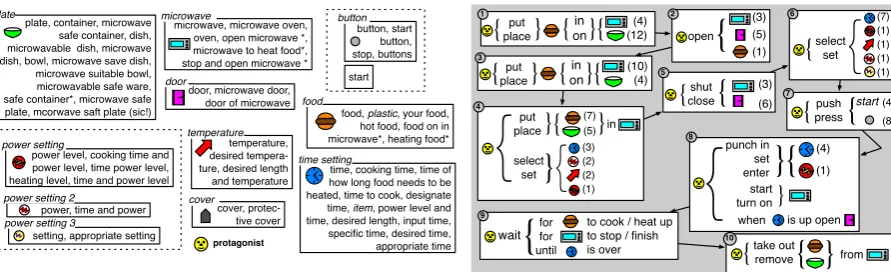
helpful comments. – This work was funded by the Cluster of Excellence “Multimodal Computing and Interaction” in the German Excellence Initia-tive, and the SALSA project of the German Re-search Foundation DFG.
References
Ernst Althaus, Nikiforos Karamanis, and Alexander Koller. 2004. Computing locally coherent dis-courses. InProc. of ACL-04.
Amit Bagga and Breck Baldwin. 1998. Algorithms for scoring coreference chains. InProc. of LREC-98. Collin F. Baker, Charles J. Fillmore, and John B. Lowe.
1998. The berkeley framenet project. In Proc. of COLING-98.
Avron Barr and Edward Feigenbaum. 1981. The Handbook of Artificial Intelligence, Volume 1. William Kaufman Inc., Los Altos, CA.
Regina Barzilay and Mirella Lapata. 2006. Aggrega-tion via set partiAggrega-tioning for natural language genera-tion. InProc. of HLT-NAACL 2006.
Jonathan Berant, Ido Dagan, and Jacob Goldberger. 2010. Global learning of focused entailment graphs. InProc. of ACL-10.
Michel Berkelaar, Kjell Eikland, and Peter Notebaert. 2004. lp solve, a Mixed Integer Linear Program-ming (MILP) solver Version 5.0. Website.
Jie Cai and Michael Strube. 2010. Evaluation metrics for end-to-end coreference resolution systems. In
Proc. of SIGDIAL 2010.
Nathanael Chambers and Dan Jurafsky. 2008. Unsu-pervised learning of narrative event chains. InProc. of ACL-08: HLT.
Nathanael Chambers and Dan Jurafsky. 2009. Unsu-pervised learning of narrative schemas and their par-ticipants. InProc. of ACL-IJCNLP 2009.
Richard Edward Cullingford. 1977. Script applica-tion: computer understanding of newspaper stories.
Ph.D. thesis, Yale University, New Haven, CT, USA. Deborah A. Dahl, Madeleine Bates, Michael Brown, William Fisher, Kate Hunicke-Smith, David Pallett, Christine Pao, Alexander Rudnicky, and Elizabeth Shriberg. 1994. Expanding the scope of the ATIS task: the ATIS-3 corpus. InProceedings of the HLT-94, HLT ’94.
Pascal Denis and Jason Baldridge. 2007. Joint de-termination of anaphoricity and coreference resolu-tion using integer programming. InProc. of HLT-NAACL 2007.
Richard Durbin, Sean Eddy, Anders Krogh, and Graeme Mitchison. 1998. Biological Sequence Analysis. Cambridge University Press.
Christiane Fellbaum. 1998. WordNet: An Electronical Lexical Database. The MIT Press, Cambridge, MA. Jenny Rose Finkel and Christopher D. Manning. 2008. Enforcing transitivity in coreference resolution. In
Proc. of ACL-08: HLT.
W. N. Francis and H. Kucera, 1979. Manual of Infor-mation to Accompany a Standard Corpus of Present-Day Edited American English, for use with Digital Computers. Department of Linguistic, Brown Uni-versity.
William A. Gale, Kenneth W. Church, and David Yarowsky. 1992. One sense per discourse. In Pro-ceedings of the workshop on Speech and Natural Language.
Dan Klein and Christopher D. Manning. 2003. Accu-rate unlexicalized parsing. InProc. of ACL-03. Dekang Lin. 1998. An information-theoretic
defini-tion of similarity. InProc. of ICML-98.
Inderjeet Mani, Marc Verhagen, Ben Wellner, Chong Min Lee, and James Pustejovsky. 2006. Machine learning of temporal relations. InProc. of COLING/ACL-2006.
Mitchell P. Marcus, Mary Ann Marcinkiewicz, and Beatrice Santorini. 1993. Building a large anno-tated corpus of english: the penn treebank. Comput. Linguist., 19.
Erik T. Mueller. 2004. Understanding script-based sto-ries using commonsense reasoning. Cognitive Sys-tems Research.
James Pustejovsky, Marc Verhagen, Roser Sauri, Jes-sica Littman, Robert Gaizauskas, Graham Katz, In-derjeet Mani, Robert Knippen, and Andrea Setzer. 2006. TimeBank 1.2. Linguistic Data Consortium. Lisa F. Rau, Paul S. Jacobs, and Uri Zernik. 1989.
In-formation extraction and text summarization using linguistic knowledge acquisition. Information Pro-cessing and Management.
Michaela Regneri, Alexander Koller, and Manfred Pinkal. 2010. Learning script knowledge with web experiments. InProc. of ACL-10.
Roger C. Schank and Robert P. Abelson. 1977.Scripts, Plans, Goals and Understanding. Lawrence Erl-baum, Hillsdale, NJ.
Reid Swanson and Andrew S. Gordon. 2008. Say any-thing: A massively collaborative open domain story writing companion. InProc. of ICIDS 2008. Luis von Ahn and Laura Dabbish. 2008. Designing
games with a purpose.Commun. ACM, 51(8). Laurence Wolsey. 1998.Integer programming.