Singletons and Coreference Resolution Evaluation
Sandra K ¨ubler
Indiana University
Desislava Zhekova
University of Bremen
Abstract
This paper presents an empirical study on the influence of singletons on the evalua-tion of coreference resoluevalua-tion systems. We present results on two English data sets used in the SEMEVAL 2010 shared task 1 and the CONLL 2011 shared task using the scorers of both shared tasks. We show that single-tons, both in the gold standard and in the sys-tem output, have an immense impact on the overall evaluation – in an experiment where the coreference resolution results remain un-changed over the different settings.
1 Introduction
In the last decade, the task of Coreference Resolu-tion has become an important enterprise in Natural Language Processing. At the same time, the need for proper benchmarking increased over time. In the last year, two major shared tasks were concerned with coreference resolution: the SEMEVAL 2010 task 1 “Coreference Resolution in Multiple Languages” (Recasens et al., 2010) and the CONLL shared task 2011 “Modeling Unrestricted Coreference in OntoNotes” (Pradhan et al., 2011). Both shared tasks introduced a new element into the definition of coreference resolution: The detection of men-tions. Previous to these shared tasks, the availability of gold standard mentions was often assumed, and research concentrated on the resolution of corefer-ence relationships between mentions. (e.g. (Luo et al., 2004; Denis and Baldridge, 2007)).
However, in many approaches to coreference res-olution, the problem is even more restricted, and the coreference resolution component expects only such
mentions that are coreferent in the present context, i.e. no singletons are present in the data. “Sin-gleton” is a cover term for mentions that are never coreferent, such as in in general or on the contrary, and mentions that are potentially coref-erent but occur only once in a document. If the ex-traction of mentions is part of the task definition, then filtering singletons is generally necessary since methods for mention identification often overgener-ate and produce all noun phrases (NPs), including all singletons. Twinless mentions (Stoyanov et al., 2009) are mentions that have been identified by a coreference resolution system but are not included in the gold data, or vice versa. Twinless mentions can lead to considerable changes in overall system performance, and Stoyanov et al. (2009) report that at that time B3was not prepared to handle them. For the CONLL shared task, the metrics were updated to obtain ”better alignment for B3and CEAF so that the gold standard set and the system output have the same number of mentions” (p.c. S. Pradhan). In this paper, we investigate how the presence of singletons in either gold standard or in the system output influ-ences the results. We compare the English data sets of the SEMEVAL and the CONLL shared task and the two versions of the scorer used there.
CEAF MUC B3 BLANC R P F1 R P F1 R P F1 R P F1 SINGLETONS 71.2 71.2 71.2 0.0 0.0 0.0 71.2 100 83.2 50.0 49.2 49.6
ALL-IN-ONE 10.5 10.5 10.5 100 29.2 45.2 100 3.5 6.7 50.0 0.8 1.6
Table 1: Baseline scores for the English data set in the SEMEVALtask 1.
IM MUC B3 CEAFE BLANC
R P F1 R P F1 R P F1 R P F1 R P F1 SEMEVALscorer
ABC, DE 100 100 100 66.7 66.7 66.7 73.3 73.3 73.3 80.0 80.0 80.0 58.3 58.3 58.3 ABC, DE, Y 100 83.3 90.9 66.7 66.7 66.7 73.3 61.1 66.7 80.0 53.3 64.0 51.8 52.3 49.8 ABC, DE, X 83.3 100 90.9 66.7 66.7 66.7 61.1 73.3 66.6 53.3 80.0 64.0 58.3 58.3 58.3
CONLL scorer
ABC, DE 100 100 100 66.7 66.7 66.7 73.3 73.3 73.3 80.0 80.0 80.0 58.3 58.3 58.3 ABC, DE, Y 100 83.3 90.9 66.7 66.7 66.7 73.3 73.3 73.3 80.0 80.0 80.0 58.3 58.3 58.3 ABC, DE, X 100 100 100 66.7 66.7 66.7 77.8 77.8 77.8 86.7 86.7 86.7 65.9 65.9 65.9
Table 2: Coreference scores on an artificial example.
objective overview of the system coreference perfor-mance. But it is not possible in a real world system. The remainder of the paper is structured as fol-lows: Section 2 discusses coreference evaluation metrics and their behavior in the presence of sin-gletons. Section 3 describes the English data sets from the shared tasks, which we use for our inves-tigation, and section 4 gives a short description of the coreference resolution system that we use. In section 5, we investigate the influence of singletons in the gold standard and system sets for both data sets, and in section 6, we investigate how the pres-ence and treatment of pronoun singletons influpres-ences scoring results on the CONLL data set.
2 Coreference Evaluation
Apart from the open research question how to dis-tinguish singletons from coreferent mentions, there is the question how the standard evaluation metrics, MUC (Vilain et al., 1995), B3(Bagga and Baldwin, 1998), CEAF (Luo, 2005), and BLANC (Recasens and Hovy, 2011), react to the presence of single-tons in the data. Recasens et al. (2010) present two baselines, one in which every mention in the data set is considered a singleton, and one in which all mentions are grouped into one chain. The singleton baseline reaches high scores for the metrics CEAF and B3, with an overall performance of above 70% for English. The MUC metric, on the other hand, is not at all sensitive to the existence of singleton mentions. Yet, for the second baseline, in which all
mentions were linked to one single entity, the MUC metric reported the highest results. Table 1 shows the results for both baselines.
Let us consider a small artificial example, in which the gold standard contains two coreference chains,A-B-CandD-Eand the system erroneously attached A to the chain D-E. Then, we introduce one singleton in the gold standard, X and one in the system output Y. Since, the metrics in the CONLL shared task were modified to handle sin-gletons (cf. section 1) we use both versions of the scorer, the SEMEVALscorer and the CONLL scorer. The results are presented in table 2. This example shows that with the SEMEVALscorer, all metrics but MUC, are sensitive to singletons in the system out-put and in the gold standard data. However, the pres-ence of a singleton (Y) in the system output leads to a decrease in the results while an additional sin-gleton (X) in the gold standard increases results al-though the system output is unchanged. With the CONLL scorer, all metrics are insensitive to sin-gletons in the system output. An additional single-ton in the gold standard still increases scores for B3, CEAFE (mention-based CEAF), and BLANC.
Overall, this scorer leads to higher system results.
1 0 By IN (TOP(S(PP* - - - Speaker#1 * (ARGM-TMP* (ARGM-TMP* - -1 -1 -1940 CD (NP*)) - - - Speaker#-1 (DATE) *) *) (29) (1)
1 2 , , * - - - Speaker#1 * * * -
-1 3 China NNP (NP(NP(NP* - - - Speaker#-1 (GPE) (ARG0* (ARG0* (31 (2)|(3|(4|(5
1 4 ’s POS *) - - - Speaker#1 * * * 31) 5)
1 5 War NNP *) - - - Speaker#1 (EVENT) * * - (6)|4)
1 6 of IN (PP* - - - Speaker#1 * * * -
-1 7 Resistance NNP (NP(NP*) - - - Speaker#-1 (ORG) * * - (7)|(8|(9)
1 8 against IN (PP* - - - Speaker#1 * * * -
-1 9 Japan NNP (NP*))))) - - - Speaker#-1 (GPE) *) *) (72) (10)|(11)|8)|3)
1 10 had VBD (VP* have 03 - Speaker#1 * (V*) * - (12)
1 11 entered VBN (VP* enter 01 1 Speaker#1 * * (V*) - (13)
1 12 a DT (NP* - - - Speaker#1 * * (ARG1* - (14
1 13 stalemate NN *))) - - - Speaker#1 * * *) - 14)
1 14 . . *)) - - - Speaker#1 * * * -
-Table 3: An example sentence from the CONLL shared task data set.
data sets of the SEMEVALand the CONLL shared task. We investigate different strategies of handling singletons, and their influence on results of a robust coreference resolution system, UBIU.
3 The Shared Task English Data Sets
Both shared tasks for coreference resolution in the last year, the SEMEVAL2010 task 1 (Recasens et al., 2010) and the CONLL shared task 2011 (Pradhan et al., 2011), included an English data set, based on OntoNotes (Hovy et al., 2006). However, both data sets differ in the texts selected for their assembly as well as in the annotations on the gold standard. We discuss these differences below.
3.1 TheSEMEVALEnglish Data Set
The SEMEVALtask 1 (Recasens et al., 2010) aimed at the evaluation and comparison of coreference res-olution systems in a multilingual environment tar-geting six languages (Catalan, Dutch, English, Ger-man, Italian, Spanish). The main focus of the task was on system portability across different languages and the importance of various linguistic annotations for the system performance for all languages.
All data sets contained linguistic annotation at the morphological, syntactic, and semantic levels, in-cluding both gold standard and automatic annota-tions. The task description defined that only NP con-stituents and possessive pronouns were considered mentions; nominal predicates, appositives, expletive NPs, attributive NPs, and NPs within idioms were not considered mentions. The task description also specified that singletons were included in the data annotations since they represent coreference chains
containing a single mention.
3.2 TheCONLL2011 Shared Task Data Set
The CONLL 2011 shared task (Pradhan et al., 2011) was defined as modeling unrestricted coreference. This shared task focused on English as its only lan-guage, and it also used the OntoNotes corpus as its basis. The task definition specifies that names, nom-inal mentions, and pronouns are considered men-tions. Additionally, verbs that are coreferent with a noun phrase are marked as mentions. Singletons are not considered mentions. The annotation in the data set included POS tags, syntactic information, se-mantic role labeling, and WordNet information and corpus-based number and gender information.
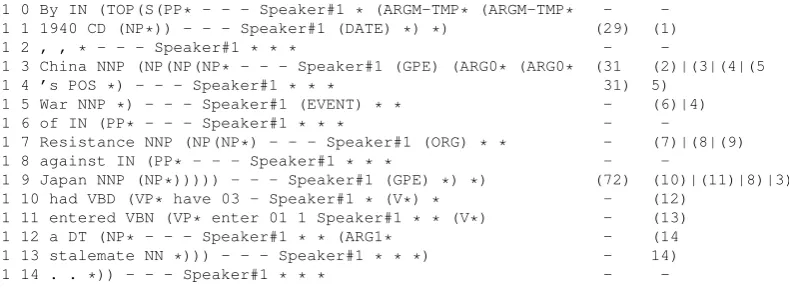
Table 3 shows an example sentence from the CONLL shared task data set with automatic an-notations. Here, mention (72), Japan is corefer-ent with the mcorefer-ention the enemy’s in the fol-lowing sentence. Since in contrast to the SEM -EVALdata set, singletons are not annotated as men-tions, noun phrases such as China’s War of Resistance are not annotated as mentions. The last column in the example is not from the data set but is generated by UBIU (see below).
4 UBIU
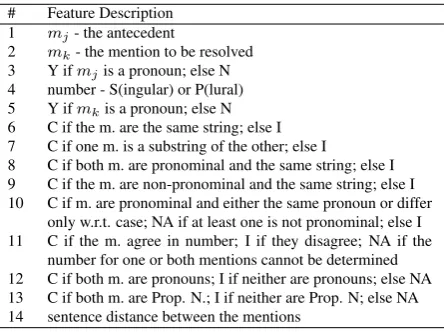
use a mention-pair approach, in combination with TiMBL (Daelemans et al., 2007), a memory-based learner that labels the feature vectors from the test set based on the k nearest neighbors in the train-ing data. Based on a non-exhaustive parameter opti-mization on the development set, we use theIB1 al-gorithm, weighted overlap as similarity metric, and gain ratio for weighting. The number of nearest neighbors is k = 3. The classifier is preceded by a mention extractor, which identifies possible men-tions, and a feature extractor to gather the informa-tion required for classificainforma-tion in the form of vector features.
The mention extractor uses POS, syntactic, and lemma information that was provided in the CONLL data set. An example of its output for the example sentence is given in the last column of table 3. Syntactic information is used to assign a mention to each of the noun phrases existing according to that annotation. Additionally, possessive pronouns and proper nouns, which are selected based on POS information are assigned a separate mention. Since verbs can be coreferent, additional mentions are in-cluded for each verb with a predicate lemma.
The feature extractor creates a feature vector for each possible pair of a mention and all its possi-ble antecedents in a context of 3 sentences. Since mentions are represented by their syntactic head, the module uses a heuristic to select the rightmost noun in a noun phrase. However, since postmodifying prepositional phrases may be present in the mention, the noun may not be followed by a preposition.
Initially, UBIU used a wide set of features (Zhekova and K¨ubler, 2010), which constitutes a subset of the features by Rahman and Ng (2009). Our experiments in the CONLL 2011 shared task (Zhekova and K¨ubler, 2011) showed that adding additional information, such as WordNet or num-ber/gender information, does not improve per-formance for our system when applied on the CONLL data set. For this reason, we use the basic feature set shown in table 4.
Another important step is to separate singleton mentions from coreferent ones since only the latter are annotated in OntoNotes. Our mention extrac-tor overgenerates in that it extracts all possible men-tions, and only after classification, the system can decide which mentions are singletons.
# Feature Description 1 mj- the antecedent
2 mk- the mention to be resolved
3 Y ifmjis a pronoun; else N
4 number - S(ingular) or P(lural) 5 Y ifmkis a pronoun; else N
6 C if the m. are the same string; else I 7 C if one m. is a substring of the other; else I
8 C if both m. are pronominal and the same string; else I 9 C if the m. are non-pronominal and the same string; else I 10 C if m. are pronominal and either the same pronoun or differ
only w.r.t. case; NA if at least one is not pronominal; else I 11 C if the m. agree in number; I if they disagree; NA if the
number for one or both mentions cannot be determined 12 C if both m. are pronouns; I if neither are pronouns; else NA 13 C if both m. are Prop. N.; I if neither are Prop. N; else NA 14 sentence distance between the mentions
Table 4: The pool of features used in the base feature set.
5 Singletons in theSEMEVALand CONLLData Sets
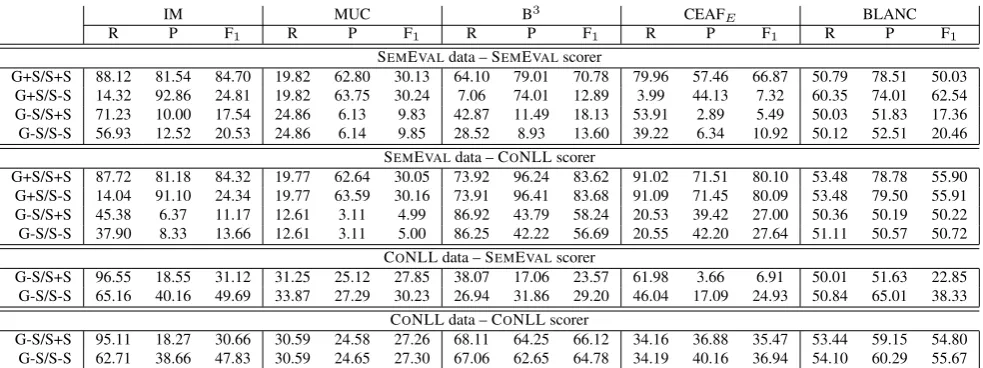
In this section, we investigate the influence of single-tons on the evaluation of UBIU. Since the system’s coreference resolution performs below the state of the art systems, we assume that a wide range of er-rors will be present in the system output. We com-pare the system performance based on the data sets from the shared tasks, and we evaluate the system output with the two versions of the scorer from the shared tasks. For both data sets, we train UBIU on the training data. For the SEMEVAL data, we test on the test set, for the CONLL set, we use the de-velopment set since the gold standard annotation for the test set is not available yet. Overall, we have four different settings for the experiment w.r.t. singletons:
1. G+S/S+S: Singletons are included in the gold standard (i.e. training and test data) and in the system output.
2. G+S/S-S: Singletons are included in the gold standard but are removed in the system output. 3. G-S/S+S: Singletons are removed from the gold standard but not from the system output. 4. G-S/S-S: Singletons are removed from the gold
standard and from the system output.
IM MUC B3 CEAFE BLANC
R P F1 R P F1 R P F1 R P F1 R P F1
SEMEVALdata – SEMEVALscorer
G+S/S+S 88.12 81.54 84.70 19.82 62.80 30.13 64.10 79.01 70.78 79.96 57.46 66.87 50.79 78.51 50.03 G+S/S-S 14.32 92.86 24.81 19.82 63.75 30.24 7.06 74.01 12.89 3.99 44.13 7.32 60.35 74.01 62.54 G-S/S+S 71.23 10.00 17.54 24.86 6.13 9.83 42.87 11.49 18.13 53.91 2.89 5.49 50.03 51.83 17.36 G-S/S-S 56.93 12.52 20.53 24.86 6.14 9.85 28.52 8.93 13.60 39.22 6.34 10.92 50.12 52.51 20.46
SEMEVALdata – CONLL scorer
G+S/S+S 87.72 81.18 84.32 19.77 62.64 30.05 73.92 96.24 83.62 91.02 71.51 80.10 53.48 78.78 55.90 G+S/S-S 14.04 91.10 24.34 19.77 63.59 30.16 73.91 96.41 83.68 91.09 71.45 80.09 53.48 79.50 55.91 G-S/S+S 45.38 6.37 11.17 12.61 3.11 4.99 86.92 43.79 58.24 20.53 39.42 27.00 50.36 50.19 50.22 G-S/S-S 37.90 8.33 13.66 12.61 3.11 5.00 86.25 42.22 56.69 20.55 42.20 27.64 51.11 50.57 50.72
CONLL data – SEMEVALscorer
G-S/S+S 96.55 18.55 31.12 31.25 25.12 27.85 38.07 17.06 23.57 61.98 3.66 6.91 50.01 51.63 22.85 G-S/S-S 65.16 40.16 49.69 33.87 27.29 30.23 26.94 31.86 29.20 46.04 17.09 24.93 50.84 65.01 38.33
CONLL data – CONLL scorer
G-S/S+S 95.11 18.27 30.66 30.59 24.58 27.26 68.11 64.25 66.12 34.16 36.88 35.47 53.44 59.15 54.80 G-S/S-S 62.71 38.66 47.83 30.59 24.65 27.30 67.06 62.65 64.78 34.19 40.16 36.94 54.10 60.29 55.67
Table 5: System results with and without singletons on the SEMEVALand CONLL data.
shown in table 5. Overall, there are considerable dif-ferences in the results, ranging in F-score from 4.99 in the SEMEVALdata set with the G-S/S+S setting and the MUC metric of the CONLL scorer to 83.68 in the same data set with the G+S/S-S setting and the B3metric of the CONLL scorer. This is discon-certing given that there is no difference in system quality, but simply in the representation of single-tons. The differences between settings within a sin-gle metric are similarly extreme: B3’s F-score, for example, ranges from 70.78 to 12.89, on the same data set using the same scorer, the only difference is the presence of singletons in the system output.
A comparison of the scores for mention identifica-tion (IM) shows that the scorer version has a consid-erable influence on the results on the SEMEVALdata set: In the G-S/S+S setting, recall decreases from 71.23% to 45.38%. In the CONLL data set, this ef-fect is also present, but to a lesser degree: The F-score decreases from 31.12 to 30.66 in the same set-ting. Any setting with a difference in the presence of singletons between gold standard and system out-put results in extreme differences in precision and recall. When singletons are present in the system output but not in the gold standard, recall is boosted; precision profits from the presence of singletons in the gold standard. The fact that UBIU obtains higher IM scores on the CONLL data set may be due to the strategy for mention detection, which was developed explicitly for the CONLL data set.
Contrary to our expectation that MUC will re-main constant across the 4 settings, there is a sig-nificant decrease in F-score on the SEMEVAL data set between the settings in which the gold stan-dard contains singletons and the one where it does not. The F-scores drop from approximately 30 to 9. Additionally, while there is no significant differ-ence between the settings in which there are no sin-gletons in the gold standard for the SEMEVAL set, the CONLL set shows a deterioration of approxi-mately 3 percent points from G-S/S+S to G-S/S-S for the SEMEVALscorer. The B3results of the SEM -EVAL scorer closely model mention quality. Addi-tionally, the results of the CONLL scorer are signifi-cantly higher than those by the SEMEVALscorer. In the G-S/S-S setting, for example, the F-score ranges from 13.60 to 56.69 on the SEMEVALdata and from 29.20 to 64.78 on the CONLL data. CEAFE and
BLANC show similar trends.
IM MUC B3 CEAFE BLANC
R P F1 R P F1 R P F1 R P F1 R P F1
SEMEVALscorer
AllS 96.55 18.55 31.12 31.25 25.12 27.85 38.07 17.06 23.57 61.98 3.66 6.91 50.01 51.63 22.85 NoS 58.86 38.42 46.50 33.87 27.29 30.23 25.13 29.62 27.19 40.56 17.26 24.22 50.86 63.97 37.61 PronS 65.16 40.16 49.69 33.87 27.29 30.23 26.94 31.86 29.20 46.04 17.09 24.93 50.84 65.01 38.33 AttP 70.52 28.69 40.78 28.70 12.35 17.27 26.94 16.03 20.10 40.54 14.29 21.13 50.51 57.15 32.64
CONLL scorer
AllS 95.11 18.27 30.66 30.59 24.58 27.26 68.11 64.25 66.12 34.16 36.88 35.47 53.44 59.15 54.80 NoS 56.44 36.84 44.59 30.59 24.65 27.30 67.06 62.65 64.78 34.19 40.16 36.94 54.10 60.29 55.67 PronS 62.71 38.66 47.83 30.59 24.65 27.30 67.06 62.65 64.78 34.19 40.16 36.94 54.10 60.29 55.67 AttP 67.76 27.56 39.18 25.68 11.05 15.45 75.97 42.30 54.34 21.44 42.02 28.39 52.56 52.19 52.36
Table 6: System results with varying treatment of pronouns.
6 Pronominal Singletons in the System Output
Here, we have a closer look at pronoun singletons in the system output. We include all types of anaphoric pronouns in our investigation, i.e. personal, reflex-ive, demonstratreflex-ive, and possessive pronouns. Rel-ative and indefinite pronouns are not annotated as mentions in the data and thus excluded from our study. Since most of the pronouns are inherently anaphoric, we know that, apart from expletive pro-nouns, they must be part of a coreference chain. We examine the effect of singleton pronouns on the scor-ers’ results.
We use the CONLL data set for this study since it does not contain singletons. This means, the ex-pectation for the system is that it does not include singletons in the answers. On the system side, we investigate the following four settings:
1. AllS: In this setting, singletons are not filtered out, i.e. all mentions for pronouns, NPs, names, verbs, etc. remain in the final system.
2. NoS: This setting filters out all singletons, i.e. all mentions that were marked by the mention extractor but for which the coreference resolu-tion module did not find any coreferring men-tions, are deleted from the system answers. 3. PronS: This is similar to the NoS setting, but
here all the pronominal singletons remain in the answers. I.e. the filter deletes all NP mentions, but does not delete any pronoun mentions. 4. AttP: In the final setting, singleton pronouns
are attached to an antecedent. I.e. the system enforces coreference for all pronouns. If the coreference resolution module does not find an
antecedent for the pronoun, a heuristic enforces coreference to the closest preceding mention. As in the NoPron setting, all singletons that do not consist of a pronoun are deleted.
The results of the system performance given the above settings are shown in table 6. Similar to the findings in section 5, there is a difference between the scores achieved by the SEMEVAL scorer and the CONLL scorer. The CONLL MUC scores are somewhat lower while the CONLL B3, CEAFE, and
BLANC scores are higher by a wide margin to max-imally 2.8 times the original F-score.
The mention quality (IM) shows the expected re-sults: For the AllS setting, the system reaches a very high recall of 96.55/95.11%, but at the same time a very low precision, which also results in the low-est F-score. Since all the singletons are included in the system answer, a high number of mentions are found, but many of the identified mentions are twinless singletons. When we exclude all singletons in the NoS setting, recall reaches its lowest value, but precision profits so that the F-score is higher overall than the AllS score. Forcing the pronouns into a coreference relation has a positive influence on recall, which increases to 70.52/67.76%, but a negative influence on precision, which decreases to 28.78/27.56%. These results show that adding the pronouns and their coreferent mentions has a posi-tive influence on recall but the missing separation of expletive pronouns from anaphoric ones has a detri-mental effect on precision.
pronominal singletons. Given the CONLL scorer, all metrics show the same scores for the NoS and PronS settings, thus they are insensitive towards the presence of non-pronominal singleton. However, for the setting with all singletons, all scores based on the SEMEVALscorer are considerably lower than for the settings without singletons or with only pronominal singletons. The reason for this difference is unclear at this point and needs to be investigated further.
7 Conclusion and Future Work
In this paper, we investigated the influence of single-tons in the gold standard as well as in the system out-put on coreference resolution evaluation. We have shown that all metrics are affected by the presence of singletons in the gold standard. Especially in a setting in which both the gold standard and the sys-tem output contain singletons, the evaluation scores of both versions of the scorer are artificially boosted. However, the presence of singletons in the system output also has an effect on evaluation, but to a con-siderably lesser degree. This means that a system may not always be rewarded for having a reliable fil-ter for singletons. Including singletons in the train-ing data is a necessary step towards more realistic settings. However, including singletons in the gold standard for evaluation artificially boosts results.
Acknowledgment
This work is based on research supported by the US Office of Naval Research (ONR) Grant #N00014-10-1-0140. We also gratefully acknowledge the support of the Deutsche Forschungsgemeinschaft (DFG) through the Collaborative Research Center SFB/TR 8 Spatial Cognition (Project I5-DiaSpace).
References
Amit Bagga and Breck Baldwin. 1998. Algorithms for scoring coreference chains. InProceedings of the LREC Workshop on Linguistic Coreference, Granada, Spain.
Walter Daelemans, Jakub Zavrel, Ko van der Sloot, and Antal van den Bosch. 2007. TiMBL: Tilburg memory based learner – version 6.1 – reference guide. Techni-cal Report ILK 07-07, ILK-CL, Tilburg University. Pascal Denis and Jason Baldridge. 2007. Joint
deter-mination of anaphoricity and coreference resolution
using integer programming. InProceedings of HLT-NAACL 2007, Rochester, NY.
Eduard Hovy, Mitchell Marcus, Martha Palmer, Lance Ramshaw, and Ralph Weischedel. 2006. Ontonotes: The 90% solution. InProceedings of HLT-NAACL, New York, NY.
Xiaoqiang Luo, Abe Ittycheriah, Hongyan Jing, Nanda Kambhatla, and Salim Roukos. 2004. A mention-synchronous coreference resolution algorithm based on the bell tree. InProceedings of ACL, Barcelona, Spain.
Xiaoqiang Luo. 2005. On coreference resolution perfor-mance metrics. InProceedings of HLT-EMNLP, Van-couver, Canada.
Sameer Pradhan, Lance Ramshaw, Mitchell Marcus, Martha Palmer, Ralph Weischedel, and Nianwen Xue. 2011. CoNLL-2011 shared task: Modeling unre-stricted coreference in OntoNotes. InProceedings of CoNLL 2011, Portland, OR.
Altaf Rahman and Vincent Ng. 2009. Supervised models for coreference resolution. InProceedings of EMNLP, Singapore.
Altaf Rahman and Vincent Ng. 2011. Narrowing the modeling gap: A cluster-ranking approach to corefer-ence resolution.JAIR, 40:469–521.
Marta Recasens and Eduard Hovy. 2011. BLANC: Im-plementing the Rand Index for coreference evaluation.
Natural Language Engineering.
Marta Recasens, Llu`ıs M´arquez, Emili Sapena, M. Ant`onia Mart´ı, Mariona Taul´e, V´eronique Hoste, Massimo Poesio, and Yannick Versley. 2010. SemEval-2010 task 1: Coreference resolution in multiple languages. In Proceedings of SemEval, Uppsala, Sweden.
Veselin Stoyanov, Nathan Gilbert, Claire Cardie, and Ellen Riloff. 2009. Conundrums in noun phrase coref-erence resolution: Making sense of the state-of-the-art. InProceedings of ACL-AFNLP, Singapore.
Marc Vilain, John Burger, John Aberdeen, Dennis Con-nolly, and Lynette Hirschman. 1995. A model-theoretic coreference scoring scheme. InProceedings of MUC-6, Columbia, MD.
Holger Wunsch. 2009. Rule-Based and Memory-Based Pronoun Resolution for German: A Comparison and Assessment of Data Sources. Ph.D. thesis, Universit¨at T¨ubingen.
Desislava Zhekova and Sandra K¨ubler. 2010. UBIU: A language-independent system for coreference resolu-tion. InProceedings of SemEval, Uppsala, Sweden. Desislava Zhekova and Sandra K¨ubler. 2011. UBIU: