Efficient Algorithm for Context Sensitive Aggregation in Natural
Language Generation
Hemanth Sagar Bayyarapu Language Technologies Research Center International Institute of Information Technology
Hyderabad, AP, India - 500032
Abstract
Aggregation is a sub-task of Natural Lan-guage Generation (NLG) that improves the conciseness and readability of the text outputted by NLG systems. Till date, approaches towards the aggregation task have been predominantly manual (man-ual analysis of domain specific corpus and development of rules). In this paper, a new algorithm for aggregation in NLG is proposed, that learns context sensitive ag-gregation rules from a parallel corpus of multi-sentential texts and their underly-ing semantic representations. Addition-ally, the algorithm accepts external con-straints and interacts with the surface re-alizer to generate the best output. Ex-periments show that the proposed con-text sensitive probablistic aggregation al-gorithm performs better than the determin-istic hand crafted aggregation rules.
1 Introduction
Aggregation is the process in which two or more linguistic structures are merged to form a single sentence. It helps in generating concise and flu-ent text and hence is an essflu-ential componflu-ent in any NLG system (Reiter and Dale 2000). Fig-ure 1(a) presents an example of de-aggregated text while Figure 1(b) shows its aggregated counter-part. Clearly, the aggregated text is fluent while the de-aggregated text is artificial with lot of re-dundancy.
Reiter (1994) proposed a consensus pipeline ar-chitecture for NLG systems with three stages:
• Content-Determination: Selects the
informa-tion (proposiinforma-tions) to be conveyed and orga-nizes the information in a rhetorically coher-ent manner.
• Sentence-Planning: Generates referring
ex-pressions, combines multiple propositions, selects appropriate lexical items and syntac-tic structures for each (aggregated) proposi-tion and adds cohesion devices (eg, discourse markers) to make the text flow smoothly.
• Surface-Realizer: Converts the lexicalized linguistic structure into a linearized string while ensuring grammaticality, proper punc-tuation, correct morphology.
Figure 1: Example showing de-aggregated text and its equivalent aggregated text.
The essential idea behind semantic grouping is that the propositions that form a set and get real-ized as a meaningful sentence are related some-how. For example in Figure 1, the first two propo-sitions (Bacteria are unicellular. Bacteria are prokaryotic.) are two assertive sentences about Bacteriaand hence are aggregated. But it is not true that these two propositions will always be ag-gregated into a single sentence as shown in Figure 2.
Figure 2: Example answer from a corpus of QAs in Biology domain.
This shows that semantic grouping depends not only on the similarity between propositions, but also on the context (communicative goal of the text). The issue of context in semantic group-ing gains importance especially in systems that present the same information in different views (Example: QA systems). For example, the two propositions (Bacteria are unicellular. Bacteria are prokaryotic) occur in examples shown in Fig-ures 1 & 2. In the example in Figure 1, these propositions are aggregated while in the example in Figure 2 they are not. If we look at the context of these texts, the text in Figure 1 isa short de-scription about Bacteria. On the other hand, the text in Figure 2 talks aboutthe fundamental differ-ence between Bacteria and Fungi.
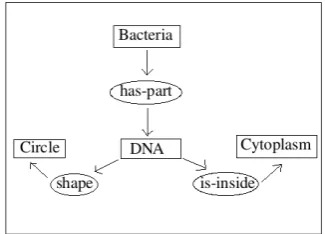
The problem that is considered in this paper is as follows: Given a parallel corpus of multi-sentential texts and their underlying semantic rep-resentations along with the communicative goal of the text, can we learn semantic grouping rules automatically? The semantic representation as-sumed in this paper is a conceptual graph (Fig-ure 3 shows an example of a conceptual graph), but the applicability of the approach is generic and can be customised to accomodate any seman-tic representation. A context-dependent discrim-inative model is learned which, given a proposi-tion set and the context, estimates the probabil-ity of aggregation of the propositions. The
prob-lem of semantic grouping is modelled as a hyper-graph partitioning problem that uses the probabil-ities outputted by the context-dependent discrim-inative model. To address the problem of hyper-graph partioning, Multi-level Fiduccia-Mattheyses Framework (MLFM) is used (Karypis and Kumar, 1999).
Figure 3: Example of a conceptual graph.
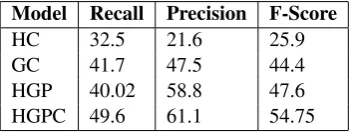
The approach is evaluated in the biology do-main against two alternatives, namely hand-crafted rules (HC) and a greedy clustering ap-proach (GC) using the probabilities outputted by the context-dependent discriminative model. Ad-ditionally, we also test the impact of context by ignoring context while learning the discrimina-tive model (Context-independent discriminadiscrimina-tive model).
An overview of related work is presented in Section 2. The corpus used in the experiments is discussed in Section 3. Then, in Section 4, the ap-proach is discussed followed by Section 5 which presents the experiments done and their results. Finally, Section 6 concludes the paper with dis-cussions and future work.
2 Related Work
Hand-crafted aggregation rules developed as a re-sult of corpus analysis are employed by (Scott and de Souza, 1990; Hovy, 1990; Dalianis, 1999; Shaw, 1998). Walker et al. (2001) proposed a overgenerate-and-select approach in which the over-generate stage lists out large number of po-tential sentence plans while the ranking stage se-lects the top ranked sentence plan using rules that are learned automatically from the training data. Cheng and Mellish (2000) propose a genetic algo-rithm coupled with a preference function. Barzi-lay and Lapata (2006) view the problem of seman-tic grouping as a set partioning problem. They employ a local classifier that learns similarity be-tween the propositions and then use ILP (Branch-and-bound algorithm) to infer a globally optimal partition.
This work is different from the earlier work in two aspects. We use contextual information to ob-tain better grouping that is applicable across differ-ent systems (even QA systems) while their work does not use the contextual information. Also, we assume a more generic hypergraph representation and use MLFM technique which works well even with large number of propositions.
Figure 4: Example of a QA pair and its triple rep-resentation.
3 Corpus
A total of 717 QA pairs are collected from vari-ous sources in the biology domain. Concepts are extracted from the question which acts as
contex-tual information. For example, when the question is What is a binary fission?, the concept Binary-Fissionbecomes the context. The answer is con-verted into sets of triples, each set corresponding to a sentence. Each triple consists of two concepts (or instances of concepts) connected by a relation. For example, the triple(Mitosis next-event Cytoki-nesis)contains two concepts namelyMitosis and Cytokinesisconnected by the relation next-event. Figure 4 shows a QA pair and its triple representa-tion. The context and sets of triples are extracted from each QA pair manually. The manual annota-tion process uses the component library described in (Barker et al., 2001).1
A total of 6337 triples are collected correspond-ing to 717 answers with each answer havcorrespond-ing 8.839 triples on an average. The highest number of triples for an answer is 46 while the lowest is 1. The total number of sentences in the answers is 1862, i.e., 2.596 sentences per an answer.
4 Approach 4.1 Hypergraphs
A hypergraph (H) is a generic graph wherein edges can connect any number of vertices and are called hyperedges. In other words, each edge is a set of vertices. It is formally represented by a pair (V,E) where V is the set of vertices and E is the set of hy-peredges. Each edgeei�E has associated weight wi. An edge with zero weight means that the the edge does not exist.
4.2 k-way Hypergraph Partitioning problem
Let P be a k-tuple (p0,p1,p2...) where eachpiis
a set of vertices from V such that∩ii==0k−1pi = φ
and∪ii==0k−1pi=V. The k-way Hypergraph
parti-tioning problem can be formulated as follows:
Given a hypergraph H = (V,E), find a k-way partitionmentδ : V → P that maps each of the vertices of H to one of the k disjoint par-titions such that some cost functionγ:P →
Ris minimized.
4.3 Modelling Aggregation as hypergraph partitioning problem
Relationships among the propositions are often complex than pairwise. Assuming this complex relationship as pairwise ones reduces the fluency 1The component library is available online at
of the verbalized text in some cases. To deal with this complex relationship, it is better to directly use hypergraphs instead of pair-wise approxima-tion.
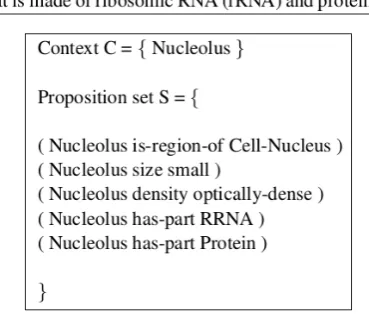
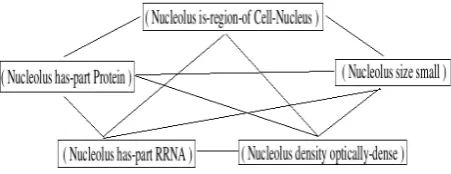
We view the problem of aggregation as a hyper-graph partioning problem guided by a data-driven context sensitive discriminative model. The input to the algorithm is aconceptual graphwhich can be alternatively represented as a set of proposi-tions. The goal is to find optimal partitions of the set of propositions given context, where each par-tition represents an aggregated sentence. The set of propositions is viewed as a graph where each proposition represents a vertex as shown in Fig-ure 5. Hyperedges are constructed on the graph obtained from propositions. Each hyperedge of this hypergraph connects one or more proposi-tions. The weightwi of each hyperedge is given by the context sensitive discriminative model dis-cussed in section 4.4. The hypergraph along with edge weights is the input to the multi-level k-partitioning algorithm.
Figure 5: Example of a proposition set and its view as a graph
4.4 Context Sensitive Discriminative Model
The weightwiAof a hyperedge (A) in the hyper-graph formed from the inputs (S) is the probability of aggregation of propositions inAgiven contex-tual information (C) andS.
wiA=pA=P(A|C, S) (1) The contextual information include the commu-nicative goal (the concepts in the question) The features that are used to predict the probability of aggregation of a proposition set are based on:
• Cohesion of the proposition set is the aver-age score of similarities between each pair of propositions in A:
CohA=
�i=|A|,j=|A|
i=1,j=1,i�=jsim(Ai, Aj)
|A| (2)
The similarity between each pair is the number of matches in the components of triples. For example, since the triples (Mi-tosis subevent Prophase), (Mi(Mi-tosis subevent Anaphase)match in two slots, the similarity score is 2/3.
• Complexity of the realizationis a cumulative weighted score of number of words, number of relative clauses, number of connectives, etc. and this score depicts how difficult it is to interpret the sentence corresponding to the proposition set A (if it is generated using the surface realizer). The score value is∞if the propositions cannot be realized as a sin-gle sentence because the surface realizer can-not find suitable structure that accomodates all the propositions.
• Dissimilarity with rest of the propositions cal-culates how dissimilar the proposition set A is with the rest of the propositions (S-A). The maximum distance (or minimum similarity) of each proposition in S-A from A is calcu-lated and averaged.
• Similarity with context C is the score of the
extent of the cover of context by the triples. It is the ratio of number of concepts in the context C that occur in any of the triples in A to the total number of concepts in C.
A number of boolean features and their conjunc-tive features are generated using the above scores with score bounds. Such feature structures are generated for each hyperedge in the hypergraph formed from S. All the subsets of S which are in Z (the correct partitioning of S) are positive in-stances and rest are negative inin-stances. A max-imum entropy model is employed to predict the probabilities of aggregation of a set of proposi-tions.
two generation systems. In Proceedings of INLG-2000, Israel.
Dalianis, Hercules. 1999. Aggregation in Natural Language Generation. Journal of Computational Intelligence, Volume 15, Number 4, pp 384-414, November 1999. Abstract
Davey, Anthony C. 1979. Discourse Production. Ed-inburgh University Press, EdEd-inburgh.
Derr, Marcia A. and Kathleen R. McKeown. 1984. Using focus to generate complex and simple sen-tences. In Proceedings of the Tenth Interna-tional Conference on ComputaInterna-tional Linguistics (COLING-84) and the 22nd Annual Meeting of the ACL, pages 319326, Stanford University, Stanford, CA.
Donia R. Scott and Clarisse S. de Souza. 1990. Get-ting the message across in RST-based text genera-tion. In R. Dale, C. Mellish, and M. Zock, editors, Current Research in Natural Language Generation
Hovy, Eduard H. 1990. Unresolved issues in para-graph planning. In R. Dale, C. Mellish, M. Zock, eds., Current Research in Natural Language Gener-ation, 1741. Academic Press, New York.
Karypis, G. and V. Kumar. 1999. Multilevel k-way hypergraph partitioning. In Proceedings of the De-sign and Automation Conference, 1999.
Kukich, Karen. 1983. Design of a knowledge-based report generator. In Proceedings of the 21st Annual Meeting of the ACL, pages 145150, Cambridge, MA, June 15-17,.
Mann, William C. and James A. Moore. 1980. Com-puter as author results and prospects. Technical Re-port RR-79-82, USC Information Science Institute, Marina del Rey, CA.
Reiter, Ehud and Robert Dale. 2000 Building Natural Language Generation Systems. Cambridge Univer-sity Press, Cambridge.
Reiter, Ehud. 1994 Has a consensus NL genera-tion architecture appeared, and is it psycholinguis-tically plausible? In Proceedings of the Seventh In-ternational Workshop on Natural Language Genera-tion, pages 163170, Nonantum Inn, Kennebunkport, Maine.
Shaw, James. 1998. Clause aggregation using linguis-tic knowledge. In Proceedings of the 9th Interna-tional Workshop on Natural Language Generation., pages 138147.
Wilkinson, John. 1995. Aggregation in natural lan-guage generation: Another look. Co-op work term report, Department of Computer Science, University of Waterloo, Septembe