On the Syntax and Semantics of the Bound Noun
Constructions: With a Computational Implementation
∗Jong-Bok Kim and Jaehyung Yang
Kyung Hee University, School of English, [email protected] and
Kangnam University, School of Computer Engineering, [email protected]
Abstract.The so-called Korean BNC (bound noun construction) displays complex syntactic, semantic, and constructional properties. This paper, couched upon a constraint-based ap-proach, two different syntactic structures for the construction with articulated lexical proper-ties for the BNs and relevant predicates. The paper reports an implementation of this analysis in the LKB (Linguistic Knowledge Building) system and shows us that this direction is robust enough to pare relevant sentences.
Keywords:bound noun construction, complex predicate, implementation
1. Introduction
Bound nouns (BN) exhibit various peculiar properties, not found in common nouns in the lan-guage. For example, unlike canonical nouns, bound nouns cannot occur independently: they obligatory select a complement (determiner or sentence). This is rather unusual when considering the language allows most of the arguments to be freely omitted with proper context:
(1) a. *(i) kes this thing
b. *(wuli-ka motu nollass-ten) kes we-NOM all surprise-MODBN ‘the thing that we all surprised’
Bound nouns also place restrictions on the types of their complements. There are at least two different types of BNs with respect to their complements: BNs selecting only a dependent clause (Type I) and those selecting either a dependent clause or a determiner phrase (Type II) (cf. Cha 2001):1
(2) a. Type I: cheyk (‘pretense’), cwul (‘method’), li (‘reason’), cek (‘experience’), ppen (‘be-ing close to do(‘be-ing someth(‘be-ing’), ba (’way’), etc.
b. Type II: swu (‘possibility), hwu (‘after’), cen (‘before’), etc
For example, unlike Type II BNhwu, Type I BNliselects only a dependent sentence, as observed in the following contrast:
(3) a. [John-i cam-ul ca-n]/ku hwu-ka mwusep-ta
John-TOPsleep-ACCsleep-MOD/that BN-NOMnot.exist-PAST-DECL
‘the time after John was sleeping/after the time’ ∗
Copyright 2007 by Jong-Bok Kim and Jaehyung Yang
1
b. [John-i cam-ul ca-l]/*ku li-ka eps-ess-ta
John-NOMsleep-ACCsleep-MOD/that BN-NOMnot.exist-PAST-DECL
‘It is not possible that John was sleeping’
Bound nouns also place tight restrictions on the verb forms of their sentential complement. In the noun complement construction (NCC), the dependent clause places no strict constraints on the head verb’s VFORM value:
(4) [John-i cam-ul ca-n/ca-ss-ta-nun] sasil John-TOPsleep-ACCsleep-PNE/sleep-PAST-DECL-PNEfact ‘the fact that John slept
As in (4), the head verb of the dependent clause, functioning as the complement of the factive noun
sasil‘fact’, can be either in a short formca-nor in a full formcan-ss-ta-nunwith the declarative ending. Meanwhile, in the BN construction, the head verb of the dependent clause cannot be in a full verb form: only a short form with restricted tense is allowed:
(5) a. John-un cam-ul *ca-n-ta-nun/ca-l/*ca-n
John-TOPsleep-ACC*sleep-PRES-DECL-PNE/sleep-FUT/*sleep-PRES
swu-ka eps-ess-ta
BN-NOMnot.exist-PAST-DECL
‘John couldn’t sleep.’
b. John-un cam-ul *ca-n-ta-nun/*ca-l/ca-nun
John-TOPsleep-ACC*sleep-PNE-DECL-PNE/s*leep-FUT/sleep-PNE
chey hayess-ta
BN did-DECL
‘John pretended to sleep.’
In both cases, the full dependent form (with the declarative marking) is not possible. In addition, the BNswurequires the head verb of its complement clause be in the future form, whereaschey
restricts the dependent verb to be marked with the present tense.
Bound nouns are also peculiar in that they impose restrictions on the types of the predicates following them. For example, the BNswu can combine only with the predicate iss-‘exist’ or
eps-‘not exist’ whereas the BNlirequires only the lattereps-. Also BNs liketes,ppen, andccek
occur only withha-‘do’, whereas BNs likekescan be followed only by the auxiliary verbkath-ta
‘seem’:
(6) a. [John-i o-l li-ka] eps-ta/*iss-ta/*kath-ta
John-i come-MODBN-NOMnot.exist-DECL/exist-DECL/seem-DECL
‘It is unlikely that John will come.’
b. [John-i o-l tus] ha-ta/*eps-ta/*kath-ta
John-NOMcome-MODBN do-DECL/not.exist/seem-DECL
‘It seems that John will come.’
Bound nouns have an additional restriction on the occurrence with case markers, which may be related to the function of the dependent clause:
(7) a. Either NOM or ACC can be attached to the BN: tey (‘place’), pa (‘way’), ccohk (‘side’), etc
b. Only NOM: nawi (‘degree’), li (‘reason’), swu (‘possibility’), ci (‘whether’), etc c. Only ACC: tung (‘so forth’), yang (‘pretense’), cwul (‘way’), chey (‘pretense’), etc d. Only DEL: tus (‘seem’), man (‘possible’), sang (‘seem’), kes (‘possible’), etc
The fact that the BNs in (7b) can occur only with NOM and those in (7c) only with ACC can be expected when considering the possible predicate they can be followed. Though all the BNs can occur with a delimiter, those in (7d) allow no case markers at all:
(8) a. pi-ka o-nun tus-*ul/*i ha-ta rain-NOMcome-PNEBN-ACC/NOMdo-DECL
‘It seems to rain.’
b. John-i o-l *kes-i kath-ta
John-NOMcome-MODBN-*NOMseem-DECL/exist. ‘It seems that John will come.’
As observed here and in the literature, BNs display complex combinatory possibilities with their complements, case/delimiter markers, and predicates following them. In addition to the constructional properties that each BNC shares, each BN also has its own idiosyncratic lexical properties. This implies that to process these BN constructions with intriguing properties, we need to develop an explicit syntactic and semantic analysis.
2. Syntax and Semantics of the Bound Noun Construction
2.1. Two Different Types
Based on the observations we have seen earlier, one could argue that a BN forms a morphological unit with the following predicate or undergoes a lexical process. However, this fails empirically in several respects: the BN’s occurrence with a case or delimiter marker evidences both its syntactic and phonological independence from the following predicate:
(9) a. sensayngnim-i o-si-l swu-(ka/cocha/man) eps-ta teacher-NOM come-HON-PNE BN-NOM/even/only not exist ‘It is not possible that the teacher comes.’
b. sensayngnim-i o-si-l kes-(to/man) kathta teacher-NOM come-HON-PNE KES-also/only seem ‘It seems that the teacher also will come.’
(10) a. [wuli-ka kwanye ha-l] (*cincca) pa-ka ani-ta we-NOMintervention do-MODreally BN-NOMnot-DECL
‘This is not the case where we can intervene.’
b. [wuli-nun ku-ka ka-l] (*cal) cwul-un moll-ass-ta
we-TOP he-NOMgo-MOD BN-TOPnot.know-PAST-DECL
‘We didn’t know that we would leave.’
Further note that there are at least two different types of the BNC. In thekesBNC, for example, there is strong syntactic cohesion between the BN and the following predicate. However, such a strong syntactic unity is not found in thecwulBNC:
(11) a. pi-ka o-l kes (*cengmal) kah-ta rain-NOMcome-PNE BN really seem-DECL
‘It seems that it will rain.’
b. wuli-nun ku-ka ka-l cwul-ul/un (cengmal) moll-ass-ta
we-TOP he-NOMgo-MODBN-ACC/TOPreally not.know-PAST-DECL
‘We really didn’t know that we would leave.’
These two types are also different with respect to the projection of a full NP. That is, when BNs combine with its complement (dependent clause or determiner), not all can function as a full NP. Observe the following coordination data:
(12) a. *[[sensayngnim-i ka-l swu] kuliko teacher-NOM go-PNE BN and [haksayngtul-i o-l swu]] iss-ta student-NOM come-PNE BN exist ‘The teacher can go and students can come.’
b. [[sensayngnim-i ka-ko] [hasayngtul-i o-l] swu] issta teacher-NOM go-or student come-PNE BN exist
As noted in (12a), theswuBNC cannot be coordinated with another BNC. This implies that this type of BNC cannot project a full NP even with its sentential complement. This can be further evidenced by the fact that the BNC cannot be used as an NP fragment, either:
(13) a.*[sensayngnim-i ka-l swu] ‘(lit.) the possibility that the teacher goes’ b. [sensangnim-i ka-l hakkyo] ‘the school where the teacher will go’
Unlike this, there are examples where the BN with its sentential complement behaves like a constituent:2
(14) a. [[aitul-un ca-nun chek], [eleu-un cwuk-un chek]] hayessta children-TOPsleep-PNE BN adult die-PNE pne did
‘Children pretended to be sleeping whereas adults pretended to be dead.’ b. [[aitul-un ka-nun cwul], [elun-un o-nun cwul]] alassta
children-TOPgo-sleep-PNE BN adult-TOPcome-PNE BN know ‘(We) thought that children go while adults come.’
2
Notice that there is one difference from BNs likeswu. That is, complex-predicate BNs are marked as carrying the feature LEX to reflect that it will form ahead-lex-ph. In addition, its semantics is identified with the complement, reflecting the fact that it behaves like a sentential complementizer, even though it is categorically a noun.
But how about the predicate kath-ta ‘seem’? Does this select only one argument? Unlike nominal elements, all verbal elements have a subject. What is the subject of this verb? Can it be identical with the subject of the dependent clause? The subject of the dependent clause cannot be identified with that ofkath-ta. Observe the following between the AVC and the BNC:
(25) a. sensayng-nim-i o-si-ko siph-(usi)-ta
teacher-HON-NOMcome-HON-COMPwould.like-HON-DECL
‘The teacher would like to come.’
b. sensayng-nim-i o-si-l kes kath-(*usi)-ta teacher-HON-NOMcome-HON-PNE BN seem-HON-DECL
‘The teacher would like to come.’
If the subject ofkath-‘seem’ issensayngnim‘teacher-HON-NOM, there is no reason why we cannot have the formkath-usi-taas insiph-usi-ta. This appears that the BNC does not have any overt subject, but a covert subject not realized in syntax. As a way of reflecting this idea, we posit the following lexical entry forkath-ta‘seem’:
(26)
aux-v-bn
hkath-i
HEAD
"
POSverb AUX +
#
ARG-ST
*
NP[pro],
"
IND3 NFORMkes
#+
SEM
RELS *"
PREDseem ARG0 3
#+
This lexical entry specifies that the auxiliary verbkath-taselects two arguments: the first one is realized as theprosubject whereas the second one is realized as the COMPS whose NFORM value iskes.
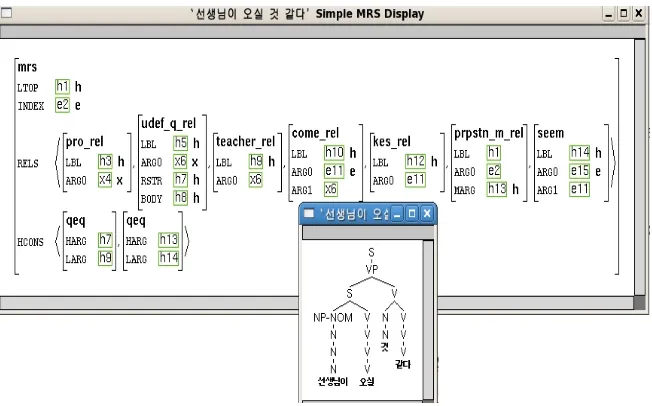
Figure 1: Parsed Tree and MRS for ‘There is no possibility that the teacher will come.’
that the ARG1 value ofseemis ‘e9’ which is also the ARG0 value of the BN’s meaningkes rel. This ‘e9’ is in fact the event thatcome reldenotes.
4. Conclusion
The Korean BNC (bound noun construction) display complex syntactic, semantic, and construc-tional properties. In particular, their combinatorial possibilities with respect to the complement and predicate types call for a much finer-grained syntax. The BNCs can even be classified into two types, depending on the syntactic coherence with the following predicate.
This paper has developed a constraint-based approach that can dissolve such issues. In terms of syntax, we postulated two different syntactic structures: head-complement and complex-predicate structures and then specify articulated lexical properties for the BNs and relevant predicates. This system has been implemented in the LKB system, which gave us robust parsing results for the given sentences.
References
Bender, Emily M., Dan Flickenger, and Stephan Oepen. 2002. The grammar matrix: An open-source starter-kit for the rapid development of cross-linguistically consistent broad-coverage precision grammars. InProceedings of the Workshop on Grammar Engineering and Evalua-tion at the 19th InternaEvalua-tional Conference on computaEvalua-tional Linguistics, pages 8–14, Taiwan. Taipei.
Cha, Jong-Yul. 2001. Constraints on Clausal Complex Noun Phrases in Korean with Focus on the Gapless Relative Clause Construction. Ph.D. thesis, UIUC.
Copestake, Ann. 2002. Implementing Typed Feature Structures. CSLI Publications, Stanford. Copestake, Ann, Dan Flickinger, Carl Pollard, and Ivan A. Sag. 2005. Minimal recursion
seman-tics: an introduction. Research on Language and Computation, 3(4):281–332.
Flickinger, Dan and Emily M. Bender. 2003. Compositional semantics in a multilingual grammar resource. InProceedings of the ESSLLI 2003 Workshop “Ideas and Strategies for Multilingual Grammar Development”, Vienna, Austria.
Kim, Jong-Bok. 2004.Korean Phrase Structure Grammar. Hankook Publishing. In Korean. Kim, Jong-Bok and Jaehyung Yang. 2004. Projections from morphology to syntax in the