A morphosyntactic analysis of the pronominal system
of Philippine languages
Shirley N. Dita
Department of English and Applied Linguistics, De La Salle University, 2401 Taft Avenue, Manila, the Philippines 1004
Abstract. Pronominal orientation is widely argued to be universal component of human languages. Meanwhile, the pronominal system of Philippine languages (henceforth, PL) has always been an obscure subject of investigation. With approximately 150 living languages, the structures of pronominals are just as many. This study attempts to explicate the grammatical functions, along with other known phenomena such as cliticization, homography, inclusivity/exclusivity, person-deixis interface, and hierarchy of some languages in the Philippines. Using an ergative-absolutive analysis, this cross-linguistic investigation of Philippine languages presents examples that illustrate the distinctive features of personal pronouns. Using a 100,000-word corpus for each language included, there are various similarities and differences revealed by the study: (1) some languages allow encliticization and some don’t; (2) homography, as well as inclusivity/exclusivity, is a persistent feature of the languages; and (3) the strength of hierarchy poses semantic constraints, among others.
Keywords: pronominals, Philippine language, cliticization, ergative-absolutive, transitivity.
1
Introduction
With approximately 150 living languages in the Philippines (Headland, 2003), there are just as many structures of the pronominal system of these languages. The present paper attempts to compare the morphosyntactic features of personal pronouns of ten Philippine languages (henceforth, PL): Tagalog, Cebuano, Ilocano, Hiligaynon, Waray-waray, Kapampangan, Bikol, Pangasinan, Kinaray-a and Ibanag. The first nine are considered major languages, whereas the last is minor.
Pronominals are a universal component of human languages and are considered basic vocabulary of any given language. Specifically, personal pronouns are generally closed-class and are unaffected by borrowing or code-switching. With these, it is hoped that a careful analysis of their features will shed light to the many controversies concerning PL (cf. Himmelman, 1991).
Literature suggests that there is an obvious paucity of studies on the pronominal systems of PL. Early studies (Reid, 1975; Tharp, 1974) have dealt more with the reconstruction of prototypes and a few looked into deictics (e.g., MacFarland, 2006). It is this gap that the present research aims to address.
1.1 Ergative-absolutive analysis
among others. There had been varied analyses for PL over the years. Bloomfield’s (1917) work on Tagalog utilized the nominative-accusative distinction and has then dominated the literature on PL for quite some time. The ergative-absolutive analysis came about in the 80s with the works of Payne (1982), Starosa (1986), Gerdts (1988), to name a few. Other analyses have also emerged: the active-stative analysis (Drossard, 1994); the fluid voice analysis (Shibatani, 1999); the hybrid analysis (Machlachlan 1996), and the precategorial symmetrical voice analysis (Foley, 1998). This paper maintains that PL can be best analyzed using an ergative-absolutive distinction.
The ergative-absolutive language (or simply ergative language) treats the object of a transitive verb and the single core argument of an intransitive verb the same, while treating the agent of a transitive verb differently. If semantic roles are to be assigned, the agent of a transitive clause is case-marked differently from the undergoer of an intransitive clause and the patient of a transitive clause. To illustrate this, a TAG1 example in (1) shows that ako which is the sole argument of the intransitive clause and thus plays the semantic role of undergoer is case-marked as ABS2 (absolutive).
(1) Bibili ako ng mangga. will.buy ABS.1s DET mango ‘I will buy a mango (or some mangoes).’
Compare (1) with (2) which is a canonical transitive. The agent ko is case-marked as ERG (ergative) as opposed to ABS in (1). Conversely, ako in (3) which is the patient of a transitive clause is case-marked as ABS.
(2) Binili ko ang mangga. bought ERG.1s DET mango ‘I bought the mango.’ stilletos
(3) Nakita nila ako saw ERG,3p ABS.1s ‘They saw me.’
Such analysis contrasts with ‘nominative-accusative’ languages (such as English), where the agent of a transitive verb and the core argument of an intransitive verb are treated alike but distinctly from the object of a transitive verb.
He arrived this morning. NOM.3s
He bought a book. NOM.3s
I saw him. ACC.3s
1
The following codes were used in this study: TAG-Tagalog, CEB-Cebuano, ILO-Ilocano, HIL-Hiligaynon, WAR-Waray, KAP-Kapampangan, BIK-Bikol, PAN-Pangasinan, KIN-Kinaray-a, IBA-Ibanag.
2
The figures below further illustrate the difference of these two analyses. In figure 1, the first row shows the core arguments of a canonical transitivie, agent (A) and object (O), as in (). The object of the transitive clause (or the patient) and the sole argument of an intransitive clause (or the subject) in second row are treated alike, that is, they both receive absolutive case-marks.
Figure 1: Ergative-absolutive alignment
In contrast, figure 2 below shows that the agent of a transitive clause and the subject of an intransitive clause are treated alike, thereby receiving the same case-marks. The object of the transitive clause, on the other hand, gets a different treatment.
Figure 2: Nominative-accusative alignment
Put simply, if S=A, then the language belongs to the nominative-accusative type, and if S=O, it belongs to the ergative- absolutive type.
1.2 Transitivity in PL
Relative to the ergative-absolutive analysis of PL is the issue of transitivity. As for English, the transitivity of verb is determined by the number of complements it gets, as in monotransitive, ditransitive, and complex transitive (Quirk, Greenbaum, Leech, & Svartvik, 1985:54; Wardhaugh, 2001). Transitivity in PL, as Reid and Liao (2004) and Ruffolo (2004) argue, is determined by the type of the complements the verb gets, that is, whether the argument is core or peripheral. While intransitive constructions only require one core argument, transitive constructions may take two or more core arguments.
Dixon and Aikhenvald (2000) distinguish core from peripheral arguments. In their view, the occurrence of core arguments is determined by the head of the clause, whereas, the occurrence of peripheral arguments (or adjuncts in this paper) is less dependent on the kind of the head of the clause. Peripheral arguments or adjuncts are those that indicate the place, time, frequency, reason, purpose, and so on. As is their nature, they are optionally included in the clause.
2
Methodology
This study utilizes a 100,000-word corpus3 for each language under investigation. Unless otherwise specified, all sample utterances used in this study are drawn from the corpus4. Although the analysis is corpus-based, I will refrain from doing quantitative analyses of the occurrence of linguistic structures. Instead, I restrict myself to qualitative analyses of the various phenomena going on in these languages.
3
The General Characteristics of Personal pronouns in PL
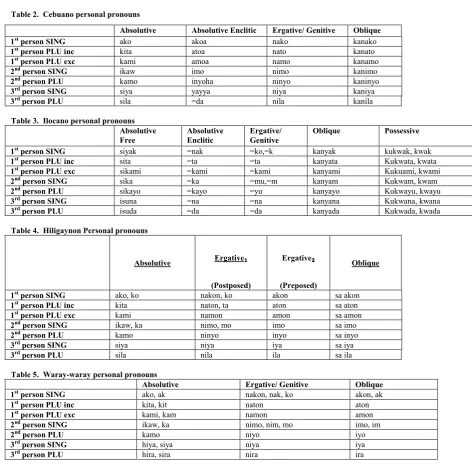
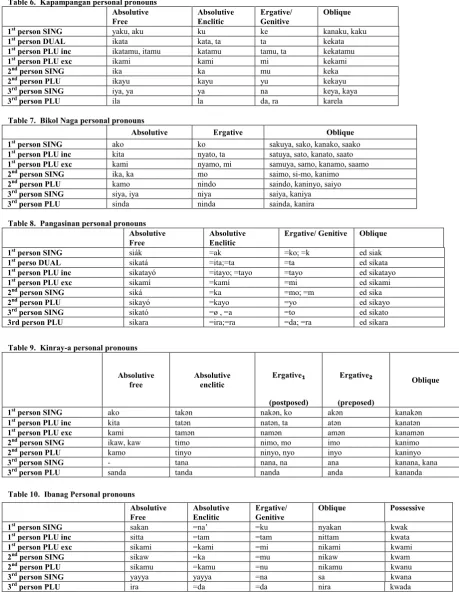
Philippine-type languages exhibit some characteristics that are incongruent with other languages (cf. English). For one, there appears to be a four-way distinction of person: first person, first+second person, second person, and third person. In addition to the pronouns listed in the charts (see appendix), there are portmanteau pronouns in PL, that is, a combination of ERG.1s and ABS.2s, where the former is the agent and the latter the patient in a clause. In (4), the TAG portmanteau kita encodes both the agent and the patient; whereas in (5), the ILO portmanteau ka encodes these two roles, too. These portmanteau pronouns are not included in the tables provided (see appendix) since these are not a PL universal.
(4) Mahal kita. (TAG) love ERG.1s+ABS.2s ‘I love you.’
(5) Ay-ayaten ka. (ILO) love ERG.1s+ABS.2s ‘I love you.’
(6) Kaluguran da ka. (KAP) love ERG.1s ABS.2s ‘I love you.’
(7) Hinigugma ko ikaw (CEB) love ERG.1s ABS.2s ‘I love you.’
As for the number, PL have three distinctions: singular, dual, and plural. However, duality is evident only in ILO, KAP and PAN and considered antiquated in TAG.
(8) Agkararag ta. (ILO) Pray ABS.1d ‘Let us pray.’
(9) Munta kata kekami. (KAP) Go ABS.1d OBL.1p ‘Let’s go to my place.’
In (8), the dual pronoun ta refers to two people only: the addresser and the addressee. When the doer is pluralized, the clause becomes (Agkararag) tayo which is plural inclusive and (agkararag) kami for plural exclusive. Likewise, kata in (9) refers to two people only, the speaker and the one spoken.
Additionally, first person plural in PL is further distinguished as inclusive or exclusive. As evident in the free translations of both (10 - (11) and (12) - (13), Consider the following examples:
3
The corpora used for Ilocano and Ibanag come from my project “Building a corpus of Philippine languages” funded by the University Research and Coordination Office (URCO) of De La Salle University.
4
(10) Kakain kami. (TAG) Will.eat ABS.1pe
‘We will eat (excluding addressee).’ (11) Kakain tayo. (TAG)
Will.eat ABS.1pi
‘We will eat (including addressee).’ (12) Ala tamung nasi. (KAP)
NEG ABS.1pe rice
‘We don’t have rice (excluding addressee).’ (13) Ala keng nasi. (KAP)
NEG ABS.1pe rice
‘We don’t have rice (including addressee).’
PL pronouns do not mark gender distinctions. Hence, third person singular encode both masculine and feminine genders, as illustrated in (14) and (15).
(14) Kalussaw=na yayya. (IBA) hate=ERG.3s ABS.3s ‘S/he hates her/him.’
(15) Kasal na hiya
married already ABS.3s ‘S/he is already married.’
Finally, PL distinguish four basic grammatical functions: absolutive, ergative, genitive, and oblique. Some languages may differ though in the form of their absolutives, some are free absolutives and others are clitics. As for obliques, some languages use the same function to encode absolute possessives while others use a different form for this. The following section explains the grammatical functions of PL.
4 Grammatical functions of pronouns
There are four basic grammatical functions in PL: the absolutive, the ergative, the genitive, and the oblique.
4.1 Absolutives
The term ‘absolutive’ is used in this study, as opposed to ‘nominative’ in Reid and Liao (2004), Liao (2003), Rubino (1997), among others. Absolutive, as Trask (1993) defines, “is the case form which marks both the doer/experiencer of an intransitive and the patient of a transitive verb, and which contrasts with the ergative” (p.3).
Some languages have two possible forms for the absolutives: free and enclitics. Absolutives are free when they are the sole arguments in a clause and are enclitics when they function as objects in dyadic transitives. The positions of absolutives also vary cross-linguistically.
First, free absolutives may function as response to question, as in (16); or as sentence initial subject, as in (17) and (18);
(16) Sinni i kimminan ta dupo? (IBA) who DET ate DET banana ‘Who ate the banana?
Sakan!
ABS.1s
(17) Kami it magpadis. (WAR) ABS.1pe LIN partners
‘We are partners.’
(18) Sikato so nanluto. (PAN) ABS.3s DET cooked
‘S/he is the one who cooked.’
Second, absolutives also function as predicates in an identificational nominal clauses, that is, those in which the predicate provides specific identification for the entity expressed in the ABS NP of the clause as in hiya of (19) and isuna of (20);
(19) Hiya an kumuha han bolpen. (WAR) ABS.3s DET took DET ball pen
‘He is the one who took the ball pen.’ (20) Isuna iti nanglipat. (ILO)
ABS.3s DET forgot ‘S/he is the one who forgot.’
Third, absolutives function as predicates in classificational nominal clause. In (21), the ABS sikara is classified as the entity expressed in the predicate mayaman ‘rich’:
(21) Mayaman sikara. (PAN) rich ABS.3p ‘They are rich.’
Fourth, absolutives are also topics in a contrastive clause, as in (22)
(22) Kami buotan, hira maraot. (WAR) ABS.1pi nice, ABS.3p bad.
‘We are nice, they are bad.’
Fifth, absolutives are the sole arguments or experiencer in intransitive constructions, as in (23) or the object or patient in a transitive construction, as in (24) and (25).
(23) Mag binisaya mi diri. (CEB) to.speak Visayan ABS.1pi here ‘We speak Cebuano5 in here.’ (24) Iniwan ko sila.
left ERG.1s ABS.3p ‘I left them.’
(25) Inalegad=da sakan. looked.for=ERG.3p ABS.1s ‘They looked for me.’
In addition, some PL exhibit a peculiar syntactic feature, that is the grammatical antecedent may co-occur with the pronoun. ILO and KAP require that the noun referent is present along with the pronoun used. In (26), ya refers to ‘Erning’ as da in (27) refers to ‘the children. The sentence becomes ungrammatical if the pronoun is removed.
(26) Dinatang
ya i Erning. (not *dinatang i Erning) arrived ABS.3s DET Erning‘Erning arrived.’
5
(27) Natúrog=da dagiti ubbing. sleep=ABS.3p DET.p children
‘The children slept.’ (Reid & Liao 2004:446)
4.2 Ergatives
As earlier established, ergatives are simply defined as “subject of a transitive clause” (Bickford, 1998:269). Ergatives function as agents of two types of transitives: either dyadic6 or triadic. The examples below illustrate how ergatives are used as agents of transitive constructions.
(28) Igpapasyada ko kamo (WAR) will.take around ERG.1s ABS.2p ‘I will take you around.’
(29) Nakitan namon hira ha gawas. (WAR) found ERG.1pi ABS.3p outside. ‘We saw them outside.’
Note that in the given examples here, the ERG arguments are generally postverbal in
distribution, as opposed to ABS which may occur in initial position in a clause. Additionally, ERG may also encliticize with the host word, like IBA in (30) but not for KAP, as in (31).
(30) Binambarad=da sakan. (IBA) punished=ERG.3p ABS.1s
‘They punished me.’
(31) Ibie ke ing susi kang Carmen. (KAP) give ERG.1s DET key OBL Carmen
‘I will give the key to Carmen.’
4.3 Genitives
Genitives are morphologically identical with ergatives. It is with this morphological synonymity that prompted some Philippinists to use the label GEN to both ergative and genitive functions (e.g., Reid & Liao, 2004). I argue in this paper that these items should not receive similar treatment. To distinguish the two, PL genitives are generally postnominals whereas ergatives are postverbals. Dita (2007) uses the following example in IBA to illustrate the distinction of the two grammatical points.
(32) Nassingan=na i wagi na. (IBA) saw=ERG.3s DET sibling GEN.3s ‘S/he saw her/his sibling.’
(33) Baggawan=nu i takki nu. (IBA) wash=ERG.2p DET feet GEN.2p ‘Wash your feet.’
The examples in (30) and (31) clearly show that the items na and nu function both as ERG and ABS, respectively. However, it is also clear that the ERGs function as agents of the transitive clauses and the GENs are possessors of the NPs.
As opposed to English genitives which are prenominals, a prototypical possessive phrase in PL is postnominal, as in (34).
6
(34) ang bahay ko (TAG) DET house GEN.1s ‘my house’
However, some PL prefer an oblique construction to express possession. Consider the following examples in TAG and HIL.
(35) ang akin=g bahay (TAG) DET OBL.1s+LIG
house
‘my house’
(36) ang akon nga kape (HIL) DET OBL.1s LIG coffee ‘my coffee’
As provided in the matrix of personal pronouns (see Tables 1 and 4, respectively ), akin and akon are obliques but they can also be used to encode genitives. Apparently, KAP utilizes the prenominal genitives over the postnominal, as in:
(37) Ing kakung bale iyang gamitan da. (KAP) DET OBL.1s house DET+LIN use ABS.3p ‘It’s my house they are going to use.
(38) Malapit ya mu ing bale ku. (KAP) near DEM only DET
‘My house is just near.’
4.4 Obliques
Obliques are used to express direction towards a person or persons, or the transmission of an object towards the entity or party specified by the oblique pronoun. Obliques have the following functions: First, they denote the semantic role of ‘source’, as in (39) for IBA.
(39) Naggafu nyakan yaw. (IBA) came OBL.1s this
‘This came from me.’
(40) Pimmanaw da kaniami. (ILO) left ABS.3p OBL.1pe ‘They left us (lit. from our place).
They also denote the goal semantic role, as in (41) for WAR:
(41) Iglabog ini ha iya. (WAR) throw this OBL.3s ‘Throw this to him’
Locatives also express the presence in terms of person, as in (42) for TAG.
(42) Kapag ikaw ay may problema, kailangan mo ng isang kaibigan sa iyo. If ABS.2s LIN EXI problem need ERG.2s DET one friend OBL.2s ‘If you have a problem, you need one friend (to be) with you.’
Next, obliques can also function as benefactives, or, in Rubino’s (1997:69) words, patientive or recipient.
(43) Para nyakan kanu yari kansion=na. for OBL.1s PAR7 DEM song=GEN.3s ‘That song of his is apparently for me.’
7
(44) Itavvung mi nikaw i sakrifisyo. . . offer ERG.1pe OBL.2s DET sacrifice ‘We offer you sacrifice. . .’
5 Other phenomena in PL pronouns
Aside from the various distributions of the four grammatical functions of pronouns, there are also some noted features of PL that are worth investigating.
5.1 Homomorphy
One distinct feature of pronouns in PL is that two sets, the ergatives and genitives, can be homomorphs, that is, they are both spelled and pronounced the same but they have different meanings. In literature, some use the same case-marking for both cases, i.e., ERG to mark both ergative and genitive (cf. Reid, 1979). In some cases, the label used is ERG/GEN to refer to either of the two (cf. Reid & Liao, 2004). In my earlier paper (Dita, 2007), I have distinguished the functions of ERG and GEN and I have argued that homomorphic items be labeled accordingly to distinguish the function of the two. This paper maintains separate case-marking for these two sets. To illustrate homomorphy in PL, the following examples are drawn.
(45) Nakita niya ang kaibigan niya. TAG) saw ERG.3s DET friend GEN.3s ‘He/she saw his/her friend.’
(46) Inusar da ti sapatos da. (ILO) Used ERG.3p DET shoes GEN.3p ‘They used their (own) shoes.’
Dita (2007) reports that in IBA, the first person absolutive enclitic and the third person singular ergative have the same morphological form: na. Phonologically, though, the two have notable difference. The absolutive is glottal stop whereas the ergative is not. Hence, they can be considered more as homographs or heteronyms. The more apparent distinction of the two lies in their syntactic properties. The absolutive is the actor in an intransitive clause, as in (47); whereas, the ergative is the agent in a transitive clause, as in (48).
(47) Kimminan na’ ta dupo. ate ABS.1s OBL banana ‘I ate banana.’
(48) Nassingan na i dupo’
saw ERG.3s DET banana=GEN.1s ‘S/he saw the banana.’
Still in IBA, these homomorphs can also co-occur with each other. If the ergative case is the agent and the absolutive case is the benefactive, only one na appears in the sentence. The ergative therefore is not phonologically overt anymore. Consider the following examples:
(49) Iniddan na’ ta bagga. gave ERG.3s+ABS.1s OBL rice ‘S/he gave me rice.’
5.2 Cliticization
Pronominal clitics in PL exhibit various characteristics. Clitics are grammatical words that are unable to stand on their own phonologically, but must instead lean on another adjacent word. They must be incorporated into the prosodic structure of another word (Aronoff & Fudeman 2005:35)
.
CEB, KAP, PAN, ILO, IBA, and KIN are among the languages which demonstrate encliticization for absolutives.
There are cases in which the ergative and the absolutive pronouns both encliticize with the host word. Such is usually evident in ILO, as in the following examples:
(51) Arakupen=na=k. (ILO)
hug=ERG.2s+ABS.1s
‘(You) hug me.
Compare the same utterance with TAG and KAP where neither of the arguments ecliticize with the host word, as in (52) and (53).
(52) Yakapin mo ako. (TAG) hug ERG.2s ABS.1s ‘(You) hug me.”
(53) Kawlan mu aku. (KAP)
hug ERG.2s ABS.1s
‘(You) hug me.”
Another noteworthy feature of the IBA ergatives concerns the singular forms of the first and second persons, respectively. Note that when they are attached to host words ending in vowel, the first person =ku becomes morphologically covert and thus represented by the glottal stop (’). On the other hand, the second person =mu can only be reduced to =m but can never be omitted.
(54) Inatawa’(k) yari kofun mu turi high school. (IBA) married=ERG.1s DEM friend GEN.1s REM high school
‘I married your former friend in high school.’ (55) Inatawa=m kari yayya? (IBA)
marry=ERG.2s PAR ABS.3s ‘Did you really marry him/her?’
5.3 Hierarchy
Schachter (1973) explains that in TAG, monosyllabic pronouns always precede disyllabic pronouns. Hence:
(56) Kilala ko sila. (TAG) know ERG.1s ABS.3p ‘I know them.’
But not
*Kilala sila ko. (TAG) know ABS.3p ERG.1s ‘I know them.’
(57) Nakita ka nila. (TAG) saw ABS.1s ERG.3p ‘They saw you.’
In the example above, the monosyllabic ka ‘you’, which is the object of the ‘see’ appears before the disyllabic nila ‘they’ which is the agent in the clause.
When both pronouns are disyllabic, however, the agent precedes the patient, as in
(58) Kilala nila ako. (TAG) know ERG.3p ABS.1s ‘They know me.’
This constraint also holds true for other PL. Here are relevant examples to illustrate this:
(59) Nababati-an ka nira . (WAR) heard ABS.2s ERG.3p
‘They heard you.’
But not
*Nababati-an nira ka. (WAR) heard ERG.3p ABS.2s
‘They heard you.’
5.4 Person-Deixis Interface
MacFarland (2006) explains that it is quite common in PL to use a deictic pronoun in place of a personal pronoun, as in the case of TAG ito'this' instead of siya (3s). Consider the following example:
(60) Magaling ang bata=ng ito. (TAG) Smart DET child=LIG DEM ‘This child is smart.’
Although the above utterance is grammatically correct, it would have been more polite to use the third person singular to refer to the child, as in:
(61) Magaling siya. (TAG) Smart ABS.3s ‘S/he is smart.’
Conversely, present-day speakers of TAG have the tendency to use ABS.3s for inanimate entities, as well. The more semantically acceptable expression would have been a deixis, too, specifically, iyan ‘that’.
(62) Gusto ko siya. (referring to an object, eg., a shirt, or toy) Like ERG. 1s ABS.3s
6 Conclusion
I have attempted to provide in this paper the basic grammatical features of personal pronouns of ten PL. In summary, PL have four person distinction, as opposed to three in English. These are the basic first, second, and third with the addition of the portmanteau pronoun which encodes first and second persons. As discussed, only a few PL display such characteristic. As for the number, PL have three distinction, as opposed to two in English: singular and plural with dual for some PL. Conversely, there is no gender distinction in PL, as opposed to the masculine and feminine genders in English. Finally, PL have four grammatical function distinction: the absolutive, ergative, genitive, and oblique. I have illustrated the distribution and some constraints of these grammatical functions.
In addition to the basic features of personal pronouns, I have tried to address some controversies evident in PL pronominals such as homomorphy, cliticization, hierarchy, and person-deixis interface. Although there was an attempt to present a cross-linguistic account for these phenomena, there are yet other features that need further scrutiny. It is hence recommended that more PL be included in the investigation of other possible observable facts in PL pronominals.
References
Aronoff, M. and K. Fudeman. 2005. What Is Morphology? Oxford: Blackwell.
Bloomfield, L. (1917). Tagalog texts with grammatical analysis. University of Illinois, Studies in Language and Literature 3, 2-4. Urbana, Illinois: University of Illinois Press.
Dita, S. N. 2007. A reference grammar of Ibanag. Ph.D. thesis, De La Salle University, The Philippines.
Dita, S. N., R.E.O Roxas, and P. Inventado. 2009. Building Online Corpora of Philippine Languages. Proceedings of the Twenty-third Pacific Asia Conference on Language, Information and Computation, 646-653.
Dixon, R. M. W. 1994. Ergativity. Cambridge: Cambridge University Press.
Dixon, R. M. W. 1972. The Dyirbal language of North Queensland. Cambridge: Cambridge University Press.
Dixon, R.M.W. and A. Y. Aikhenvald. 2000. Introduction. In R.M.W. Dixon and A.Y.
Aikhenvald, eds., Changing valency: Case studies in transitivity, pp. 1-29. Cambridge and New York: Cambridge University Press.
Drossard, W. 1994. The systematization of Tagalog morphosyntax. Arbeitspapier Nr. 19. Koln: Institut fur Sprachwissenschaft, Universitat zu Koln.
Foley, W.A. 1998. Symmetrical voice system and precategoricality in Philippine languages. In M. Butt and T.H. King, eds., Proceedings of the LFG 98 conference: Workshop on voice and grammatical functions in Austronesian languages. Stanford: CSLI.
Gerdts, D.B. 1988. Antipassives and causatives in Ilokano: Evidence for an ergative analysis. In R. McGinn. ed., Studies in Austronesian linguistics, pp. 295-321. Monographs in International Studies, Southeast Asia Series No. 76. Athens, Ohio: Center for Southeast Asia Studies, Ohio University.
Headland, T. 2003.
Thirty Endangered Languages in the Philippines. Work Papers of theSummer Institute of Linguistics, University of North Dakota Session (vol. 47). Dallas: SIL International.
Lewis, M. P. (Ed.) 2009. Ethnologue: Languages of the world (16th ed.)Dallas, Tex.: SIL International. Online version: http://www.ethnologue.com/
Machlachlan, A.E. 1996. Aspects of ergativity in Tagalog. PhD dissertation, McGill
University.
Payne. T. E. (1982). Role and reference related subject properties and ergativity in Yup’ik and
Tagalog. Studies in Language 6,75-106.
Reid, L. A. and H. Liao. 2004. A brief syntactic typology of Philippine languages. Language
and Linguistics,5(2), 433-490.
Reid, L. A . 1979. Towards a reconstruction of the pronominal systems of Proto-Cordilleran,
Philippines. In South-East Asian Linguistic Studies, Vol. 3, ed. by Nguyen Dang Liem,
259-275. Pacific Linguistics Series C, No. 45.
Rubino, C. R. G. 1997. A reference grammar of Ilocano. Ph.D. thesis, University of California,
Santa Barbara.
Schachter, P. 1973. Constraints on clitic order in Tagalog. In AB. Gonzalez, F.S.C.,
ed., Parangay Kay Cecilio Lopez: Essays in Honor of Cecilio Lopez on His Seventy-fifth
Birthday, pp. 214-231. Quezon City: Linguistic Society of the Philippines.
Schachter, P. and F. T. Otanes. 1972. Tagalog Reference Grammar. Berkeley, Los
Angeles, London: University of California Press.
Shibatani, M. 1999. Case, voice, and language type. Lecture given at the University of the Philippines, Diliman, Quezon City.
Starosta, S. 1986. Focus as recentralization. In P. Geraghty, L. Carrington, and S.A. Wurn,
eds., FOCAL 1: Papers from the Fourth International Conference on Austronesian
Linguistics, pp. 73-95. Canberra: Department of Linguistics, Research School of Pacific
Studies, The Australian national University.
Tharp, J. A. 1974. The Northern Cordilleran subgroup of Philippine languages. Working Papers