Effective Tag Set Selection in Chinese Word
Segmentation
via Conditional Random Field Modeling
Hai Zhao1,2?, Chang-Ning Huang2, Mu Li2, and Bao-Liang Lu1 1
Department of Computer Science and Engineering, Shanghai Jiao Tong University, 1954 Hua Shan Rd., Shanghai 200030, China
{zhaohai,blu}@cs.sjtu.edu.cn, 2
Microsoft Research Asia, 49, Zhichun Road, Haidian District,
Beijing, China, 100080
[email protected], [email protected]
Abstract. This paper is concerned with Chinese word segmentation, which is regarded as a character based tagging problem under conditional random field framework. It is different in our method that we consider both feature template selection and tag set selection, instead of feature template focused only method in existing work. Thus, there comes an empirical comparison study of perfor-mance among different tag sets in this paper. We show that there is a significant performance difference as different tag sets are selected. Based on the proposed method, our system gives the state-of-the-art performance.
1
Introduction
Chinese text is written without natural delimiters, so word segmentation is an essential first step in Chinese language processing. In this aspect, Chinese is quite different from English in which sentences of words delimited by white spaces. Though it seems very simple, Chinese word segmentation is not a trivial problem. Actually, it has been active area of research in computational linguistics for almost 20 years and has drawn more and more attention in the Chinese language processing community. To accomplish such a task, various technologies are developed [1].
To give a comprehensive comparison of Chinese segmentation on common test cor-pora, two International Chinese Word Segmentation Bakeoffs were held in 2003 and 2005, and there were 12 and 23 participants respectively [4], [5].
In all of proposed methods, character based tagging method [2] quickly rose in two Bakeoffs as a remarkable one with state-of-the-art performance. As reported in [5], the results of Bakeoff-2005 shows a general trend to a decrease in error rates from 3.9% to 2.8% compared to the results of Bakeoff-2003. Especially, two participants, Ng and Tseng, gave the best results in almost all test corpora [6], [7].
We continue to improve CRF-based tagging method of Chinese word segmentation on the track of Ng and Tseng in this study. It is different in our method that we consider
?
wherehi∈H andti∈T.
For convenience, features are generally organized by some groups, which used to be called feature templates. For example, a bigram template C1 stands for the next character occurring in the corpus after each character .
A feature template set we selected is shown in Table 1. We give an explanation to feature templateT−1T0T1. Here,T−1,T0orT1stands for predefined class. There are four classes defined: numbers represent class 1, those characters whose meanings are dates represent class 2, English letters represent class 3, and other characters represent class 4. This feature template is improved from the corresponding one in [6]. Refer it for more details.
Table 1.Feature templates
Type Feature Function
Unigram C−1, C0, C1 The previous, current and next character
Bigram C−1C0, C0C1 The previous (next) character and current character
C−1C1 The previous character and next character
Punctuation P u(C0) Current character is a punctuation
Date, Digital and Letter T−1T0T1 Types of previous, current and next character
Table 2.Definitions of different tag sets
Tag set Tags Words in tagging
2-tag (Peng/Tseng) B, E B, BE, BEE, ...
4-tag (Xue/Ng) B, M, E, S S, BE, BME, BMME, ...
5-tag B, B2, M, E, S S, BE, BB2E, BB2M E, BB2M M E, ...
6-tag B, B2, B3, M, E, S S, BE, BB2E, BB2B3E, BB2B3M E, ...
2-tag set. We will see 2-tag set selection is as important as feature template set selection in the empirical comparison.
To effectively perform tagging for those longer words, we extend 4-tag set of Ng/Xue. The tag ’B2’ is added into 4-tag set to form 5-tag set, in which stands for the second character position in a Chinese word. Similarly, the tag ’B3’ is added into 5-tag set to form 6-tag set, in which stands for the third character position in a Chinese word. This extension is based on our observation of average weighted word length distribution in each corpus. We will give further discussions in Section 4.
4
Experiments
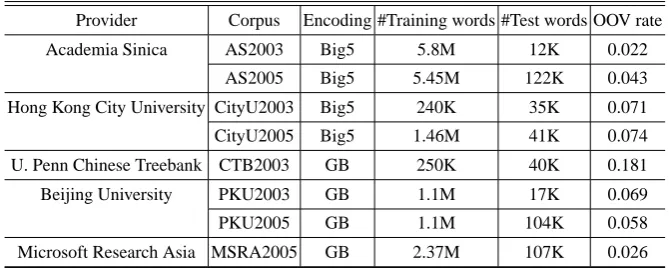
Eight corpora are available from Bakeoff-2003 and 2005. We use all of them to perform the evaluation. A summary of these corpora is shown in Table 3.
Table 3.Corpora statistics of Bakeoff-2003 and 2005
Provider Corpus Encoding #Training words #Test words OOV rate
Academia Sinica AS2003 Big5 5.8M 12K 0.022
AS2005 Big5 5.45M 122K 0.043
Hong Kong City University CityU2003 Big5 240K 35K 0.071
CityU2005 Big5 1.46M 41K 0.074
U. Penn Chinese Treebank CTB2003 GB 250K 40K 0.181
Beijing University PKU2003 GB 1.1M 17K 0.069
PKU2005 GB 1.1M 104K 0.058
Microsoft Research Asia MSRA2005 GB 2.37M 107K 0.026
4.1 Experimental Results under Different Tag Sets
To observe the trends of performance under different feature template sets and different tag sets, we define another two feature template sets in addition to the feature template set defined in Table 3. Their definitions are shown in Table 4. The experimental results of CityU2003 and PKU2005 are shown in Table 5. From the experimental results, we can get a general trend of performance increasing from 2-tag to 6-tag set.
Table 4.Four feature template sets
ID Description
TMPT-01 Defined in Table 1.
TMPT-02 AddC−2, C2, and removeP u, T−1T0T1in TMPT-01
TMPT-03 AddC−2in TMPT-01
TMPT-04 RemoveP uandT−1T0T1in TMPT-01
Table 5.Experimental results of CityU2003 and PKU2005 under different feature template sets and tag sets
Feature Set CityU2003 PKU2005
2-tag 4-tag 5-tag 6-tag 2-tag 4-tag 5-tag 6-tag
TMPT-01 0.9320 0.9472 0.9478 0.9483 0.9505 0.9522 0.9531 0.9536
TMPT-02 0.9302 0.9450 0.9461 0.9462 0.9461 0.9479 0.9499 0.9503
TMPT-03 0.9324 0.9471 0.9464 0.9467 0.9493 0.9499 0.9523 0.9526
There is another comparison between our system and Tseng’s: we propose 8 groups of feature templates shown in Table 1, while there are 15 groups of selected feature templates in Tseng’s system. However, with a selected appropriate tag set, our system gives its superior performance.
4.2 Comparisons of Best Existing Results and Our Results
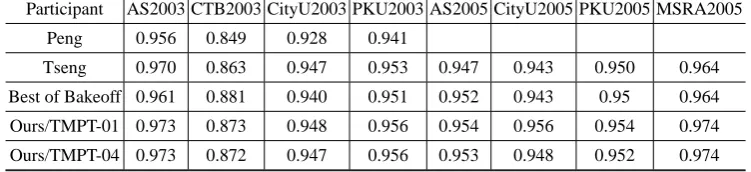
The comparison between our results and best existing results are shown in Table 63. There are two types of existing results. One is the best F score of Bakeoff-2003 and 2005 for each corpus under closed test. The other is the results of Tseng et al.. All of our results are performed under TMPT-01 (or TMPT-044) and 6-tag set.
3The Third SIGHAN Chinese Language Processing Bakeoff has been held, the results will be
presented at the 5th SIGHAN Workshop, to be held at ACL-COLING 2006 in Sydney, Aus-tralia, July 22-23, 2006. We also participate this Bakeoff, and our system with the techniques presented in this paper won four highest and two third highest F measures in six Chinese word segmentation tracks. Our results on Bakeoff-2006 appear in SIGHAN-2006 [11].
4
Table 6.Comparisons of best existing results and our results in the corpora of Bakeoff-2003 and 2005
Participant AS2003 CTB2003 CityU2003 PKU2003 AS2005 CityU2005 PKU2005 MSRA2005
Peng 0.956 0.849 0.928 0.941
Tseng 0.970 0.863 0.947 0.953 0.947 0.943 0.950 0.964
Best of Bakeoff 0.961 0.881 0.940 0.951 0.952 0.943 0.95 0.964
Ours/TMPT-01 0.973 0.873 0.948 0.956 0.954 0.956 0.954 0.974
Ours/TMPT-04 0.973 0.872 0.947 0.956 0.953 0.948 0.952 0.974
4.3 Determine Effective Tag Sets
How to select an effective tag set for current segmentation task is an interesting problem. Since our task is to segment sequence into various length words, it is natural for us to analyze the word length distribution in a corpus.
Average weighted word length distribution of eight concerned training corpora are shown in Table 7. The length of a Chinese word is measured by the number of including characters. The numerical values in Table 7 are calculated through dividing the sum of lengths of words with specified length by the number of all words in the corpus. We may notice that average weighted word length of MSRA2005 and CTB2003 are the longest. As for CityU2005, though it is not the shortest one, the average length of all words which are longer than three-character is the shortest. This is what we are more interested in, since our tag set trends to extend the case with more tags.
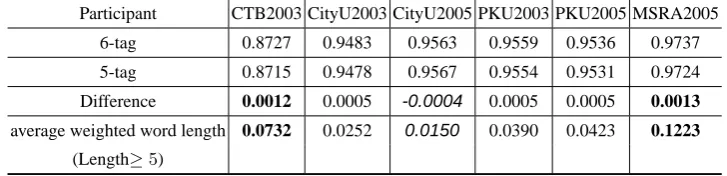
Notice 6-tag set can label a five-character word without repeating its tags, that is, ’BB2B3M E’, we may take average weighted word length of those words whose char-acter lengths are larger than four as our experimental criteria to determine if 6-tag set should be taken or not. For example, we may calculate a value through dividing the sum of lengths of those words whose lengths are larger than four characters by the number of all words in corpus. The threshold is empirically set to 0.02 for our current task. If the obtained value is larger than the threshold, then we adopt 6-tag set, otherwise, we adopt a tag set with five or less tags. Comparison results are shown in Table 9. The experimental results show that CityU2005 corpus with shortest average weighted word length among eight corpora gets its higher performance at 5-tag set instead of 6-tag set though the difference is slight, while MSRA2005 and CTB2003 corpora with the longest word lengths win the most performance improvement from 5-tag to 6-tag set.
Table 7.Average weighted word length distribution of eight training corpora
Word Length AS2003 AS2005 CTB2003 CityU2003 CityU2005 PKU2003 PKU2005 MSRA2005
Total 1.5458 1.5089 1.7016 1.6130 1.6275 1.6429 1.6455 1.7101
≥2 1.001 0.9378 1.2649 1.1190 1.1586 1.1708 1.1728 1.2401
≥3 0.2135 0.1804 0.3211 0.2648 0.2479 0.2692 0.2730 0.3619
≥4 0.0747 0.0730 0.1195 0.0887 0.0688 0.1208 0.1244 0.2193
≥5 0.0320 0.0334 0.0732 0.0252 0.0150 0.0390 0.0423 0.1223
≥6 0.0228 0.0241 0.0351 0.0133 0.0072 0.0105 0.0142 0.0776
Table 8.The distribution of words with different lengths in eight training corpora
Word Length AS2003 AS2005 CTB2003 CityU2003 CityU2005 PKU2003 PKU2005 MSRA2005
≤5 0.9973 0.9974 0.9950 0.9981 0.9990 0.9985 0.9983 0.9899
6 0.0008 0.0007 0.0024 0.0010 0.0005 0.0007 0.0007 0.0037
≥7 0.0019 0.0019 0.0026 0.0009 0.0006 0.0008 0.0010 0.0063
Table 9.Relation between tag set and average weighted word length under feature template set TMPT-01
Participant CTB2003 CityU2003 CityU2005 PKU2003 PKU2005 MSRA2005
6-tag 0.8727 0.9483 0.9563 0.9559 0.9536 0.9737
5-tag 0.8715 0.9478 0.9567 0.9554 0.9531 0.9724
Difference 0.0012 0.0005 -0.0004 0.0005 0.0005 0.0013
average weighted word length 0.0732 0.0252 0.0150 0.0390 0.0423 0.1223
5
Conclusion
In this work, we have shown an appropriate tag set can give a substantial performance improvement of Chinese word segmentation for character based tagging method under CRF framework. Furthermore, we propose that average weighted word length distribu-tion of the corpus can be taken as the criteria to choose tag set. Based on the proposed method, our system obtains state-of-the-art performance in all corpora of Bakeoff-2003 and 2005.
References
1. Jianfeng Gao, Mu Li, Andi Wu and Chang-Ning Huang. 2005. Chinese Word Segmenta-tion and Named Entity RecogniSegmenta-tion: A Pragmatic Approach.Computational Linguistics, Vol. 31(4): 531-574.
2. Nianwen Xue. 2003. Chinese Word Segmentation as Character Tagging. Computational Linguistics and Chinese Language Processing, Vol. 8(1): 29-48.
3. Nianwen Xue and Libin Shen. 2003. Chinese Word Segmentation as LMR Tagging. In Pro-ceedings of the Second SIGHAN Workshop on Chinese Language Processing, in conjunction with ACL’03, 176-179. Sapporo, Japan.
4. Richard Sproat and Thomas Emerson. 2003. The First International Chinese Word Seg-mentation Bakeoff. Proceedings of the Second SIGHAN Workshop on Chinese Language Processing, 133-143. Sapporo, Japan.
5. Thomas Emerson. 2005. The Second International Chinese Word Segmentation Bakeoff.
Proceedings of the Fourth SIGHAN Workshop on Chinese Language Processing, 123-133. Jeju Island, Korea.
6. Jin Kiat Low, Hwee Tou Ng and Wenyuan Guo 2005. A Maximum Entropy Approach to Chinese Word Segmentation.Proceedings of the Fourth SIGHAN Workshop on Chinese Lan-guage Processing, 161-164. Jeju Island, Korea.
7. Huihsin Tseng, Pichuan Chang, Galen Andrew, Daniel Jurafsky, Christopher Manning. 2005. A Conditional Random Field Word Segmenter for Sighan Bakeoff 2005. Proceedings of the Fourth SIGHAN Workshop on Chinese Language Processing, 168-171. Jeju Island, Korea. 8. Fuchun Peng, Fangfang Feng and Andrew McCallum. 2004. Chinese Segmentation and New
Word Detection Using Conditional Random Fields. InCOLING 2004, 562-568. Geneva, Switzerland, August 23-27, 2004.
9. John Lafferty, A. McCallum and F. Pereira. 2001. Conditional Random Field: Probabilis-tic Models for Segmenting and Labeling Sequence Data. InProceedings of the Eighteenth International Conference on Machine Learning, 282-289. June 28-July 01, 2001.
10. Adwait Ratnaparkhi. 1996. A Maximum Entropy Part-of-speech Tagger. InProceedings of the Empirical Method in Natural Language Processing Conference, 133-142. University of Pennsylvania.