Text Simplification Tools for Spanish
Stefan Bott, Horacio Saggion and Simon Mille
Universitat Pompeu Fabra
Departament of Information and Communication Technologies C/ Tanger, 122-140
08018 Barcelona, Spain
{stefan.bott,horacio.saggion,simon.mille}@upf.edu
Abstract
In this paper we describe the development of a text simplification system for Spanish. Text simplification is the adaptation of a text to the special needs of certain groups of readers, such as language learners, people with cognitive difficulties and elderly people, among others. There is a clear need for simplified texts, but manual production and adaptation of existing texts is labour intensive and costly. Automatic simplification is a field which attracts growing attention in Natural Language Processing, but, to the best of our knowledge, there are no simplification tools for Spanish. We present a prototype for automatic simplification, which shows that the most important structural simplification operations can be successfully treated with an approach based on rules which can potentially be improved by statistical methods. For the development of this prototype we carried out a corpus study which aims at identifying the operations a text simplification system needs to carry out in order to produce an output similar to what human editors produce when they simplify texts.
Keywords:Text Simplification, Monolingual Parallel Corpora, Dependency Tree Transduction
1.
Introduction
In the last decades the amount of available information has dramatically increased. But while the average reader has benefited from the new communication technologies to a large extend, for people with cognitive disabilities or other comprehension problems the situation is different. For them the real barrier is often not the availability of textual information, but the fact that many of the available texts are still too hard to read and to understand. Most texts are writ-ten for a general public with no special needs and the quan-tity of available simple text, which is specifically addressed to this reader group, is still rather limited. This is espe-cially true in the case of news. News texts are only relevant for a limited time period and it is hard for human editors to keep pace with the constant production of new content and create simplified versions for even a relevant subset of them. Various organizations are dedicated to the produc-tion of textual material adapted to the needs of specific user communities. One methodology commonly used by these organizations to produce such adaptable textual material is the easy-to-read method (Petz and Tronbacke, 2008). But its dependence on human expertise and resources seriously limits the amount of simplified content which can be pro-duced based on existing texts. There are also notable efforts to produce encyclopedic material in a simple language, like the Simple English Wikipedia1, but such texts usually do not cover news and the efforts are necessarily limited to languages which have a large enough user community or enough financial backup to compensate the lack of volun-teer work.
Automatic text simplification is a technology to produce simplified texts, aiming at reducing, at least in part, the ef-forts required by manual simplification. Text simplification can reduce the syntactic, semantic, and lexical complexity
1
http://simple.wikipedia.org
of a given text by producing a quasi-paraphrase which will contain simple sentences, expressed in a common vocabu-lary. Our research is concerned with the development of a text simplification system for Spanish. Text simplification has been studied for some years in computational linguis-tics with research undertaken for English, Portuguese, and Japanese, but, to the best of our knowledge there is no re-search on simplification for Spanish.
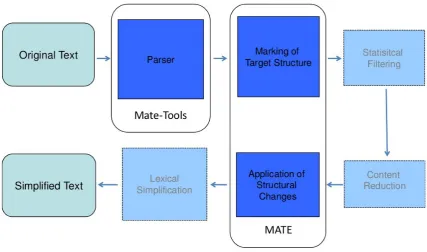
Figure 1: The architecture of the simplification system
• Gerundive constructions and participle constructions (e.g.the elections scheduled for next November)
• Coordinations of clauses (e.g.the problem is difficult and there is probably no right answer) and verb phrases (e.g. The problem is difficult and has no easy solution).
• Coordinations of objects clauses (e.g. . . . to get close to the fauna, the plant life and the culture of this im-mense American jungle regionin (1))
Finally, we found that there is one particular reordering type which is rather frequent in simplified text and included it in our simplification grammar. We dubbed this operation quotation inversion, since it occurs in the context of direct speech. In normal text the pattern <Quoted speech, said X> is very common and in all of the cases we observed in manually simplified text this pattern was changed to<X said: Quoted speech>.
A typical case of sentence splitting are relative clauses like the one in (3), and we will illustrate the functioning of the splitting rules with this example. As a matter of fact, this example also contains an object coordination (have been revised and are being offered . . .), which our grammar can handle, but which we will not discuss here.
(3) Estos pisos son inventariados (. . . ) y se ofrecen a los j´ovenes solicitantes, a los que se acompa˜na en la visita.
”These flats have been revised and are being of-fered to young applicants, which will be accompa-nied during the visit.”
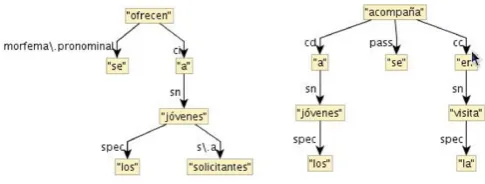
Figure 2: A target structure containing a relative clause
This is a case of a complex relative clause where the relative pronoun is combined with the prepositiona. The preposi-tion in this case has a case-marking funcpreposi-tion in Spanish and signals that the phrasea los queis the object of the imper-sonal clause, despite the fact that it occurs in a clause ini-tial position. The sentence can be simplified by expressing the content of the relative clause in a separate sentence, as shown in (4).
(4) Estos pisos son inventariados (. . . ) y se ofrecen a los j´ovenes solicitantes.
A los jovenes se acompa˜na en la visita.
”These flats have been revised and are being offered to young applicants.
Figure 3: A target structure containing a relative clause
visit.”
The first step towards simplification is the identification of a target structure. In the case of relative clauses we look for a syntax subtree where a relative pronoun is preverbal and directly or indirectly depends on an inflected verb. A target structure for this simplification type is represented by the dependency tree shown in figure 2. The information on linear ordering between words is present in the structures we work with, but it has been omitted here for the sake of readability. In figure 2 the verbacompa˜na(accompanied) is the head of the relative clause. It depends on the noun jovenesand the label of the dependency isSfor a sentential subordination. The sequencea los que, which contains the preposition and the relative pronoun, in turn, forms a sub-tree which depends on this verb. This allows the grammar to identify the structure as a target for simplification. In a next step the relative pronoun is replaced by the full noun form of its antecedent. In this case the nounjovenes already carries an article but in many cases the article has to be added, respecting agreement. Finally, the dependency branch between the main verb of the relative clause and the superordinate clause is cut, resulting in two independent clauses. This can be seen in figure 3.
The simplification operations shown here are implemented as syntactic rules within the MATE framework (Bohnet et al., 2000). The syntactic rules in MATE identify a target structure in what is called the left side of a rule and maps them to new nodes and relations on the right side of the same rule. The rule for the manipulation of (3), expressed informally, requires three nodes: a noun, a verb and a rela-tive pronoun. Between noun and verb a sentential (subordi-nating) relation must hold. Then three corresponding nodes in the output structure are created, corresponding to the three input nodes. The space between the noun and the sub-ordinate verb is marked as cutoff point. Finally, the relation which still holds between matrix clause and the former rel-ative clause is cut in a second step, which requires a further, quite generic, rule. In the example we show here, word or-der does not interfere with the operation, but in many cases relative clauses occur sentence internally, so they have to be moved out of the matrix clause.
Note that there is also an implicitchangeoperation involved in the treatment of this example. The relative pronoun has to be substituted by a lexical NP. In this case the lexical content of the noun can be copied in the place of the former relative pronoun. Here this only involves the copying of lexical content from one syntactic node into another, but in
some cases the presence of an article must be checked, or a tree fragment must be copied from the matrix clause into the place of the relative pronoun.
The current version of the simplification component cover those phenomena which are most frequent and those, which we consider to have the strongest influence on text simplic-ity. The approach is also extensible to other cases, which represent similar problems, like various types of delete op-erations or the treatment of nominal appositive construc-tions.
3.3. Evaluation
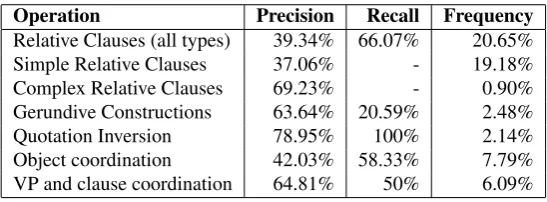
We carried out an evaluation of the different rules of the simplification grammar over 886 sentences of our corpus. We considered every case a rule had been applied and de-cided if the rule had been applied in a correct context and if the rule was able to produce a felicitous output. Minor errors in the grammatical output were ignored when it was apparent that the rule identified the correct target structure and that the grammaticality of the output can be resolved with further fine-tuning of the grammar rules. The results are given in table 1. The precision here is defined as the per-centage of correct cases of the application of each rule. For the calculation of recall we hand annotated 262 sentences for structures which contain a target structure which could be simplified.3 The frequency of rule application is given as the percentage of sentences affected by a rule. When-ever we could observe an error, we tried to attribute it to a category of error sources.
Quote inversion is the operation type which the simplifi-cation grammar handles most reliably. This is because the syntactic configuration on which it operates can be defined in a very concise way.Relative clauses splittingis the most frequent operation. At first sight the application of the cor-responding rules does not seem to be very precise. But at the moment we do not perform any filtering. One of the main problems is that 57.58% of the bad rule applications are due to the restrictive nature of the clause. Restrictive clauses usually cannot be turned into individual sentences and, as we explained above, Spanish usually does not repre-sent the distinction orthographically. For this reason we are developing a statistical filter for such cases. We are con-fident that the combination of the simplification grammar with a statistical filter can improve the overall performance significantly. An additional problem is that in 18.18% of the cases the error occurred because the rule was applied to structures which are structures different from relative clauses, such as verb-dependent object clauses. Also these cases can possibly be filtered out by a statistical classifier. Finally, 16.16% of the errors are caused by idiomatic ex-pressions which can be confounded with relative pronouns. Fortunately these errors can also be detected easily and be eliminated by further grammar development.
In order to decide if a simplification rule should be ap-plied to a target structure we have trained a number of classifiers. The methodology is as follows: the simplifi-cation rules that identify target constructions (e.g., relative
3
Operation Precision Recall Frequency Relative Clauses (all types) 39.34% 66.07% 20.65%
Simple Relative Clauses 37.06% - 19.18%
Complex Relative Clauses 69.23% - 0.90%
Gerundive Constructions 63.64% 20.59% 2.48%
Quotation Inversion 78.95% 100% 2.14%
Object coordination 42.03% 58.33% 7.79%
VP and clause coordination 64.81% 50% 6.09%
Table 1: Percentage of right rule application and frequency of application per rule type
clauses, participial phrase) were run over a dependency-parsed corpus of Spanish news articles. Sentences in which rules have been fired were identified, collected, and man-ually annotated with classes “yes” or “no” depending on whether the human annotator considered the actual simpli-fication should take place (between 100 and 150 sentences where annotated depending on the task). A number of fea-tures have been implemented, all of them computed based on the context surrounding the target structure to be sim-plified (e.g., a participle or a relative pronoun). Features include the actual syntactic information of the target struc-ture, parts of speech surrounding the target, and features based on linguistic intuitions such as the depth of the node in the dependency tree, the number of sibling structures, etc. The classifiers are based on support vector machines (SVMs) (Li et al., 2005) distributed with the GATE system (Maynard et al., 2002). Results are still preliminar, but for classification of simple relatives the classifier achieves 86% F-score in cross-validation experiments which we consider a reasonable figure. This improves over aselect-all base-line F-score of 78%. There is of course still the question of whether the application of the filter after structure identifi-cation and marking would actually improve the effective-ness of rule-application, a question we are addressing right now and results of which will be reported elsewhere.
4.
Conclusion and Outlook
In this paper we described the development of a text simpli-fication system for Spanish. The development is part of an ongoing research project4and many of the results represent a snapshot of a current state of work in progress. We have argued in favour of a rule based system with support from data-driven techniques. We argued for that mainly because we have not enough data available for Spanish which would allow for the statistical treatment of the global problem. But we also argued that a statistical approach would have to confront problems which are not trivial. These problems mainly are mainly present in the form of complex copy op-erations which are involved in sentence splitting and such problems would require a careful formulation of the learn-ing task.
We have shown that many structural simplification opera-tions can be handled successfully and that many of the er-rors of the structural simplification module can be identified in a way which makes their solution feasible. This shows
4
Simplext:http://www.simplext.es
that there is still much room for improvement without mak-ing the required machinery too complex.
There is still a lot of work to be done. In particular, we plan to integrate a statistical filter in the system, which will re-duce the number of bad applications of simplification rules. Preliminary experiments have shown that statistical filters of this kind can achieve good results in isolation, so we are confident that they will improve the system as a whole when they are integrated. Content reduction is a problem which requires a similar treatment. We are developing a statistical classifier which decides for different target units (sentences, clauses, adverbial phrases, etc.) whether it can be deleted or not without harming the understandability of the output. Finally, we are trying to combine the struc-tural simplification described here with lexical simplifica-tion, which presents a different problem setting, but which is extremely important to make texts easier to read.
5.
Acknowledgements
The research described in this paper arises from a Span-ish research project called Simplext: An automatic system for text simplification (http://www.simplext.es). Simplext is led by Technosite and partially funded by the Ministry of Industry, Tourism and Trade of the Govern-ment of Spain, by means of the National Plan of Scien-tific Research, Development and Technological Innovation (I+D+i), within strategic Action of Telecommunications and Information Society (Avanza Competitiveness, with file number TSI-020302-2010-84). We are grateful to fel-lowship RYC-2009-04291 from Programa Ram´on y Cajal 2009, Ministerio de Econom´ıa y Competitividad, Secretar´ıa de Estado de Investigaci´on, Desarrollo e Innovaci´on, Spain.
6.
References
Sandra M. Alu´ısio, Lucia Specia, Thiago Alexan-dre Salgueiro Pardo, Erick Galani Maziero, and Re-nata Pontin de Mattos Fortes. 2008. Towards brazil-ian portuguese automatic text simplification systems. In ACM Symposium on Document Engineering, pages 240– 248.
Bernd Bohnet, Andreas Langjahr, and Leo Wanner. 2000. A development environment for mtt-based sentence gen-erators. Revista de la Sociedad Espaola para el Proce-samiento del Lenguaje Natural.
pages 67–72, Boulder, Colorado. Association for Com-putational Linguistics.
Stefan Bott and Horacio Saggi´on. 2011a. Spanish text sim-plification: An exploratory study. InXXVII Congreso de la Sociedad Espaola para el Procesamiento del Lenguaje Natural (SEPLN 2011), Huevla, Spain.
Stefan Bott and Horacio Saggi´on. 2011b. An unsuper-vised alignment algorithm for text simplification corpus construction. InWorkshop on Monolingual Text-To-Text Generation, co-located with ACL 2011, Porland, Oregon. Nadjet Bouayad-Agha, Gerard Casamayor, Gabriela Fer-raro, and Leo Wanner. 2009. Simplification of patent claim sentences for their paraphrasing and summariza-tion. InFLAIRS Conference.
Yvonne Canning, John Tait, Jackie Archibald, and Ros Crawley. 2000. Cohesive generation of syntactically simplified newspaper text. InTSD, pages 145–150. John Carroll, Guido Minnen, Yvonne Canning, Siobhan
Devlin, and John Tait. 1998. Practical simplification of english newspaper text to assist aphasic readers. In In Proc. of AAAI-98 Workshop on Integrating Artificial In-telligence and Assistive Technology, pages 7–10. Raman Chandrasekar, Christine Doran, and Bangalore
Srinivas. 1996. Motivations and methods for text sim-plification. InCOLING, pages 1041–1044.
William Coster and David Kauchak. 2011. Learning to simplify sentences using wikipedia. In Proceedings of Text-To-Text Generation, Portland, Oregon. Association for Computational Linguistics.
Caroline Gasperin, Erick Galani Maziero, and Sandra M. Alu´ısio. 2010. Challenging choices for text simplifica-tion. InPROPOR, pages 40–50.
Yaoyong Li, Katalina Bontcheva, and Hamish Cunning-ham. 2005. Using Uneven Margins SVM and Percep-tron for Information Extraction. InProceedings of Ninth Conference on Computational Natural Language Learn-ing (CoNLL-2005).
Diana Maynard, Valentin Tablan, Hamish Cunningham, Cristian Ursu, Horacio Saggion, Katalina Bontcheva, and Yorik Wilks. 2002. Architectural Elements of Lan-guage Engineering Robustness. Journal of Natural Lan-guage Engineering – Special Issue on Robust Methods in Analysis of Natural Language Data, 8(2/3):257–274. Simon Mille and Leo Wanner. 2008. Making text resources
accessible to the reader: The case of patent claims. Mar-rakech (Marocco), 05/2008.
Sarah E. Petersen and Mari Ostendorf. 2007. Text simpli-fication for language learners: a corpus analysis. InIn Proc. of Workshop on Speech and Language Technology for Education.
Andrea Petz and Bror Tronbacke. 2008. People with spe-cific learning difficulties: Easy to read and hci. In IC-CHP, pages 690–692.
Advaith Siddharthan. 2002. An architecture for a text sim-plification system. In In LREC’02: Proceedings of the Language Engineering Conference, pages 64–71. Advaith Siddharthan. 2011. Text simplification using
typed dependencies: A comparison of the robustness of different generation strategies. InProceedings of the
13th European Workshop on Natural Language Genera-tion (ENLG), pages 2–11, September.
Mariona Taul´e, Maria Ant`onia Mart´ı, and Marta Recasens. 2008. AnCora: Multilevel Annotated Corpora for Cata-lan and Spanish. In Proceedings of the LREC-2008, Marrakesh, Morroco.