Measuring Interlanguage:
Native Language Identification with L1-influence Metrics
Julian Brooke and Graeme Hirst
Department of Computer Science, University of Toronto Toronto, ON, Canada M5S 3G4
jbrooke, [email protected]
Abstract
The task of native language (L1) identification suffers from a relative paucity of useful training corpora, and standard within-corpus evaluation is often problematic due to topic bias. In this paper, we introduce a method for L1 identification in second language (L2) texts that relies only on much more plentiful L1 data, rather than the L2 texts that are traditionally used for training. In particular, we do word-by-word translation of large L1 blog corpora to create a mapping to L2 forms that are a possible result of language transfer, and then use that information for unsupervised classification. We show this method is effective in several different learner corpora, with bigram features being particularly useful.
Keywords:Native Language Identification, Unsupervised Text Classification, Interlanguage
1.
Introduction
In Second Language Acquisition (SLA) research, an
in-terlanguage1is an emerging second language (L2) system
(Selinker, 1992). One of the defining qualities of an in-terlanguage is the use of native language (L1) features, a phenomenon which is known more generally aslanguage
transfer (Odlin, 1989). Though in related languages this
may provide a early boost to learning, language interfer-enceis often the result where the two systems differ signif-icantly, with learners continuing to use L1 features that are not appropriate to the L2, even after years of exposure. In computational linguistics, native language identification (Koppel et al., 2005) is a task in which features of the L2 texts written by learners of various different language back-grounds are used to identify those language backback-grounds. One potential application of this is in author profiling, which can be used to identify those who misrepresent them-selves online (Fette et al., 2007). Another important use is as a preprocessing step to ESL error correction (Leacock et al., 2010): for example, Rozovskaya and Roth (2011) use L1-specific information to improve their preposition-correction system, while recent work in collocation correc-tion relies on the specific forms present in the native lan-guage (Chang et al., 2008b; Dahlmeier and Ng, 2011). Most previous work in L1 identification has avoided stan-dard lexical features (e.g. word n-grams); the reason for this is not that these features would not be useful, but rather that there is significant topic variation across the languages in the corpora used for this task. Our recent work (Brooke and Hirst, 2011) suggests that this problem in fact extends even to non-lexical features, leading us to reject traditional within-corpus evaluation (i.e. crossvalidation). In this pa-per, we explore a novel approach to L1 identification which relies only on externally-derived lexical information. It in-volves deriving metrics from large weblog corpora for four L1s (Chinese, Japanese, Spanish, French), lessening our
re-1Not to be confused with the idea ofinterlinguain machine
translation.
liance on scarce learner corpora. More specifically, we use the average ratios of (translated) word counts in different languages as indicators of interlanguage. If we see the un-likely English bigramtake coffeein a learner text, our clas-sification of that text will then depend on whether there are patterns of language in some L1 that could be the source of this L2 feature: among French, Spanish, Chinese, or Japanese, is there one language where we see a word that means taketogether with a word that means coffee? We show that this method is superior to L2-only cross-corpus classification results using standard features.
2.
Related Work
Early native language detection includes that of Koppel et al. (2005). They classified texts from the International Corpus of Learner English (ICLE) into one of five (Eu-ropean) native language backgrounds using support vec-tor machines (SVMs). They described their feature set as stylistic; features included the frequency of function words, rare POS bigrams, lettern-grams, and spelling errors. They reported a performance of just over 80% on the task using the full feature set.
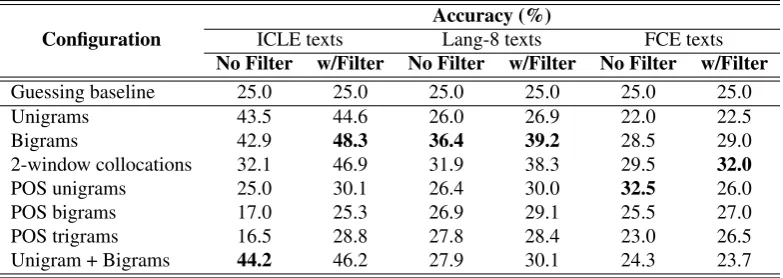
associ-Table 1: Native language classification results Accuracy (%)
Configuration ICLE texts Lang-8 texts FCE texts
No Filter w/Filter No Filter w/Filter No Filter w/Filter
Guessing baseline 25.0 25.0 25.0 25.0 25.0 25.0
Unigrams 43.5 44.6 26.0 26.9 22.0 22.5
Bigrams 42.9 48.3 36.4 39.2 28.5 29.0
2-window collocations 32.1 46.9 31.9 38.3 29.5 32.0
POS unigrams 25.0 30.1 26.4 30.0 32.5 26.0
POS bigrams 17.0 25.3 26.9 29.1 25.5 27.0
POS trigrams 16.5 28.8 27.8 28.4 23.0 26.5
Unigram + Bigrams 44.2 46.2 27.9 30.1 24.3 23.7
peared often (at least 5 times)7in the corresponding sub-corpus. For Chinese, we used iciba.com, for French
larousse.fr, for Spanishspanishdict.com, and for Japanese
jisho.org; our choice of websites was based on dictionary
quality, ease of extraction, and, in particular for the Euro-pean languages, the ability to deal with inflected forms, i.e. to find their corresponding lemma without need for addi-tional lemmatization on our part. Although we attempted to keep the size of the dictionaries comparable, in terms of lemmas the Chinese and Japanese lexicons are markedly larger than the French and Spanish ones;8if inflected forms are considered, however, the European-language lexicons are larger.
For all languages, we ignored translations longer than three English words, as we found that many of these were expla-nations rather than translations. Some very common words in some lexicons had only explanatory entries; for these (fewer than 10 in each lexicon) we manually inserted a di-rect translation based on examples or, in the case of certain particles, left them with an empty translation. The transla-tions of verbs and nouns were generally in base form, which would have resulted in only uninflected bigrams; instead, we used the part-of-speech tagging to create simple corre-spondences between forms in the L1 and inflected forms in English. For instance, plurals in French are translated into plural forms in English; for Chinese, however, which does not mark number on most nouns, both English forms are included as potential translations. All of the dictionaries categorized their translations by part of speech, and in gen-eral we used the translations for only the part of speech as given by the tagger, though all translations were used if that strategy failed.
Our first evaluation corpus is the International Corpus of Learner English (ICLE), version 2 (Granger et al., 2009), which has English-learner essays (primarily argumentative) for 16 languages. For each of the 4 languages investigated
7All of our query-derived lexicons in fact may have more than
just those words appearing 5 times in the corpus, but this is the last cutoff point that all dictionaries reached. We do not, however, believe there is much benefit to be gained from further extraction, since such rare words rarely have definitions in the online dictio-naries.
8Chinese: 109,061, Japanese: 85,867, Spanish: 26,627,
French: 26,495.
here, we used the first 50 texts in each subcorpus for de-velopment, and the next 200 for testing. Our second eval-uation corpus is our new Lang-8 corpus (Brooke and Hirst, 2011), which consists of 154,702 journal entries (mostly from Asian languages) from the Lang-8 learner website. Since the average entry in the Lang-8 is significantly shorter than those in the ICLE (about 150 tokens), we concatenate multiple entries together to form our ‘texts’ of roughly the same length as those in the ICLE, also 200 for each lan-guage.9 Our third corpus is a small sample of texts from the Cambridge Learner Corpus that has recently been made available (Yannakoudakis et al., 2011); these texts consist of short answers from the First Certificate in English (FCE) exams. The set we use here consists of only 50 texts per language, and the average length of the texts is roughly half of the other two corpora; thus we expect classification to be harder.
5.
Evaluation
Table 1 contains the L1 classification results for the var-ious feature types and evaluation corpora. The boundary bigram andk-window collocations are obviously the most useful feature types; their performance is consistently well above chance, even without filtering. By comparison, the POS features do not appear to transfer properly and per-form often near or even below chance, perhaps because the sequences in which POSs appear are just simply too lan-guage dependent. The effectiveness of unigram features vary widely: in the ICLE, they are roughly as good as bi-grams, but in the FCE they are worse than guessing. We suspect that these variations may reflect a fundamental dif-ference in the nature of the two corpora: the short answers in the FCE are constrained to a very restricted topic and genre—letters expressing gratitude at winning a prize— which may limit the extent to which vocabulary choice can distinguish among L1s. It is therefore the choice of which words are put together that is particularly telling, reflecting transfer from the L1.
One very clear result is the effect of filtering: in nearly ev-ery case, filtering out elements that were common in En-glish improved classification accuracy. This effect is most
9Although this may appear to be a fairly small sample of this
for errors. InProceedings of the 11th ACM SIGKDD In-ternational Conference on Knowledge Discovery in Data
Mining (KDD ’05), pages 624–628.
Claudia Leacock, Martin Chodorow, Michael Gamon, and Joel Tetreault. 2010. Automated Grammatical Error
De-tection for Language Learners. Morgan & Claypool.
Anke L¨udeling, Seanna Doolittle, Hagen Hirschmann, Karin Schmidt, and Maik Walter. 2008. Das Lernerkor-pus Falko. Deutsch als Fremdsprache, 42:67–73. Terence Odlin. 1989. Language Transfer. University of
Cambridge Press.
Alla Rozovskaya and Dan Roth. 2011. Algorithm selection and model adaptation for ESL correction tasks. In Pro-ceedings of the 49th Annual Meeting of the Association
for Computational Linguistics (ACL ’11).
Helmut Schmid. 1995. Improvements in part-of-speech tagging with an application to German. InProceedings
of the ACL SIGDAT Workshop, pages 47–50.
Larry Selinker. 1992. Rediscovering Interlanguage. Long-man, London.
Oren Tsur and Ari Rappoport. 2007. Using classifier fea-tures for studying the effect of native language on the choice of written second language words. In Proceed-ings of the Workshop on Cognitive Aspects of
Computa-tional Language Acquisition (CACLA ’07), pages 9–16.
Hans van Halteren. 2008. Source language markers in EUROPARL translations. In Proceedings of the 22nd International Conference on Computational Linguistics
(COLING ’08), pages 937–944.
Sze-Meng Jojo Wong and Mark Dras. 2009. Contrastive analysis and native language identification. In Proceed-ings of the Australasian Language Technology
Associa-tion Workshop, pages 53–61.
Sze-Meng Jojo Wong and Mark Dras. 2011. Exploit-ing parse structures for native language identification.
In Proceedings of the 2011 Conference on Empirical
Methods in Natural Language Processing (EMNLP ’11),
pages 1600–1610.