Using the Web as Corpus for Un-supervised Learning
in Question Answering
Yi-Chia Wang
1, Jian-Cheng Wu
2, Tyne Liang
1and Jason S. Chang
21. Dep. of Computer and Information Science, National Chiao Tung University, Taiwan, R.O.C. 2. Dep. of Computer Science, National Tsing Hua University, Taiwan, R.O.C.
Abstract. In this paper we propose a method for unsupervised learning of relation between terms in questions and answer passages by using the Web as corpus. The method involves automatic acquisition of relevant answer passages from the Web for a set of questions and answers, as well as alignment of wh -phrases and keywords in questions with phrases in the answer passages. At run time, wh-phrases and keywords are transformed to a sequence of expanded query terms in order to bias the underlying search engine to give higher rank to relevant passages. Evaluation on a set of questions shows that our prototype improves the performance of a question answering system by increasing the precision rate of top ranking passages returned by the search engine.
1. Introduction
It was noted that people have submitted longer and longer queries to the Web search engines. Recently, users have started to submit natural language queries instead of a list of keywords. It has encouraged many researchers to develop question answering systems which specifically aim at natural language questions , such as AskJeeves (www.ask.com) and START (www.ai.mit.edu/projects/infolab/).
For typical question answering systems, document/passage retrieval is the most significant subtask. In this step, the QA system breaks a natural language question into a set of keywords, uses keywords to query a search engine, and returns documents or messages that are related to the queries for further processing. However, the keywords in questions usually are not very effective in retrieving relevant passages. Consider the question “Who invented glasses with two foci?” Typically, we will send the keywords “invented glasses two foci” to a search engine to retrieve documents or passages. Submitting such keywords to AltaVista, we got irrelevant information about astronomy or physics rather than the inventor “Benjamin Franklin” of bifocal glasses. Intuitively, if we include the phrase “inventor of” or “bifocal” in the query sent to the search engine (SE), we are likely to retrieve passages with the answer.
We pres ent the system Atlas (Automatic Transform Learning by Aligning Sentences of question and answer), which automatically learns the transforms from wh -phrases and keywords to n-grams in relevant passages by using the Web as corpus. The transformed query should be more likely to retrieve passages that contain the answer. For instance, consider the natural language question “Who invented the light bulb?” Using the keywords in the question directly, we end up with the keyword query, “invented light bulb,” for a search engine such as Google. We observed that such a query has room for improvement in terms of bringing in more instances of the relevant answer. Our experiment indicates that the proposed method will determine the best transforms for the wh-phrase “who invented” including “inventor of”, “was invented”, and “invented by”. On the other hand, the best transforms discovered for the keyword “bulb” include “light bulb” and ”electric light.” Intuitively, these transforms used together will convert the question into an expanded query for Google, “("was invented" || "invented by") ("electric light" || "light bulb")” which is more effective in retrieving relevant sentences in the top ranking summaries returned by the search engine, such as “The light bulb was invented by an illuminated scientist called Thomas Edison in 1879!”. One indicator of effective query is the precision rate at R document retrieved (PR), the percentage of first R top ranking Web pages (or summaries) which contain the answer. Another indicator is the mean reciprocal rank (MRR) of the first relevant document (or summary) returned. If the r-th document (summary) returned is the first one with the answer then the reciprocal rank is 1/r. Our goal in this study is exploration of methods that will automatically learn the transforms that convert natural language questions to queries with high average PR or MRR.
system. The experiment and evaluation results are given in Section 4. In the last section, we conclude with discussion and future work.
2. Related Work
Extensive work on question answering has been reported in the many literature (Buchholz et al., 2001; Harabagiu et al., 2001; John et al., 2002; Shen et al., 2003). In this study, we focus on learning the transforms that can be used to convert questions into effective queries in order to retrieve re levant passages.
Hovy et al. (2000) utilized hypernyms and synonyms in WordNet to expand queries for increasing recall. However, blindly expanding a word to its synonyms sometimes causes undesirable effects. As for hypernyms, it is difficult to determine how many hypernyms a word should be expanded. In contrast to this approach, our method learns query transforms specific to a word or phrase based on real-life questions and answer passages.
In a recent study most closely related to our method, Agichtein et al. (2004) described the Tritus system that learns transforms of wh-phrases such as “what is“ to “refers to” by using FAQ data automatically. Our method learns transforms for wh-phrases as well as keywords from the web. Tritus system uses heuristic rules and thresholds for term and document frequency to learn transforms, while we rely on a mathematical model method for statistical machine translation. Shen, Lin and Chen (2003) proposed a method that is similar to the Tritus
system for the why question.
Recently, Echihabi and Marcu (2003) presented a noisy channel approach to question answering. Their method also involves collecting answer passages from the web and aligning words across a question and relevant answer passages. However, they require full parsing of the sentences and complicated decision of making a “cut” in the parse tree to determine whether to align word, syntactic, or semantic categories. Our simple method is also based on alignment but it does not require full parsing and perform alignment at the surface levels of words and n -grams.
In contrast to previous work on query expansion for question answering, we propose a method that learns query transforms for all phrases in a natural language question automatically on the Web.
3. Method for Learning Question to Query Transforms
In this section, we present an unsupervised method for QA which automatically learns transforms from wh-phrases and keywords to answer n -grams by using the Web as corpus.
3.1 Problem Statement
Given a set of natural language questions Qs and answer terms As, we obtain a collection of passages that contain the answer A to the question Q via some search engine SE. From the collection of answer passages APs, our goal is to discover a set of transforms T that can be applied to wh-phrases and keywords in Q in the hope that the transformed queries are more effective in retrieving passages containing A.
3.2 Procedure for Learning Transforms
(1) Automatically collect pairs of Q and AP from the Web for training. (Section 3.2.1)
(2) Select frequent wh-phrases. (Section 3.2.2)
(3) Apply the alignment technique to the collected material. (Section 3.2.3)
Fig.1. Procedure for learning transforms
3.2.1 Collecting Training Material from the Web
In the first step of the learning process (see Figure 1), we retrieve a set of (Q, A, AP) pairs from the Web for training purpose where Q stands for a natural language question, and AP is a passage containing keywords in Q
and the answer term A. The data gathering process is described as follows:
1. For each (Q, A) pair in the given collection, we extract keywords K of Q, say, k1, k2, … , kn.
2. Submit (k1, k2, … , kn, A), as a query to SE.
3. Download the top M summaries that are returned by SE.
4. Retain only those summaries containing A. See Table 1 for details.
Table 1. An example of converting a question (Q) with its answer (A) to SE query and retrieving answer passages (AP)
(Q, A) AP
Bungalow For Rent in Islamabad, Capital Pakistan. Beautiful Big House For …
What is the capital of Pakistan? Answer:( Islamabad)
(k1, k2, … , kn, A)
Islamabad is the capital of Pakistan. Current time, …
capital, Pakistan, Islamabad … the airport which serves Pakistan's capital
Islamabad, …
3.2.2 Selecting Frequent Wh-phrases
In the second step, we produce a set of high frequency phrases that characterize different question categories. We follow the method proposed by Agichtein et al. (2004). The method simply involves computing the frequency of all n-grams in Qs and filters out those with small counts. We will treat the wh-phrases (QPs) as a token in the subsequent steps. However, we differ from their approach in that we are not limited to n-grams of function words. For instance, we derived “in what year”, “who wrote”, etc. More examples of wh-phrases are listed in Table 2.
Table 2. An example of wh-phrases that are used
Wh-words Wh-phrases QPs
What “what is the”, “in what year”, “what was”, … Who “who was the”, “who wrote”, …
Which … “which country”, “with which”, … …
3.2.3 Learning Question to Query Transforms
1. Perform Part of Speech (POS) tagging on both Q and AP in the collection. (See Table 3 and 4)
2. Replace all instances of A with the tag <ANS> in AP. For example, the answer “Islamabad” in AP for the question “What is the capital of Pakistan?” is replaced with <ANS>. (See Table 4.) The purpose of <ANS> is to avoid data sparseness while counting bigrams in the following step.
3. Segment Q into unigrams or QPs and eliminate unigrams with low counts. We denote the remaining unigrams as q1, q2, ..., qn. (See Table 5)
4. Segment AP into bigrams and eliminate bigrams with small term frequency (tf) or very large document frequency(df). We denote the remaining bigrams a1, a2, ..., am. (See Table 6)
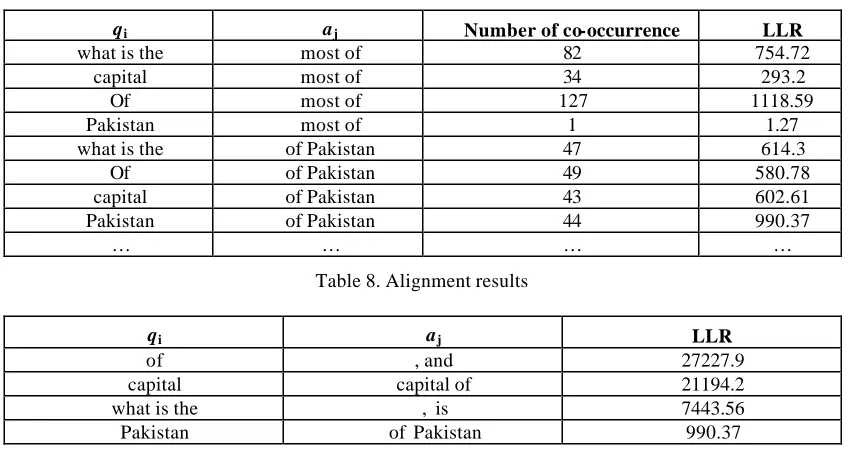
5. For all i, j, calculate log likelihood ratio (LLR) of qi and aj. (See Table 7) 6. Eliminate candidates with a LLR value lower than 7.88. (See Table 8) 7. Sort list of (qi, aj) by decreasing LLR value. (See Table 8)
8. Go down the list and select a pair if it does not conflict with previous selection. 9. Stop when running out of pairs in the list.
10. Produce the list of aligned pairs for all Qs and APs.
11. Select top N bigrams, a1, a2, ..., ar, for every wh-phrase or unigram qi in alignment pairs. (See Table 9)
Table 3. Part of Speech of Q
Q word Lemma Position POS
What is the what be the 1 *
capital capital 2 nn
of of 3 in
Pakistan Pakistan 4 np
? ? 5 .
Table 4. Part of Speech of AP
AP word Lemma Position POS
Most most 1 rbt
of of 2 in
Pakistan Pakistan 3 np
rainfall rainfall 4 nn
is be 5 bez
scarce scarce 6 jj
. . 7 .
Islamabad <ANS> 8 np
, , 9 ,
the the 10 at
capital capital 11 nn
of of 12 in
Pakistan Pakistan 13 np
since since 14 in
1963 1963 15 cd
, , 16 ,
and and 17 cc
Rawalpindi Rawalpindi 18 np
, , 19 ,
are be 20 ber
both both 21 abx
located locate 22 vbn
on on 23 rp
the the 24 at
Pothowar Pothowar 25 np
Table 5. Wh-phrases and u nigrams in Q
Question words Number of occurrence
what is the 14,571
capital 7,513
of 29,673
Pakistan 135
Table 6. Bigrams in AP
N-gram in AP Number of occurrence
most of 368
of Pakistan 54
Pakistan rainfall 1
rainfall be 4
be scarce 2
scarce . 1
. <ANS> 8574
<ANS> , 16665
, the 10227
the capital 1690
capital of 1669
of Pakistan 54
Pakistan since 1
since 1963 3
1963 , 58
, and 9994
and Rawalpindi 3
Rawalpindi , 5
, be 3718
be both 77
both locate 2
locate on 174
on the 4868
the Pothowar 2
Pothowar Plain 2
Note: The entries in the shaded area are eliminated for their low counts
Table 7. Combination of qi and aj
qi aj Number of co-occurrence LLR
what is the most of 82 754.72
capital most of 34 293.2
Of most of 127 1118.59
Pakistan most of 1 1.27
what is the of Pakistan 47 614.3
Of of Pakistan 49 580.78
capital of Pakistan 43 602.61
Pakistan of Pakistan 44 990.37
… … … …
Table 8. Alignment results
qi aj LLR
of , and 27227.9
capital capital of 21194.2
what is the , is 7443.56
Table 9. Examples of transforms selected from alignment results for N=3
Wh-phrase and Keyword in
Q
Bigram in AP Alignment counts
what is the is the 1,254
what is the in the 503
what is the , the 242
capital capital of 545
capital capital city 241
capital state capital 236
Pakistan Pakistan , 39
Pakistan of Pakistan 21
Pakistan in Pakistan 6
3.3 Runtime Transformation of Questions
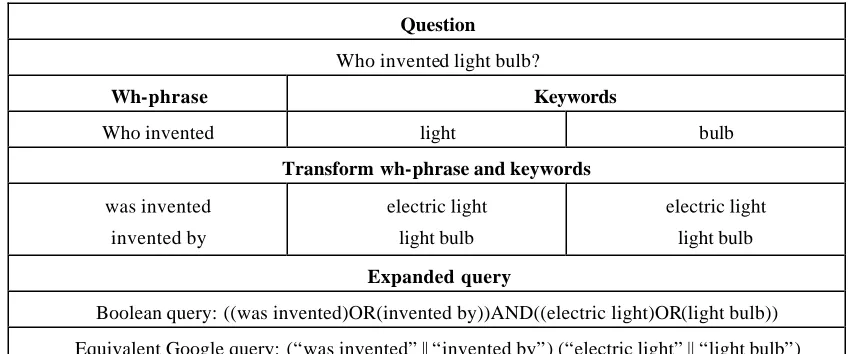
At run time, Q is broken into wh-phrases and keywords which are converted to a sequence of query terms according to transforms based on the alignment results described in Section 3.2 in order to give higher ranks to passages that contain the answer for specific SE. See Table 10 for example of the conversion process of the question “Who invented light bulb?”
Table 10. An example of transformation from question into query
Question
Who invented light bulb?
Wh-phrase Keywords
Who invented light bulb
Transform wh-phrase and keywords
was invented
invented by
electric light
light bulb
electric light
light bulb
Expanded query
Boolean query: ((was invented)OR(invented by))AND((electric light)OR(light bulb))
Equivalent Google query: (“was invented” || “invented by”) (“electric light” || “light bulb”)
4. Experiments and Evaluation
4.1 Training Data Set
Our data training data set were collected from http://www.quiz-zone.co.uk.We use 3,581 distinct (Q, A) pairs for automatically retrieving AP from the search engine Google. For each Q, top 100 summaries returned by Google are downloaded. See Table 11 for details of the training corpus.
Table 11. The training corpus
Training data set Distinct (Q, A) Distinct (Q, AP)
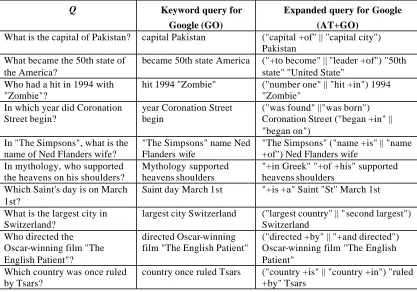
Table 14. Evaluation results
Performances MRR Precision (%)
AT+GO
(Atlas expanded query for Google) 0.70 47
GO
(Direct keyword query for Google) 0.48 40
5. Conclusions and Future Work
We show that our method clearly provide means for learning transformation from a natural language question to a query by applying statistical word alignment technique. The method involves automatically acquiring relevant passages from the Web for a set of questions and answers, aligning phases across from questions to answer passages in order to create phrase transforms that involve wh-words as well as content words. Evaluation on a set of questions shows that our prototype in conjunction w ith a search engine outperforms the underlying search engine used alone.
Many future directions present themselves. For example, the patterns learned from answer passages acquired on the Web can be extended to include longer and more effective n -grams to further booster the MMR value or average precision rate. Additionally, an interesting direction to explore is creating phrase transforms that contain the answer extraction patterns. These answer extraction patterns can be learned for different types of answers. Yet another direction of research would be to provide confidence factors for ranking the likelihood of many candidate answers extracted using patterns.
In summary, we have introduced a method for learning query transforms that improves the ability to retrieve passages with answers using the Web as corpus . The method involves finding query transformations based on techniques borrowed from training a noisy channel in machine translation study. We have implemented and thoroughly evaluated the method as applied to a set of more than 4,000 questions. We have shown that the method can be used with a search engine as an effective component in a question answering system.
References
[1] Abdessamad Echihabi, Daniel Marcu. A Noisy-Channel Approach to Question Answering. In Proceedings of the 41st Annual Meeting of the Association for Computational Linguistics, pp.16-23, July 2003.
[2] Buchholz, Sabine. Using grammatical relations, answer frequencies and the World Wide Web for question answering. In Proceedings of the Tenth Text REtrieval Conference(TREC 2001).
[3] Eugene Agichtein, Steve Lawrence, Luis Gravano. Learning to find answers to questions on the Web. In
ACM Transactions on Internet Technology (TOIT), Volume 4, Issue 2, pp.129-162, 2004.
[4] Harabagiu, S., D. Moldovan, M. Pasca, R. Mihalcea, M. Surdeanu, R. Buneascu, R. Gîrju, V. Rus and P. Morarescu. FALCON: Boosting Knowledge for Answer Engines. In Proceedings of the 9th Text Retrieval Conference (TREC-9), pp.479–488.
[5] Hovy, E., Gerber, L., Hermjakob, U., Junk, M., and Lin, CY. Question answering in Webclopedia. In
Proceedings of the TREC-9 Question Answering Track, pp.655-672, 2000.
[6] John M. Prager, Jennifer Chu-Ca rroll, Krysztof Czuba. Use of WordNet Hypernyms for Answering What-Is Question. In Proceedings of the TREC-2002 Conference (TREC 2002).
[7] Melamed, I. Dan. A Word-to-Word Model of Translational Equivalence. In Proceedings of the 35st Annual Meeting of the Association for Computational Linguistics, pp.490-497, 1997.
[8] , , . Why . In Proceedings of