Extracting Verb-Noun Collocations from Text
Jia Yan Jian
Department of Computer Science
National Tsing Hua University
101, Kuangfu Road, Hsinchu, Taiwan
Abstract
In this paper, we describe a new method for extracting monolingual collocations. The method is based on statistical methods extracts. VN collocations from large textual corpora. Being able to extract a large number of collocations is very critical to machine translation and many other application. The method has an element of snowballing in it. Initially, one identifies a pattern that will produce a large portion of VN collocations. We experimented with an implementation of the proposed method on a large corpus with satisfactory results. The patterns are further refined to improve on the precision ration.
1
Introduction
Collocations are recurrent combinations of words that co-occur more often than chance. Collocations like terminology tend to be lexicalized and have a somehow more restricted meaning than the surface form suggested (Justerson and Katz 1994). The words in a collocation may be appearing next to each other (rigid collocation) or otherwise (flexible/elastic collocations). On the other hand, collocations can be classified into lexical and grammatical collocations (Benson, Benson, Ilson, 1986). Lexical collocations are formed between content words, while the grammatical collocation has to do with a content word with a function word or a syntactic structure. Collocations are pervasive in all types of writing and can be found in phrases, chunks, proper names, idioms, and terminology.
Automatic extraction of monolingual and bilingual collocations are important for many applications, including Computer Assisted Language Learning, natural language generation, word sense disambiguation, machine translation, lexicography, and cross language information retrieval. Hank and Church (1990) pointed out the usefulness of pointwise mutual information for identifying collocations in lexicography. Justeson and Katz (1995) proposed to identify technical terminology based on preferred linguistic patterns and discourse property of repetition. Among many general methods presented in Manning and Schutze (1999), the best method is filtering based on both linguistic and statistical constraints. Smadja (1993) presented a program called XTRACT, based on mean and variance of the distance between two words that is capable of computing flexible collocations. Kupiec (1992) proposed to extract bilingual noun phrases using statitistical analysis of coocurrance of phrases. Smadja, McKeown, and Hatzivassiloglou (1996) extended the EXTRACT approach to handling of bilingual collocation based mainly on the statistical measures of Dice coefficient. Dunning (1993) pointed out the weakness of mutual information and showed that log likelihood ratios are more effective in identifying monolingual collocations especially when the occurrence count is very low.
POS preceding O
POS sequence between O and V (4) POS following V
2.1.3 Step3: Manipulating the correct structure statistics of VN patterns
We eliminated patterns that appear less than three times. These patterns are much more stringent than pattern we started out with. These patterns help us get rid of unlikely VN instances such as “make film” in “make a leap into TV and film,” since the POS sequence of “a leap into TV and” has a low count in the initial batch of “likely” collocations. On the other hand, “make film” in “make my first film” would be kept as a legistimate instance of VN, since the pos sequence of “my first” has rather high count in the initial batch of “likely” collocations.
Actually, the POS sequences of intervening words has a skew distribution concentrating on a dozen of short phrases(see Table1):
Table 1
Samples of VN collocation from text
VN collocation Translation POS of VN
ride a bike 騎自行車 vb + at + nn
take my advice 聽我的勸告 vb + pp$ + nn
keep a diary 寫日記 vb + at + nn
action will be taken 採取行動 nn + md + be + vbd problem is solved 解決問題 nn + be + vbd decision can be made 做決定 nn + md + be + vbd
These patterns can be coupled with other constraints for best results:
1. No punctuation marks should come between V and O 2. The noun closest to the verb takes precedence
For now, we only consider verbs with two obligatory arguments of subject and object. Therefore, we exclude instance like (make, choice) in “makeentertainment at home a choice.” We plan to extract VN in three-argument proposition separately.
The other issue has to do with data sparseness. For collocation types with low count, the estimation of LLR is not as reliable. In the future, we will also experiment with using search engine such as Google to estimate word counts and VN instance count for more reliable estimation of LLR.
XTRACT does not touch on the issue of identify VN collocation instances in (6) and exclude that in (5). In our research, we explored the identification of collocation instances and attempt to avoid cases that maybe a correct collocation type but not a correct collocation instance.
… make a leap into TV and film… (5) … made great efforts to promote documentary film… (6)
2.2
Example
To extract VN collocations, we first run part of speech tagging on sentences. For instance, we get the results of tagging below :
After tagging English sentences, we construct N-gram extracted likely VN types with high count from bigram, trigram and fourgram. We then obtained got a list of highly likely collocation types (Table 2). The pairs with LLR lower then 7.88 are eliminated from Table 2. If the pair appeared less than once. we also eliminated the pair.
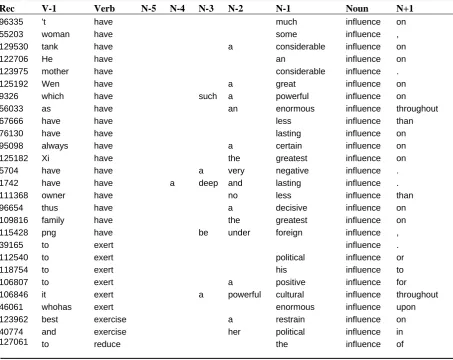
After obtaining likely collocation types, we gathered all instances where the VN appears in the corpus. The distance between the verb and the object is at most five words. Both of the words before the verb and after the object are recorded. Table 3 shows those patterns of VN instances.
Table 2
A list of highly likely collocation types
Table 3
Extracting VN collocation from corpus
Rec V-1 Verb N-5 N-4 N-3 N-2 N-1 Noun N+1
96335 't have much influence on
55203 woman have some influence ,
129530 tank have a considerable influence on
122706 He have an influence on
123975 mother have considerable influence .
125192 Wen have a great influence on
9326 which have such a powerful influence on 56033 as have an enormous influence throughout
67666 have have less influence than
76130 have have lasting influence on
95098 always have a certain influence on 125182 Xi have the greatest influence on 5704 have have a very negative influence . 1742 have have a deep and lasting influence . 111368 owner have no less influence than 96654 thus have a decisive influence on 109816 family have the greatest influence on 115428 png have be under foreign influence ,
39165 to exert influence .
112540 to exert political influence or
118754 to exert his influence to
106807 to exert a positive influence for 106846 it exert a powerful cultural influence throughout 46061 whohas exert enormous influence upon 123962 best exercise a restrain influence on 40774 and exercise her political influence in
127061 to reduce the influence of
Verb Noun Count (VN) Count(V) Count(N) llr_score
have influence 24 5293 57 52.28961
exert influence 4 14 57 40.58210
exercise influence 4 23 57 36.09338
reduce influence 3 188 57 12.43681
eradicate influence 1 6 57 8.876641
3
Experiment and evaluation
We worked with around 50,000 aligned sentences from the Sinorama parallel Corpus in our experiments with an implementation of the proposed method. The average English sentence had 43.95 words. From the experimental data, we have extracted 17,298 VN collocation types. Then, we could obtain 45,080 VN instances for these VN types. See Table 3 for some examples for the verb “influence.”
We select 100 sentences from the parallel corpus of Sinorama magazine to evaluate the performance. A human judge majoring in English identified the VN collocations in these sentences. The manual VN collocations are compared with the instances extracted from the corpus and the result is showed in the Appendix. The evaluation indicates an average recall rate of 74.47% and precision of 66.67 %.
Table 4
Experiment result of VN collocation extracted from Sinorama parallel Corpus
#answer keys #output #Correct Recall (%) Precision (%)
94 105 70 74.47 66.67
It is very difficult to evaluation the experimental results. There were obvious and clear-cut collocations and non collocation, but there were a lot of cases such as “improve environment” and “share housework” that were difficult to judge and may be evaluated differently by different people. There is room for improvement as far as recall and precision ratios are concerned. Nevertheless, the extracted VNs are very diverse and useful for language learning purpose.
4
Discussion
The proposed approach offers a simple algorithm for automatic acquisition of the VN instances from a corpus. The method is particularly interested in following ways:
i. We use a data-driven approach to extract monolingual collocations. ii. The algorithm is applicable to elastic collocations.
iii. Systematic way of setting thresholds for a certain level of confidence
iv. We could obtained instances of VN collocation through the simple statistical information.
While Xtract extracts VN types, we focus on the VN instances. It is understandable that we would get slightly lower recall and precision rates.
5
Conclusion & Future work
In this paper, we describe an algorithm that employs statistical analyses to extract instance of VN collocations from a corpus. The algorithm is applicable to elastic collocations. The main difference between our algorithm and Xtract lies in that we extract the instances from the sentence instead of extracting the VN types directly.
Moreover, in our research we observe other types related to VN such as VP (ie. verb + preposition) and VNP (ie. verb + noun + preposition). In the future, we will further take these two patterns into consideration to extract more types of verb-related collocations.
References
Choueka, Y. (1988) : "Looking for needles in a haystack", Actes RIAO, Conference on User-Oriented Context Based Text and Image Handling, Cambridge, p. 609-623.
Choueka, Y.; Klein, and Neuwitz, E.. Automatic retrieval of frequent idiomatic and collocational expressions in a large corpus. Journal of the Association for Literary and Linguistic Computing, 4(1):34-8, (1983)
Church, K. W. and Hanks, P. Word association norms, mutual information, and lexicography. Computational Linguistics, 1990, 16(1), pp. 22-29.
Dagan, I. and K. Church. Termight: Identifying and translation technical terminology. In Proc. of the 4th Conference on Applied Natural Language Processing (ANLP), pages 34-40, Stuttgart, Germany, 1994.
Dunning, T (1993) Accurate methods for the statistics of surprise and coincidence, Computational Linguistics 19:1, 61-75.
Haruno, M., S. Ikehara, and T. Yamazaki. Learning bilingual collocations by word-level sorting. In Proc. of the 16th International Conference on Computational Linguistics (COLING '96), Copenhagen, Denmark, 1996. Huang, C.-R., K.-J. Chen, Y.-Y. Yang, Character-based Collocation for Mandarin Chinese, In ACL 2000,
540-543.
Inkpen, Diana Zaiu and Hirst, Graeme. ``Acquiring collocations for lexical choice between near-synonyms.'' SIGLEX Workshop on Unsupervised Lexical Acquisition, 40th meeting of the Association for Computational Lin
Justeson, J.S. and Slava M. Katz (1995). Technical Terminology: some linguistic properties and an algorithm for identification in text. Natural Language Engineering, 1(1):9-27.
Kupiec, Julian. An algorithm for finding noun phrase correspondences in bilingual corpora. In Proceedings of the 31st Annual Meeting of the Association for Computational Linguistics, Columbus, Ohio, 1993.
Lin, D. Using collocation statistics in information extraction. In Proc. of the Seventh Message Understanding Conference (MUC-7), 1998.
Melamed, I. Dan. "A Word-to-Word Model of Translational Equivalence". In Procs. of the ACL97. pp 490-497. Madrid Spain, 1997.
Smadja, F. 1993. Retrieving collocations from text: Xtract. Computational Linguistics, 19(1):143-177
Smadja, F., K.R. McKeown, and V. Hatzivassiloglou. Translating collocations for bilingual lexicons: A statistical approach. Computational Linguistics, 22(1):1-38, 1996.
Appendix
The manual VN collocations are compared with the instances extracted from the corpus:
Rec Manual VN collocations Automatic extracting VN collocations
162 ask question \ hold conference \ grant
amnesty \ realize probability grant amnesty \ ask question \ realize probability
1647 enforce rule (被動) \ break rule \ enhance
image \ forge reputation \ respect law
enhance image \ respect law \ improve organization \
break rule \ reward reputation 2106
4898
5857 take power \ do reserch done research \ accuse linguistics
6489 make demand \make improvement \ make
breakthrough make breakthrough
6871 put mark \ release album release album \ put mark
6887 meet friend
7710
7878 make money \ make profit \ rise price stop conglomerate \ make money \ rise price \ make profit
7932 eliminate unfariness \ seek equity seek equity \ eliminate unfairness
8056
8510 improve environment improve environment
8630
9326 do research \ have influcence have influence
9433 10600
10624 contemplate footstep
11293 understand meaning understand meaning
11603
12937 receive attention \ witness progress receive attention \ witness progress
13033 promote idea \ invest effort \ share
housework \ expend effort
expend effort \ share housework \ promote idea \ invest effort
13491
13576 test wisdom
15349 take paycut \ exceed budget \ unload
property show increase \ house price \ unload property
16949
17106 block view \ make offering make offering
17608 lose ability lose ability \ save forest 17924 take effort \ take time consider success 18183
18717 carry work carry work
18745
19735 bear son bear son
20002 make money \ think way make money \ think way
21450 buy portion
21663 live life live space 22610
23067 adopt method adopt method
23074
24307 move production move production \ develop computer 25478
26030 make thing make thing
28303 increase chance \ increase production increase chance \ increase production
28336
28417 write essay write essay
28806 write seller write seller
28826
29003 make money \ take care \ have time take care \ make money \ have time
29292
29736 damage environment damage environment \ insure recovery \ choose
styrofoam \ recover styrofoam 30881 donate kidney\ implant kidney donate kidney \ implant kidney
31096 drive car \ take transportation \ have
responsibility
drive car \ consume pastry \ have responsibility \ wrap candy
33558 take part in take part \ detail research 33993
33994 have chance have chance
34008 excite pupil
34966 have drink \ kick habit carry card \ ask carrier \ have drink \ kick habit
35113 come face
35898 announce approval (被動) \ bear child announce approval \ bear child
35906 make adjustment \ build contact make adjustment
36931 apply concept apply concept
36988 supplant worth
37025 start movement
37811 hear sound hear sound
37835 dedicate life \ achieve dream (被動) \ put
effort put effort \ dedicate life
37916 gain influence \ spend day spend day
38197 unload burden \ pursue success 38200
38231 begrudge money
38626
40823 do service
40873 pay attention \ put emphasis \ incite
response pay attention \ put emphasis 41102
41383 exist nativism
41532 move oxcart
43027 personalize book
43199 follow road follow road
43304 derive satisfaction derive satisfaction
43465 44052
44189 strip circle
44276 impose sanction impose sanction \ endanger specie 44351 carry burden \ raise image carry burden
44990 45187 45191
45499 pay a visit to pay visit
45756 stoop frame
45857 point way point way
45905 46466
47134 offend policeman borrow hairpin \ offend policeman
47226 47337
47428 receive treatment 47720
48694