A Computational Platform for development of Morphologic and phonetic
lexica
0DWHM5RMF=GUDYNR.DþLþ
Faculty of Electrical Engineering and Computer Science, University of Maribor Smetanova 17, 2000 Maribor
[email protected], [email protected]
Abstract:
Statistic approaches in speech technology, either based on statistical language models, trees, hidden Markov models or neural networks, represent the driving forces for the creation of language resources (LR), e.g. text corpora, pronunciation lexica and speech databases. This paper presents the system architecture for rapid construction of morphologic and phonetic lexica for Slovenian language. The integrated graphic user interface focuses in morphologic and phonetic aspects of the Slovenian language and allows the experts good performance in analysis time.
1. Introduction
During this decade an important effort can be identified in developing lexical knowledge databases, including different linguistic knowledge types as syntactic, morphological, phonological, semantic and others. Every natural language processing system needs to manage linguistic knowledge and high volume of lexical data, as well as incorporate efficient computational techniques to perform linguistic analysis. Practical NLP applications require large lexica resources, but as their construction is very time consuming and on the other hand since the development of natural language processing systems must be quick and efficient, the appropriate tools for rapid resources development is needed. In this paper the morphologic and grapheme-to-phoneme conversion tool with graphical interface that allows the construction of the two lexica as rapidly as possible, was created.
The tool allows experts to include, revise and validate the lexical knowledge, with explanation capabilities and linguistic knowledge editing, while achieving good performance in analysis time. The linguistic knowledge included in the graphical user interface focuses in morphologic and phonetic aspects of the Slovenian language. The emphasis of our tool was on making this process as productive as possible.
First the definition of needed text resources for lexica build-up will be given and data preparation step described in more details. Then the architecture of the tool including all modules will be presented and more detailed description of all modules given. The basic capabilities of the system will be discussed and used notation described. Also performance evaluation of the tool will be given and at the end conclusion will be drawn.
2.
Text corpora
Nowadays a lot of text corpora resources are available in electronic form (e.g. Internet, CD-ROMs). In our work most of the needed text corpora to be processed for morphology and phonetic lexicon build-up were available on CD-ROMs with newspaper articles or were downloaded from the Internet in various formats (also
texts from the literature were available). The obtained text corpus consisted of about 31 million words. After conversion into the text format, the tokenization of text into word tokens was performed to obtain the list of root items for build-up process of morphologic and phonetic lexica.
2.1.
Tokenization and word selection process
Before using tool for building morphology and phonetic lexicon for Slovenian language, some text pre-processing on the obtained text corpus has to be done. According to the general, unrestricted nature of the text those algorithms have to be highly flexible and robust. The input text corpus (raw ASCII text) is fed to a tokenizer (finite-state machine) (Rojc,1999), which emits hypotheses about tokens and segments the input text into words.
The tokenizer engine is multilevel organised. At the lowest level the lexical scanner separate the input text into tokens. Some tokens may not be in dictionary form, appropriate for building up of morphology and phonetic lexicon. In this case the text normalisation processing level breaks such tokens into its constituent words.
All tokens like date, hour, cardinal and ordinal numbers are expanded into corresponding word forms during tokenization process at the ’expand text processing level’. The obtained words were sorted and word frequency was assigned to each one. Final list of items was defined using the 30.000 most frequent words in the input corpus (root forms).
3.
System architecture for building up
morphologic and phonetic lexica
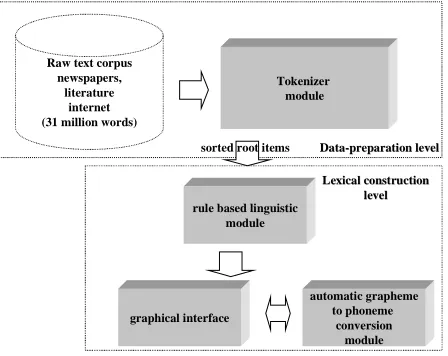
In the figure 1 the system for lexica development is shown. From the figure we can see, that the system architecture consists of basically two levels. First the data preparation step is performed, followed by the lexica build-up level. The data-preparation step was already described above.
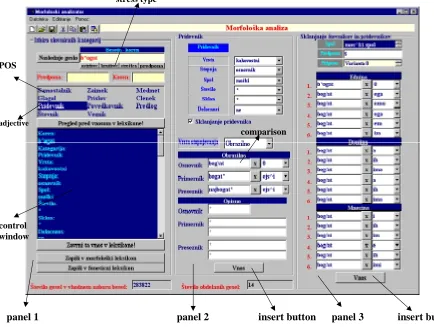
window. If some mistakes still exist, they can be corrected here, before the information is written into the morphology lexicon.
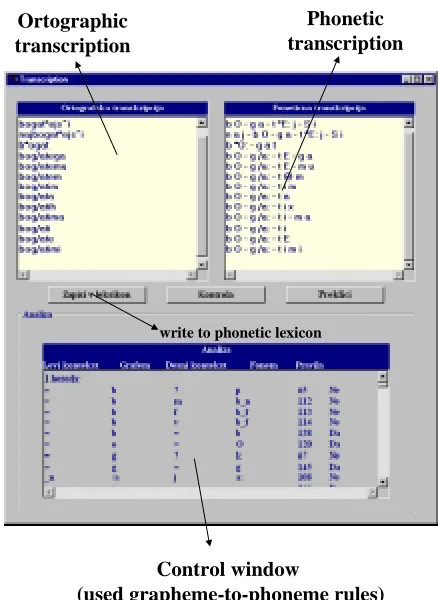
To verify automatically generated phonetic transcription, the expert has to open window, which visualises generated phonetic transcription, done with automatic grapheme to phoneme conversion module. The window is shown on Figure 2. The user is actually able to switch between using rule-based or data-driven approach (using neural network). Since a lot of inflectional forms for corresponding item are the same, only different orthographic words are send to the grapheme-to-phoneme conversion module.
The grapheme-to-phoneme transcription module gets as input only non-duplicated words and returns the corresponding phonetic transcriptions with syllable break marks ’-’ and stress marks.
The linguistic expert verifies the results and writes everything into the phonetic lexicon. Below there is also control window for inspection, which rules were used to identify the problem in case of errors in the obtained phonetic transcriptions. This is possible if rule-based approach is used.
6.
Notation and attribute/value tables
The notation format of the output of the system for building morphology and phonetic lexica, consists of
linear strings of characters representing the morphosyntactic information to be associated with word forms. We constructed the string following the philosophy of the Intermediate Format proposed in the EAGLES Corpus proposal (Leech and Wilson, 1994). It consists of agreed symbols in predefined and fixed positions. The categories used with the relevant attributes and values are based on EAGLES documents (MULTEXT,1996).
7.
Performance evaluation of the system
Currently six linguistic experts work with the system, in order to build Slovenian morphology and phonetic lexica. After more than half a year of intensive work, the system was evaluated as a very efficient help for the expert. The linguistic expert finds it very easy for use, accurate enough in automatic generation of linguistic descriptions for items and also in grapheme to phoneme transcriptions. In case of errors, they can be corrected fast and easy without extensive typing, but mostly using mouse. They are able to verify approximately 100 root items in 15 hours. Since the Slovenian language is very inflectional language, in average 30 inflectional forms (during analysis of verbs most of the inflectional forms are generated) per root item are generated. That means that we get in average 3000 inflectional forms for 100 root items. Since a lot of duplicated inflectional forms are obtained during conjugation/declension, the phonetic panel 1 panel 2 insert button panel 3 insert button
POS
adjective
stress type
comparison
control window
lexicon is in average ten times smaller than the morphologic lexicon.
8.
Conclusion
Currently six linguistic experts work very intensively with the developed system. The morphologic lexicon currently contains more than 400.000 items (root items plus corresponding inflectional forms) and about ten times smaller phonetic lexicon (49.000). The alphabetic coverage will be achieved in the next few months, since every expert works on root items from before determined alphabetic letter. It is planned to use the Slovenian phonetic lexicon in research work in the field of automatic continuous speech recognition of Slovenian language. Both phonetic and morphology lexicon will be used for Slovenian text-to-speech synthesis.
9.
References
Matej Rojc, Janez Stergar, Ralph Wilhelm, Horst-Udo Hain, Martin Holzapfel, Bogomir Horvar, (1999) A Multilingual text processing Engine for Text-To-Speech Synthesis system, Proceedings EUROSPEECH 1999, Budapest, pp. 2107-2110 Zell, A.(1994). Simulation Neuronaler Netze. Bonn,
Paris; Reading, Mass., Addison-Wesley
Horst-Udo Hain, (1999) Automation of the training procedure for neural networks performing multi-lingual grapheme to phoneme conversion, Proceedings EUROSPEECH 1999, Budapest, pp. 2087-2090 SAMPA for Slovenian, (1998)