Development and Evaluation of a Korean Treebank and its Application to NLP
Chung-hye Han , Na-Rare Han
, Eon-Suk Ko
, Martha Palmer
Dept. of Linguistics Simon Fraser University
8888 University Drive Burnaby BC V5A 1S6, Canada
Dept. of Linguistics University of Pennsylvania
619 Williams Hall Philadelphia, PA 19104, USA
nrh,esko @ling.upenn.edu
Dept. of Computer Information and Science University of Pennsylvania
256 Moore School Philadephia, PA 19104, USA [email protected]
Abstract
This paper discusses issues in building a 54-thousand-word Korean Treebank using a phrase structure annotation, along with developing annotation guidelines based on the morpho-syntactic phenomena represented in the corpus. Various methods that were employed for quality control are presented. The evaluation on the quality of the Treebank and some of the NLP applications under development using the Treebank are also presented.
1.
Introduction
With growing interest in Korean language processing, numerous natural language processing (NLP) tools for Ko-rean, such as part-of-speech (POS) taggers, morphological analyzers and parsers, have been developed. This progress was possible through the availability of large-scale raw text corpora and POS tagged corpora (ETRI, 1999; Yoon and Choi, 1999a; Yoon and Choi, 1999b). However, no large-scale bracketed corpora are currently available to the pub-lic, although efforts have been made to develop guidelines for syntactic annotation (Lee et al., 1996; Lee et al., 1997). As a step towards addressing this issue, we built a 54-thousand-word1Korean Treebank using a phrase structure annotation at the University of Pennsylvania, creating the Penn Korean Treebank. At the same time, we also devel-oped annotation guidelines based on the morpho-syntactic phenomena represented in the corpus, over the period of Jan. 2000 and April 2001. The corpus that we used for the Korean Treebank consists of texts from military language training manuals. These texts contain information about various aspects of the military, such as troop movement, intelligence gathering, and equipment supplies, among oth-ers. This corpus is part of a Korean/English bilingual cor-pora that was used for a domain specific Korean/English machine translation project at the University of Pennsylva-nia. One of the main reasons for annotating this corpus was to train taggers and parsers that can be used for the MT
1This word count is computed on tokenized texts and includes
symbols.
project.
In this paper, we first discuss some issues in develop-ing the annotation guidelines forPOStagging and syntactic bracketing. We then detail the annotation process in 3., including various methods we used to detect and correct annotation errors. 4. presents some statistics on the size of the corpus. 5. discusses the results of the evaluation on the Treebank, and 6. presents some of the NLP applications we did so far using the Treebank.
2.
Guideline development
for inconsistentPOStags and illegal syntactic bracketings. LexTract was used to detect formatting errors (Xia et al., 2000a).
3.3.1. CorrectingPOStagging errors
Errors in POS tagging can be classified into three types: (a) assignment of an impossible tag to a morpheme (b) un-grammatical sequence of tags assigned to a word-phrase, and (c) wrong choice of a tag (sequence) candidate in the presence of multiple tag (sequence) candidates.
Type (a) was treated by compiling a tag dictionary for the entire list of morphemes occurring in the corpus. For closed lexical categories such as verbal endings, postpo-sition markers and derivational suffixes, all of them were examined to ensure that they are assigned with correct tags. For open-set categories such as nouns, adverbs, verbs and so on, only those word-tag combinations exhibiting a low frequency count were individually checked.
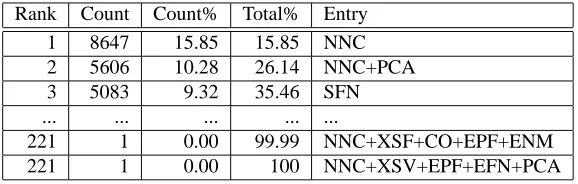
Treating type (b) required knowledge of Korean mor-phosyntax. First, a table of all tag sequences and their fre-quencies in the corpus was compiled, as shown in Table 1.
Those tag sequences found less than 3 times were all manually checked for their grammaticality, and corrected if found illegal. As a next step, a set of hand-crafted morpho-tactic rules were created in the form of regular expressions. Starting from the most rigorous patterns, we checked the tag sequences against the patterns already incorporated in the set of grammatical morphotactic rules, expanding the set as needed or invalidating a tag sequence according to the outcome.
Type (c), assignment of a wrong tag in the case of am-biguity, cannot be handled by looking at the morphemes by themselves, but the syntactic context must be considered: therefore this type of problem was treated along with other illegal syntactic structures.
3.3.2. Correcting illegal syntactic structures
To correct errors in syntactic bracketing, we targeted each local tree structure (parent node + daughter nodes). To do this, all local tree structures were extracted in the form of context-free rules (Table 2). For local trees with a lexi-cal daughter node, the lexilexi-cal information was ignored and onlyPOSinformation on the node was listed in the rule.
The next step taken was to define the set of context-free rules for Korean. For each possible intermediate node label (phrasal categories as S, NP, VP and a few lexical cat-egories such as VV and VJ) on the lefthand side of the rule, its possible descendant node configuration was defined as a regular expression, as seen in (6):
(6) a. VP (shown in part):
(NP-OBJ(-LV)?6 NP-COMP(-LV)?
6 S-COMP6 S-OBJ )+ VV7 S* b. VV:
NNC(7 +XSF)?7 +XSV
6ˆVV7 S* VV7 S*$ 6 (VV )*(ADCP )?VV
Example (6a) shows that a local tree with VP as the parent node can have as its daughter nodes any numbers of NP-OBJ, NP-COMP, S-COMP or S-OBJ nodes followed by a VV node, which is the head.
As with the case of word-internal tag sequences, the most frequent context-free rules were examined and incor-porated into the set of rules first, and this set gradually grew as more and more rules were examined and decided to be included in the rule set or rejected to be corrected later. As a result, a large number of illegal syntactic bracketings were identified and corrected. Particularly frequent types of syntactic tagging errors were: (a) redundant phrasal pro-jections (i.e. VP 8 VP), (b) missing phrasal projections, and (c) misplaced or ill-scoped modifying elements such as relative clauses and adverbial phrases/clauses.
3.3.3. Corpus search
We compiled a list of error-prone or difficult syntactic constructions that had been observed to be troublesome and confusing to annotators, and used corpus search tools (Ran-dall, 2000) to extract sentence structures containing each of them from the Treebank. Each set of extracted structures were then examined and corrected. The list of construc-tions we looked at in detail include relative clauses, com-plex noun phrases, light verb constructions, comcom-plex verbs, and coordinate structures. By doing a construction by con-struction check of the annotation, we were able to not only correct errors but also enhance the consistency of our anno-tation.
4.
Statistics on the size of the corpus
In this section, we present some quantitative aspects of the Penn Korean Treebank corpus. The corpus is a rela-tively small one with 54,528 words and 5,083 sentences, averaging 9.158 words per sentence. A total of 10,068 word types are found in the corpus, therefore the measured type/token ratio (TTR) is rather high at 0.185. However, for languages with rich agglutinative morphology such as Ko-rean, even higher type/token ratios are not uncommon. For comparison, a comparably sized portion (54,547 words) of the ETRI corpus, an annotated corpus withPOS tags, was selected and analyzed.4 This set contained 19,889 wordtypes, almost double the size of that of the Penn Korean Treebank, as shown in Table 3.
word
token type type/token ratio Treebank 54,528 10,068 0.185
ETRI 54,547 19,889 0.364
morpheme
token type type/token ratio Treebank 93,148 3,555 0.038
ETRI 101,100 8,734 0.086
Table 3: Type/token ratios of two corpora
Taking individual morphemes, rather than words in their fully inflected forms, as the evaluation unit, the ratio be-comes much smaller: the Penn Korean Treebank yields a
4
Rank Count Count% Total% Entry
1 8647 15.85 15.85 NNC
2 5606 10.28 26.14 NNC+PCA
3 5083 9.32 35.46 SFN
... ... ... ... ...
221 1 0.00 99.99 NNC+XSF+CO+EPF+ENM
221 1 0.00 100 NNC+XSV+EPF+EFN+PCA
Table 1: Frequency of tag sequences
Rank Count Count% Total% Entry
1 5993 7.72 7.72 S8 NP-SBJ VP
2 4079 5.26 12.98 NP-SBJ8 *pro*
3 2425 3.12 16.11 ADVP8 ADV
... ... ... ... ...
1394 1 0.00 99.99 ADJP8 VJ+EPF+EFN+PAU
1394 1 0.00 100 ADJP8 S NP-ADV ADVP ADJP
Table 2: Frequency of context-free rules
morpheme type/token ratio of 0.038 (93,148 tokens and 3,555 types). Compared to the same portion of the ETRI corpus, we can see that the Penn Korean Treebank still shows a lower ratio: the ETRI corpus showed a morpheme type/token ratio of 0.086 (101,100 morpheme tokens and 8,734 unique morpheme types).
These results suggest that the Penn Korean Treebank, as a domain-specific corpus in the military domain, is highly homogeneous and low in complexity at least in terms of its lexical content. The ETRI corpus, on the other hand, con-sists of texts from different genres including novels, news articles and academic writings, hence the higher counts of lexical entries per word token. In our future work, we hope to expand the Treebank corpus in order to achieve a broader and more general coverage.
5.
Evaluation
For evaluating the consistency and accuracy of the Tree-bank, we used Evalb software that produces three met-rics, bracketing precision, bracketing recall and numbers of crossing brackets, as well as tagging accuracy.
For the purposes of evaluation, we randomly selected 10% of the sentences from the corpus in the beginning of the project and saved them to a file. These sentences were thenPOStagged and bracketed just like any other sentences in the corpus. After the first pass of syntactic bracketing, however, they were double annotated by two different an-notators. We also constructed a Gold Standard annotation for these test sentences. We then ran Evalb on the two anno-tated files produced by the two different annotators to mea-sure the inter-annotator consistency. Evalb was also run on the Gold Standard and the annotation file of the 1st anno-tator, and on the Gold Standard and the annotation file of the 2nd annotator to measure the individual annotator accu-racy. Table 4 shows the accuracy of each annotator com-pared to the Gold Standard under 1st/gold and 2nd/gold column headings, and the inter-annotator consistency un-der 1st/2nd column heading. It shows that all the measures
are well over 95%, tagging accuracy reaching almost 100%. These measures indicate that the quality of the Treebank is more than satisfactory.
Consistency Accuracy 1st/2nd 1st/gold 2nd/gold
Recall 96.60 97.69 98.84
Precision 97.97 98.89 98.84
No Crossing 95.89 97.57 97.53
Tagging 99.72 99.99 99.77
Table 4: Inter-annotator consistency and accuracy of the Treebank
Most of the inter-annotator inconsistencies belonged to one of the following types:
9
In coordinated sentences with an empty subject and an empty object, whether the level of coordination is VV, VP or S;
9
Whether a sentence has an empty object argument or not;
9
Whether a noun modified by a clause is a relative clause construction or a complex NP;
9
Whether a verb is a light verb or a regular verb;
9
In a complex sentence in which the subject of the ma-trix clause and the subordinate clause are coreferential, whether a topic marked NP is the subject of the matrix clause or the subordinate clause;
9
Index Word POS tag Elem Anchor Node Subst/Adjoin (morph) Tree Label Address into (Index)
0 VW DAN ] NP*=1 anchor root 2
1 Y/^ NNC ] NP*=1 anchor root 2
2 XY +4 NNC+PAU _ NP=0 anchor 0 6
3 `ba ADV ] VP*=25 anchor 1 6
4 24 NNU ] NP*=1 anchor 0 5
5 c +. NNX+PAD ] VP*=17 anchor 1 6
6 ZD[ +\ VV+ECS _ S-NPs=23 anchor - TOP
7 d +'+e VX+EFN ] VP*=13 anchor 1 6
8 . SFN - - -
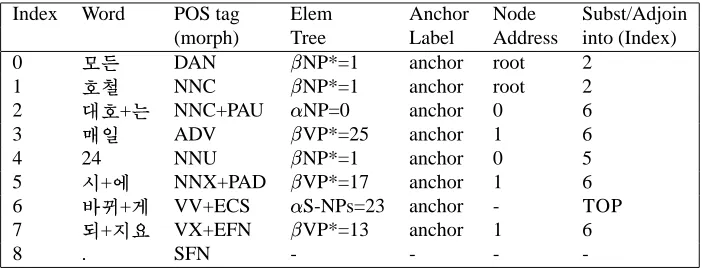
-Figure 2: Example of derivation of a sentence reported by the statistical parser
We plan to release the Treebank in the near future mak-ing it available to the wider community. The corpus we used for the Korean Treebank is originally from a Ko-rean/English parallel copora, and we have recently finished creating a Korean/English parallel Treebank by treebank-ing the English side and aligntreebank-ing the two Treebanks. We would like to expand the size and coverage of the corpus by treebanking newswire corpora, employing as rigorous an annotation methodology as we did for the 54K Treebank. We hope to speed up the annotation process by automating the annotation process as much as possible (Cf., along the lines described in (Skut et al., 1997) for NEGRA corpus at the University of Saarbr ¨uken), incorporating a parser as well as a tagger to the annotation interface.
Acknowledgements
We thank Aravind Joshi, Tony Kroch and Fei Xia for valuable discussions on many occasions. Special thanks are due to Owen Rambow, Nari Kim and Juntae Yoon for discussions in the initial stage of the project. We would also like to thank Myuncheol Kim, Chulwoo Park and Heejong Yi for their participations in various parts of the project. The work reported in this paper was supported by contract DAAD 17-99-C-0008 awarded by the Army Research Lab to CoGenTex, Inc., with the University of Pennsylvania as a subcontractor, NSF Grant -VerbNet, IIS 98-00658, and DARPA Tides Grant N66001-00-1-8915.
8.
References
Ann Bies, Mark Ferguson, Karen Katz, and Robert Mac-Intyre. 1995. Bracketing guidelines for treebank ii style penn treebank project.
Michael Collins, Jan Hajicˇc, Lance Ramshaw, and Christoph Tillmann. 1999. A statistical parser for czech. In Proceedings for the 37th Annual Meeting of the
Asso-ciation for Comoputational Linguistics, pages 505–512.
Association for Computational Linguistics.
Michael Collins. 1997. Three generative, lexicalised mod-els for statistical parsing. In Proceedings of the 35th
An-nual Meeting of the Association for Computational Lin-guistics, Madrid, Spain, July.
ETRI. 1999. fDHhgij'Kkml . Technical report, 'n
o
Lbp
&q , r+s*t -uvw*xK ?+y
p
&u , z{
*p
&*| , Taejun, Korea. ETRI POS tagset guide-lines.
Chung-hye Han and Na-Rae Han. 2001. Part of speech tagging guidelines for Penn Korean Treebank. Technical Report IRCS Report 01-09, IRCS, University of Penn-sylvania. ftp://ftp.cis.upenn.edu/pub/ircs/tr/01-09/. Chung-hye Han, Benoit Lavoie, Martha Palmer, Owen
Rambow, Richard Kittredge, Tanya Korelsky, Nari Kim, and Myunghee Kim. 2000. Handling structural di-vergences and recovering dropped arguments in a Ko-rean/English machine translation system. In John S. White, editor, Envisioning Machine Translation in the
Information Future, pages 40–53. Springer-Verlag.
Pro-ceedings of AMTA 2000.
Chung-hye Han, Na-Rae Han, and Eon-Suk Ko. 2001. Bracketing guidelines for Penn Korean Treebank. Tech-nical Report IRCS Report 01-10, IRCS, University of Pennsylvania. ftp://ftp.cis.upenn.edu/pub/ircs/tr/01-10/. Chung-hye Han. 2002. A morphological analyzer/tagger
for Korean: statistical tagging combined with corpus-based morphological rule application. Ms. Simon Fraser University.
Anthony Kroch and Ann Taylor. 1995. The Penn-Helsinki parsed corpus of Middle English.
Kongjoo Lee, Jaehoon Kim, Pyengkyu Cang, Kisun Choi, and Kilchang Kim. 1996. Syntactic tag set for Ko-rean syntactic tree tagged corpus. Technical Report CS-TR-96-102, Department of Computer Science, KAIST. Written in Korean.
Kongjoo Lee, Pyengkyu Cang, and Kilchang Kim. 1997. Bracketing guidelines for Korean syntactic tree tagged corpus version i. Technical Report CS-TR-97-112, De-partment of Computer Science, KAIST. Written in Ko-rean.
Mitch Marcus, Beatrice Santorini, and M. Marcinkiewicz. 1993. Building a large annotated corpus of English.
Computational Linguistics, 19(2):313–330.
Martha Palmer, Chung-hye Han, Anoop Sarkar, and Ann Bies. 2002. Integrating Korean analysis components in a modular Korean/English machine translation system. Ms. University of Pennsylvania and Simon Fraser Uni-versity.
The-ory. John Benjamin, Amsterdam, Philadelphia.
Beth Randall, 2000. CorpusSearch User’s
Manual. University of Pennsylvania.
http://www.cis.upenn.edu/ brandall/CSManual/.
Philip Resnik. 1992. Probabilistic tree-adjoining gram-mars as a framework for statistical natural language pro-cessing. In Proceedings of COLING ’92, volume 2, pages 418–424, Nantes, France.
Anoop Sarkar. 2002. Statistical Parsing Algorithms for
Lexicalized Tree Adjoining Grammars. Ph.D. thesis,
University of Pennsylvania.
Yves Schabes. 1992. Stochastic lexicalized tree-adjoining grammars. In Proceedings of COLING ’92, volume 2, pages 426–432, Nantes, France.
Wojciech Skut, Brigitte Krenn, Thorsten Brants, and Han Uszkoreit. 1997. An annotation scheme for free word order languages. In Proceedings of the Fifth
Confer-ence on Applied Natural Language Processing (ANLP),
Washington, D.C.
Fei Xia, Martha Palmer, , and Aravind Joshi. 2000a. A uni-form method of grammar extraction and its applications. In Proceedings of the EMNLP 2000.
Fei Xia, Martha Palmer, Nianwen Xue, Mary Ellen Okurowski, John Kovarik, Shizhe Huang, Tony Kroch, and Mitch Marcus. 2000b. Developing Guidelines and Ensuring Consistency for Chinese Text Annotation. In
Proceedings of the 2nd International Conference on Lan-guage Resources and Evaluation (LREC-2000), Athens,
Greece.
Juntae Yoon and Kisun Choi. 1999a. Study on kaist cor-pus. Technical Report CS-TR-99-139, Department of Computer Science, KAIST. Written in Korean.
Juntae Yoon and Kisun Choi. 1999b. Study on pos tagged corpus for Korean. Technical Report CS-TR-99-138, Department of Computer Science, KAIST. Written in Korean.
Juntae Yoon, C. Lee, S. Kim, and M. Song. 1999. Mor-phological analyzer of Yonsei univ., Morany: Morpho-logical analysis based on large lexical database extracted from corpus. In Proceedings of Korean Language