© 2018 IJSRCSEIT | Volume 3 | Issue 3 | ISSN : 2456-3307
A Review : E-Counseling
Shweta Kolekar 1, Mansi Surve1, Pallavi Redkar1, Sachin Bojewar2
1B.E. Student Department of Information Technology, Vidyalankar Institute of Technology, Mumbai, India
2Assistant Professor Department of Information Technology, Vidyalankar Institute of Technology, Mumbai,
India
ABSTRACT
In today’s competitive world, education is one of the most important aspects of our life. Students get confused about their career which is the defining point of their life. Our system helps in guiding the students for choosing the appropriate field. For that we will be taking several assessment tests which includes aptitude test i.e. verbal, quantitative, logical and miscellaneous test and personality test. In our system we will be using data mining algorithms so that we could better assess the students. We will be providing the students with an assessment report which would help them choose a suitable stream according to their personality type.
Keywords : Data Mining, Career Guidance, Counseling, Stream
I.
INTRODUCTIONIn today’s world, students have a wide range of career options to choose from. We often get swayed away when we see someone having a successful career and we feel like we should be doing the same as well. Choosing a field of study that is not really suited to your interest or skills could prove disastrous and the student will be left with no option but to regret his decision of choosing this particular career path. Parental and peer pressure also burdens the students. This is where career counseling comes into the picture. There are very few online counseling systems which have their own counselors who counsel students through video calls and chatbots. We plan on designing a fully automated system for counseling secondary and higher secondary students. This system does not have the need for a human counselor. For this we are taking students’ academic details, hobbies, aptitude tests (Quantitative, verbal, logical) and personality assessment tests [1]. By performing an in depth analysis on the scores of these tests, we will suggest suitable career options to students.
II.
EXISTING SYSTEMThe existing online counseling systems are manual based as there is huge involvement of man power to counsel the students. To generate the results, a narrow range of parameters are covered which degrades the accuracy of report [2]. In Traditional counseling systems, students have a one to one conversation which consumes more time as well as the counselor suffers from human limitations while the machine is accurate.
III.
AIM & OBJECTIVEyears, there has been a tremendous rise in the number of career paths that are available for students to choose from most of which they are not aware about. Consider an extroverted student, such a person would prefer having a job that requires a lot of interaction with people whereas an introverted student would prefer a cubicle based job. Thus, analytical career counseling is important [3]. Thus our project aims at providing suitable career options to all such students.
The main objective of our project is to provide two most suitable streams to a student by analyzing his academics, aptitude, hobbies and interest [4]. Apart from providing a viable career option, we would also recommend colleges of that particular stream, best suited for that student [5]. This would reduce extra efforts on the students’ part while searching for colleges. We would also be taking personality assessment tests and providing statistics of each personality trait so that students can know themselves very well.
IV.
LITERATURE SURVEYEDTitle of Paper, Journal name
Observations/ Process Flow Challenges/
Limitations available where students can search colleges by their courses. System allows student to give two tests. First test is there to identify the field in which the student is interested in and second test have questions related to that field.
They are not guiding students based on his/her personality.
Also for
recommending stream/field they are
not considering
Recommendation and Tracking) model wherein a general survey
questionnaire is provided
depending upon different factors like different career related field questions, personality identifying questions. The results consist of the career option along with the percentage of inclination of student in that career.
There are various
career options
available to the student’s. Although the questionnaire for all career option is
This expert system, in the form of web access, can provide the appropriate evaluation to diagnose
Counseling Expert System based on Agent, IEEE
occupational problems that
visitors ask, and provide advice or solutions for visitors according to inference of professional issues. This system uses artificial intelligence, career experts to provide career counseling.
exist parameters for educational
counseling which are not considered.
for higher secondary
students. Academics
should have been
considered for providing career options [4].
Scope of the project must cover all standard or class students for suggesting career path [5]. student performance prediction, based on their personal and
academic performance
characteristics. This prediction is performed by using data mining algorithms such as Bayesian Classification, Neural Networks, Clustering, Association Rule, K-means algorithm.
They are considering academic details and other class room activities in the college during the
course time.
Although they are not considering other parameters.
Personality
characteristics should also be included. And some kind of aptitude test must be taken for further
An Automated Career Guidance Expert System (AC-GES) is to assist high school students in choosing career paths that best suit their abilities based on their previous performances in some selected subjects. It uses data training dataset has record of only 1000 students.
Training set should have contained large number of records for accuracy. Personality test should also be included [7].
V.
PROPOSED SYSTEMExisting systems are lagging behind in terms of newly introduced technologies, which might affect the accuracy of results. In proposed system we are using recent technologies like Data Mining algorithms, web technologies [6]. We are using HTML5, CSS3, JavaScript, JQuery and Bootstrap for
algorithms, we are using K-nearest neighborhood algorithm which is non-parametric method used for classification and regression. This algorithm performs processing on the training dataset of marks and classifies the test data to predict appropriate stream. The accuracy of KNN algorithm is very high as we are focusing on accuracy of result [7]. Our UI is user friendly. It is reliable, robust and efficient as it is E-counseling it does not require human involvement for generating report.
VI.
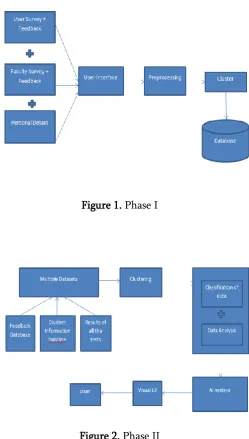
WORKING OF PROPOSED SYSTEMIn the previous section we have understood the various parts of the proposed system. It even clarifies about the significance of each of the parts. Now in this section, let us understand the working of the proposed system. This would enable us to understand how this proposed system can be effectively used to get rid of the problems in traditional method.
Project methodology involves collecting quantifiable data from students such as:
1. Personal Details 2. Academics Details 3. Aptitude Test 4. Personality Test, etc.
In accordance with our system, we have assigned weightage to each parameter. We have assigned 30% weightage to academics and 70% weightage to the aptitude tests which we are conducting. We have prepared our own business logic to predict stream. In today’s competitive world students get confused about their future career stream. We are guiding them with our system to choose appropriate career path. We are also assessing their personality by taking personality test which we are conducting in addition to academics and aptitude test. We are also taking the favorite subject according to that we are using business logic i.e. we are giving 5% extra weightage to that particular subject. Suppose a student’s favorite subject is math then after taking all the tests we will add 5% extra marks in math. Our
system will guide to those students who are confused but also to those students who know what they want to do by suggesting at what they are good at and what they should improve.
Figure 1. Phase I
Figure 2. Phase II
The project will be broadly divided into 3 iterations:
1. Data Collection:
2. Data Preprocessing and Analysis of data:
As we are concerned with many factors for giving results, we have assigned weights to each of the factors. Say we assign 30% weightage to academics and 70% weightage to aptitude test scores. For data mining we are using historical or training dataset. Before we apply algorithm on dataset we would clean the data and make sure that all values in appropriate format. That means data preprocessing is done to remove data redundancy and inconsistency.
3. Generating student report:
In this stage, we will provide a report which will be generated by analyzing all the parameters. The report will consist of scores of all the modules of the aptitude test and the top two courses or career options. From personality test we would tell the nature and behavior of a student and would suggest in which field student has to improve. We would also recommend the colleges to the student as per the stream suggested.
VII.
CONCLUSION & FUTURE WORKOnly few students knows in which field they are interested in but most of the students who are confused about deciding career option can use this system in order to know the suitable career option for them.
Schools can use this system in order to guide their children for choosing a suitable career path. 10th std. students can use it to select a stream of their choice. Whereas junior colleges can use this system as well so that students after completing their 12th std. could determine a suitable field for themselves so that they can choose a viable career option that they would actually enjoy doing and might help them succeed as well.
Future scope for this project could be applying even more sophisticated algorithms which could be customized for this particular application [8].
Machine learning capabilities could also be included for this method in order to provide more accurate results to the students.
VIII.
REFERENCES
[1]. Crystal D'Mello, Rini Aranha,Boni Gregory, Varsha Shrivastava "Online Career Guidance System", 2016 Volume 6, Issue 4, April 2016 International Journal of Advanced Research in Computer Science and Software Engineering.
[2]. Waghmode M. L, Dr. P.P.Jamsandekar, "A Study of Expert System for Career Selection", September 2015 International Journal of Advanced Research in Computer Science and Software Engineering. [3]. Prof. Seema K. Yadav, Mr.Sujit J. Singh, Mr.
Akshay M. Bora, Mr. Shashankit N.Thakur,
"Educational Recommendation and tracking
System", International Journal of Scientific and Engineering Research, Volume 7, Issue 11, November-2016.
[4]. Ying Cao Lei Zhang, "Research about the College Students Career Counseling Expert System based on Agent", 2011 IEEE.
[5]. Mohammed Abdellah Alimam, Hamid Seghiouer, Mohammed Amine Alimam and Mohammad Cherkaoui, "Automated system for matching scientific students to their appropriate career pathway based on science process skill model",
2017 IEEE Global Engineering Education
Conference (EDUCON),2017).
[6]. Dr. K. Karthikeyan, Dr. K. Karthikeyan, "On Improving Student Performance Prediction in Education Systems using Enhanced Data Mining Techniques", Volume 7, Issue 5, May 2017 International Journal of Advanced Research in Computer Science and Software Engineering 2017. [7]. Chinedu Pascal Ezenkwu, Enyenihi Henry
Johnson, Otobong Jerome, "Using Case-Based Reasoning Technique Automated Career Guidance Expert System ", Computing, Information systems, development informatics and allied research journal.March 2017.