Efficient Minimal Perfect Hash Language Models
David Guthrie, Mark Hepple, Wei Liu
Department of Computer Science, University of Sheffield
[email protected], [email protected], [email protected]
Abstract
The recent availability of large collections of text such as the Google 1T 5-gram corpus (Brants and Franz, 2006) and the Gigaword corpus of newswire (Graff, 2003) have made it possible to build language models that incorporate counts of billions ofn-grams. This paper proposes two new methods of efficiently storing large language models that allow O(1) random access and use significantly less space than all known approaches. We introduce two novel data structures that take advantage of the distribution ofn-grams in corpora and make use of various numbers of minimal perfect hashes to compactly store language models containing full frequency counts of billions ofn-grams using 2.5 Bytes pern-gram and language models of quantized probabilities using 2.26 Bytes pern-gram. We show that our approaches are simple to implement and can easily be combined with pruning and quantization to achieve additional reductions in the size of the language model.
1.
Introduction
Determining the most probable sequence of words is an in-tegral part of many natural language processing tasks and the probabilities of these word sequences are often stored in a structure called a language model. Language models typically must holdn-grams of each distinct sequence of words up to lengthnthat occur in a collection of training documents and associate with each of these sequences a fre-quency count or a probability. The use of language models for tasks such as machine translation and speech recogni-tion have shown that increasing the size of the model is a constructive way of improving the performance on those tasks. Recently, Brants et al. (2007) showed that machine translation quality continues to improve even when increas-ing the size of the text used to build the language model above 1 trillion tokens.
Storing language models so that counts or probabilities can be accessed quickly has become problematic due to the space required to store these large models. Language mod-els have commonly been stored in compact trie structures that allow fast searching and enumeration ofn-grams, yet these structures do not scale well and require space propor-tional to both the number of n-grams and the vocabulary size. Recently, significant advances in reducing the amount of space required to store a language model have been made by the introduction of random access models by Talbot and Osborne (2007a), Talbot and Osborne (2007b), and Talbot and Brants (2008).
Random access language models make use of the idea that it is not necessary to actually storen-grams in the language model as long as when queried with ann-gram the model returns the correct count or probability associated with that n-gram. This has been achieved through the clever use of Bloom filters (Bloom, 1970) and Bloomier filters (Chazelle et al., 2004) that trade a very small probability of return-ing a false positive for the fact that they can represent data very efficiently. These techniques allow the storage of lan-guage models that are no longer dependent on the size of the vocabulary, but only on the number ofn-grams. In this paper we propose two new random access language models that introduce the use of tiers of minimal perfect hash functions to exploit the distribution of words in
lan-guage and further reduce the size required to store lanlan-guage models. We achieve this reduction in space without increas-ing the time required to query the model for ann-gram’s probability or increasing the false positive rate. Our method achieves storage of fulln-gram counts using just 2.5 Bytes pern-gram, which is 36% of the size that would be required by the previously most compact random access model pro-posed by Talbot and Brants (2008).
2.
Related Work
Several methods have been used to reduce the amount of storage required for language models by storing less infor-mation. For instance it is possible to reduce the number ofn-grams that must be stored in the model using entropy pruning techniques (Stolcke, 1998), clustering (Jelinek et al., 1990; Goodman and Gao, 2000) or simply by throw-ing awayn-grams that occurred infrequently in the training data. It is also possible to reduce the amount of bits required to store eachn-gram’s associated probability or count by sacrificing some precision using quantization (Whittaker and Raj, 2001). Quantization divides the possible range intoQdiscrete values so that probabilities can be stored us-ing onlydlog2Qebits. These techniques can be used with any structure (including ours) for further reductions in the size of the language model and so can be seen as comple-mentary to ours. This paper focuses on the data structures that are used to store thesen-grams and their probabilities whether or not they have first been pruned or quantized. Two main approaches to storing language models have been used: compact trie structures and hash like data structures that allow random access. In this section we give a brief overview of both approaches, highlighting the advantages and disadvantages of each.
2.1. Trie based language models
Forn-gram language models these prefixes are typically 24 or 32 bit integers that represent words (typically all words in the vocabulary are assigned a distinct integer representa-tion). So every node in the trie along with its parent nodes represents a distinctn-gram. The probabilities or counts as-sociated with ann-gram can be stored in the tree node along with the word. Very compact representations of these struc-tures have been devised that do not require storing pointers and are used in the CMU toolkit (described in Whittaker and Raj (2001)) as well as the MITLM and others (Harb et al., 2009; Germann et al., 2009). Tries allow the model to be stored in relatively little space and they also permit enumeration over n-grams in the model. For instance it is possible to list alln-grams in the model or to query the model forn-grams that begin with certain words and iterate through all of the results.
The main drawback of the trie approach is that it needs to store a representation for every word in then-gram and the probabilities. Even using 24 bit integers for words in the vocabulary and quantizing probabilities to 8-bit integers; this model requires significantly more space than the ran-dom access approach described in the next section. The size of the trie model can be reduced using block compres-sion as in Harb et al. (2009), but this technique can equally be applied to random access models if the increase in the time required to query the model is acceptable.
2.2. Random Access Language Models
Random access language models (Talbot and Osborne, 2007b; Talbot and Brants, 2008; Talbot and Osborne, 2007a) make use of hash functions to map n-grams to their associated probabilities or counts. These structures do not allow enumeration over then-grams in the model, but for many applications this is not a requirement and their space and speed advantages make them extremely attrac-tive. These methods store language models in relatively little space by not actually storing then-gram key in the structure and allowing a small probability of returning a false positive. In the case ofn-grams these models always return the correct probability associated with ann-gram if then-gram is in the model, but forn-grams that are not in the model there is a small probability that the model will return some random probability instead of correctly report-ing that then-gram was not found. There have been two major approaches used for storing random access language models: Bloom Filters and Bloomier Filters. We give an overview of these approaches below.
A Bloom filter (Bloom, 1970) is a data structure used in membership queries. It can be used to answer simple queries of the form “Is this key in the Set?”. This is a weaker structure than a dictionary or hash table which also can associate a value with a key. Bloom filters use well below the information theoretic lower bound of space re-quired to actually store the keys and can answer queries in O(1) time. Bloom filters achieve this feat by allow-ing a small probability of returnallow-ing a false positive. A Bloom filter stores a set S of n elements in a bit array B of size m. Initially B is set to contain all zeros. To store an item xfrom S in B we compute k random in-dependent hash functions onxthat each return a value in
the range 1 tom. These values serve as indices to the bit array B and the bits at those positions are set to 1. So, B[hi(x)] = 1fori= 1tok. We do this for all elements in S storing to the same bit array. Elements may hash to an index inBthat has already been set to 1 and in this case we can think of these elements as “sharing” this bit.
To test whether the set S contains a key, sayw, we run our khash function onwand check to see if all those locations inBare set to 1. Ifw∈Sthen the bloom filter will always declare that wbelongs toS, but if x /∈ S then the filter can only say with high probability thatwis not inS. This error rate depends on the number ofkhash functions and the ratio ofm/n. For instance withk = 3hash functions and a bit array of size m = 20n, we can expect to get a false positive rate of .0027.
Talbot and Osborne (2007b) and Talbot and Osborne (2007a) made use of bloom filters to store a trigram lan-guage model by inserting into the bloom filter a concatena-tion of ann-gram and its associated count. To insert a tri-gram that occurredctimes they inserted the trigram into the Bloom filterctimes, each time appending a count from 1 to c. To retrieve a trigram count from the model, a trigram is first queried by appending a count of 1 and then if the filter returns true the trigram is queried again appending a count of 2. This process is repeated until the filter returns false. They limit this process by quantizing all counts to 8-bits so there are a maximum of 256 iterations that must be tried. The Zipf-like distribution of language means that many of the n-grams in the test data will occur a small number of times, so for most lookups the iteration count is small. More recently Talbot and Brants (2008) proposed the use of the Bloomier filter for storing language models. A Bloomier filter (Chazelle et al., 2004) is a membership test-ing data structure that allows values associated with the keys to be retrieved from the filter. Bloomier filters gener-alize the Bloom Filters to encode arbitrary functions while maintaining their economical use of storage. For details on the construction of Bloomier Filters see Chazelle et al. (2004; Talbot and Brants (2008). The Bloomier filter is used by Talbot and Brants (2008) to store for each n-gram an associated probability. Like the Bloom filter, the Bloomier filter has a small probability of returning an incor-rect result when queried with ann-gram that does not exist in the model, but will always return the correct probability if then-gram is in the model.
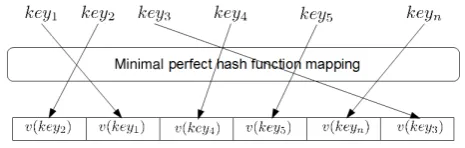
Figure 1: A minimal perfect hash function maps keys to integers in the range 0 to|keys| −1with no collisions
function (Botelho et al., 2007) and this is a helpful way of understanding how it trades some probability of false positives for efficient storage. A perfect hash function is a function that maps the ndistinct elements ofS to dis-tinct integers in the range 1 to r with no collisions. (A minimal perfect hash function, described in the next sec-tion, is a function that can do this withn=r, see Fig. 1.) We can think of a Bloomier language model as consisting a perfect hash functionph()that mapsn-grams to integers in the range 1 torand then storing at that index a finger-print and a value. The fingerfinger-print is generated by a standard independent hash function and the value is the probability or count associated with thatn-gram. The amount of bits used for the fingerprint determines the false positive rate forn-grams not in the model. Storage of the fingerprint is necessary if we know that the model might be queried for n-grams not in the model because the perfect hash func-tionph()will likely map unseen trigrams to some random index and only by comparing the fingerprints we can say with high probability whether thatn-gram was actually in the model. (Talbot and Brants, 2008) give results of using this model for Machine Translation experiments using 8 to 16 bit fingerprints and storing 5 to 8 bit quantized probabil-ity values. Using this approach it is possible to store 8-bit quantized probabilities (256 discrete values) for n-grams with 12-bit fingerprints, using only 3.08 Bytes pern-gram. This is significantly less than all known approaches, but we show that using our tiered minimal perfect hash structure, described in the next sections, it is possible to store full n-gram counts (no quantizing) using only 2.5 Bytes per n-gram (without increasing the false positive rate or the time required to query the model).
3.
Single MPHR Approach
In this section we describe our basic Single Minimal Perfect Hash Rank approach (Single MPHR). Later in the paper we show that this model can be extended by using two tiers of minimal perfect hashes to save even more space while still keeping a constant look up time.
3.1. Storing Ranks of Frequencies
We describe our storage structure assuming we are storing frequency counts of n-grams. Instead of storing the fre-quency count of eachn-gram, we store the ‘rank’ of the frequency count for eachn-gram and have a separate array to store the actual frequency count values, where the index of this array is the ‘rank’. This was motivated by the spar-sityn-gram frequency counts in corpora in the sense that if we take the lowestn-gram frequency count and the highest n-gram frequency count then most of the integers in that range do not occur as a frequency count of any n-grams in the corpus. For example in the Google Web1T data, there are 3.8 billion uniquen-grams with frequency counts ranging from 40 to 95 Billion yet thesen-grams only have 770 thousand distinct frequency counts (see Table 1). Be-cause we only store the frequency rank, to keep the precise frequency information we need onlydlog2Kebits per n-gram, whereKis the number of distinct frequency counts. To keep all information in the Google Web1T data we need onlydlog2771058e = 20bits pern-gram. The memory
savings in this step is thus due to the fact that the number of bits needed to store all the unique ranks is much less than the bits needed to store the maximum frequency count associated with ann-gram,dlog2Ke dlog2maxcounte.
FP5 FP FP1 FP3 FP2 FP FP4 ...
rank(key5) rank(key) rank(key1) rank(key3) rank(key2) rank(key) rank(key4) ...
key1 key2 key3 key4 key5 ... keyN
Minimal Perfect Hash Function
Array of K distinct probability values / frequency counts
p1 p2 p3 p4 p5 p6 ... pK
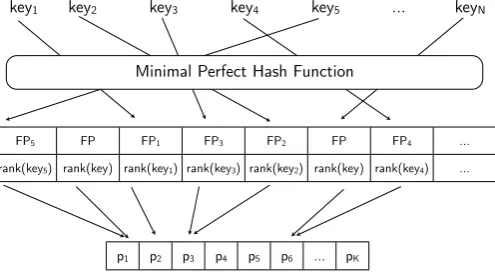
Figure 2: Single MPHR data structure
3.2. Structural Overview
Like the random access models of Talbot and Osborne (2007b; Talbot and Brants (2008; Talbot and Osborne (2007a) we do not storen-grams directly, but instead map eachn-gram that we want to store using a perfect hash func-tion. This hash function assigns to eachn-gram an index that we use to store af ingerprintand arank. The hash function will always return the correct index for each stored n-gram, but it will also return an index for n-grams that were never stored, so it is necessary to store the additional fingerprint to reduce the probability of getting false posi-tives.
To query ann-gram, we first look at the fingerprint stored in the position given by the perfect hash function, then we check whether the fingerprint of thisn-gram matches the stored fingerprint. If they match then we return its rank, and another look-up into the value array is required to re-turn the actual frequency count or probability of the n-gram. If thef ingerprintsdo not match, we can be sure that the queryn-gram is not stored in our model. These lookups are order O(1). The structure of this model is shown in Figure 2.
It should be noted that storing frequency counts is not a requirement of the model, if instead of storing frequency counts we were to store probabilities quantized toQvalues, our method will at most requiredlog2Qebits pern-gram and likely less.
3.3. Fingerprints
We use Austin Appleby’s Murmurhash21function to
finger-print eachn-gram and then store the mhighest order bits of the fingerprint. This is a simple function that produces a random sequence of bits given a key. We store this random bit sequence, or fingerprint, for everyn-gram in the model and then later when the model is queried for ann-gram we check to see if the queriedn-gram’s fingerprint matches the
1
Google maximumn-gram unique frequency Web1T frequency count counts
1gm 95,119,665,584 238,592
2gm 8,418,225,326 504,087
3gm 6,793,090,938 408,528
4gm 5,988,622,797 273,345
5gm 5,434,417,282 200,079
Total 95,119,665,584 771,058
Table 1: unique n-gram frequency counts from Google Web1T corpus
fingerprint no. of FPs FP Rate size (bits)
8 5132312 3.906e-2
12 320574 2.440e-4
16 19804 1.507e-05
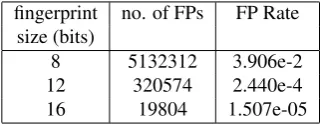
Table 2: False positives using the MPHR approach. We queried the Google Web 1T 1+2+3-gram model with 1.3 billion unseen 4-gram keys.
stored one. This is necessary because, as we mentioned in the previous section, even though the minimal perfect hash function always returns a distinct integer in the range 1 to N for everyn-gram stored in the model, it will also return an integer for a previously unseenn-gram that was never stored in the model. A false positive occurs if the stored fin-gerprint located by the minimal perfect function happens to match the fingerprint of thisunseenn-gram. If this happens the model will incorrectly return the value associated with that storedn-gram rather than reporting that theunseen n-gram was not found.
If the fingerprints were generated by a truly random hash function then the expected false positive rate of the model would be the same as selecting two identical fingerprints:
1
2m (1)
Wheremis the number of bits used for the fingerprint. To test the actual false positive rates for our model we used it to store all 1 to 3 grams in the Google Web1T corpus, and then queried the model for all 4-grams from the Web1T corpus. These 4-grams are all unseen for this model, so when the fingerprints are compared, if the fingerprint of the query matches the stored fingerprint then a false positive has occurred. Table 2 shows that our actual false positive results are very close to the expected value.
3.4. Minimal Perfect Hashing
We use theHash, displace, and compress (CHD) (Belaz-zougui et al., 2009) algorithm to generate a minimal perfect hash function that requires requires 2.07bits per key and hasO(1)access. The algorithm works as follows. Given a setSthat containsN =|S|keys (in our casen-grams) that we wish to map to integers in the range0toN−1, so that every key maps to a distinct integer (no collisions). The first step is to use a hash functiong(x), to map every key to a bucket B in the range0 tor. (For this step we
use a simple hash function like the one used for generating fingerprints in the pervious section.)
Bi={x∈S|g(x) =i}0≤i≤r
The function g(x)is not perfect so several keys can map to the same bucket. Here we choose r ≤ N, so that the number of buckets is less than or equal to the number of keys (to achieve 2.07 bits per key we user = N5, so that the average bucket size is 5). The buckets are then sorted into descending order according to the number of keys in each bucket|Bi|.
For the next step, a bit array,T, of sizeN is initialized to contain all zerosT[0. . . N−1]. This bit array is used dur-ing construction to keep track of which integers in the range
0 toN −1the minimal perfect hash has already mapped keys to. Next we must assume we have access to a family of random and independent hash functions h1, h2, h3, . . . that can be accessed using an integer index. Belazzougui et al. (2009) show that in practice it sufficient to use functions that behave similarly to fully random independent hash functions and they demonstrate how such functions can be generated easily by combining two simple hash functions. Next is the “displacement” step. For each bucket, in the sorted order from largest to smallest, they search for a ran-dom hash function that maps all elements of the bucket to values inT that are currently set to0. Once this function has been found those positions in T are set to1. So, for each bucketBi, it is necessary to iteratively try hash func-tions,h`for`= 1,2,3, . . .to hash every element ofBito an indexjinT that contains a zero.
{h`(x)|x∈Bi} ∩ {j|T[j] = 1}=∅
When such a hash function is found we need only to store the index,`, of the successful function in an arrayσand set T[j] = 1for all positionsjthath`hashed to. Notice that the reason the largest buckets are handled first is because they have the most elements to displace and this is easier when the arrayTcontains more empty positions (zeros). The final step in the algorithm is to compress theσarray (which has length equal to the number of buckets|B|), re-tainingO(1)access. This compression is achieved using simple variable length encoding with an index as proposed by Fredriksson and Nikitin (2007).
fingerprint value RPH S-MPHR savings (bits) bytes/n-gram
8 8 2.46 2.26 8.18%
8 12 3.08 2.76 10.28%
8 20 4.31 3.76 12.69 %
8 32 6.15 5.26 14.49 %
12 8 3.08 2.76 10.28%
12 12 3.69 3.26 11.69%
12 20 4.92 4.26 13.44 %
12 32 6.77 5.75 14.87 %
Method Space bytes/n-gram
CMU 24 bit 6.2
IRSTLM 9.1
Randomized (Talbot&Brants) 3.08
Single MPHR 2.76
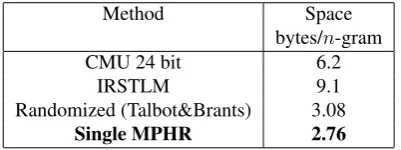
Table 4: Comparison between different language model storage representations all storing 8-bit quantized values and using 12 bit fingerprints for the random access meth-ods.
3.5. Storage Requirement
Using theHash, displace, and compress (CHD)algorithm, our hash function takes up2.07∗N bits for an N sized n-gram language model. Let us assume that theNsized n-gram model has a totalKdistinct frequencies counts. An N sized array is needed to store the bits needed to keep m-bitf ingerprintsanddlog2Kebits for the rank of each n-gram. Lastly, another Ksized array to store the actual frequency count or probability associated with eachn-gram (each being stored using say a 32 or 64 bit integer of size T). This array is very small compared to the other parts of the structure sinceKNand in a typically largen-gram language model its memory usage is insignificant. The total space requirement of our model can be calculated as shown in Equation 1. Table 3 and 4 show the bytes pern-gram re-quirement of our Single Minimal Perfect Hash Rank Model compared to other methods.
2.07×N MPH function
+(m+dlog2Ke)×N fingerprints+ranks
+K×sizeof(T) value array
= bits required
Equation 1: Calculating space requirements of the Single MPHR structure
To demonstrate this we storedn-grams and full frequency counts for the entire Google Web1T corpus (Brants and Franz, 2006). This corpus is 24.6GB compressed and con-tains over 3.7 billion n-grams, so storing full frequency counts for everyn-gram in a representation where they can be accessed quickly can be difficult. The Web1T corpus contains frequencies as large as 95 billion, so we would need at least 37 bits to store accurate counts for each n-gram. Using the RPH algorithm of Talbot and Brants (2008) with 37 bit values and 12 bit fingerprints would re-quire 7.53 bytes/n-gram, so we would need 26.63GB to store a model for the entire corpus.
In comparison, our Single Minimal Perfect Hash Rank method requires only 4.26 bytes per n-gram to store full frequency count information and so can store the entire cor-pus in just14.98GBor57%of the space required by the RPH method.
This savings is mostly due to the fact that we need only 20
bits pern-gram, instead of 37, to store theranksfor every n-gram frequency count in the corpus. We can apply the same rank array optimization to the RPH method, so that it would also use only 20 bits to storeranksand an addi-tional array to hold the actual frequency counts; this sig-nificantly reduces the amount of memory required, but our Single MPHR structure still uses 86% of the space required by the RPH approach.
4.
Tiered MPHR
We next describe our model can be elaborated into one that uses multiple hash stores to achieve even greater space effi-ciency. We go on to consider how this approach might pro-vide a basis for storing even larger language models within a distributed architecture.
4.1. Improving space efficiency
Although the Single MPHR approach achieves a signifi-cant improvement in space efficiency over previous meth-ods, there is still a considerable premium on achieving even more efficient space usage, given the size of current large language models and the larger ones that may be over the horizon. Our use of countranksto record count informa-tion may be seen as exploiting distribuinforma-tional characteristics of the data in achieving more compact storage, i.e. the fact that in the range up to the maximum count found in some data, many of the possible count values are not used, and so replacing actual counts with ranks allows them to be repre-sented using a much smaller numerical range.
FP5 FP FP1 FP3 FP2 FP FP4 ...
rank(key5) rank(key) rank(key1) rank(key3) rank(key2) rank(key) rank(key4) ...
key1 key2 key3 key4 key5 ... keyN
Minimal Perfect Hash Function
some of the values in the rank array are used for redirection
Array of K distinct frequency counts
f1 f2 f3 f4 f5 f6 f7 f8 f9 f10 f11 f12 ... fK
Minimal Perfect Hash Function Minimal Perfect Hash Function
rank(key) rank(key) ... rank(key) rank(key) rank(key) ... rank(key) Fingerprints are stored for all n-grams
Frequencies for ranks stored in top level MPHR
structure
Frequencies for ranks stored in second MPHR
structure
Frequencies for ranks stored in third MPHR
structure
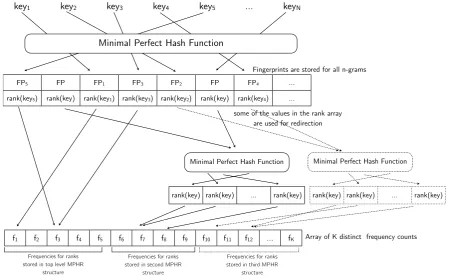
Figure 3: Tiered minimal perfect hash data structure
We will here explore an alternative approach to using multi-ple hashes that we callTieredMPHR, which entirely avoids the compounding of false-positive errors, and which limits the maximum number of looks up steps to 2, irrespective of how many hashes are used. In this approach, there is a singletop-levelMPHR which has the full set of n-grams for its key-set, and which stores a fingerprint for every n-gram. In addition, space is allocated to store rank values, but with some possible values of this store being reserved to indicateredirectionto othersecondaryhashes where count values can be found. Each secondary hash has a minimal perfect hash function that is computed only for then-grams whose values it stores. Secondary hashes do notneed to record fingerprints, as fingerprint testing is done in the top-level hash. For example, we might have a configuration of three hashes, with the top-level MPHR having 8-bit storage, and with secondary hashes having 10 and 20 bit storage re-spectively. Two values of the 8-bit store (e.g. 0 and 1) are reserved to indicate redirection to the specific secondary hashes, with the remaining values (2 . . 255) representing ranks 1 to 254. The 10-bit secondary hash can store 1024 different values, which would then represent ranks 255 to 1278, with all ranks above this being represented in the 20-bit hash. To look up the count for an n-gram, we begin with the top-level hash, where fingerprint testing can im-mediately reject unseenn-grams. For some seenn-grams, the required rank value is provided directly by the top-level hash, but for others a redirection value is returned, indicat-ing precisely the secondary hash in which the rank value will be found by simple look up (with no additional finger-print testing). Figure 3 gives a generalized presentation of the structure of two-level MPHRs. Let us represent a con-figuration for a two-level MPHR as a sequence of bit values
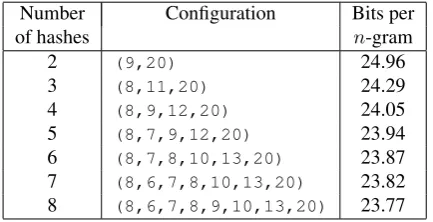
for their rank storage components, e.g. (8,10,20)for the example above, orH = (b1, . . . .bh)more generally. The overall memory cost of a particular configuration de-pends crucially on distributional characteristics of the data to be stored. In particular, for each rank value r, we need to know the proportion ofn-grams accounted for by ranks[1. . r], which we denoteµ(r), which is easily com-puted from the data. The top-level MPHR of a configu-rationH = (b1, . . . .bh)has alln-grams from the data in its key-set, so its memory cost is calculated as before as N ×(2.07 +m+b1) (where m is the fingerprint size). The memory cost for each secondary MPHR depends on the number ofn-grams it stores, which in turn depends on the range of ranks that it covers. For example, a secondary hash with storage size bi that covers ranks rj, . . , rk has N ×(µ(rk)−µ(rj−1))n-grams in its key-set and so has memory costN ×(µ(rk)−µ(rj−1))×(2.07 +bi). The range of ranks covered by a secondary hash depends on the hashes that precede it in the configuration sequence and the overall number of hashes. In a configuration withhhashes overall, the top-level MPHR must reserveh−1values for redirection, and so covers ranks[1. .(2b1 −h+ 1)]. The
second hash will then cover the next2b2 ranks, starting at (2b1−h+ 2), and so on.
in-InProceedings of ESCA Eurospeech 1997, pages 2707– 2710.
Marcello Federico and Mauro Cettolo. 2007. Efficient han-dling of n-gram language models for statistical machine translation. In StatMT ’07: Proceedings of the Second Workshop on Statistical Machine Translation, pages 88– 95, Morristown, NJ, USA. Association for Computa-tional Linguistics.
Edward Fredkin. 1960. Trie memory. Commun. ACM, 3(9):490–499.
Kimmo Fredriksson and Fedor Nikitin. 2007. Simple com-pression code supporting random access and fast string matching. InProc. of the 6th International Workshop on Efficient and Experimental Algorithms (WEA’07), pages 203–216.
Ulrich Germann, Eric Joanis, and Samuel Larkin. 2009. Tightly packed tries: How to fit large models into mem-ory, and make them load fast, too. Proceedings of the Workshop on Software Engineering, Testing, and Quality Assurance for Natural Language (SETQA-NLP 2009), pages 31–39.
Joshua Goodman and Jianfeng Gao. 2000. Language model size reduction by pruning and clustering. In Pro-ceedings of ICSLP’00, pages 110–113.
David Graff. 2003. English Gigaword. Linguistic Data Consortium, catalog number LDC2003T05.
Boulos Harb, Ciprian Chelba, Jeffrey Dean, and Sanjay Ghemawat. 2009. Back-off language model compres-sion. InProceedings of Interspeech, pages 352–355. Bo-June Hsu and James Glass. 2008. Iterative language
model estimation:efficient data structure & algorithms. InProceedings of Interspeech, pages 504–511.
F. Jelinek, B. Merialdo, S. Roukos, and M. Strauss I. 1990. Self-organized language modeling for speech recogni-tion. In Readings in Speech Recognition, pages 450– 506. Morgan Kaufmann.
Andreas Stolcke. 1998. Entropy-based pruning of backoff language models. InProceedings of DARPA Broadcast News Transcription and Understanding Workshop, pages 270–274.
Andreas Stolcke. 2002. SRILM - an extensible language modeling toolkit. In Proceedings of the International Conference on Spoken Language Processing, volume 2, pages 901–904, Denver.
David Talbot and Thorsten Brants. 2008. Randomized lan-guage models via perfect hash functions.Proceedings of ACL-08 HLT, pages 505–513.
David Talbot and Miles Osborne. 2007a. Randomised lan-guage modelling for statistical machine translation. In Proceedings of ACL 07, pages 512–519, Prague, Czech Republic, June.
David Talbot and Miles Osborne. 2007b. Smoothed bloom filter language models: Tera-scale LMs on the cheap. In Proceedings of EMNLP, pages 468–476.