The QALL-ME Benchmark:
a Multilingual Resource of Annotated Spoken Requests for Question Answering
Elena Cabrio
1, Milen Kouylekov
1, Bernardo Magnini
1, Matteo Negri
1,
Laura Hasler
2, Constantin Orasan
2, David Tom´as
3, Jos´e L. Vicedo
3,
G ¨unter Neumann
4, Corinna Weber
41FBK- irst
{cabrio, kouylekov, magnini, negri}@fbk.eu
2University of Wolverhampton
{L.Hasler, c.orasan}@wlv.ac.uk
3University of Alicante
{tomas, vicedo}@dlsi.ua.es
4DFKI
{neumann, cowe01}@dfki.de
Abstract
This paper presents the QALL-ME benchmark, a multilingual resource of annotated spoken requests in the tourism domain, freely available for research purposes. The languages currently involved in the project are Italian, English, Spanish and German. It introduces a semantic annotation scheme for spoken information access requests, specifically derived from Question Answering (QA) research. In addition to pragmatic and semantic annotations, we propose three QA-based annotation levels: theExpected Answer Type, theExpected Answer Quantifierand theQuestion Topical Targetof a request, to fully capture the content of a request and extract the sought-after information. The QALL-ME benchmark is developed under the EU-FP6 QALL-ME project which aims at the realization of a shared and distributed infrastructure for Question Answering (QA) systems on mobile devices (e.g. mobile phones). Questions are formulated by the users in free natural language input, and the system returns the actual sequence of words which constitutes the answer from a collection of information sources (e.g. documents, databases). Within this framework, the benchmark has the twofold purpose of training machine learning based applications for QA, and testing their actual performance with a rapid turnaround in controlled laboratory setting.
1.
Introduction
This paper presents the QALL-ME benchmark, a multilin-gual resource of annotated spoken requests in the tourism domain, freely available for research purposes. The QALL-ME benchmark is developed under the EU-FP6 QALL-QALL-ME project1which aims at the realization of a shared and
dis-tributed infrastructure for Question Answering (QA) sys-tems on mobile devices (e.g. mobile phones). Within this framework, our main motivation is to deliver a human-annotated resource for QA systems development and eval-uation.
Since the project deals with both textual and spoken re-quests, the annotation of the resource pays particular at-tention to the information needed in the QA and speech processing research areas. Annotation levels include both pragmatic and semantic annotations. Moreover, additional layers specifically referring to QA processing have been considered to fully capture the relevant information for more general applications. In particular, we introduced three QA-based annotation levels: Expected Answer Type, Expected Answer Quantifier, and Question Topical Target. To the best of our knowledge, none of the currently avail-able annotated corpora of spoken language dealing with in-formation requests contains QA specific labels. Therefore, our contribution aims at improving the proposed annotation
1
http://qallme.fbk.eu
schemes by considering specific information broadly and successfully exploited in QA. The benchmark currently in-cludes 14645 questions in four different languages (Italian, Spanish, English, and German), related to the domain of cultural events in a town (e.g. cinema, theatre, exhibitions, etc.).
The paper is structured as follows: Section 2 provides an overview of the QALL-ME benchmark as inserted in the project frame; Section 3 presents the data collection, with respect to the spoken language acquisition, the transcription and the translations of the data into English; Section 4 in-troduces the annotation layers, in particular the annotation of the speech acts; Section 5 presents the three QA-based annotation levels: the Expected Answer Type, the Expected Answer Quantifier and the Question Topical Target; Section 6 describes the annotation of the relations contained in the questions; Section 7 concerns related work; finally, Section 8 discusses future work and draws some conclusions.
2.
The QALL-ME Benchmark
# speakers males females non-native tot. speech dur. avg. utt. dur.
ITALIAN 161 68 93 12 9h 20’ 7”
SPANISH 150 109 41 8 16h 4’ 5.14”
ENGLISH 113 46 63 21 7h 35’ 6.1”
GERMAN 9 4 5 2 1h 21’ 4.9”
Table 1:Data acquisition features.
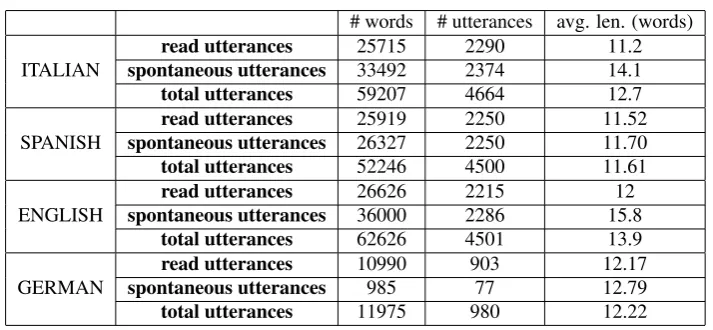
# words # utterances avg. len. (words)
ITALIAN
read utterances 25715 2290 11.2
spontaneous utterances 33492 2374 14.1
total utterances 59207 4664 12.7
SPANISH
read utterances 25919 2250 11.52
spontaneous utterances 26327 2250 11.70
total utterances 52246 4500 11.61
ENGLISH
read utterances 26626 2215 12
spontaneous utterances 36000 2286 15.8
total utterances 62626 4501 13.9
GERMAN
read utterances 10990 903 12.17
spontaneous utterances 985 77 12.79
total utterances 11975 980 12.22
Table 2:Features of the valid utterances in the collected database.
in Example 2. For non-request acts (utterances used by the speaker to introduce or contextualize the request), we use the labelGREETINGS,THANKS,ASSERT(usually referred to as “declarative clause” as in (Soria and Pirrelli, 1999)), andOTHER, which includes non request utterances such as “well”, “hallo”, and“listen”. To date, this level of anno-tation has been completed only for Italian (see (Cabrio et al., 2007)) and Spanish.
The inter-annotator agreement has been calculated for Ital-ian using the Dice coefficient, over 1000 randomly picked sentences annotated by two annotators. The Dice coef-ficient is computed as 2C/(A+B), where C is the num-ber of common annotations, while A and B are respec-tively the number of annotations provided by the first and the second annotator. The overall agreement is 96.1%, with the following label breakdown: ASSERT: 85.5%;DI
-RECT: 97.88%;GREETINGS: 99.49%;INDIRECT: 97.33%;
OTHER: 76.47%;THANKS: 98.51%.
Example 1: Speech acts (direct requests).
<direct>what is the name of the pharmacy located in via San Pio X 77 in Trento
</direct>
Example 2: Speech acts (indirect requests).
<greetings> good morning </greetings>
<indirect>I would like to know the address of the church of Santissima Trinita’ in
Trento </indirect> <thanks> thanks </thanks>
4.1. Speech Acts Annotation for the English section
For speech acts annotation on the English section of the QALL-ME benchmark, a slightly different scheme is ap-plied using the multipurpose annotation tool PALinkA
(Orasan, 2003). Labels such as GREETING, THANKING,
THANK-BYE andREQUEST-INFO are adapted from exist-ing speech acts theories and dialogue annotation projects (see, e.g. (Larsson, 1998) for an overview/comparison) to suit our data. First, utterances are marked as suitable (<utterance>) or unsuitable (<interrupted>, <trash>,
<nonsense>); then, C-units (Biber et al., 1999) are marked within suitable utterances. The C-UNIT tag takes the at-tributesCLAUSALandNON-CLAUSAL; NON-CLAUSAL is further split intoPRAGMATICandSPECIFY-INFO.
Next, the speech acts themselves are annotated. There are two general tags, PRIMARY SPEECH ACT and
SECONDARY SPEECH ACT, the attributes assigned to which determine the attribute given to the final tag,
SPEECH ACT TYPE, which is marked as a relation between the two Speech Acts tags. PRIMARY SPEECH ACT can take any of the attributes REQUEST, QUESTION, STATE,
INTRODUCE,END, depending on the surface form. As we are concerned with requests/questions requiring a response, only primary Speech Acts which are labelled asREQUEST,
QUESTION,STATEare assigned a secondary speech act tag. The attributes ofSECONDARY SPEECH ACTareREQUEST,
QUESTION,STATE, depending on the underlying, or ’real’ function of the utterance (e.g., a statement or a question can function to request information). SPEECH ACT TYPE
isDIRECTif the primary and secondary Speech Acts take the same attribute, andINDIRECTif they do not (as shown in Example 3).
Example 3: Speech acts .
<clausal><question><request><indirect> would you be able to tell me
number of questions in the Cinema/Movie domain 367
number of possible relations 12
average relations per question 2.43
min relations per question 1
max relations per question 6
Table 3:Annotation of relations in the Italian Cinema/Movie questions
These include relations such as HASDATE(EVENT,DATE), ISINDESTINATION(SITE,DESTINATION), and HASPHO
-NENUMBER(SITE,PHONENUMBER), which respectively connect an event (e.g. of the type MOVIE, CONCERT, MATCH, etc.) and the site (e.g. of the type CINEMA, MU
-SEUM, PHARMACY, etc.) where it takes place, a site and the city where it is located, and a site and its telephone num-ber. As an example, the relation HASDATE(MOVIE,DATE) represents a relation which has MOVIE as domain and DATEas range. Possible lexicalizations of the relation are:
• “when will Eragon be on in Trento”
• “what is the name of the director of dreamgirls today at Nuovo Roma cinema”
• “which dramatic movie directed by Gabriele Muccino is now showed”
As can be seen from the previous examples (specifically the first and the second) relation annotation is related to EAT annotation, with partial overlaps. Often, in fact, the EAT of a question (e.g. TIME) can be mapped to the range of one of the annotated relations (e.g. STARTINGHOUR).
In the current version of the QALL-ME benchmark around 10% of the Italian questions (367 out of 3289), namely those referring to the Cinema/Movie domain, have been annotated with the 12 (out of 75) relations that hold in such domain. Even though this is a relatively small subset of the whole benchmark, it’s worth noting that all the relations annotated for a specific question are portable across languages, being our translations strictly literal. As an example, all the translations of the Italian question “what is the name of the director of 007 Casino Royale on today at cinema Modena”can be assigned to the three relations:
HASDATE(MOVIE,DATE)
HASMOVIESITE(MOVIE,CINEMA) HASDIRECTOR(MOVIE,DIRECTOR).
Table 3 provides some relevant figures about the annotation completed to date.
A Kappa value of 0.94 (almost perfect agreement) was measured for the agreement between two annotators over the same dataset, showing that relation annotation, at least in the Cinema/Movie domain, is a well defined task.
7.
Related Work
In recent years, a number of research projects supported spoken dialogue annotation at different levels, with the pur-pose of creating language, domain, or task-specific bench-marks. Depending on the specific developers’ purposes, the
proposed annotation schemes cover a broad variety of in-formation, ranging from the syntactic to the semantic and pragmatic level.
Released in the nineties, the ATIS and TRAINS corpora7
are collections of task-oriented dialogues in relatively sim-ple domains. The former contains speech data related to air travel information, and is partially annotated (2,900 out of a total of 7,300 utterances) with reference answers, and a classification of sentences intoi)those dependent on con-text for interpretation, ii) those whose interpretation does not depend on context, and iii) the not evaluable ones. The latter includes 98 dialogs (6,5 hours of speech, 55,000 transcribed words), dealing with routing and scheduling of freight trains. Utterances are annotated with dialogue acts (or “Communicative Functions”) including, among oth-ers, the types INFO-REQUEST, EXCLAMATION, EXPLICIT
-PERFORMATIVE, and ANSWER.
More recently, the VERBMOBIL project (http://verbmobil.dfki.de) on speech-to-speech transla-tion released large corpora (3,200 dialogs, 181 hours of speech, 1,520,000 running words) for German, English, and Japanese. Part of such material (around 1,500 dialogs) is annotated with different levels of information including: orthography, segmentation, prosody, morphology and POS tagging, semantic and dialog acts annotation. The latter annotation level has been carried out considering a hierarchy of 32 dialog acts such as GREET, THANK, POLITENESSFORMULA, and REQUEST.
Spoken dialogue material collected within the MATE project8 refers to any collection of spoken dialogue data (human-human, human-machine), including not only speech files, but also log-files or scenarios related to spoken dialogue situations. The annotation levels in-clude prosody, morpho-syntax, co-reference, communica-tion problems, and dialogue acts (e.g. OPENING, ASSERT, INFO REQUEST, ANSWER).
Finally, the ongoing project LUNA (http://www.ist-luna.eu) is developing a multilingual and multidomain spo-ken language corpus, with the transcription and the seman-tic annotation of human-human and human-machine spo-ken dialogs collected for different application domains (call routing, travel information) and languages (French, Italian and Polish). At present, the completed annotation layers concern the argument structure, co-reference/anaphoric re-lations, and dialog acts.
Even though the proposed annotation schemes proved to be suitable for specific information access systems, we believe that additional layers referring to QA processing should
7
http://www.ldc.upenn.edu/Catalog
8
audio transcr. transl. speech acts EAT Sekine EAT ontol.
ITALIAN X X X X X X
SPANISH X X X X X May 08
ENGLISH X X – April 08 April 08 April 08
GERMAN June 08 June 08 undefined undefined undefined undefined
Table 4:Present situation and tentative scheduling of the availability of the resource.
be considered to fully capture the relevant information for more general applications.
8.
Conclusions and Future Work
This paper presented the QALL-ME benchmark, a multi-lingual resource (for Italian, Spanish, English and German) of annotated spoken requests in the tourism domain. The benchmark takes into account the importance of annotation layers specifically referring to the QA area.
The present situation is summarized in Table 4. Accord-ing to the QALL-ME project agenda, the above mentioned annotation layers will be completed, for all languages in-volved, during the second year of the project (due to tech-nical problems, the scheduling of the availability of the resource for German is still undefined). Additional lay-ers will be considered in the future: these include Multi-words, Named Entities, and normalized Temporal Expres-sions. The expected result is a reference resource, useful to train and test information access models not limited to QA.
9.
Acknowledgements
The present work has been partially supported by the QALL-ME EU Project - FP6 IST-033860 (http://qallme.fbk.eu).
10.
References
Douglas Biber, Stig Johansson, Geoffrey Leech, Susan Conrad, and Edward Finnegan. 1999. Longman gram-mar of spoken and written english. InTechnical report, Longman, Harlow.
Elena Cabrio, Bonaventura Coppola, Roberto Gretter, Milen Kouylekov, Bernardo Magnini, and Matteo Negri. 2007. Question answering based annotation for a corpus of spoken requests. InProceedings of the workshop on the Semantic Representation of Spoken Language, Sala-manca, Spain, November.
A.C. Graesser, K. Lang, and D. Horgan. 1988. A taxon-omy for question generation.Questioning Exchange. Staffan Larsson. 1998. Coding schemas for dialogue
moves. In Technical report, G¨oteborg University, De-partment of Linguistics.
Christof Monz. 2003. From Document Retrieval to Ques-tion Answering. Ph.D. thesis, University of Amsterdam. Matteo Negri, Milen Kouylekov, and Bernardo Magnini. 2008. Detecting expected answer relations through tex-tual entailment. InProceedings of Cicling 2008, Haifa, Israel, February.
Constantin Orasan. 2003. PALinkA: A highly customis-able tool for discourse annotation. In4th SIGdial Work-shop on Discourse and Dialogue, ACL’03, Sapporo, Japan, July.
John Prager. 2007. Open-Domain Question-Answering. In Foundations and Trends in Information Retrieval. Now Publishers.