Propbank Instance Annotation Guidelines
Using a Dedicated Editor, Jubilee
Jinho D. Choi, Claire Bonial, Martha Palmer
University of Colorado at BoulderBoulder, CO 80302, USA
[email protected], [email protected], [email protected]
Abstract
This paper gives guidelines of how to annotate Propbank instances using a dedicated editor, Jubilee. Propbank is a corpus in which the arguments of each verb predicate are annotated with their semantic roles in relation to the predicate. Propbank annotation also requires the choice of a senseIDfor each predicate. Jubilee facilitates this annotation process by displaying several resources of syntactic and semantic information simultaneously: the syntactic structure of a sentence is displayed in the main frame, the available senses with their corresponding argument structures are displayed in another frame, all available Propbank arguments are displayed for the annotators choice, and example annotations of each sense of the predicate are available to the annotator for viewing. Easy access to each of these resources allows the annotator to quickly absorb and apply the necessary syntactic and semantic information pertinent to each predicate for consistent and efficient annotation. Jubilee has been successfully adapted to many Propbank projects in several universities. The tool runs platform independently, is light enough to run as an X11 application and supports multiple languages such as Arabic, Chinese, English, Hindi and Korean.
1.
Introduction
Jubilee is a Propbank instance editor developed at the Uni-versity of Colorado at Boulder. Propbank is a corpus in which the arguments of each verb predicate are annotated with their thematic roles (Palmer et al., 2005). In addi-tion, each predicate is annotated with its sense ID, alter-natively referred to as a roleset or frameset ID. All the Propbank annotations are done on top of the Penn Tree-bank style phrase structure (Marcus et al., 1993). For each verb predicate found in every tree of a corpus, we create a Propbank instance that consists of the predicate’s sense
ID(e.g.,run.02) and its arguments labeled with numbers corresponding to thematic roles (e.g.,ARG0,ARG1). The argument structure of each individual predicate is outlined in its corresponding frameset file (e.g., run.xml). If a tree contains more than one verb predicate, several Prop-bank instances are generated from the tree. Table 1 shows an example of a Propbank instance associated with a verb predicate, ‘run’.
E.g. Johnranthe Boston Marathon.
ID run.02(‘walk quickly, a course or contest’) ARG0 John (‘runner’)
ARG1 the Boston Marathon (‘course, race, distance’)
Table 1: Propbank instance associated with ‘run’
Prior to annotation, instances that are neither sense-tagged nor annotated are grouped by different predicates and formed into tasks. Each task is double-annotated and sub-sequently adjudicated; during the adjudication process, the annotation that is the most appropriate is selected for the gold standard. If neither annotation is appropriate, adjudi-cators may correct the annotation of the instance.
In the past, this procedure was done using several dif-ferent tools. First, an annotator would claim a task using a command-line tool. Each task could be claimed by only a
certain number of annotators, generally two, to prevent an-notation of the same task by more annotators than intended. After claiming a task, the annotator would start annotation using a different tool with aGUI. Using this tool, the anno-tator could view the tree structure of each instance in par-enthetical notation. However, visualizing the constituent boundaries and selecting the appropriate node for an argu-ment was often very difficult for annotators with less ex-pertise in this format. Furthermore, the tool did not support information from frameset files, which must be consulted for the appropriate annotations. Once the task was com-pletely double-annotated, an adjudicator would adjudicate the annotations using the same tool; however, the adjudica-tor would subsequently use another tool to denote the verb sense of each instance. Thus, three different tools were re-quired to create one Propbank instance. Although each tool worked effectively on its own, using several tools for one task not only decreased the efficiency of the project, but also required another process of checking if all tools were used properly. This motivated the creation of a new annota-tion tool, Jubilee, which can do all of the above and more.
With Jubilee, the entire annotation procedure can be done using one tool that simultaneously provides rich syn-tactic information as well as comprehensive semantic infor-mation. More importantly, the use of Jubilee ensures that all the annotations are saved in one place using one uni-fied format, the lack of which had been a delaying factor when using other tools. Moreover, this makes data mainte-nance much easier and more consistent. The tool is highly adaptable such that creating a new Propbank project from a different corpus is as easy as editing a simple text file.
accommo-dates several different languages; in fact, it has been used for Propbank projects in Arabic (M.Diab et al., 2008), Chi-nese (Xue and Palmer, 2009), English (Palmer et al., 2005), and has been tested in Hindi and Korean (Han et al., 2002). This paper details how to annotate Propbank instances using Jubilee. There are two modes in which to run Ju-bilee: normal and gold mode. In normal mode, annota-tors are allowed to view and edit only tasks that have been claimed by themselves or by one other annotator. In gold mode, adjudicators are allowed to view and edit all tasks that have undergone at least single-annotation. Annotators and adjudicators are expected to run Jubilee in normal and gold mode, respectively. Although there are two different modes, the interfaces are very similar, so learning one mode effectively teaches the other.
2.
How to obtain Jubilee
Jubilee is available as an open source project on Google code.1 The webpage gives detailed instructions of how to download, install and launch the tool (Choi et al., 2009).
3.
Jubilee in normal mode
Annotators are expected to run Jubilee in normal mode. In normal mode, annotators are allowed to view and edit only tasks claimed by themselves or one other annotator when the max-number of annotators allowed is two. Jubilee gives the option of assigning a different max-number of annota-tors as well.
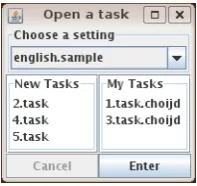
When you run Jubilee in normal mode, you will see an open-dialog (Figure 1). There are three com-ponents in the open-dialog. The combo-box at the top shows a list of all Propbank projects. Once you select a project (e.g., english.sample), both[New Tasks] and[My Tasks]will be updated.[New Task]shows a list of tasks that have either not been claimed, or claimed by only one other annotator.[My Tasks]shows a list of tasks that have been claimed by the current annotator.
Figure 1: Open-dialog
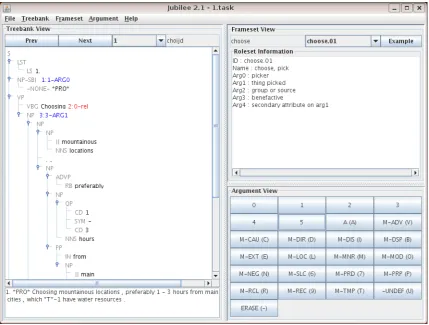
Once you choose a task and click the[Enter]button, Ju-bilee’s main window will be prompted (Figure 5). There are three views available in the main window: the treebank view, frameset view and argument view. The following sec-tions explain how each view is used for Propbank annota-tion.
3.1. Treebank view
By default, the treebank view shows the first tree in the selected task. Each node in the tree consists of two
ele-1http://code.google.com/p/propbank/
ments: POS-tag and word-token. Upon annotation, a Prop-bank argument label is added to each node constituting an argument of the selected predicate. The verb predicate is marked with a special tag ‘rel’. The text-box on the right shows the user ID indicating the user annotating this in-stance. The text-box at the bottom shows the raw sentence of the tree.
Figure 2: Treebank view
3.2. Frameset view
The frameset view displays and allows the annotator to choose the sense of the predicate with respect to the current tree. The predicate text-box on the left shows the lemma of the predicate associated with the selected roleset.2 The roleset combo-box at the middle gives the full list of role-setIDs associated with the predicate lemma. As a roleset is selected, a short definition of the roleset as well as its generalized argument structure appear in the roleset infor-mation pane. To view annotation examples of the currently selected roleset, click the[Example]button.
Figure 3: Frameset view
3.3. Argument view
The argument view contains buttons representing each of the Propbank argument labels. To annotate an argument (e.g., ARG0), select the node to be annotated in the tree-bank view, then click the corresponding argument button (e.g.,[0]). When you click the button, the argument label
2The term ‘roleset’ is interchangeable with a term ’frameset’
Figure 5: Jubilee’s main window
Thus, each of the described operators assists annotators in capturing the appropriate semantic information given cer-tain syntactic constraints.
3.5. Verb particle constructions
Some English verbs use particles to form their predicate lemmas (e.g., ‘run out’, ‘run up’). For such verb particle constructions, the particle is concatenated with the verb to form a single predicate lemma, annotated with the ‘rel’ (‘relation’) tag. To concatenate the particle, choose the par-ticle node and type Ctrl+Shift+/. The resulting rel annotation will reflect the locations of both the original predicate and the concatenated particle. Note that if the an-notator accidentally erases thereltag on any verb, it can be recovered using the same shortcut,Ctrl+Shift+/, on the verb.
4.
Jubilee in gold mode
Adjudicators are expected to run Jubilee in gold mode. In gold mode, adjudicators are allowed to view and edit all tasks that have undergone at least single-annotation. When you run Jubilee in gold mode, you will see the same open-dialog as you saw in Figure. 1. The[New Tasks]shows a list of tasks that have not been adjudicated and the[My Tasks]shows a list of tasks have been adjudicated. Gold mode does not allow adjudicators to open tasks that have not been at least single-annotated.
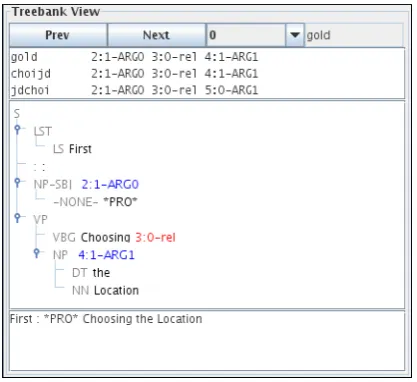
Once you launch Jubilee in gold mode, you will see al-most the same main window as in Figure 5, except there
will be a list showing all annotations for the currently se-lected instance at the top of the treebank view (Figure 6). The first line shows the annotation done by the adjudicator, and the following lines show annotations done by differ-ent annotators. By default, the first annotation is chosen as gold. The adjudicator can choose an alternate annota-tion by clicking on the other annotaannota-tion. The treebank view dynamically changes to reflect the selected annotation. Ju-bilee also gives an option of skipping instances for which all annotations are the same, thereby quickening the pace of adjudication. To modify the annotation in cases where neither is perfectly correct, the adjudicator can simply ma-nipulate the arguments as described for the normal mode.
5.
Software demonstration
demon-Figure 6: The treebank view in gold mode
strating that having each of these labels clearly visible helps the annotator to remember and evaluate the appropriateness of each possible argument label. Finally, we will show how intuitive it is to adjudicate the annotations in gold mode.
6.
Advantages and future work
Jubilee has drastically simplified and streamlined the Prop-bank annotation process because what was once done with three separate tools can now be completed with one. This has several distinct advantages. First, it speeds up the entire process of annotation and adjudication because argument annotation and the choice of a senseID(roleset or framesetID) for the verb can be completed simultaneously. This also ensures that annotators have a greater awareness of the ar-gument structure and semantics of the predicate as defined in the frameset file. Thus, annotators can quickly and ef-ficiently familiarize themselves with a predicate and apply that knowledge consistently to each instance. Additionally, Jubilee’s treebank view gives the annotator a more effective visual representation of the syntax of each instance than the previous parenthetical notation, clarifying the relationship between the argument structure found in the frame and that of the individual instance. Finally, the use of one tool sim-plifies data maintenance because one unified file format can be used throughout the process.
Jubilee has been successfully adapted to Propbank projects in several universities such as the University of Colorado at Boulder, the University of Illinois at Urbana-Champaign, and Brandeis University. We will continuously develop the tool by improving its functionalities through user-testing and feedback, and also by applying it to more languages.
Acknowledgments
Special thanks are due to Professor Nianwen Xue of Bran-deis University for his very helpful insights, as well as Scott Cotton, the developer of RATS and Tom Morton, the de-veloper of WordFreak, both previously used for PropBank annotation.
We also gratefully acknowledge the support of the Na-tional Science Foundation Grants CISE-CRI-0551615,
To-wards a Comprehensive Linguistic Annotation and CISE-CRI 0709167, Collaborative: A Multi-Representational and Multi-Layered Treebank for Hindi/Urdu, and a grant from the Defense Advanced Research Projects Agency (DARPA/IPTO) under the GALE program, DARPA/CMO Contract No. HR0011-06-C-0022, subcontract from BBN, Inc. Any opinions, findings, and conclusions or recommen-dations expressed in this material are those of the authors and do not necessarily reflect the views of the National Sci-ence Foundation.
7.
References
Jinho D. Choi, Claire Bonial, and Martha Palmer. 2009. Jubilee: Propbank instance editor guideline (version 2.1). Technical report, Institute of Cognitive Science, the University of Colorado at Boulder.
C. Han, N. Han, E. Ko, and M. Palmer. 2002. Korean treebank: Development and evaluation. InProceedings of the 3rd International Conference on Language Re-sources and Evaluation.
Mitchell P. Marcus, Mary Ann Marcinkiewicz, and Beat-rice Santorini. 1993. Building a large annotated corpus of english: The penn treebank. Computational Linguis-tics, 19(2):313–330.
M.Diab, A.Mansouri, M.Palmer, O.Babko-Malaya, W Za-ghouani, A.Bies, and M.Maamouri. 2008. A pilot arabic propbank. InProceedings of the 7th International Con-ference on Language Resources and Evaluation. Martha Palmer, Daniel Gildea, and Paul Kingsbury. 2005.
The proposition bank: An annotated corpus of semantic roles.Computational Linguistics, 31(1):71–106. Nianwen Xue and Martha Palmer. 2009. Adding semantic