International Journal of Scientific Research in Computer Science, Engineering and Information Technology © 2017 IJSRCSEIT | Volume 2 | Issue 4 | ISSN : 2456-3307
Bayesian Multi-Scale Optimization For Software Cost
Estimation
Somaraju Mouli*1, Dr. Merajothu Chandra Naik2 1Research Scholar, Dept. of CSE, Andhra Pradesh, India
2Professor, Department of CSE, Sri Indu Institute of Engineering & Technology, Hyderabad, Telangana, India
ABSTRACT
Software Cost Estimation is very important challenging task for completing the project successfully. The estimation in software development depends on various factors particularly managing project cost, time and quality and effort factors. Therefore, accurate assessment is a consequential factor in projects success and reducing the risks. In the last two decades, many researchers and practitioners presented statistical and machine learning-based models for software effort estimation. In this paper, a novel approach based Bayesian multi-class algorithm is proposed for software cost estimation. It helps project manager to provide nimble and realistic estimate for the project effort and development time that in turn gives software cost. The proposed work is carried in two steps, in first phase known as training phase, optimizing the parameters and second step known as validating phase, the prediction process. The Parameters SSE, RME, MAD and R2are calculated for COCOMO-II dataset. Statistical results show that our method could significantly improve accuracy, error minimization and has potential to become an effective method for software cost estimation.
Keywords: Software Cost Estimation, Bayesian multi-class algorithm, COCOMO-II, SSE, RME, MAD.
I.
INTRODUCTION
Software development has become an essential activity for many modern organizations. In fact the quality, cost, and timeliness of developed software are often crucial elements of an organization’s success. Effort assessment of software development has been a critical task for software engineering community. The global software market has grown exponentially over the past decade. Significantly, the cost of developing software has grown. The main idea behind increasing trend in the software costs is the employment intensive nature of the software development process. To manage software projects effectively, it is important to have accurate assessments of cost and effort involved in software development. The number of project deficiencies and the cases of cost and schedule overwhelm have been a significant issue for software project managers.
Poor estimates not only led projects to exceed budget and go overscheduled but also in many cases to be terminated entirely. Software cost assessment is the set of techniques and procedures that organizations use to arrive at an estimate for proposal request, project planning and probability estimates. Accurate assessment means better planning and proficient use of project resources such as cost, duration and effort requirements for software projects. Efficient software development effort estimation is one of the most demanding tasks in software industry. Unfortunately software industry suffers from the crisis of inaccurate estimate for projects and in many cases inability to set exact release date, leads to low quality of delivered product.
with project complexity and hence accurate cost estimates are highly desired during the early stages of development. A major problem of the software cost estimation is first obtaining an accurate size estimate of the software to be developed. An important objective of the software engineering community is to develop useful models that constructively give the details of software development life cycle and accurately estimate the cost of software development. In order to develop software effectively in competitive and complex environment many organizations use software metrics as a part of their project development. In this paper, a novel approach based Bayesian multi-class algorithm is proposed for software cost estimation. It helps project manager to provide nimble and realistic estimate for the project effort and expansion time that in turn gives software cost [11].
The Paper is organized in following manner: section 1 describes introduction, sections 2 and 3 presents related work and software cost estimation process. Proposed work, results and discussion is described in section4 and 5. Section 6 ends the paper with a conclusion.
II.
RELATED WORK
The most frequently used methods for predicting software development effort have been based on linear-least-squares regression such as COCOMO. As such, the models have been extremely susceptible to local variations in data points. In addition, the models have failed to deal with implicit
nonlinearities and interactions between the
characteristics of the project and effort. In recent years, a number of alternative modeling techniques have been proposed and they consist of artificial neural networks, analogy based reasoning, regression trees and rule induction models. Gray and MacDonnell applied fuzzy logic to software metric models for enhancement effort estimation[10]. They outlined the use of fuzzy logic for define software metrics as linguistic variables and for modeling
processes. They made comparison of results obtained from a basic fuzzy inference system with other techniques such as linear regression and neural network techniques and found that it outperformed them well. He also described a simulation-based study on the performance of these experiential modeling techniques using size and effort software metric dataset and observed that M-estimation regression outperformed of every parametric and non-parametric techniques. Xu and Khoshgoftaar presented an innovative fuzzy identification software cost estimation modeling technique, which is an advanced fuzzy logic technique that integrates fuzzy clustering, space projection, fuzzy inference and defuzzification [1]. Based on their case study on the COCOMO’81 database it was observed that the fuzzy recognition model provided significantly better cost estimations.
Many of Machine Learning (ML) techniques in the literature have been applied to progress the software effort estimation. ML optimization algorithms that are encouraged from nature have received much awareness to find more truthful estimation for software effort. Nature-encouraged ML algorithms include Cuckoo Search, Particle Swarm Optimization (PSO), Bat Algorithm, Firefly Algorithm, and many others. The following are Research papers reviewed for this study.
software enhancement depends on cost estimation. There are various budget assessment techniques to compute cost of the development and Function point analysis (FPA) is the technique of calculating the dimension of software. The benefit is that it can avoid source code error when selecting dissimilar programming languages. Shivani Sharma, Aman Kaushik, AbhishekTomar proposed a model for computing budget of project based on Top down method. The whole process will be done by Ant colony optimization algorithm. To compare and evaluate the outcomes of the proposed algorithm with K Modes algorithm and RF model and it has been noticed that when we have compared with K modes and RF model then proposed work gives better results [3]. Software development effort estimation is treated a fundamental task for software development life cycle as well as for managing project cost, time and quality. In recent years, software effort estimation has received a considerable amount of concentration from researchers and became a challenge for software industry.
III.
SOFTWARE COST ESTIMATION PROCESS
Cost estimation is a prediction method to get close result of necessary cost. It includes the process of considering the necessary cost, experiences, time constraints, risks, schedules, resources and other elements related to the expansion of a project. Hence, cost estimation is vital in managing a project mainly to the project manager when proposing budget for assured project. In software development a broadly used term is “software project estimation” where its task is to calculate the estimation procedure [9]. Cost estimation is the determination of abundance and predicting or forecasting within a clear scope of the costs requisite to construct and equip a facility to constructer goods or to furnish a service. These costs are included assessments and a valuation of risks and uncertainties. A cost estimation process considers and determines utilized experience by professional, calculating and forecasting the future cost of
resources and schedule for any project development. It provides input to unique baselines and changes the baselines against cost comparisons right through a project. It is performed at a sure point based on the obtainable information at a certain time. Normally, it includes cost estimation details, a cost estimation review, basis of estimation which describes the project information, estimation methodologies, type of cost estimation together with risk, cost driven, cost adjustment and so on. In software life cycle, there are many decision situations involving limited resources in which software engineering techniques offer useful assistance. To provide a feel for the environment of these economic decision issues, the following example is given below for the major phases in the software life cycle [8].
Feasibility Phase: How much should one spend in information system analyses (user questionnaires interviews, current-system analysis, workload characterizations, simulations, and scenarios, prototypes) in order to obtain convergence on an appropriate definition and concept of operation for the system to be implemented? Plans and Requirements Phase: How rigorously should necessities to be specified?
Product Design Phase: Should developers arrange software to create possible to use a complex piece of existing software which usually but not totally meets requirements? Programming Phase: Given a selection between three data storage and recovery schemes which are primarily execution time-efficient, storage-efficient, and easy-to-modify, respectively. The actual cost estimation process involves seven steps:
Set up cost-estimating objectives.
Generate a project plan for required data and assets.
Pin down software necessities.
Use several independent cost assessment techniques to capitalize on their combined strengths
Compare different estimates and iterate the estimation process.
Once the project has started, monitor its actual cost and progress, and feedback results to project management
For an effective management accurate assessment of various measures is a must. With accurate estimation managers can manage and manage the project more efficiently and effectively. Project assessment may involve the following:
Software size estimation: Software size may be estimated either in terms of KLOC (Kilo Line of Code) or by calculating number of function points in the software.
Effort estimation: The managers estimate efforts in terms of personnel requirement and man-hour required to construct the software.
Time estimation: Once size and efforts are estimated, the time required to construct the software can be estimated. The sum of time required to complete all tasks in hours or days is the total time invested to complete the project. Cost estimation: This might be considered as the most difficult of all because it depends on more elements than any of the previous ones.
Figure 1. Software Cost Estimation Process
IV.
PROPOSED WORK
The Bayesian optimization construction has two key factors. The first factor is a probabilistic model, which consists of a prior distribution that
confiscation our beliefs about the performance of the unknown objective function and a scrutiny model that describes the data generation mechanism [7]. The second factor is a loss function that describes how optimal sequences of queries are; in practice, these loss functions often take the form of regret, either simple or cumulative. Ideally, the predictable loss is then minimized to select an optimal sequence of queries. After observing the result of each query of the objective, the prior is updated to produce a more informative posterior distribution over the space of objective functions. The proposed algorithm is called the Bayesian optimization algorithm (BOA) [4]. The permutation of prior information and the set of promising solutions is used to estimate the distribution. Prior information about the structure of a problem as well as the information represented by the set of high-quality solutions can be incorporated into the algorithm. The ratio between the prior information and the information acquired during the run used to generate new solutions can be controlled.
The pseudo-code of the BOA follows:
(1) Set i ← 0 randomly generate initial population F (0)
(2) Select a set of promising strings G (i) from F (i) (3) construct the network A using a chosen metric and constraints
(4) generate a set of new strings H (t) according to the joint distribution encoded by A
(5) Create a new population F (t+1) by replacing some strings from F (t) with H (t) set i ← i + 1. (6) If the termination criteria are not met, go to (2)
Bayes methods can be trained very efficiently and Bayes’ theorem is used for calculating conditional probabilities. The conditional Probability that an event ' ' will occur, given that ' ' has occurred is denoted by the symbol P (A/B) and is defined as by P ( / ) = ; P ( ) >0 (5.1)
probability of ' ' and the conditional Probability of ' ' on the assumption that ' ' occurred.
i.e. P ( ∩ ) =P ( ). P ( / ) =P (C). P ( / ) (5.2)
From (1) & (2) P ( / ) = P ( ). P (C / ) / P( ). (5.3)
If (C ∩ ) and (C ∩ ') are mutually exclusive events then by axiomatic definition
P (C) = P (D) .P ( / ) + P (D ') .P (C / ') (5.4)
From (3) & (4) P (C / ) =
(5.5)
If D 1, D 2, D 3…... D n are ' n' mutually exclusive events of which one of the event occur then,
P (C) = ∑ . P (C / Di)
From (3) P (C /D) = ∑
(5.6)
Bayes’ theorem provides a way of calculating the posterior probability, P(C / ) from P(D), P(D /CD) and P(C).
The main advantage of Bayes optimization is that it only craves a small amount of training data to estimate the parameters necessary for classification. It also show high accuracy and speed when applied to large databases. The step-by-step procedures used for Software cost estimation based on Bayesian optimization algorithm are [6]:
Algorithm: Pseudo code of Bayesian optimization Task: Software cost estimation based on Bayesian optimization algorithm
Parameter: COCOMO-II data set and Bayesian classifier.
Methodology: 1: i = 1
2: while samples available do
3: Update the expressions for the sufficient statistics of the posterior distribution using the available data D1:i.
4: Find xi+1 by minimizing the expected deviation from the maximum. The expectation is taken with respect
To the posterior distribution P(fjD1:n). 5: Calculate the objective function, g(xi+1)
6: Enhance the data G1: i+1 = g (G1: i; (yi+1; g (yi+1)) h
7: i = i + 1 8: end while
Output: Statistical results show that our method
could significantly improve accuracy, error
minimization and has potential to become an Effective method for software cost estimation.
V.
RESULTS AND DISCUSSIONS
Table 1. A model report with training and validation sets
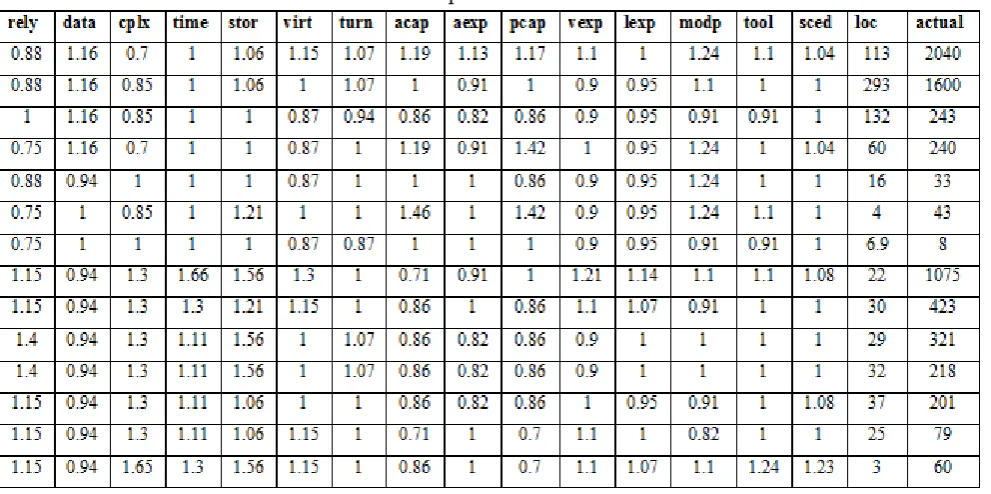
Table 2. A Sample COCOMO-II dataset
The following 5.1 shows Plots the actual versus the predicted response, Available only for continuous responses. The predicted value for the observations in each leaf is the average response. The plot is divided into three sections, corresponding to the three leafs. These predicted values are shown on the
plot with black lines. The points are put into random horizontal positions in each section. The vertical position is based on the response produces a plot of actual values by predicted values. This is for continuous responses only.
Bayesian Optimization Algorithm
S.No Parameters Training Phase Validation Phase
1 RMSE 0.16126 0.20164
2 SSE 1.09221 0.85382
3 MAD 0.12284 0.15098
4 SF 42 21
The following figure 5.2 shows Plots the residuals versus the predicted responses.
VI.
CONCLUSION
The accurate and reliable cost estimation is very crucial task for software project development. The estimation in software development depends on various factors particularly managing project cost, time and quality and effort factors. Therefore, accurate assessment is a consequently factor in projects success and reducing the risks. Researchers have developed various models for assessment but there is no estimation method which can present the best estimates in all cases and each technique can be suitable in the special project. In this paper, a novel approach based Bayesian multi-class algorithm is proposed for software cost estimation. It helps project manager to provide nimble and realistic cost estimation. The proposed work is carried in two steps, in first phase known as training phase, optimizing
the parameters and second step known as validating phase, the prediction process. The Parameters SSE, RME, MAD and R2are calculated for COCOMO-II dataset. Statistical results show that our method
could significantly improve accuracy, error
minimization and has likely to become an efficient method for software cost estimation.
VII.
REFERENCES
[1]. Isa Maleki1 and Laya Ebrahimi," ANALYSIS OF SOFTWARE COST ESTIMATION USING FUZZY LOGIC", International Journal in
Foundations of Computer Science &
Technology (IJFCST), Vol.4, No.3, May 2014. [2]. Oliveira, A.L.I., Braga, P.L., Lima, R.M.F. and
Software Technology, 52, 1155-1166. http://dx.doi.org/10.1016/j.infsof.2010.05.009.
[3]. Aman Kaushik and AbhishekTomar,"
Proposing an Enhanced Artificial Neural Network Prediction Model to Improve the Accuracy in Software Effort Estimation" DOI: 10.14445/22315381/IJETT-V37P212, July 2016. [4]. https://www.mathworks.com/help/stats/bayesia
n-optimization-algorithm.html
[5]. Genetic Algorithm for Optimizing Neural Network Based Software Cost Estimation Tirimula Rao Benala, Computing, Volume 7076 of the series Lecture Notes in Computer Science pp 233-239.
[6]. A New Approach for Software Cost Estimation with Hybrid Genetic Algorithm and Ant Colony Optimization Isa Maleki,Ali Gaffer,and Mohammad Masdari, International Journal of Innovation and Applied Studies ISSN 2028-9324 Vol. 5 No. 1 Jan. 2014, pp. 72-81 2014.
[7]. Software Cost Estimation using Hybrid
Algorithm Shivani Sharma,Aman
Kaushik,Abhishek Tomar International Journal of Engineering Trends and Technology (IJETT)-Volume 37 Number 2- July 2016. [8]. Optimizing Software Effort Estimation Models
Using Firefly Algorithm, Nazeeh Ghatasheh, Hossam Faris, Ibrahim Aljarah, Rizik M. H. Al-Sayyed, Journal of Software Engineering and Applications, 2015, 8, 133-142 Published Online March 2015 in SciRes.
[9]. Novel Meta-Heuristic Algorithmic Approach for Software Cost Estimation, Ruchi Puri, Iqbaldeep kaur, International Journal of Innovations in Engineering and Technology (IJIET), Volume 5 Issue 2 April 2015, ISSN: 2319-1058.
[10]. A New Hybrid For Software Cost Estimation Using Particle Swarm Optimization And Differential Evolution Algorithms, Majid
Ahadi,Ahmad Jafarian, Informatics