CSEIT411805 | Published - 25 April 2018 | March-April-2018 [ (4 ) 1 : 28-33 ]
National Conference on Recent Advances in Computer Science and IT (NCRACIT)
International Journal of Scientific Research in Computer Science, Engineering and Information Technology
© 2018IJSRCSEIT | Volume 4 | Issue 1 | ISSN : 2456-3307
28
Adaptive Background Subtraction using Fuzzy based Gaussian
Mixture Model
Gulreen Kour
11Department of CSE, SMVDU, Katra, Jammu and Kashmir, India
ABSTRACT
Background Subtraction is one of the initial steps in object tracking in visual surveillance which we all know holds a great importance in today’s world. BGS involves the segmentation of foreground objects by differencing the current frame from the background image or the reference image, but it is not always as simple as that. BGS in practice involves environmental challenges like camera jitter, shadows, camouflage, illumination changes, occlusion, night videos, changing weather etc. A lot of work has been done over the years for coming up with techniques which are robust to these challenges. Here, in this paper we try to study various background subtraction techniques. A study on Gaussian Mixture Model (GMM) has been made and its drawback of uncertain and noisy data are studied and an approach is proposed for overcoming this drawback.
Keywords : BGS,T2-FGMM,GMM,Covariance,intervalued T-2 FS
I.
INTRODUCTION
Background subtraction is the process of separating the foreground objects from the background from a sequence of video frames. In practice, BGS suffers from a lot of challenges. A lot of techniques have been developed over the years to overcome these challenges. A brief about the techniques is given in [1] and [3]. Through literature survey it is found that the Gaussian Mixture Model (GMM) is the mostly used model due to its robustness to various challenges and good computation and memory requirements. Gaussian basically is a probability distribution which is also known as bell shaped distribution because its probability density graph is in the form of a bell. The mixture model here represents that the data points are modelled by a mixture of Gaussians rather than being modelled by a single Gaussian. Earlier to the GMM, each pixel of
an image was characterized by a single distribution. If the pixel belonged only to a single surface and if there would only be illumination changes than modelling using one Gaussian would have been sufficient. But in practice, a unimodal model is not sufficient to handle an image in which each pixel may have different values at different points of time owing to the multimodality of the environment, for example, waving trees, moving clods, fountains etc. Thus, to deal with the multimodality of the environment the GMM is very beneficial. It also adapts robustly to illumination changes, shadows, tracking through cluttered regions, insertion of an object in the background, removal of an object from the background and so on.
pixels is modelled by a mixture of Gaussian distributions. The current pixel value is given by the equation as given by the following equation as in [2]
Where K=number of Gaussian distributions ω= weight distribution
μi,t = mean of the ith distribution
Ʃi,t = covariance matrix of the ith Gaussian Ƞ= Gaussian probability density function given by
Where t=time
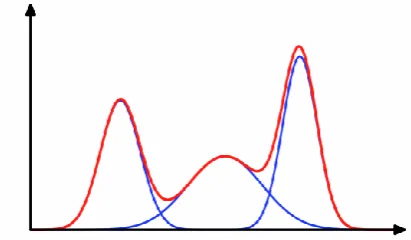
All these are the parameters of the Gaussian mixture model (GMM) which play the most important role in the whole process of background subtraction. These parameters are actually modelled and worked upon to get desired and efficient results.
Figure 1. A Gaussian (bell shaped) distribution
Figure 2. A mixture of Gaussian distributions
Now, like any other method, GMM also suffers from a number of drawbacks, as it cannot handle fast
GMM uses Expectation-Maximization (EM)
algorithm to initialize its parameters i.e. weight, mean and covariance. The EM algorithm is explained below
Table I: Comparison of Different Techniques Using GMM
Algorithm Working Limitations
A. Expectation Maximization (EM) Algorithm: This algorithm is used by the Gaussian Mixture Model to estimate or initialize its parameters i.e. mean, weight, and covariance. It begins with some initial estimate for the mean and variance i.e. it randomly does some initial value estimates for mean and variance for each of the K distributions. Initially, it takes the hypothesis
N= [m1,m2,m2,_ _ _ , mk: s1,s2,s3 _ _ _ ,sk : W1,w2 _ _ _, wk]
Now, the EM algorithm consists of two steps:
1) E-step: perform probabilistic assignments of each data point to one of the distributions based of the current hypothesis N
2) M-step: this step is used to calculate a new maximum likelihood for our hypothesis.
Now, EM algorithm is used to estimate parameters of the GMM model according to the maximum likelihood criterion. But it happens in practice that due to insufficient and noisy data the parameters to be estimated come out be uncertain and imprecise due to which the GMM model is not able to correctly reflect the underlying distribution of the observations which leads to incorrect results. Various improvements have been done over years for the GMM model. Also, it becomes impossible to estimate the GMM parameters which are uncertain by comparing them with likelihoods that are themselves real numbers. These include AKGMM, TLGMM, STGMM, SKMGM and so on. The table 1 represents a comparison between the various improvement methods developed over years.But none of them deals with the uncertainty which occurs due to insufficient or noisy data. So to account for this uncertainty in the training data fuzzy logic has been used along with the GMM.
II.
BACKGROUND SUBTRACTION USING
FUZZY BASED GAUSSIAN MIXTURE MODEL
Fuzzy logic is a concept based on degrees of truth rather than the 0 or 1 logic rather it includes 0 and 1 as extreme cases of truth and includes various states
of truth in between also. For example, a glass of water may not be just cold or hot but can be warm, lukewarm, less hot, less cold and so on. Therefore, fuzzy logic incorporates in it the uncertainty relating to an observation and this is the reason fuzzy logic is used with the GMM to account for the insufficient or noisy data that prevails in the training sequence. So, for this a first approach was the fuzzy GMM in which the parameters were initialized using the modified fuzzy cmeans algorithm. Also approaches have been proposed by Z Zivkovic and R Bowden and many more as stated above also. On the other hand type-2 fuzzy sets provide a much better option to model GMM to handle the uncertainties. This approach of modelling the background of GMM using T2FS was given by Bowmans et al.T2 fuzzy sets are the fuzzy sets whose membership function is not a crisp value like in type-1 fuzzy sets but has whose membership function itself is a fuzzy set called secondary membership function. The figure3 represents the region (shaded) called the Footprint of Uncertainty (FOU) taken from [2]
Figure 3. The footprint of uncertainty (FOU) defined by secondary membership function of T2FS
A. Inter-values Type-2 Fuzzy sets
Using IVFS instead of T2FS is advantageous from the perspective of software implementation and therefore they find more use in image processing over the T2FS. It consists of two membership functions to model the uncertainty
1) T2 FS upper membership function 2) T2 FS lower membership function
These membership functions are shown in the figure 4 taken from [2] where represents the upper membership function and represents the lower membership function.
Figure 4. Lower and Upper Membership Functions
These two membership functions are built from a single Gaussian usually by introducing imprecision in the mean or standard deviation of the distribution. When imprecision introduced in mean, it is known as T2FS-UM i.e. unbounded mean and similarly for standard deviation as T2 FS-UD i.e. unbounded standard deviation. Now mean does not represents a single value but a range or interval of values. Therefore, now noise or uncertainty in the training data can be taken care by introducing imprecision in the parameters of the Gaussian mixture model. This is the reason for using fuzzy logic along with the GMM. The lower and upper membership functions are defined by varying the mean inside the domain of the membership function and therefore the larger the mean, the larger will be the footprint of uncertainty.
III.
PROPOSED METHODOLOGY
Our proposed methodology consists of the following steps:
Image acquisition
Background Modelling using IVFS
Training
Foreground detection
Background Maintenance
Results
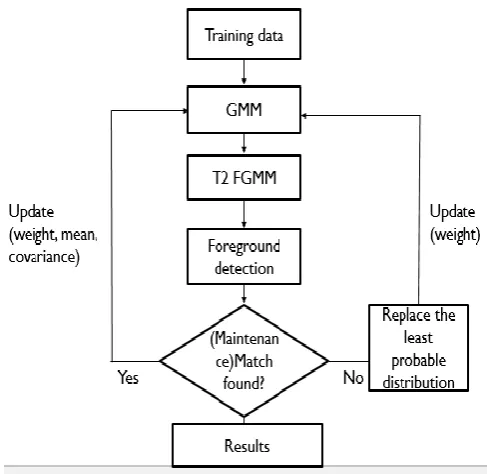
Image Acquisition consists of the basic process of image acquisition. The rest of the steps are explained below. The methodology is shown through a flowchart as shown in Figure 5. The imprecision can be introduced in either mean or standard deviation to get T2FS-UM and T2FS-UD respectively. But the T2FS-UM is the mostly used method. The methodology is explained in the proceeding sections of the paper to give a clear idea of the working. The following flowchart shows the process model of the fuzzy based GMM
Figure 5: Process model for fuzzy based GMM
and/or standard deviation of the model. Now, since there is no prior knowledge about the level of uncertainty of the parameters, therefore it is assumed that the mean and variance will vary within the given intervals only and in this way the uncertainty in the data is taken care of. Thus Background modelling basically consists of building the memberships functions so that a membership degree can be given to the uncertain parameters or data which occur in the training sequence due to noise and various other factors.
Once the membership functions have been built, the next step is to train the background model so that it can help in efficient background subtraction. For training, first the parameters of the GMM i.e. the mean, the variance and the weight are initialized using the Expectation-Maximization algorithm. Now, the amount of uncertainty that has to be added to the mean or standard deviation also has to be regulated. To do this we use two control parameters –km and kv for uncertain mean and uncertain variance respectively. These control factors also have to be added during the training phase of the process.
Now, for the foreground detection firstly the k-Gaussians are ordered to determine which of the Gaussians are most likely to be produced by the background. The pixels with less variance and high weight are considered for the background pixels due to the reason that the background is more static and present than the foreground and covers a larger portion of the distribution. For this first (say n) distributions are kept for getting the background distributions. Now when a foreground pixels occurs, it will not match any of the existing background distributions and lead to the creation of new distributions which will be considered as the foreground distributions. Now, when a new frame comes, each pixel of the frame will be matched against the existing distributions using the maximum likelihood criteria leading to two possibilities-either a match will be found with one of the existing changes can occur in the background of a scene itself. These changes have to be adapted to the model so that they don’t give any false results. This process is known as the maintenance of the background. If the incoming pixel matches with one of the k Gaussian distributions, then for the matched components all the three parameters i.e. weight, mean and variance are updated using the constants α and ρ which are the learning parameters
For the unmatched components, mean and variance are kept unchanged and only weight is replaced by the above equation. In case of no match with any of the k Gaussian distributions, the least probable distribution of the available distributions is replaced with distribution having the mean of the current
than various other background subtraction
with the GMM to overcome its limitations. Also various experiments have been done using this fuzzy based GMM approach which prove this method to be superior to the previous improvements. In future study can be done to reduce the computational complexity of the fuzzy sets.
V.
REFERENCES
[1] Massimo Piccardi,” Background subtraction
techniques: a review”, 2004 IEEE International Conference on Systems, Man and Cybernetics
[2] Chris Stauffer and W.E.L Grimson,” Adaptive
background mixture models for real-time tracking”, The Artificial Intelligence Laboratory Massachusetts Institute of Technology Cambridge
[3] Kalpana Goyal, Jyoti Singhai,”Review of background
subtraction methods using Gaussian Mixture Model for visual surveillance”, artificial intelligence review
[4] Sivabalakrishnan.M “adaptive background subtraction
in dynamic environments using fuzzy logic”, Sivabalakrishnan.M. et al. / (IJCSE) International Journal on Computer Science and Engineering
[5] Dat Tran and Michael Wagner “Fuzzy Gaussian
Mixture Models for Speaker Recognition”, Human-Computer Communication Laboratory School of Computing, University of Canberra, ACT 2601, Australia
[6] Zoran Zivkovic "Improved Adaptive Gaussian