The Present Status of Speech Database in Japan:
Development, Management, and Application to Speech Research
Hisao Kuwabara
1), Shuich Itahashi
2), Mikio Yamamoto
2), Toshiyuki Takezawa
3),
Satoshi Nakamura
3), Kazuya Takeda
4)1) Department of Electronics and Information Science, Teikyo University of Science & Technology Uenohara, Kitatsuru-gun, Yamanashi 409-0193, Japan,
2) Institute of Information Sciences and Electronics, Tsukuba University Tennodai, Tsukuba, Ibaraki 305-8573, Japan,
[email protected], [email protected] 3) ATR Spoken Language Translation Research Laboratories
Hikaridai, Soraku-gun, Kyoto 619-0288, Japan, {takezawa, nakamura}@slt.atr.co.jp
4) Center for Integrated Acoustic Information Research, Nagoya University Furomachi, Chigusa-ku, Nagoya 464-8603, Japan,
Abstract
The present status of Japanese speech database has been described. The database project in Japan started in early 1980s. The first one was a committee of Japan Electronic Industry Development Association, abbreviated as JEIDA, which aimed at creating a speech da-tabase that can commonly evaluate performance of the then existing speech input/output machines and systems. Several dada-tabase pro-jects have been undertaken since then including the one initiated by the Advanced Telecommunication Research Institute (ATR) and now it has come to the point where an enormous amount of spontaneous speech data is available. A survey has been conducted re-cently about the usage of the presently existing speech databases among industry and university institutions in Japan where speech research is now actively going on. It has been revealed that the ATR’s continuous speech database is the most frequently used followed by the equivalent version of the Acoustical Society of Japan.
1. Introduction
As the activities of speech research not only in the field of speech technologies but in many academic areas in-cluding linguistics and physiology increase, a demand for large-scale speech databases for common use and many purposes grows. Before common speech databases were available, people were making their own small databases for their own use in almost every institution without dis-tributing outside. As the computer facilities go up, espe-cially computer ’s processing speed and memory size, it has become possible to handle a large amount of speech data. Recent speech recognition and synthesis technolo-gies, such as HMM, N-gram language models and cor-pus-base synthesis, require an enormous amount of speech data for both training and assessment. It was from this atmosphere that collection and building a large-scale speech database began in Japan years ago and now it comes to a point where a great deal of spontaneous speech data are available.
Speech database projects in the so-called industrially advanced countries have been stimulated to grow more and more active from the late 1980s by a series of data-base workshops, i.e. in The Netherlands in 1989 (ESCA Workshop, 1989), in Japan in 1990 (ICSLP Workshop, 1990) and in Italy in 1991 (ESCA Workshop, 1991). In the U.S., the most advanced country in the database pro-ject, has already started LDC in the early1990s based on the accumulation of databases collected through ARPA
and DARPA projects. In Europe, they have created ELRA in 1995 as the non-profit organization. It collects, markets and distributes language resources along with the dis-semination of general information in the field of language engineering. In Japan, there is a new project called GSK, created in 1999, which aims at accumulating and control-ling language resources. However, unlike LDC and ELRA, the GSK does not include speech corpora yet while the former two are the integrated bodies for both text and speech data. The present situation in organizing the database projects in Japan is still a little behind other advanced countries.
about the usage of speech database.
2. A Brief History of Database Project
As mentioned above, the database project in Japan began through the formation of JEIDA organization in 1982 headed by Prof. S. Itahashi of Tsukuba University. It was a time when Japan needed a common speech database that would be used to uniformly evaluate the then exist-ing speech recognition machines and systems. The corpus constructed was relatively small consisting of about 300 isolated words with 150 speakers, 75 for male and female each (Itahashi, 1985). Speakers’ ages were carefully regulated so that they would constitute approximately the same age-ratio as the whole Japanese population at that time. This database was used in many institutions to evaluate their own products and the project finished its first mission in 1985 to succeed to another one.The JEDA committee was re-formed to create a new organization attached to ASJ (Acoustical Society of Ja-pan) in 1990 adding more committee members and headed again by Prof. S. Itahashi. Under the new com-mittee, several projects have been undertaken to create speech corpora placed more weights on basic speech in-put/output technologies and research than before. Under this committee, several speech corpora were created and distributed which will be mentioned later in this paper. The committee, the first author of this paper succeeded chairman three years ago, still continues and is responsi-ble for distributing/managing the existing databases and for future planning.
ATR (Advanced Telecommunication Research Institute International) started its database project at the same time of its foundation in 1986 and the first author of this paper was responsible for it. It was time when new speech rec-ognition technologies such as HMM, Neural Netwo rk and Language Models emerged. These technologies require a large amount of speech data both for training and for evaluation. Initially, it intended to collect clean read speech with professional announcers and narrators. It consists of 1) word speech database and 2) continuous speech database, and the most important aspect of this database is that it provides detailed labels in five layers (Takeda, 1988). ATR ’s database project still continues today under the name ATR-SLT (ATR Spoken Language Translation Research Laboratories) database.
A four-year database project was running from 1989 to 1992 under the priority area on “Prosodic Features of Spoken Japanese” sponsored by the then Ministry of Education (Kuwabara, 1996). The purpose of this project was to create a speech corpus by collecting regional and dialectic spoken Japanese. It aims at providing a useful database mainly for linguists, phoneticians, dialectolo-gists, speech therapists and language educators. Those who participated in this project numbered more than 300 but most of them from outside speech engineering.
Recently, a few government-sponsored projects related to speech research/database are now underway in Japan. First, a five -year project called “Spontaneous Speech Engineering,” started in 1999, is under way (Maekawa, 2000). This is a joint project connecting The National Language Research Institute, Tokyo Institute of Technol-ogy, and Communications Research Laboratory headed by Prof. S. Furui of Tokyo Institute of Technology. In this project, they are trying to build a corpus of spontaneous
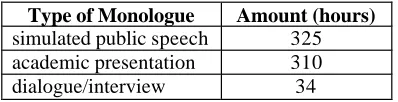
Japanese called CSJ (Corpus of Spontaneous Japanese). However, what they are collecting is not “spontaneous” speech in the exact sense. They are collecting so-called “monologue” speech by recording academic presenta-tion’s speech and simulated public speech. It aims at in-vestigating linguistic, para-linguistic structure of spoken Japanese. It has collected so far more than 680 hours (7.8 million words) of monologue speech data and approxi-mately 520 hours of them were transcribed into written text.
Second, another five -year project headed by Prof. F. Itakura of Nagoya University started in the same 1999. This is “Integrated Acoustic Information Research” pro-ject. It aims at integrating different aspects of hu-man-sound relation by investigating not only speech sounds but also other acoustic signals. Reflecting Japan’s aging society, a new speech corpus consisting of 400 eld-erly people’s speech has been completed recently under this project.
Third, a four-year project on “Realization of Advanced Spoken Language Information Processing for Prosodic Features,” headed by Prof. K. Hirose of Tokyo Unive rsity, has now entered to the third year. This project, to which some of the authors of this paper join, aims at developing and researching advanced speech input/output technolo-gies based mainly on the prosodic features of spoken Japanese. In this project, a spontaneous-speech corpus has now being constructed mainly for prosody research and text-to-speech synthesis (Kitazawa, 2001).
3. The Present Speech Corpora
As mentioned above, there are several speech corpora in Japan created in the course of progressing individual database projects. Followings are the existing speech da-tabases in Japan including ones that are in the process of building and not yet completed.
3.1. JEIDA Isolated-Word Corpus
As mentioned above, the JEDA speech corpus was de-signed to commonly evaluate speech recognizers for commercial use at that time. Table 1 represents the con-tent of the corpus. In the table, the “foreign syllable” stands for the pronunciations that are not in the original
Type of Words Number
isolated syllable 101 foreign syllable 9
single digit 15 continuous digit 35
function word 63
city/place name 100
total 323
Table 1: Content of JEIDA isolated-word corpus Japanese language but come from foreign words. The “single digit” stands for ten digit plus another pronuncia-tions for “0, 4, 7, 9.” The continuous digits are strings of four digits. The number of speakers are 150 with 75 male/female each.
3.2. ASJ Continuous Speech Corpus
Corpus for Research (CSCR),” and 2) “Japanese News-paper Article Sentences (JNAS),” were created so far in the ASJ speech database project. They are both read speech and the former is a mixture of sentence-read speech and simulated dialogue speech. Table 2 shows the content of ASJ speech corpus.
3.2.1. ASJ-CSCR
Table 2 is the content of CSCR database. Phonetically balanced sentences used here are the same as those of
ATR database but different speakers. The “simulated dia-log,” refers to the number of dialogues, not the number of sentences. Male and female speakers are almost equal number for all sentence types. These data are stored in 7 CD-ROMs. Over twenty institutions affiliated with in-dustries and universities joined this project and collected speech data at their individual places.
3.2.2. SAJ -JNAS
JNAS corpus refers to “Japanese Newspaper Article Sentences.” This project was supported by Mainichi Shinbun, one of the leading daily newspapers in Japan, and the articles were offered by the Newspaper. Project members were the same as above mentioned CSCR pro-ject. The articles cover a variety of topics from politics to sports events. Approximately 15,500 sentences plus 50 ATR phonetically balanced sentences were prepared to read by 306 speakers with 153 male/female each. Table 3 shows the content. The data are stored in 16 CD-ROMs.
3.3. ATR Speech Corpus
ATR began its database project at the same time of its foundation in 1986. The first author of this paper partici-pated in the project from the beginning. It was time when new speech methods like HMM, neural network, N-gram language models had emerged into the speech recognition technologies. These methods require a large amount of speech data for the training and also for the evaluation. A lot of discussions had been made about the database size, contents, speakers, and labeling. There are three kinds of database sets and data collection started with recordings of professional announcer ’s voice in the noise-free envi-ronments. Data collection still continues today in the present ATR-SLT (ATR Spoken Language Translation Research Laboratories).
What is important in ATR speech database is that it gives data the following detailed labels in five layers;
Layer 1: phonetic symbols Layer 2: acoustic events
Layer 3: allophonic variants Layer 4: inseparable portions Layer 5: vowel centers
3.3.1. Isolated Word Database Set (Set A)
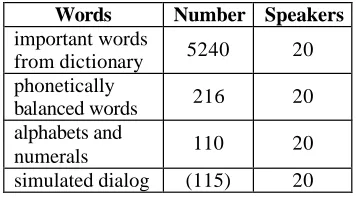
Words of this dataset were selected from a Japanese dictionary plus small number of phonetically balanced words, numerals, and others. Table 4 shows the content of
this dataset. The speakers are all professional announcers and the number is as of 1992 data. The “simulated dia-log” is a task for travel information.
3.3.2. Continuous Speech Database Set (Set B)
This dataset is a read version of phonetically balanced 503 short Japanese sentences selected from newspapers and magazines (Iso, 1988). For the sake of simplicity, the sentences are grouped into ten sets, nine sets contain 50 sentences each plus one set 53, featuring with phoneti-cally balanced within each set too. Speakers are 10 pro-fessional announcers with 5 male/female each.
3.3.3. Dataset for Large Number of Speakers (Set C)
This dataset was designed for use in the speaker inde-pendent speech recognition and in the speaker adaptation technologies. The content of this dataset is a mixture of
Set A and Set B; 750 words from Set A plus 150 sen-tences, also phonetically balanced, from Set B. Table 5 represents the content of this dataset. The number of speakers is 250 as of 1992 and still growing.
3.4. RWCP Speech Corpora
RWCP refers to as “Real World Computing Partner-ship” and the speech corpora are designed to meet devel-oping speech technologies that can be used in our living environments, not in the laboratory environment. This started in 1992 as a ten-year project There are three data-sets in the RWCP project, 1) RWCP sound scene database in real acoustic environments (Nakamura, 1999, 2000), 2) RWCP spoken dialogue dataset, 3) RWCP broadcasting news speech dataset, and 4) table-meeting speech dataset.
3.4.1. RWCP Sound Scene Database
Sound scene database was created for studies such as sound-source localization, sound retrieval, sound
recog-Type of Sentences Number Speakers
phonetically balanced 503 64
guidance task 1027 36
simulated dialog (37) 37
Table 2: Content of ASJ continuous speech corpus.
Type of Sentence Number Speaker
newspaper article 15,500 306 phonetically balanced 50 306 Table 3: Content of ASJ-JNAS speech corpus.
Words Number Speakers
important words
from dictionary 5240 20 phonetically
balanced words 216 20 alphabets and
numerals 110 20
simulated dialog (115) 20
Table 4: Content of ATR Isolated Word Database Set.
Item Number Speakers
words from Set A 750 250
environ-versity and aims at integrating different aspects of hu-man-sound relation on 1) the spatial sound localization by humans, 2) analysis and synthesis of sounds, 3) recogni-tion of sounds including speech, 4) machine understand-ing of spoken language, and 5) human perception of sounds. This projects plans to create large scale speech corpora and acoustic sound databases to be used in the project and also by the speech research community. So far, it has created a corpus of elderly people reflecting the recent trend towards the aging society.
In this project, they have created 7 databases for sound and speech. They are 1) database of room acoustics (CIAIR-RAM1999), 2) database of human head transfer functions (CIAIR-HRM1999), 3) database of driver’s commands to in-vehicle navigators (CIAIR-HCC), 4) database of children’s speech while playing video game (CIAIR-VCV), 5) database of simultaneous interpreters and original speakers speech (CIAIR-SI2000), 6) sounds of musical and acoustical instruments (CIAIR-AIS), and 7) database of elderly people (S-JNAS).
S-JNAS database consists of two datasets, 1) for acoustic modeling and 2) for recognition evaluation. The former one contains a total of 301 elderly peoples’ speech for older than 60, and two persons are even older than 85. The latter one consists of 101 elder peoples’ speech with again older than 60.
4.3. Corpus of Advanced Spoken Language Pro c-essing ? Japanese MULTEXT ?
In the project “Realization of Advanced Spoken Lan-guage Processing from Prosodic Features,” they try to build a prosodic corpus (Kitazawa, 2001). The recordings were made based on the read-passages translated from the ELRA’s MULTEXT prosodic corpus. The text was trans-lated from five European languages and modified into Japanese. It comprises 40 different passages with 6523 morae including 1085 accent kernels.
Preliminary recordings have been made for 6 profes-sional narrators and actors, 3 male/female each. For each speaker, recordings have been made in two ways; 1) read the text naturally, and 2) read it with an instructed emo-tional and paralinguistic attitude. Signals from EGG elec-trodes have also been recorded simultaneously. A total of 3 hours and 37 minutes speech have been r ecorded so far.
4.4. Corpus of Expressive Speech Processing ? JST/CREST database ?
This project aims at creating a very large spontaneous speech database, including emotional speech (Campbell, 2001). They try to record spontaneous samples, conve rsa-tional speech and daily spoken interaction, of natu-rally-occurring emotions without recourse of acting. They try to avoid laboratory regulated speech samples. The project, funded by the Agency of Science and Technol-ogy , is now running jointly with 6 groups, 1) NAIST (Nara Institute of Science and Technology), 2) Kobe University, 3) Keio University, 4) Chiba Unive rsity, 5) ICP Grenoble, and 6) ATR-ISD. The target is 1000 hours natural daily conversational speech data.
5. Database Utilization in Japan
Recently, a survey about the use of speech database has been conducted. By mailing questionnaire sheets to
ap-proximately 200 industry/university laboratories and col-lected 58 responses so far. The questions include:
(1) Which database are you now using and for what purpose?
(2) Which database did you use over the past 5 years and for what purpose?
(3) Which database will you use in the near future and for what purpose?
(4) Please give us information about the database you are now building or planning to build in the near future, if any.
(5) What kind of database will be needed/necessary for the future speech research and technology development?
The respondents were allowed to answer the questions anonymously so that, especially for some people in in-dustry, they would be able to respond more freely. The response data were analyzed with industry, government institution, university, and unknown (anonymous) groups separately.
5.1. Currently Used Database
5.1.1. Database
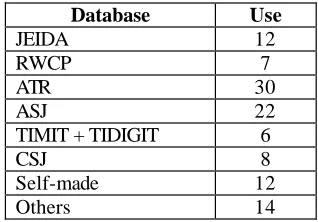
Table 8 represents currently used databases which the result for the question (1). The most frequently used one is ATR database comprising 27% of the total use fol-lowed by ASJ database’s 20%. Not small number of in-stitutions use their own self-made databases built from their own needs. “Other databases” refers to small data-bases that are not listed in this paper. The RWCP, ATR, ASJ databases include all datasets that belong to each category. If we look at the result more closely with indi-vidual institutions, it becomes Table 9 which is the de-tailed version of Table 8, where “Univ. ” stands for uni-versity, “Ind.” for industry’s research institutions, “Gov.”
Database Use
JEIDA 12
RWCP 7
ATR 30
ASJ 22
TIMIT + TIDIGIT 6
CSJ 8
Self-made 12
Others 14
Table 8: Currently used database in Japan.
Database Univ. Ind. Gov. Unkn.
JEIDA 8 3 0 1
RWCP 5 0 1 1
ATR 14 8 3 5
ASJ 16 1 1 4
TIMIT + TIDIGIT 2 2 0 2
CSJ 6 2 0 0
Slef-made 6 4 0 2
Others 11 0 1 2
for government research institutions and “Unkn.” for the unknown (anonymous) group.
5.1.2. Purpose of Database Use
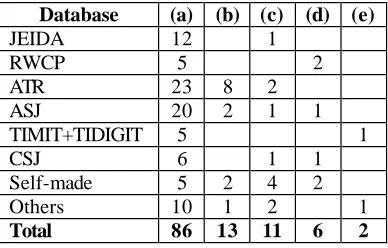
Databases that are currently used in many institutions have different nature when they were created first. The questionnaire respondents were analyzed according to their usage. The usage of speech database is summarized into the following five categories.
(a) Speech recognition (b) Speech synthesis (c) Acoustic analysis (d) Sentence analysis
(e) Speech/language education
The category (a) includes sentence comprehension, speech summarization, system development, evaluation, and speaker recognition, and (b) includes prosodic analy-sis while (c) involves speech coding research. The result
is listed in Table 10. The total number for indivi dual da-tabase does not necessarily coincide with the total num-ber listed in Table 8 since many datasets can be used in multi-purpose. It is clear that a majority of corpora are used in speech recognition and related research, about 73% of the total use, followed by synthesis research, but far less in frequency. Perhaps this result reflects the data-base-creating policy in our society.
5.2. Corpora for Future Speech Research
There is too little space left in this paper to introduce all the results of respondents. Let’s give a brief look at re-sponses towards the question (5), about database that will be necessary/needed for future research work. The fol-lowing is a list of top-ten corpora that the respondents think them important for future research.
1. Dialogue/continuous speech corpus recorded in real living environments (6 respondents).
2. Para-linguistic, emotional speech corpus (4) 3. Corpus for different speaking style (3) 4. Bi-modal, multi-modal speech corpus (2) 5. Read-speech corpus with prosody tag (2) 6. Corpus for broadcasting news speech data (2) 7. Corpus for speaker recognition including data for the
same speakers recorded in different times and/or ages (2)
8. English corpus pronounced by the Japanese (2) 9. Mobile-phone speech data with a large number of
speakers (1)
10. Speech corpus having various kinds of information about production including movie pictures (1)
There are many other responses about desirable future speech corpus that are excluded from the above list but we believe they are all important.
6. Acknowledgements
The authors would like to express their sincere grati-tude to all institutions and personnel who took precious time to respond to the questionnaire and to those who gave us detailed information about their corpora.
7. References
Campbell, N., 2001. The Recording of Emotional Speech – JST/CREST database research. Proceedings of the Oriental
COCOSDA Workshop, 78-80
ESCA Workshop on Speech Input/Output Assessment and Speech Database, 1989, Noordwijkerhout, The Netherlands ESCA Workshop on International Coordination and
Standardi-zation of Speech Databases and Speech I/O Assessment Methods, 1991, Chiavari, Italy
Furui, S., Maekawa, K., and Isahara, H., 2002. Intermediate results and perspectives of the project “Spontaneous Speech: Corpus and Processing Technology,” Proceedings of the 2nd
Spontaneous Speech Science and Technology Workshop, 1-6
ICSLP Workshop on International Coordination and Standardi-zation of Speech Databases and Assessment Techniques for Speech Input/Output, 1990, Kobe, Japan
Iso, K., et al, 1988. Design of a Japanese sentence list for a speech database. Proceedings of Acoustic Society of Japan, March
Itahashi, S., 1985. Speech database of discrete words. The
Journal of Acoustic Society of Japan, 41:723-726
Itahashi, S., 1999. On recent speech corpora activities in Japan.
The Journal of Acoustic Society of Japan, E20:163-169
Kitazawa, S., et al, 2001. Preliminary study of Japanese MULTEXT: a prosodic corpus. Proceedings of ICSP, 825-828
Kuwabara, H., et al, 1989. Constructio n of a large-scale Japa-nese speech database and its management system. Proceedings
of ICASSP, 560-563
Kuwabara, H., 1996. Speech database of the priority area “Pro-sodic Features of Spoken Japanese.” Humanities and
Infor-mation Processing, 12:60-61
Meakawa, K., Koiso, H., Furui, S., and Isahara, H. 2000. Spon-taneous speech corpus of Japan. Proceedings of LREC Second
International Conference, 947-952
Maekawa, K., 2002. Compilation of the corpus of spontaneous Japanese: A status report, Proceedings of the 2nd Spontaneous
Speech Science and Technology Workshop, 7-10
Nakamura, S., et al, 1999. Sound scene data collection in real acoustic environments. J. of Acoust. Soc. Jpn. (E), 20:225-231
Nakamura, S., et al, 2000. Acoustical sound database in real environments for sound scene understanding and hands-free speech recognition. Proceedings of the 2nd International on Language Resources and Evaluation
Takeda, K., et al, 1988. A Japanese speech database for various kinds of research purposes. The Journal of Acoustic Society of
Japan, 44:747-754
Database (a) (b) (c) (d) (e)
JEIDA 12 1
RWCP 5 2
ATR 23 8 2
ASJ 20 2 1 1
TIMIT+TIDIGIT 5 1
CSJ 6 1 1
Self-made 5 2 4 2
Others 10 1 2 1
Total 86 13 11 6 2