Improving an Ontology Refinement Method with Hyponymy Patterns
Enrique Alfonseca and Suresh Manandhar
Departamento de Ingenier´ıa Inform´atica, Universidad Aut´onoma de Madrid 28049 Madrid, Spain
Computer Science Department, University of York York YO10 5DD, United Kingdom
Abstract
We describe here a procedure to combine two different existing techniques for Ontology Enrichment with domain-specific concepts. The resulting algorithm is fully unsupervised, and the level of precision is higher than when they are used separately, so we believe that both algorithms benefit from each other. The experiments have been performed by extending WordNet with concepts extracted from The Lord
of the Rings.
1.
Introduction
Lexical semantic ontologies, such as WordNet (Miller, 1995), have proven very useful with many applications in Natural Language Applications. However, they usu-ally only include general terms, as it would be impossible to extend them with every concept used in every domain of knowledge, and there are few automatic methods for enriching them with domain-specific concepts, a subtask of what Maedche and Staab (2001) call Ontology
Refine-ment (OR). In a previous paper (Alfonseca and Manandhar,
2002) we describe an unsupervised algorithm for enrich-ing an ontology such as WordNet with concepts extracted from particular domains. Our method was a deterministic top-down algorithm that proceeded down the taxonomy, se-lecting at each level the concept that is distributionally most similar to the unknown concept.
We present in this paper a way to combine our OR sys-tem with the method described by Hearst (1992), consisting in looking for patterns inside texts from which we can ex-tract information about how to extend an ontology. In our initial experiments, the accuracy of both algorithms have increased, which indicates that both of them can benefit from each other.
1.1. Related work
Because a comprehensive review of learning applied to ontologies is beyond the scope of this paper, we shall fo-cus some systems for OR on lexical ontologies that have influenced most on our research.
One of the most widely used lexical ontologies is Word-Net (Miller, 1995), in which concepts (also called synsets, sets of synonym words) are structured through the
hyper-nymy relationship from the most general to the most
spe-cific. If a concept subsumes a concept , we say that is a hypernym of , and that is a hyponym of .
One of the first attempts to extend WordNet with domain-specific information was reported by O’Sullivan et al. (1995), who added new synsets about word processors and software applications, although the work was all done by hand by domain experts.
Concerning automatic systems for enriching existing ontologies with new concepts, two very similar systems were reported by Hastings (1994) and Hahn and Schnat-tinger (1998). Both of these systems start with an initial ontology of nouns and verbs, a set of domain-dependent texts, and restrictions about the selectional preferences of the verbs, e.g. that the object of arson is known to be a
building and the object of kill is known to be a person. At
the beginning, the hypothesis space of possible generalisa-tions for a new, unknown concept is initialised as any possi-ble concept in the ontology. When the new concept is seen in the text as subject or object of the verbs, the selectional restrictions are used to shrink that hypothesis space. The more times a concept appears in the text, the more infor-mation the system has to classify it in the ontology. Hast-ings (1994) worked on the terrorist domain, while Hahn and Schnattinger (1998) did his experiments with texts from an I.T. magazine and an ontology about electronics.
A different approach was described by Hearst (1992), and used again by Kietz et al. (2000) for his OR system. In this approach, the aim is to find regular expression pat-terns from free texts by looking at pairs of (hypernym, hy-ponym) that co-occur in the same sentence, and then to use them to learn new hypernymy relations. For example, from sentence (1), taken from (Hearst, 1998), a system can dis-cover that the patternsuch NPs as NP, * NP usu-ally states a hypernymy relation, if Herrick, Goldsmith and
Shakespeare appear as hyponyms of author in the initial
on-tology. That pattern can be used later to learn relationships between new concepts. We call these patterns hyponymy
patterns.
(1) ...works by such authors as Herrick, Goldsmith and Shakespeare...
Kietz et al. (2000) applied hand-coded patterns for ex-tending GermaNet (a German equivalent of WordNet) with concepts from a corporate intranet, and quantified the error rate of this procedure in 32%. As described by him, this procedure has several drawbacks:
attach( )
is the unknown synset,
1. Let be the root synset in the ontology. 2. return analyseLevel( , )
analyseLevel( , )
is the candidate synset most similar to .
1. Get ’s synset children, . 2. Calculate
3. For every child, calculate !
"
4. Find the concept whose semantic distance to is the lowest 4.1 If that concept is , return
4.2 Otherwise, if that concept is, return analyseLevel( ,)
Figure 1: Pseudo-code of the original algorithm for finding the correct place where the unknown synset will be attached in the ontology
If a concept never appears inside one of these patterns, the system cannot classify it.
The error rate is high, so it is necessary that a user validates the program’s output.
1.2. Structure of this document
In next section, we describe our system before we ex-tended it with Hearst-like hyponymy patterns. Next, in sec-tion 3 we describe the way in which we have combined our previous system with the patterns. Finally, sections 4 and 5 contain the results of our preliminary experiments and our conclusions.
2.
Description of the previous system
The aim of our system is the correct classification of unknown concepts in the WordNet lexical ontology.For finding which is the correct place where a new un-known synset should be attached to the ontology, we have devised an algorithm that performs a top-down search, and it stops at the synset that is most similar to . The proce-dure is detailed in Figure 1. The search starts at the most general synset , and compares with it and with all of its immediate hyponyms. If is more similar to than any of ’s children, then is assumed to be a hyponym of . Otherwise, we proceed downwards along the most similar child found.
The semantic distance used is based on the Distribu-tional Semantics model, which assumes that there is a strong correlation between the semantics of a word and the set of contexts in which that word appears Rajman and Bon-net (1992). This idea motivated the use of topic signatures, that have been applied to text summarisation (Lin, 1997) and word-sense disambiguation (Yarowsky, 1992) (Agirre et al., 2000). A topic signature (Yarowsky, 1992) of a word
#
is the list of the words that co-occur with it, together with their respective frequencies or weights. Because WordNet does not include topic signatures we used the method pro-posed by Agirre et al. (2000) to acquire them, in an unsu-pervised way, from Internet.
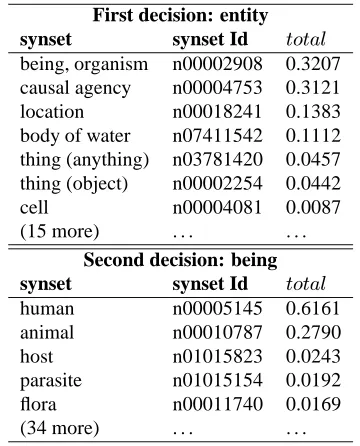
First decision: entity synset synset Id $% being, organism n00002908 0.3207 causal agency n00004753 0.3121 location n00018241 0.1383 body of water n07411542 0.1112 thing (anything) n03781420 0.0457 thing (object) n00002254 0.0442 cell n00004081 0.0087 (15 more) . . . .
Second decision: being synset synset Id $% human n00005145 0.6161 animal n00010787 0.2790 host n01015823 0.0243 parasite n01015154 0.0192 flora n00011740 0.0169 (34 more) . . . .
Table 1: Similarity values for each of the decisions that have been taken when classifying the unknown concept orc. In the first place, when deciding between entity and its children, the chosen one was being, life form. In the second decision, the chosen synset was human. Both were correct.
These signatures can be used, at each iteration of our top-down algorithm to decide which is the synset most sim-ilar to the unknown concept (step 4).
were also found somewhat similar to those of orc, and the rest of the synsets had much lower values.
3.
Learning hyponymy patterns
3.1. Motivation
If we examine the mistakes committed by the previous algorithm, we find that it is difficult for it to distinguish be-tween concepts that can appear in similar contexts. For ex-ample, the topic signatures of adult male and adult female, in WordNet, are very similar, and many mistakes were due to people classified in the wrong sex. Due to the same rea-son, when processing excerpts from The Lord of the Rings (Tolkien, 1968), all hobbits1were classified as male men.
The approach taken by Hearst (1998), by looking for hyponymy patterns and then extracting the hyponymy rela-tionships can help improve this weak point in our algorithm because, when the extracted relationship is correct, it is usu-ally relevant. However, as he notes, the hyponymy patterns used to find new hypernymy relationships can generate a large number of mistakes, either because the extracted re-lation is far too general (e.g. hypernym(exercise, thing)); because they are subjective opinions with little interest (e.g. hypernym(Gaslight, classic), re-ferring to the film Gaslight); or because of parsing errors.
Our new approach proposes the following:
The use of the hypernymy patterns only as a support for the top-down classifier for making the decisions, when the topic signature gives a similar weight to sev-eral concepts.
The automatic extraction of a different set of hyper-nymy patterns for every level of the WordNet hierar-chy.
3.2. Automatic extraction of hypernymy patterns
As (Hearst, 1998) proposes, hypernymy patterns can be extracted automatically from texts by looking at sentences that contain a pair $ from WordNet. We have defined First Order Predicate Logic (FOPL) pred-icates to represent several kinds of syntactic dependencies, and we extract the dependencies between the hypernym and the hyponym. The following are some of the rules out sys-tem generated:
To obtain the hyponymy patterns that apply to each WordNet synset, we followed the following steps:
For each WordNet synset, a query is automatically constructed for the Altavista Internet search engine, following the procedure detailed in (Agirre et al., 2000), and a set of documents is collected that con-tain the words in that synset.
The documents are processed with a Flex tokeniser, a sentence splitter, the TnT part-of-speech tagger (Brants, 2000), a Flex stemmer, and a transformation-list Noun Phrase chunker (Ramshaw and Marcus, 1995) written in Java.
1
Hobbits are a race of small people
The sentences from those documents that contain both any of the synset words and any of its hypernym’s words were selected.
The system extract the hyponymy patterns from them, using the FOPL predicates, and pruned the low-frequency ones.
For example, the following are some of the patterns that were extracted from the texts. The first one shows the case in which the verb to be functions as a copula; the second and the third phrases show appositive constructions; and the last case shows how a prepositional phrase can indicate a hypernymy relationship.
(1)Shakespeare was a first-class poet hypernym(N2, N1) :- subject(N1, be), object(N2, be) (2)Shakespeare, the poet, ...
hypernym(N2, N1) :- appositive(N2, N1)
(3)The English dramatist, Shakespeare, ... hypernym(N2, N1) :- appositive(N1, N2)
(4)...the city of Seville...
hypernym(N2, N1) :- pp modifier(of, N1, N2).
These patterns are extracted at each level of the Word-Net hierarchy, from documents downloaded from Inter-net corresponding to nearly one thousand of the WordNet synsets. From our experiments we observe that some rules such as (1), (2) and (3) are general and appear at every level, but rule (4) applies only in a few cases, specially for geo-graphic regions such as city, kingdom or valley.
3.3. Modifications to the original algorithm
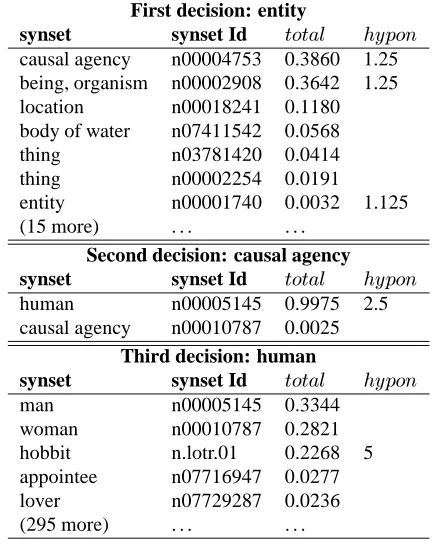
The top-down algorithm is modified so, at each level, if one of the possible decision synsets has one descendant in the ontology which had been suggested by the patterns, the support for choosing that synset is multiplied by a fac-tor which decreases with the depth of that descendant. For example, in the classification for orc shown in table 1, if the patterns had suggested that orc could be a hyponym of
animal, its weight would have been multiplied by 5, and animal would have been the decision taken; if they had
sug-gested that orc could be a hyponym of domestic animal (a child of animal), it would have been multiplied by 2.5; and so on.
In this way, we fulfil a double objective:
1. The directed search of the top-down algorithm helps in that most of the erroneous hypernyms suggested by mistakes of the patterns are never considered, because the search does not proceed near them.
2. The hypernyms suggested by the patterns help the top-down algorithm when the decision is difficult because two concepts appear in very similar contexts, such as the male-female distinction.
4.
Experiments and Results
(a) (b) (c)
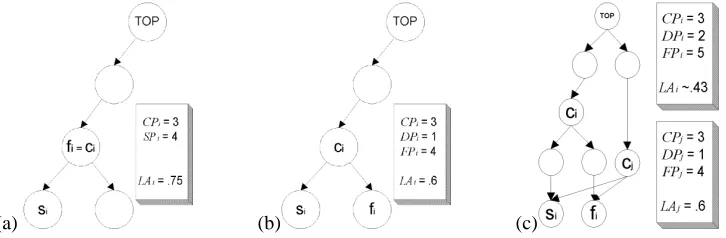
Figure 2:Learning accuracy in three different cases. (a) When the proposed concept is correct, but too general. (b) When the proposed concept is incorrect. (c) When there are different ways to compute Learning Accuracy.
5.
Conclusions
We describe here a way to improve our unsupervised
Ontology Refinement algorithm by finding hypernymy pat-terns in domain-specific texts. The integration of the two
different algorithms produces a more robust classification algorithm.
The top-down classifier, based on the context words, suggests a path from the root of the ontology down to the concept that will be suggested as the maximally specific generalisation of an unknown concept. The patterns help this algorithm in selecting a concept when the context does not give much information, such as for male-female distinc-tions.
The result is a deterministic unsupervised system that also allows the attachment of new concepts to any interme-diate level in an ontology, not only at the leaves. We have shown that it is able to tackle big ontologies with the size of WordNet.
Because it does not require any previous hand-coding of patterns, and the concept contexts are also automatically collected from the Internet, we believe it could be ported to other languages, if the syntactic processing tools used are available for them.
6.
Acknowledgements
This work has been partially sponsored by CICYT, project number TIC2001-0685-C02-01.
7.
References
E. Agirre, O. Ansa, E. Hovy, and D. Martinez. 2000. Enriching very large ontologies using the www. In In
Proceedings of the Ontology Learning Workshop, ECAI,
Berlin, Germany.
E. Alfonseca and S. Manandhar. 2002. An unsupervised method for ontology refinement. In Poceedings of the
First International Conference on General WordNet,
Mysore, India, january.
T. Brants. 2000. TnT - A Statistical Part-of-Speech Tagger. User manual.
Udo Hahn and Klemens Schnattinger. 1998. Towards text knowledge engineering. In AAAI/IAAI, pages 524–531. P. M. Hastings. 1994. Automatic acquisition of word
mean-ing from context. University of Michigan, Dissertation.
M. A. Hearst. 1992. Automatic acquisition of hyponyms from large text corpora. In Proceedings of COLING-92, Nantes, France.
M. A. Hearst, 1998. Automated Discovery of Word-Net Relations. In (Christiane Fellbaum (Ed.) WordWord-Net: An Electronic Lexical Database, pages 132–152. MIT
Press.
J. Kietz, A. Maedche, and R. Volz. 2000. A method for semi-automatic ontology acquisition from a corporate in-tranet. In Workshop “Ontologies and text”, co-located
with EKAW’2000, Juan-les-Pins, French Riviera.
Chin-Yew Lin. 1997. Robust Automated Topic
Identifica-tion. Ph.D. Thesis. University of Southern California.
A. Maedche and S. Staab. 2001. Ontology learning for the semantic web. IEEE Intelligent systems, 16(2).
George A. Miller. 1995. WordNet: A lexical database for English. Communications of the ACM, 38(11):39–41. D. O’Sullivan, A. McElligott, and R. F. E. Sutcliffe. 1995.
Augmenting the princeton wordnet with a domain spe-cific ontology. In Proceedings of the Workshop on Basic
Issues in Knowledge Sharing at the 14th International Joint Conference on Artificial Intelligence, Montreal.
M. Rajman and A. Bonnet. 1992. Corpora-based linguis-tics: new tools for natural language processing. In 1st
Annual Conference of the Association for Global Strate-gic Information, Germany. Bad Kreuznach.
L. A. Ramshaw and M. P. Marcus. 1995. Text chunking us-ing transformation-based learnus-ing. In Third ACL
Work-shop on Very Large Corpora, pages 82–94. Kluwer.
J. R. R. Tolkien. 1968. The Lord of the Rings. Allen and Unwin.