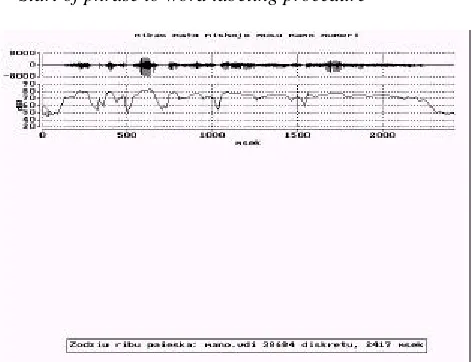
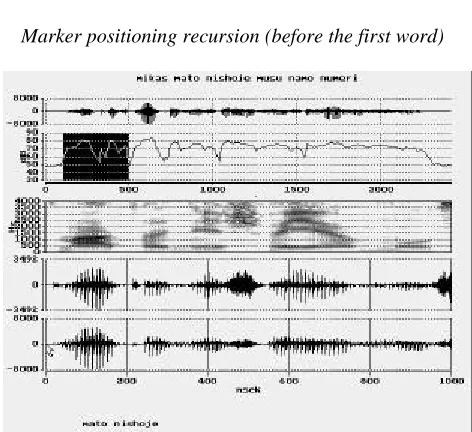
Figure 2: The phrase to word segmentation (2nd step). The two top pictures are the same as before: a) speech oscilogram, b) energy and marked by mouse line before the first word in the phrase. The three bottom pictures belong to word region: c) sonogram, d) preemphasized speech oscilogram, e) speech oscilogram. Orthography of the current (first) and the following (second) words is displayed in the bottom of this picture.
• in the next two graphs we see two oscilograms of the same part of signal. In the first oscilogram higher frequencies are emphasized (e.g., it is easier to determine end of phone ‘s’ in the first word “mikas”);
• in the left side of latter oscilogram cursor could be seen. It should be placed accurately at the start of word and then at the end of word;
• textual note “mikas” could be seen at the bottom of picture. It means that we are trying to determine boundaries or word “mikas”. After that next word “mato” should follow.
Performed actions: first accurately mark the beginning of word with cursor, then mark the end of word.
Labeling of consequent words in the phrase
• in picture (Figure 3) we see same view as in previous picture except bottom oscilogram;
• in the bottom oscilogram we see interchanged colors of background and signal curve. This shows that boundaries of these words has been determined;
• computer plays continuously selected part of signal. This is very efficient procedure which allows almost precisely determine if word boundaries has been located correctly;
• in text row below could be seen caption “if okay – q, else – repeat, if error – d“ which indicates three possible actions depending on the results of current bound labeling;
• in the bottom of this picture we see record “mikas mato“ as in the previous phase as well as digital representations of word boundaries.
Figure 3: The phrase to word segmentation (3rd step). The pictures are the same as in Figure 2. The marked first word is highlighted and continuously played. Additionally there are displayed options at the bottom: q- continue, d- escape program or repeat previous step (any other key).
Performed actions:
• if by listening we decide that word boundaries has been located properly press key q (or Q) and move to the next phase (location of next word bounds);
• if by some reason we decide that serious mistake has been made then press key d (or D). The program stops, results of current labeling aren’t saved and marking should be performed once more; if determined bounds are suspicious then press any key and return back to the previous phase (it means to repeat labeling of the same word once more).
Marker positioning recursion (before the first word)
• this step (shown in Figure 4) is very similar to the second step of procedures except that here we are trying to locate boundaries of any other word of the phrase (not the first one). So colors in the energy curve graph of marked words were changed and bottom oscilogram is prepared for accurate location of word boundaries. The start of oscilograms in lower part of picture is the end of previously located word.
Performed actions: actions at this stage are the same as in second phase: we must to place cursor accurately first at the start of the considered word and then at the end of the same word.
Word boundaries labeling recursion
Figure 5: The phrase to word segmentation (5th step). The pictures are same as in Figure 2. The marked three initial words are highlighted in the energy picture. The task is to label fourth word. Orthography of the current (fourth) and the following (fifth) words could be seen in the bottom of this picture.
• Similarly as described above it is almost third phase of these procedures except that here we are trying to find boundaries not of the first word in the phrase but any other word. So earlier found boundaries of the first three words “mikas mato nishoje“ are marked using different colors in the energy oscilogram;
• it is necessary to locate bounds of fourth word “mato“ (next word is “namo“) what could be seen in the bottom graph.
Performed actions: the same as in the third phase.
3.3. WORD TO PHONE SEGMENTATION
Word to phone labeling means location of phone bounds within single word. In this stage information about word boundaries from previous stage is used. Basic ideas of word to phone segmentation are:
• Alternative labeling – extension to right • Phone end labeling
• Phone end labeling recursion
Alternative labeling – extension to right
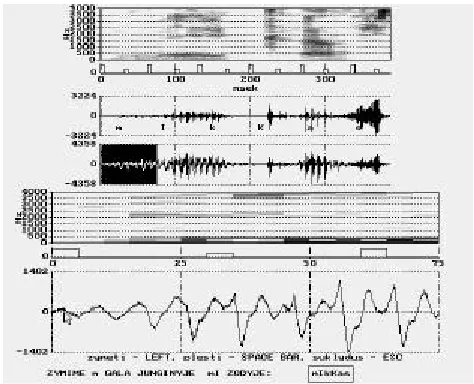
Figure 6: The word to phone segmentation (1 step). There are four pictures for the whole word. From top: a) sonogram, b) preliminary phone marks, c) preemphasized speech oscilogram and word transcription, d) speech oscilogram. The following pictures are in the phone region: e) sonogram, f) preliminary phone marks, g) signal oscilogram. There are the options at the bottom: LEFT- to label SPACEBAR- extension to right, ESC - escape program. The current and following phones are displayed too. Since in this case we can’t see all phone must press SPACEBAR.
• In the top of the Figure 6 we see sonogram of the word (in this case word “mikas”) and below we see preliminary bounds of phones in this word as well as two oscilograms of the same word (oscilograms are slightly narrower). In the last word oscilogram colors in the possible phones boundaries are changed;
• further there are presented part of possible phone, sonogram, bounds of phone and oscilogram;
• suggestions of possible actions are shown at the bottom “to mark – LEFT, to expand – SPACE BAR, to correct – ESC “ and “MARK END OF m IN SYLABLE mi IN THE WORD: mikKas“.
Performed actions: in the left side of the graph in the bottom shown cursor should be placed at the end of considered phone and then left mouse button must be pressed. This means transition to the location of next phone; if the pictures in the bottom can not cover end of phone we must press SPACEBAR and expand shown part of signal to the right; if serious error has been made by labeler then key ESC must be pressed what causes exit from program. The word to phone labeling procedure must be repeated.
Phone end labeling
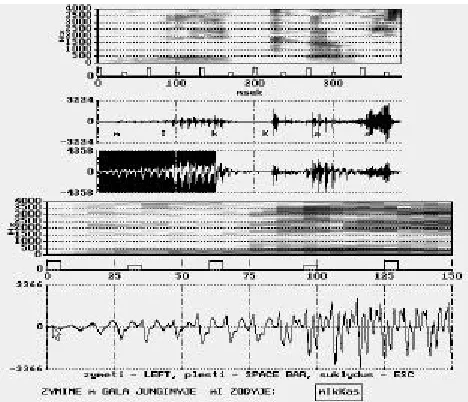
Figure 7: The word to phone segmentation (2nd step). The pictures are the same as in Figure 6. In this case we perform phone end labeling (with LEFT) since we see all m and part of I.
Performed actions: same as in the first phase.
Phone end labeling recursion
Figure 8: The word to phone segmentation (3rd step). From top: a) sonogram, b) preliminary phone marks, c) preemphasized speech oscilogram, d) speech oscilogram, e) sonogram in the phone region, f) signal oscilogram in the phone region.
• We see the same data as in Figure 6 (first phase) but here we are trying to locate bounds of the last phone (this case phone s) in the word;
Performed actions: same as in the first stage.
Figure 9 summarizes phrase to word segmentation and word to phone labeling results. Here we can see whole phrase (“mIkas mAto nisoje mUsu nAmo nUmeri”) and each of the words from this sentence. Each word in the phrase oscilogram (graph in the top of picture) is shown in different color background (blue or yellow). Below you could see six graphs
showing oscilograms of consequent words in the phrase. Similarly each phone is shown in different color background here (green or dark red). Such tool could be used for visual inspection and illustration purposes.
Figure 9: Example of the final result. There is phrase and labeled words in the top raw followed by all six words and labeled phones.
IV. CONCLUSIONS
Lithuanian speech corpora LTDIGITS have been prepared. It contains Lithuanian continuous digit sequences similarly as in TIDIGITS (Leonard, 1984) and Lithuanian computer control words. Important feature of LTDIGITS is collected set of CV (consonant - vowel) clusters containing nasals and various vowels (MA, NA etc.) and same syllables in continuous phrase. Recordings from 115 male and 225 female speakers were gathered.
Also this paper describes developed and tested procedures for phrase to word and word to phrase expert level segmentation and labeling. Segmentation procedures provides TIMIT like (Lamel, 1987) label data. These tools allows to speed up substantially speech database processing.
applied with results achieved using discriminant methods applied on other data. Also it is important to verify methods used in our earlier works with strong discrimination capabilities on LTDIGITS and other data. Previous results showed significant phoneme discrimination error rate reduction using carefully selected features and discrimination methods.
Analysis of similar CV and VC cluster data of E – set data could be promising also.
REFERENCES
Ayer C.M., Hunt M., Brookes D. (1993). A Discriminatively Derived Linear Transform for Improved Speech Recognition, Proc. of EUROSPEECH, Berlin Chengalvarayan, R. & Deng, L. (1998). “Speech Trajectory Discrimination Using the Minimum Classification error Learning”. IEEE Trans. on Speech and Audio Processing, vol. 6, no 6
Cole, R., Fanty, M., Roginski, K. A (1992). Telephone Speech Database of Spelled and Spoken Names. Proc. Int. Conf. Spoken Language Processing , pp. 891 - 893.
Fisher, W.M., Doddington, G.R., Goudie-Marshall, K. (1986). The DARPA Speech Recognition Research
Database: Specification and status. Proc. of DARPA Workshop on Speech Recognition, pp. 93 - 99.
Lamel, L.F., Kasel, R.H., Seneff, S. (1987). Speech Database Development: Design and Analysis of the Acoustic-Phonetic Corpus. In Proc. of the DARPA Speech Recognition Workshop, 1987, pp. 26-32
Leonard, R. G. (1984), A Database for Speaker Independent Digit Recognition, Proceedings of ICASSP, San Diego, Vol. 3, p. 42.11
Loizou, P. & Spanias, A. (1996) "High Performance Alphabet Recognition," IEEE Trans. on Speech and Audio Processing, vol.4, no 6, pp. 430-445.
Rudzionis, A. & Rudzionis, V. (1999). Phoneme recognition in fixed context using regularized discriminant analysis. Proc. 6th European Conference on Speech Communication and Technology, Eurospeech’99, Budapest, Hungary, pp. 2745 - 2748.