CSEIT1726259 | Received : 25 Nov 2017 | Accepted : 20 Dec 2017 | November-December-2017 [(2)6: 919-923]
International Journal of Scientific Research in Computer Science, Engineering and Information Technology © 2017 IJSRCSEIT | Volume 2 | Issue 6 | ISSN : 2456-3307
919
A Multi-Item Inventory Model with Demand-Dependent Unit
Cost : A Geometric Programming Approach with GA-SVM
Dr. M. Raja Sekar
Professor, CSE Department VNRVJIET, Hyderabad, Telangana, India
ABSTRACT
Multi-item inventory models are developed with and without back-orders where demand is related to the unit price as price is inversely proportional to demand. The models are associated with infinite/finite storage capacities. In total, there are four multi-item inventory models which are formulated with the cost functions and with/without constraints in the form of signomilas and solved by both a modified geometric programming technique and gradient-based non-linear programming method. For each model, sensitivity analysis with respect to the degree of economies of scale and invariant cost parameters are also presented. Each case is illustrated with numerical example and the results from two methods are compared.
Keywords: Genetic Algorithms, Support Vector machines, Geometric Programming, Inventory models, EOQ and
Demand dependent.
I.
INTRODUCTION
Since the development of economic order quantity model by Harris[1], the researchers have formulated and solved different types of inventory models by several methods. Detailed reviews on the development of this area can be obtained in Arrow, Karlin and Scarf[2], Hadley and Within[3], Naddor[4] and others.
In most of the inventory models, demand and unit cost of a product are assumed to be independent. But, in reality, this is not true. When demand of a product is high, the product is manufactured in large quantities and fixed cost of production are spread over large number of items. Ultimately, this process results in lower average unit production cost. For this reason, demand and unit cost are assumed to be inversely related to each other. Cheng [8, 9 and 11] developed some inventory models with this assumption and solved them using geometric programming technique [12].
Geometric Programming is a class among available amongst available non-linear programming techniques. It has certain advantages over other optimization methods. In some cases, it reduces to the unique
In this paper, multi-item modified EOQ inventory models with demand dependent unit cost and infinite replenishment has been formulated in crisp environment with/without storage space constraint. Here, shortages are allowed and fully backlogged[16, 17 and 18]. With the above assumptions, expressions for the total average cost are derived in signomial form and minimized via both a modified geometric programming technique and gradient-based non – linear optimization method[19, 20 and 21]. As a particular case, the results of the models without shortages are derived. The models are illustrated with numerical examples and the results from two minimization techniques are compared. It is seen that in some cases, especially for constrained inventory models, G.P. produces slightly better results. A sensitivity analysis is presented for both the models with respect to the cost parameters and degree of economies of scale [22].
II.
MODEL ANALYSIS
The following notations and assumptions are being made in developing the mathematical model.
2.1 Model Formulation
W= maximum allowable available storage space, n= number of items,
Parameters for the ith ( i=1,2,3,…,n) item, Di = Demand per unit time,
Qi= shortage level, Si= shortage level, Coi= cost per unit item,
C1i = holding cost per unit item, C2i = shortage cost per unit item, C3i = set up cost per cycle,
Wi= storage area required per unit time, Wji = dual variable.
2.2 Assumptions
(i) Production is instantaneous with zero lead time (ii) When the demand of an item increases then the total purchasing cost spread all over the items and hence the unit purchasing cost reduces and varies inversely with demand.
Where
Equation 2 holds good as purchasing cost and demand for an are non-negative.
III.
MATHEMATICAL FOR MULATION AND
ANALYSIS
3.1 Model 1:
The EOQ model with shortages and demand – dependent unit cost.
The total average cost of multi-item for an infinite replenishment problem is
The above objective function is an unconstrained signomial function with one degree of difficulty and is now solved by G.P. The corresponding dual problem is
subject to the normality, orthigonality and non-negativity conditions. According to Hariri and Abou-el-ata and Kotb [13] these conditions are
There are four linear equations in five unknowns having an infinite number of solutions. However the optimal values of the weights in terms of w3i are
substituting the values of Wji’s in the equation (2) we get,
To find the optimal value of W3i which maximizes d(W3i), we take logarithm on equation (4), differentiate with respect to W3i and then the result is set to zero. This yields
The other optimal values of the weights are
c
oi=
a
iD
i-
b
i
(1)
a
i>
0
and
b
i
>
1 (2)
Min
TC
(
D
i,
Q
i,
S
i)
=
a
iD
i-
b
i
+
c
3D
iQ
ii=1 n
å
(3)
Max
d
(
w
)
=
c
3iw
2i( )
i=1 n
Õ
w2ia
ib
i
( )
w1i(4)
w
1i+
w
2i+
w
3i+
w
4i-
w
5i=
1 (5)
w
1i=
1
2
b
i
-
1
(
)
(6)
w
2i=
(
b
i
-
1
)
/ 2
(
b
i
-
1
)
(7)
w
4i=
(
b
i
-
1
)
/ 2
(
b
i
-
1
)
+
w
3i(8)
d
(
w
3i)
=
a
iD
i-
b
i
+
c
3D
iQ
i i=1n
å
(9)
w
3i*=
c
1ic
2iSubstituting these optimal values of the weights in the equation (4) we get the optimal values of d(w3i) as d(w3i*).
The minimum total average cost will be obtained from relation dependent unit cost under storage capacity restriction.
The total average cost of multi items for an infinite replenishment problem is
subject to
Following Hariri and Abou-el-ata[12] or Abou-el-ata and Kotb [13], the primal problem is a constrained signomial function with degree of difficulty two and it is solved by G.P. method. The corresponding dual function is
Proceeding as in model-1, the normality and orthogonality conditions are
Solving the above equations in terms of w1i and w2i we get
substituting the above weights in the equation 5 we get
To find the optimal value of Wji’s that minimizes (6) we take logarithm of (6) differentiate with respect to W1i and W3i and then set to zero.
We have
substituting the value of w3i in equation (7) we have
Solving the above non-linear eqation by any trial and error method, we get the optimal value w*1i which maximizes the dual function and the corresponding optimal values of the weights are
The optimal values of Di*, Qi*,Si* and TC* are obtained from the relations as in model-1
and
IV.
RESULTS
Now we will illustrate the model for some numerical data. We consider two items with the following values
Table 1. The optimal values of the variables and cost
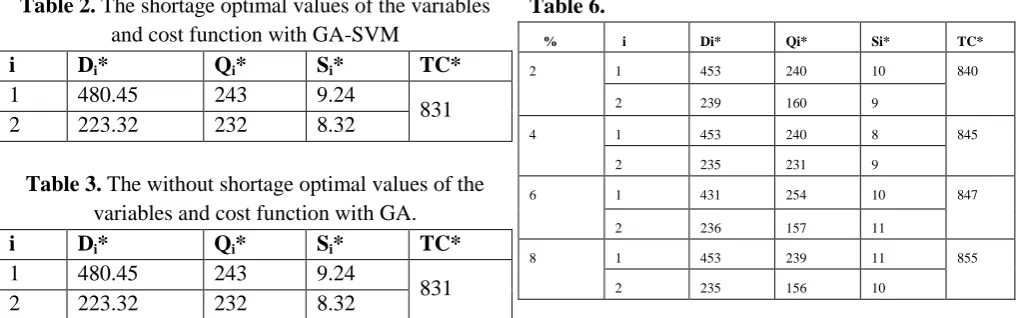
Table 2. The shortage optimal values of the variables and cost function with GA-SVM
i Di* Qi* Si* TC*
1 480.45 243 9.24
831
2 223.32 232 8.32
Table 3. The without shortage optimal values of the
variables and cost function with GA.
i Di* Qi* Si* TC*
1 480.45 243 9.24
831
2 223.32 232 8.32
Here, the results placed at the top are due to G.P. and the results from non-linear optimization techniques are placed within the brackets.
For two items we assume the following data
Table 4. The optimum values with shortages
i C1i C2i C3i W
1 170 2.8 1.7 30 44 6 2 150 2.9 2.2 35 35 7
Table 5. The optimum values without shortages
i Di* Qi* Si* TC*
1 48 32 3
246
2 32 19 4
Table 6. The mixed optimum values without shortages
i Di* Qi* Si* TC*
1 58 42 4
346
2 38 29
From the above tables, it is observed that for both models, G.P. gives better results than the gradient – based non-linear optimization technique. For the present formulation, this improvement is noticeable for the inventory models under constraints.
V.
SENSITIVITY ANALYSIS
Following Cheng [8,9, 11], the sensibility analysis has been developed with the percentage change of degree of economies of scale and cost parameters. The primal decision variables, dual objective function and primal objective function are changed due to change of c1i, c2i and c3i .
Table 6.
% i Di* Qi* Si* TC*
2 1 453 240 10 840
2 239 160 9
4 1 453 240 8 845
2 235 231 9
6 1 431 254 10 847
2 236 157 11
8 1 453 239 11 855
2 235 156 10
5.1 Sensitivity Analysis for Model-1 with
GA-SVM
Now, for the numerical data in 6.1 of model-1, the changes in the decision parameters and cost function are presented due to the percentage variation in inventory costs and the exponent.
Table 7. Effect of changing holding cost
% i Di* Qi* Si* TC*
2
1 468 240 9.01 850
2 230 160 8.95 840
4
1 475 240 7.951 873
2 230 158 8.01 750
6
1 472 233 8.8 790
2 230 156 7.92 800
8
1 470 230 7.45 790
2 225 231 6.98 810
From the above table we see that the optimal cost increases with the increase of the cost parameters, but the optimal cost decreases with increase in the degree of economies of scale.
VI.
CONCLUSION
In this paper we developed multi-item demand-dependent EOQ models with or without space capacity restriction. We investigated also the cases when the shortages are not allowed with GA-SVM. We solved such problems by revised geometric programming method. Finally, we discussed about the sensitivity analysis with respect to cost parameter and degree of economy of scale. This analysis is different from conventional GP and quite general in nature. Hence, this technique can be applied to solve the different decision making problems in inventory and other areas.
VII.
REFERENCES
[1]. Abdel-Mottaleb,M., Elgammal, A., "Face Detection in complex environments from color images,’’ IEEE ICIP, pp. 622- 626, Oct. 2016. [2]. Aizerman, M., Braverman, E., Rozonoer, L..
"Theoretical foundations of the potential function method in pattern recognition learning". Automation and Remote Control25: 821-837, 2014.
[3]. Antonio J. Colmenarez and Thomas S. Huang. Face detection with information-based maximum discrimination. In Computer Vision and Pattern Recognition, pp 782-787, 2015.
[4]. Bellaire, G., Schluns, K., Oppermann, K., Schimke, W., "Matching Using Object Models Generated from Photometric Stereo Images", Proc. Machine Vision Applications in Industrial Inspection IV, SPIE Vol. 2665, San Jose, Califomia, pp. 70-81, 2015.
[5]. M.Raja Sekar, "Region classification using SVMs", Journal of Geomatics, pp 87-89, 2007. [6]. M.Raja Sekar, "Automatic Vehicle
Identification" Journal of Advanced Research in Computer Engineering, pp 0974-4320, 2015. [7]. M.Raja Sekar "FER from Image sequence using
SVMs ", Journal of Data Engineering and computer science, pp 80-89, 2016.
[8]. Burges, C. J. C., A tutorial on support vector machines for pattern recognition. Data Mining and Knowledge Discovery, 2(2):pp 121-167, 2015.
[9]. Behrooz Kamgar-Parsi, Behzad Kamgar-Parsi, Jain, A., Dayhoff, J., "Aircraft Detection: A Case Study in Using Human Similarity Measure", IEEE Trans. Pattern Analysis and Machine Intelligence, Vol. 23, No. 12, 2001, pp. 1404-1414,2016.
[10]. Beymer, D. J., Face recognition under varying pose. AI Memo 1461, Center for Biological and Computational Learning, M.I.T., Cambridge, MA, 2016.
[11]. Brunelli, R., Poggio, T., Face recognition: Features versus templates. IEEE Transactions on Pattern Analysis and Machine Intelligence, 15(10):1042-1052, 2015.
[12]. CHAPELLE, O., HAFFNE,R, P., AND VAPNIK, V. N. Support vector machines for histogram-based image classification. IEEE
Transactions on Neural Networks 10, 5, 1055-1064, 2016.
[13]. Cohen, I., Sebe, N., Garg, A., Lew, M.S., Huang, T.S., Facial Expression Recogni- tion From Video Sequences. In IEEE Intl Conf. on Multimedia and Expo (ICME), volume 2, pages 121 - 124, 2014.
[14]. DORK ´O, G., AND SCHMID, C. Selection of scale-invariant parts for object class recognition. In IEEE International Conference on Computer Vision, vol. 1, pp. 634-639,2016.
[15]. Daugman, J.G., "Uncertainty Relation for Resolution in Space, Spatial Frequency, and Orientation Optimized by Two-Dimensional Visual Cortical Filters", Journal of Optical Society America A, Vol. 2, No. 7, 1985, pp. 1160 - 1169, 2016.
[16]. FONSECA, E. S., R. C. GUIDO, A. C. S., AND PEREIRA, J. C., Discrete wavelet transform and support vector machine applied to pathological voice signals identifiction. In IEEE International Symposium on Multimedia ,2017.
[17]. M.Raja Sekar, " Image Authentication using SVMs", Journal of Advanced Research in computer Engineering, p367-p374, 2015.
[18]. M.Raja Sekar, "Classification of images using SVMs", International Journal of Mathematics, Computer Sciences and Information Technology, p25-29,2014.
[19]. M.Raja Sekar, "Analysis of Images Using SVMS" International Journal of Mathematics, Computer Sciences and Information, p 197-201,2015.
[20]. M.Raja Sekar, "Implementation of recursive construction for building effective compression strategy", JRRECS, P23-28, 2013.
[21]. M.Raja Sekar, "An Effective Atlas-guided Brain image identification using X-rays", IJSER, P23-29,2016.